
[ORIGINAL MSRP $79. Purchased open-box from Headphones.com for $64.99 in March of 2025.]
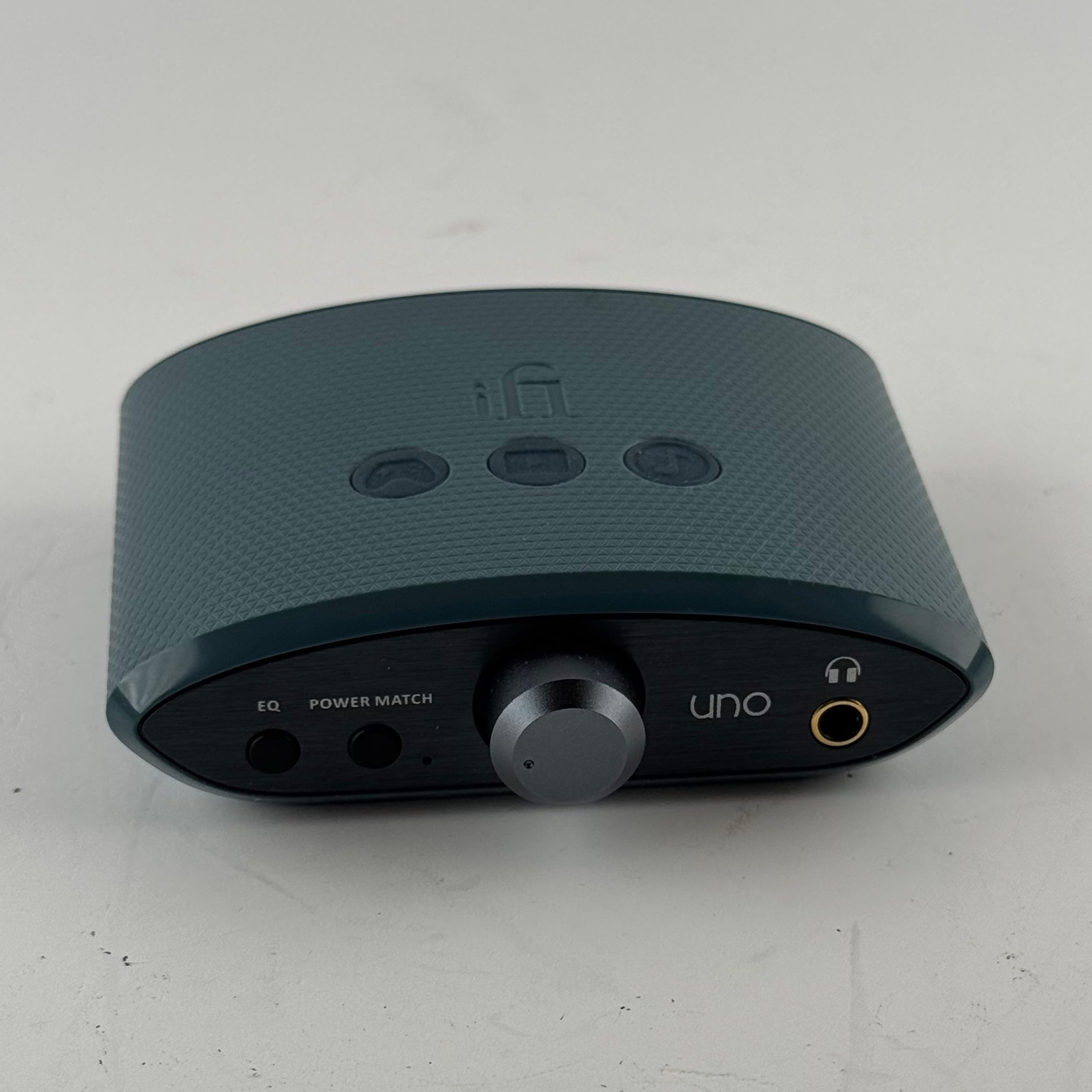
[Tl;dr: This is a surprisingly feature-rich DAC/amp unit which would be a great option for a mobile desktop setup, but is in a pretty crowded space with a lot of good options at a similar price point. It’s performance doesn’t justify displacing some of my favorite dongle DAC/amps, and it certainly can’t compete with my higher end options. In particular, it’s let down by its wonky volume knob, which makes fine control difficult at lower volumes. It’s a great unit for folks newer to the hobby or who mostly listen to higher impedance headphones and higher volumes, but it’s just not for me.
Cost-agnostic: 5 out of 10 Denalis
Cost-sensitive: 6 out of 10 Denalis
Intro to the Intro. Welcome to the inaugural edition of a new feature here at Phil’s Superpower of Enthusiasm: Quick Reviews! There are a number of things that I’d love to get quick notes down on for my own edification/memory,1 but that I don’t want to spend the 10-15 hours I devote to most of my (overly?) in-depth reviews. Some of these will be things that aren’t in production anymore (so it’s less likely anyone will read a review), or are extra niche, or that I didn’t particularly like but want to be able to point people to my reasoning, or that are in a category I don’t spend a lot of time with (like IEMs or most amplifiers).2 I’m also attempting to thin the herd, so some of these will be things that I like but no longer have a place in my collection and where I want to capture my thoughts before finding them a new home on a farm upstate.
TABLE OF CONTENTS:
- Intro to the Intro.
- Intro.
- The Basics.
- Capability.
- Sound.
- Headphone compatibility.
- Build quality/Appearance.
- Value/Comparisons.
- Dongles.
- Desktop units.
- Overall.
Intro. I think of headphone setups as having three basic use cases: 1) truly mobile (a system you listen to as you walk around the world), 2) desktop (a system you use when you’re sitting in the same place consistently) and 3) mobile desktop (a system that you use when you’re going to be in a particular place for a reasonable amount of time, but not permanently or regularly, or where you don’t have the ability to leave things set up).3 Each of these kinds of systems have different requirements or considerations; the size or weight of a system doesn’t matter that much when you’re using it solely at a desktop, but they do matter for a system that you’re using on the go. Ease of connection/packageability matter a lot for a mobile desktop system, but less for a desktop or true mobile use.

The iFi Uno falls solidly into the third category; it’s an awkward system to use for a truly mobile application, but not quite rich enough in features to compete with my real desktop systems.
[Review note: As I discussed in my Chord Mojo 2 review, I don’t do a lot of reviews of DACs and headphone amplifiers because I, personally, can’t always hear a consistent, repeatable difference between many if not most of them. There are exceptions, like the Mojo 2, but for me the difference between most competent $100 headphone system components and those in the $400-700 range are easily eclipsed by the differences between headphones, so at least until you’re far enough in the hobby to not care about my opinion, I think you’re better off putting a higher proportion of your budget into the transducers in your system (i.e. the headphones or speakers). This is the origin of my philosophy on the allocation of resources in headfi; I recommend spending no more than half as much on an amp as you do on the headphones, and no more than a third as much on the DAC. Beyond that, I buy for quality of life (connectivity, features, form, aesthetics) rather than quality of sound, pretty much the way I approach cables. I would suggest you do the same, but to whatever floats your boat.
My torture testing list: Apple, Tidal, Spotify.]
The Basics. The iFi Uno is a USB-C powered DAC/amp unit with four EQ modes (off, gaming, movies, and music), a “power match” mode (aka a high-gain setting), and both 3.5 mm and RCA outputs. It’s a pretty capable DAC, with support for DSD, MQA, and “Hi-Res Audio.” It connects to a source via a single USB-C cable providing both signal and power. It’s a pretty small, lightweight unit, measuring 3.5” x 3” x 1”, and is cased in a blue/grey plastic shell. The biggest selling point for me was the plastic physical volume knob on the front, something often lacking at this general price point. It puts out slightly more than 200 mW into 32 Ohms; not bad for a USB-C driven unit.

Capability. This is a surprisingly feature-packed unit for the price point. I personally would rather apply parametric EQ elsewhere in my signal chain (usually through Roon or Roon ARC), but it’s nice to have some options built into a budget unit. I think the biggest failing is, ironically, the volume knob that drew me to the Uno in the first place. Running out of a Mac Studio, even on low gain the unit puts out so much power I’m rarely pushing past 9 o’clock, and the volume adjustment is seriously non-linear; a fine adjustment below 9 o’clock results in an overly big volume swing. 8:45 is near silent, 9:00 is my max volume on the Fiio FT1. If I were going to use this very much, I’d need to apply a pretty substantial negative pre-gain to let me use more of the knob’s travel. Even with a -30 dB pre-gain applied through Roon Arc, I’m barely pushing 2:00 in low-gain mode. When you plug into an iPhone, it’s roughly the same. Unfortunately for me, as a person who listens to music at relatively quiet volumes, this is a real limiter for me, and I find myself constantly fiddling with the knob to make fine adjustments mid-track whenever I’m using it.

Sound. Sound is generally pleasant. I can convince myself that I don’t get the same level of detail that I get from other things in the same general price range, and that the timbre on vocals isn’t quite as natural as I get from similarly priced DACs/amps (especially for female voices), but I’m not certain it’d hold up in a blind test. In the end, it’s totally acceptable if not great. You don’t expect great from something that costs less than $70. Even with the slightly overpower amp stage, I don’t get audible hiss or noise floor even on pretty sensitive IEMs, so it’s a clean power.

The one thing I’ll say is that with some higher-end, hard-to-drive headphones like the HE6se v2, though I could get to reasonable volumes, the sound was slightly … hollow is maybe the word? I can’t explain it, but I wouldn’t use this with super hard to drive headphones.
Headphone compatibility. If I had one major complaint about the iFi Uno, it’s that they’re a little overpowered for a lot of headphones, especially IEMs.
Running out of a Mac Studio, no pre-gain applied:
- 7 Hz x Crinacle Zero Red: 9:15 (low gain)
- Beyerdynamic DT 770 Pro, 250 Ohm edition4: 12:15 (low gain)
- Capra Audio Satyr 3: 11:00 (low gain)
- Dan Clark Audio Aeon x Closed: 12:00 (low gain)
- Fiio FT1: 9:00 (low gain)
- Focal Elegia: 9:30 (low gain)
- Hifiman HE6se v2: 12:00 (high gain)5
- Meze 109 Pro: 9:00 (low gain)
- Meze 105 AER: 9:15 (low gain)
- Sennheiser HD600: 12:00 (low gain)
As you can see, outside of the HE6se v2, I’m living in pretty quiet territory; aka the portion of the range that is hard to finely adjust, at least on my unit. That’s not great.
Build quality/Appearance. The iFi Uno looks and feels pretty cheap … but that’s because it is. It’s so light that it will skip off a table or stack at the blink of an eye or the bump of a cable, but it’s also so light that it won’t pull much of anything off with it or give your headphones much of a yank. I like the color, and the overall design aesthetic is nice enough that I’ve been tempted to explore iFi’s higher-end selections. I have no qualms about the build quality and appearance at this price point, though again, I’d rather have a more useful volume range.
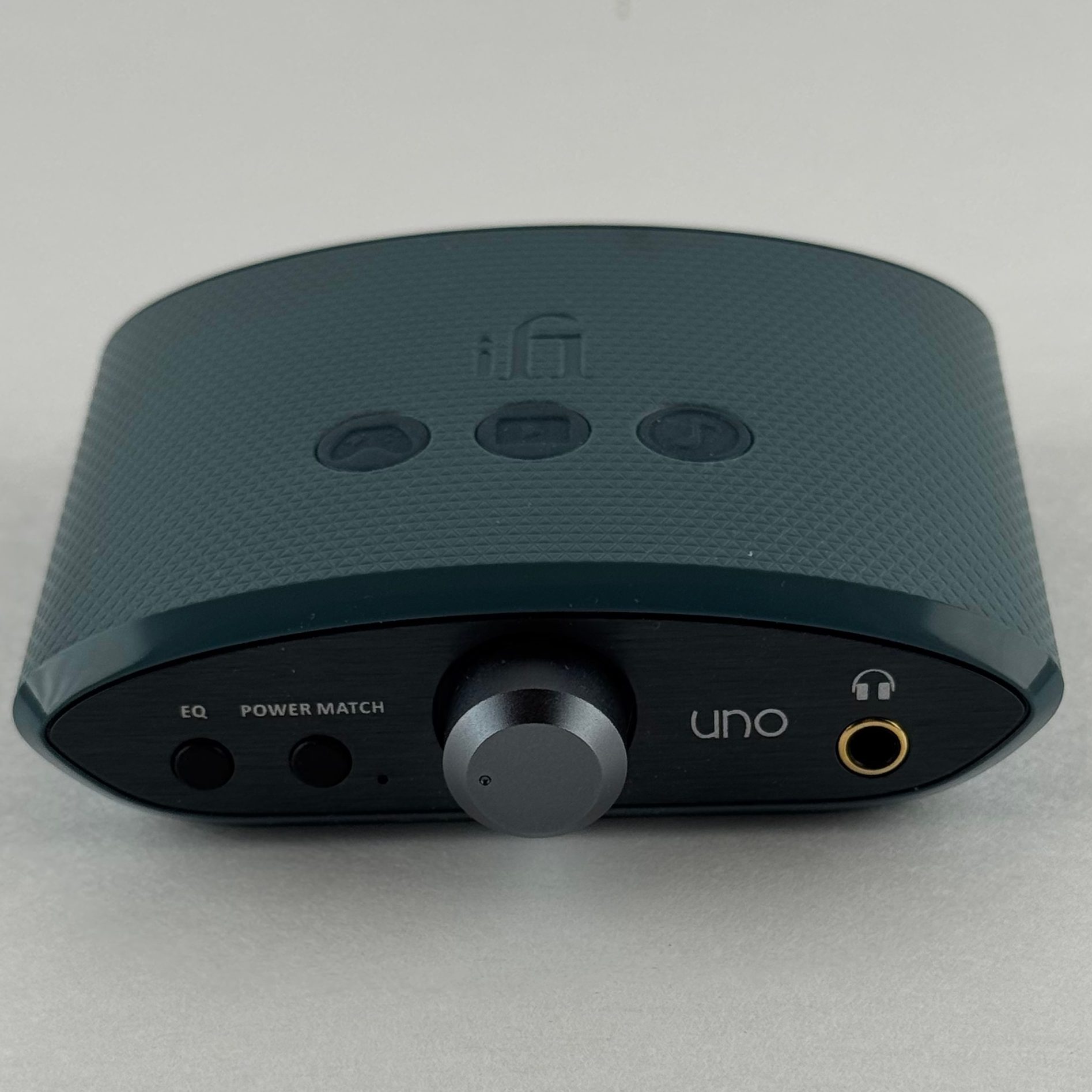
Value/Comparisons. Most of the things that I own in this general price range are dongles, other than the Schiit Fulla and Hel 2E. I really enjoy having a physical volume dial and it’s actually one of my criteria in picking an amplifier, especially a mobile one. This is even a reasonably nice one; it’s definitely made of cheap plastic but it rotates cleanly and smoothly. Unfortunately, the knob is so limited in its ability to make fine adjustments at the low end that I find myself constantly fiddling with it, which is no way to live.
Dongles. If you really want a physical volume knob, this has that going for it. I don’t personally hear much if any difference in sound compared to the ALO Pilot ($99), the Apple dongle ($9, US version), the JCALLY JM6 Pro or JM12, the Fosi DS2 ($60), or the Moondrop Dawn Pro ($55). The latter two include physical volume buttons (though not a knob), and the last two have both a single-ended (3.5 mm) and balanced (4.4 mm) output jack.6 Personally, as much as I love a physical knob, I just haven’t been picking the Uno over any of these others over the last five months; it’s mostly been sitting in a Pelican case on my desk. For the quiet listening I mostly do, the volume knob is just too finicky.
Desktop units. The one advantage the Uno has over most dongles is eliminated when we compare it to more traditionally desktop units. I don’t hear any particular sound improvement over the Schiit Fulla ($109) or the Hel 2E ($200), and I personally would rather spend the extra $30 to get the Fulla with its much better knob and construction. Short of the volume-adjusted RCA outputs on the back, the Uno just doesn’t have much going for it versus most desktop amps.

The Uno also had the misfortune of being the mobile desktop setup I had immediately before getting the Chord Mojo 2, my single most favorite listening system ever. You wouldn’t expect the Uno to be able to compete, and it can’t.
Overall. For me, the iFi Uno is a unit in search of a use case. It’s too bulky for me to use as a mobile system (though I’ve tried it) compared to any of a half-dozen dongles; it’s outclassed for mobile desktop use by things in its price range (the Fulla) and wildly outclassed by things above it (the Mojo 2), and I’ve never owned a true desktop unit that the Uno could really compete with. Particularly for mobile desktop applications, I’m probably carrying my MacBook Air, and the headphone output on it is probably better than the Uno’s.
It’s a perfectly nice device and if I didn’t have a variety of transportable DACs and amps sitting on or in my desk, it would be my mobile desktop option, funky knob and all. Someone earlier in the audiophile journey will really enjoy it, but at this point it’s just not for me.
#reviews #headphones #sennheiser #6XX #anc #spatialaudio #meh #2025 #99noir #meze #overear #cans #hifiman #arya #stealth #editionxs #budget #hahahaha #iems #quickreview
- Particularly for things that I will be moving along to new owners in the near future, as I’m trying to downsize my collection a bit. ↩︎
- Though I still aim to not spend much time or brainpower on things I don’t like, generally. Sometimes it’s nice to be able to copy/paste when someone asks me why I don’t like or recommend a thing. ↩︎
- Think an afternoon working from coffee shop, or an office where everyone is hot-desking. ↩︎
- Good lord I forget every time how damned trebly these are. I know some people love them but those people are wrong and bad people. ↩︎
- This is pretty crazy. These headphones are so hard to drive that a lot of people think they need speaker amp taps, and Hifiman itself sells a converter to let you use a stereo power amp to drive them. ↩︎
- I personally don’t think balanced matters that much in the headphone world, but it is an extra capability and can avoid having to carry adapters for some headphones/IEMs. ↩︎
 Phil's Superpower of Enthusiasm
Leave a comment