[ORIGINAL MSRP $199. Purchased from Amazon for $199 in October 2025, price adjusted to $169.99 for Black Friday 2025, currently marked down to $139.99.]

[Tl;dr: This is an absolutely phenomenal gaming headset, and an incredible value pick as a wireless headphone for music. I’m very impressed by this device all around; it’s both a really well-tuned headphone and a demonstration of the kinds of features that manufacturers should be including in their active headphone products in the future. It’s got a bit of flash (RGB lighting, wireless connectivity, low-latency dongle) and a lot of substance, with a great out-of-the box tuning and a really impressive, interestingly social parametric EQ tool that I devoutly hope becomes the norm in the near future.
Color me entirely and unabashedly impressed. I will use these for gaming, but probably not for music but that’s mostly because I have a lot of great choices.
(Editor’s note: I did, in fact, use them for music this afternoon while puttering around in my basement. Not having wires is nice sometimes, and my Bathys were in my office.]
Scores:
Cost-agnostic: 8 out of 10 Denalis
Cost-sensitive: 10 out of 10 Denalis
TABLE OF CONTENTS:
- Scores:
- Introduction
- The Basics
- Sound
- Noise Isolation
- Build
- Appearance
- Functionality
- Value & Comparisons
- Overall
Intro to the Intro
This is a quick review rather than a full review (though they do seem to be getting longer …). There are a number of things that I’d love to get quick notes down on for my own edification/memory, but that I don’t want to spend the 10-15 hours I devote to most of my (overly?) in-depth reviews. Some of these will be things that aren’t in production anymore (so it’s less likely anyone will read a review), or are extra niche, or are things that I didn’t particularly like but want to be able to point people to my reasoning, or that are in a category I don’t spend a lot of time with (like IEMs). Today, the Fractal Scape, a new gaming headset. This one probably deserves a full review in the future, but given the aggressive pricing they’re getting for Black Friday I wanted to get this review turned around quickly.
Introduction
Until pretty recently, the response you’d get from most audiophiles upon admitting that you were using a gaming headset for music would have been one of either contempt or sympathy3. For a long time, gaming headsets seemed to emphasize appearance over sound, often featuring a lot of RGB tomfoolery or camouflage and snazzy-looking designs that were often uncomfortable for long wearing sessions. Most, if not all, had pretty awful (to my ears!) sound,4 and the wireless offerings (especially Bluetooth ones) were often quite laggy. Recently, that’s been changing quite a bit, starting (at least to my knowledge) with the Audeze Maxwell, a great (albeit imperfect) offering from venerable audiophile manufacturer Audeze. They were … surprisingly great. They are well-tuned, offering good sound quality for both music and gaming, and had some pretty nifty features built in like headset-level EQ, a reasonable app, good noise filtering, audiophile design, etc., though they were VERY heavy for a headphone, especially a gaming one. The Maxwell has been on my to review list for quite some time, but, but today the Fractal Scape is leapfrogging it.5
The Fractal Scape is a new offering from Fractal Design, a Swedish company better known for producing PC cases and other kinds of hardware. It’s (as far as I can tell) their first foray into audio, and they really knocked it out of the park. I’ve had these for about a month, and I am VERY impressed. With them marked down almost $60 this week for Black Friday, I wanted to get this review turned around quickly.
My torture testing list: Apple, Tidal, Spotify.]
The Basics
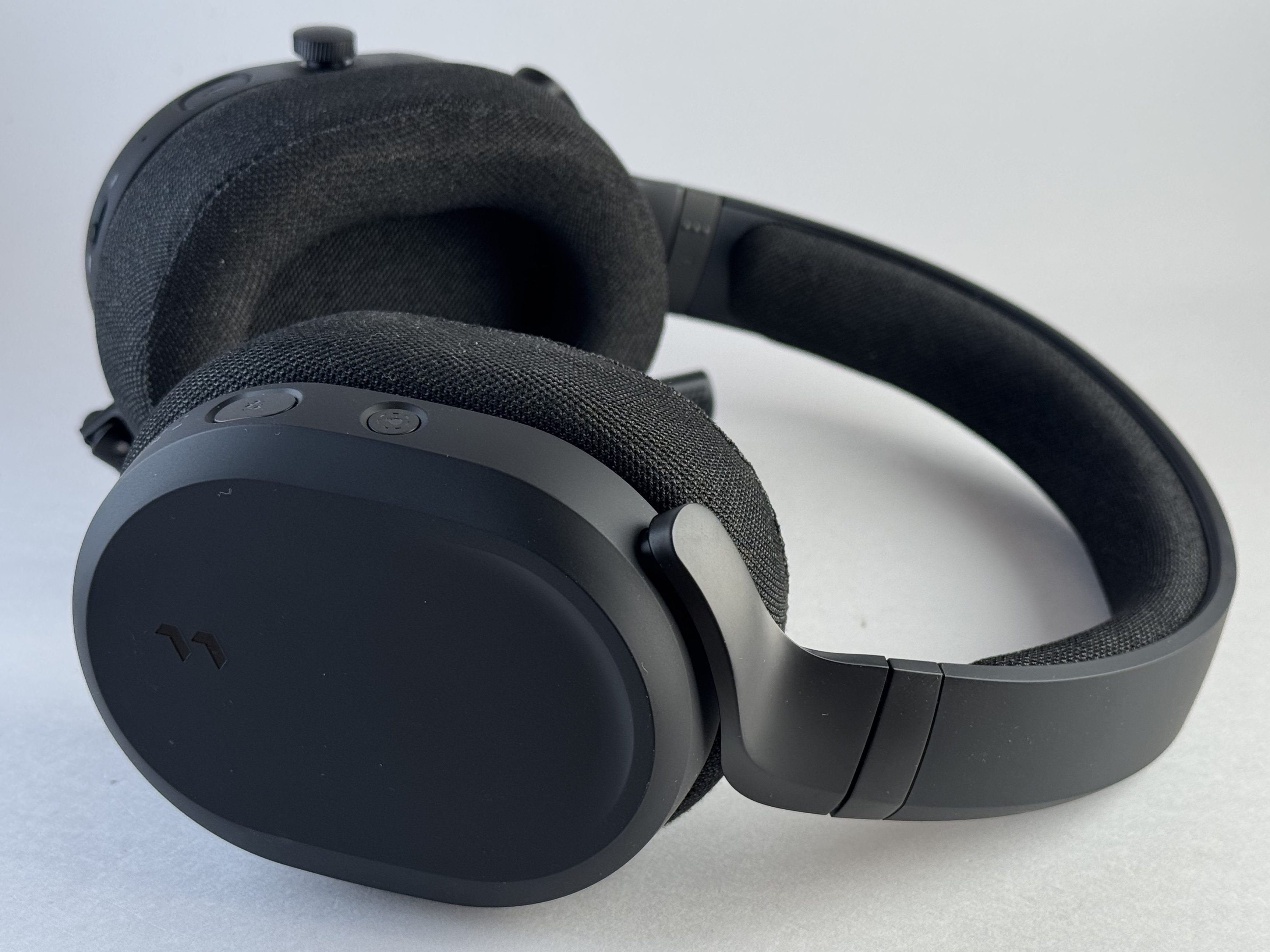
The Fractal Scape is a wireless headphone primarily marketed for gaming. It comes in either black or white (dark or light) and weighs in at a pretty reasonable 314 g without the mic (338 g with it). It can connect via either Bluetooth (lossy) or 2.4 GHz wireless via the included dongle (lossless), and can in theory be connected wired via USB-C to USB-A cable, though I wasn’t able to get that working in a short period. The primary use case is via the included wireless dongle, which can either be plugged directly into a source (PC, Mac, Playstation 5, Nintendo Switch, or iOS device with adapter), or left inserted into the really well-designed (and included) charging cradle with the cradle connected to the source via USB-C. One of my few complaints about the Scape is the lack of an optical audio connection; I get why they didn’t include one, but it would solve the Xbox issue (more below) and make it an even more impressive offering.
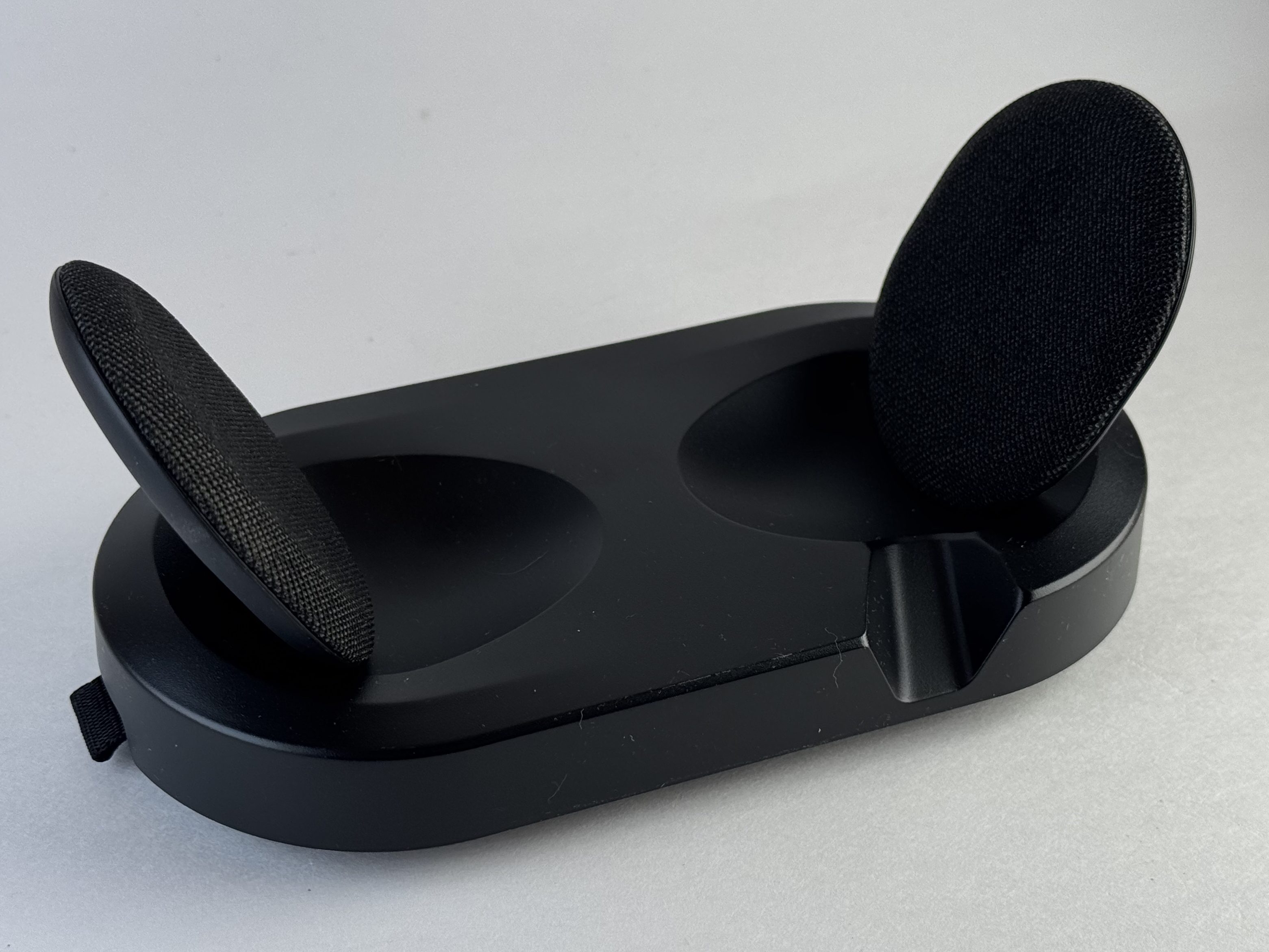
The Scape does offer a little bit of RGB lighting on the underside of the cups, with a variety of patterns and colors available (and the ability to turn it off, of course). The lighting substantially affects the battery life, with Fractal claiming 40 hour of light-less playback and only 24 hours with the RGB on. For me, this is a headphone that lives in my house so I’m not particularly worried about the battery life in either setting. The Scape also comes with a removable, flip-to-mute microphone that inserts into the left cup and fits neatly in a divot on the cradle.
The Scape has a really excellent and interestingly social equalization (“EQ”) system. It’s browser-based, and allows you to share your EQ settings with anyone using a custom EQ code. As someone who’s spent a lot of time copying and entering parametric EQ codes, I find this system hilarious and delightful, and not only because some people have come up with some genuinely WEIRD profiles and it’s fun to play around with.
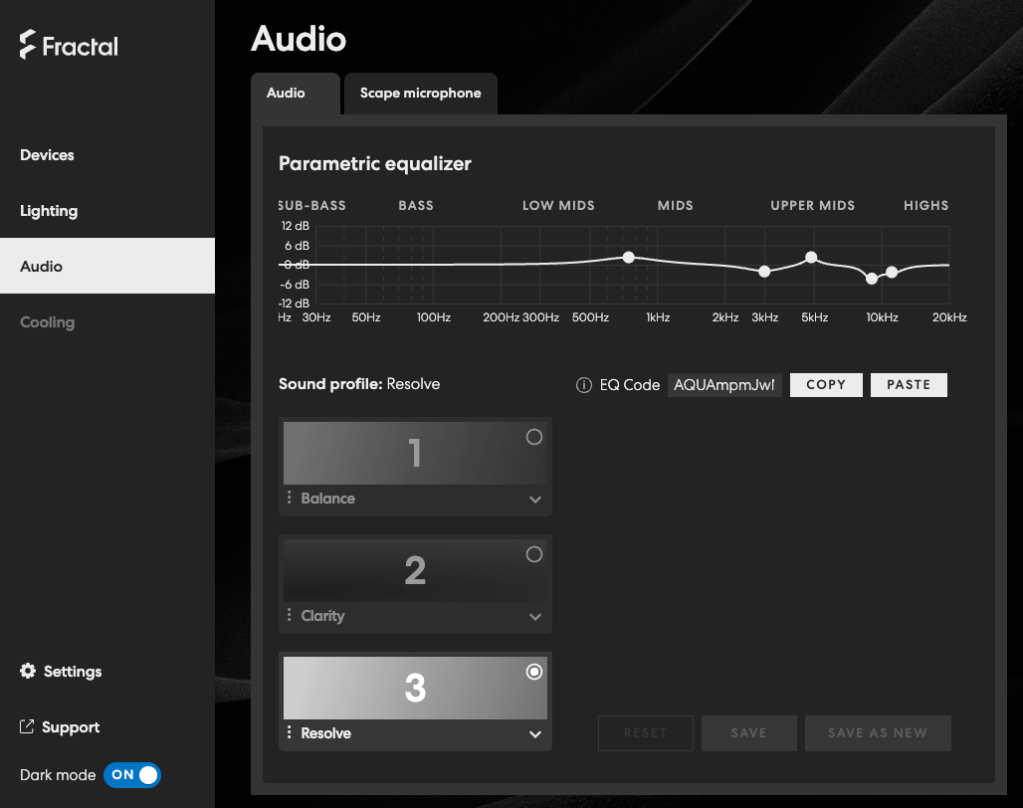
While you’re logged into a full-fat browser, you can store up to three EQ profiles on the device itself, and swap between them at the press of a physical button. Changes to those three options have to be done via browser (no iOS app here, at least for now!), and have to be done on a computer rather than on a phone version of a browser.
The biggest knock on these for me is that they’re not compatible with Xbox, though I freely acknowledge that this is 100% a Microsoft problem, not a Fractal problem.6 They seem to play very nicely with everything else I’ve tried them on.
Sound
[Disclaimer: I’ve only had this for a few weeks, and those have been weeks where I’ve been working on a lot of reviews, and I rarely reach for a wireless headphone when I’m at my desk. I’m sure I’ll update this review in a few months after I have more hours under my belt.
EQ Notes
As noted in my Bathys review, I mostly prefer to test headphones with their default tuning, assuming that most people won’t take the time or make the effort necessary to use a third-party EQ. BUT, the Scape have a really excellent, headset-level EQ system so I’ve been using the profile created by Resolve from the Headphone Show.7 They sound really good without it, but even better with it.
My testing method/philosophy.
My torture testing list: Apple, Tidal, Spotify.]
Overall Sound
The Fractal Scape sound really, really good. Period. Not good for gaming, not good for a gaming headset, but GOOD. For games, music, movies, etc.
I really like the Scape’s soundstage. You would expect a headphone designed for gaming to have a reasonably broad and detailed soundstage, and you will be pleasantly surprised by the Scape. It’s not the widest soundstage I’ve ever experienced (some of Hifiman’s planars will be MUCH wider, even at this price point), but all of the musicians on “Chan Chan” are clearly and consistently placed in space, and even instruments that are located close to each other are distinct and clear in the mix. You don’t get a huge amount of front-to-back rotation on “Love Can Damage Your Health (Laid Mix)” but it’s there.
They’re not the most detailed or resolving headphone, but for an active headphone costing less than $200 less they’re pretty damned good. Will you get more detail from something like the Sennheiser x Drop HD 6XX? Sure, but it’s not as big a difference as you might expect.
Microdynamics are good, not great, with more heft and impactful accents on higher tones than lower tones; on “Angel (Blur Remix)” the low bell tones are solid but not particularly emphasized, while the higher bells tones are much crisper and clear. Dynamic range is really good, particularly for a wireless headset; starting “It’s All So Incredibly Loud” off at a reasonable volume gets unpleasant around 2:30 or so. The one thing that I’d like is maybe a little more crispness to notes; some notes (particularly low notes) linger just a hair longer than I want them to for music, but that’s a tiny quibble.
Bass
The bass on the Scape is really quite good; very controlled and impactful without getting thumpy or splattery. Even on a challenging track like “Superpredators”, you only get a very little bit of fragmenting on some of the heavier notes. Surprisingly, even the lowest notes on “Limit To Your Love” don’t particularly roll off, even compared to something like an Arya Stealth.
Midrange
If the Scape has one weakness in its frequency response it’s probably in the midrange. It’s not bad by any means, but it’s not as strong as either the bass or the treble response. Timbre is generally pretty good, with guitars on some tracks not being as resonant and rich as I want. Same with male vocals; Justin Hicks’ voice doesn’t carry through as strongly as I might want on “What Did I Do?” Female vocals are much clearer, though maybe with a hint of echo or metallic tinge particularly at higher volumes. Despite this quibbles, overall mids performance is still pleasant.
Treble
Treble on the Scape is solid and balanced; not over powering or harsh, not relaxed or rolled off. This translates to really good directionality and soundstage for gaming, without making them unpleasant for music. The bells on “Coffee” are clear and crisp without becoming sharp or overwhelming Amelia Meath’s voice, and both the muted trumpets on “Will O’ the Wisp” and the high guitar riffs on “2021” are clean without edging into harshness.
Noise Isolation
The Fractal Scape do not have active noise canceling, and while they are closed-back, they don’t have a particularly impressive amount of passive noise isolation. I’d put them slightly ahead of the FT1 in terms of sound reduction, but not in the same category as something like the DCA Aeon x Closed or the Focal Elegia.
Build
Overall, the Fractal Scape feel surprisingly solid and well-built. It’s a good combination of smooth metal and relatively dense plastic without feeling heavy, and while they don’t feel quite as indestructible as something like the Audeze Maxwell, I’m not worried about setting them down too hard or even knocking them off a table.
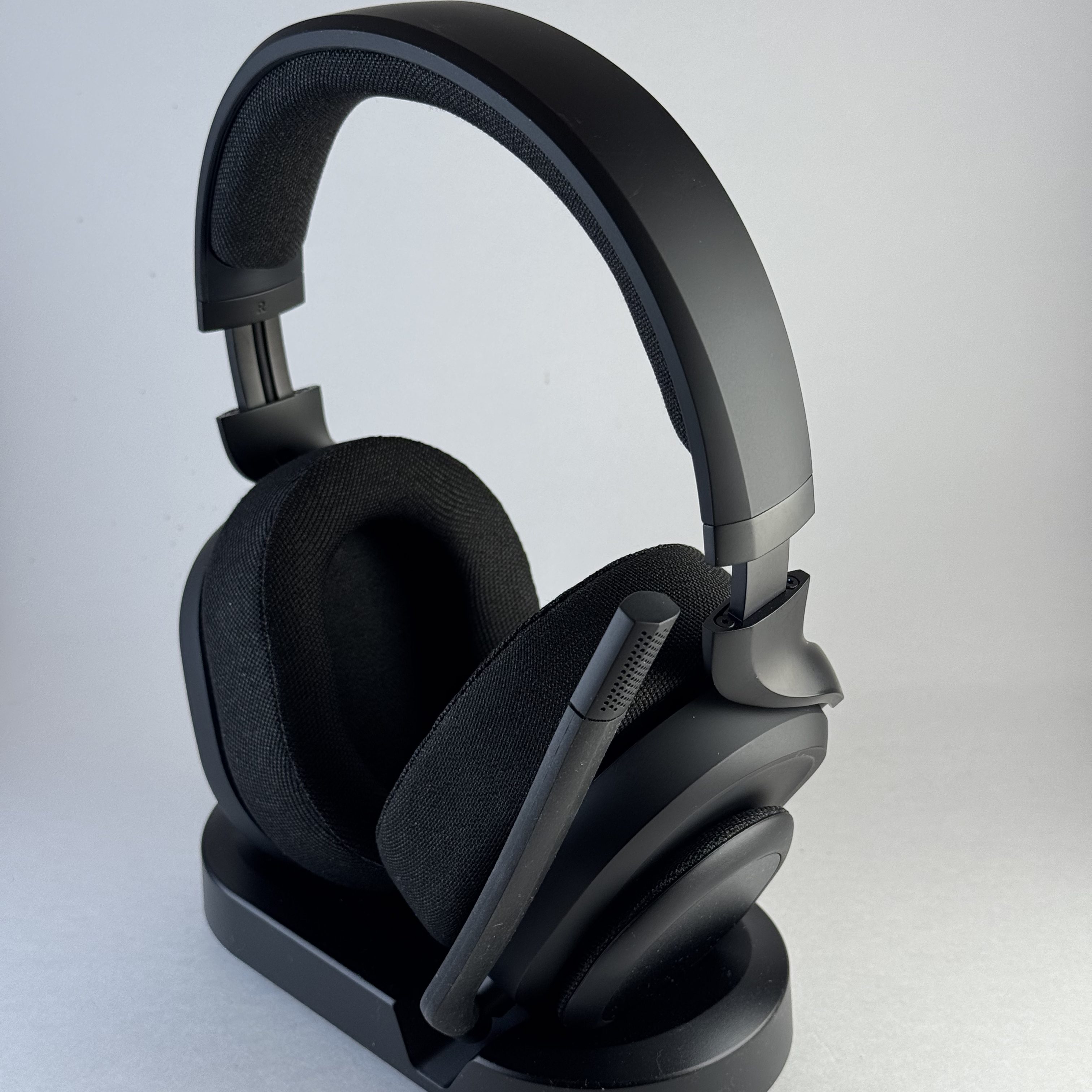
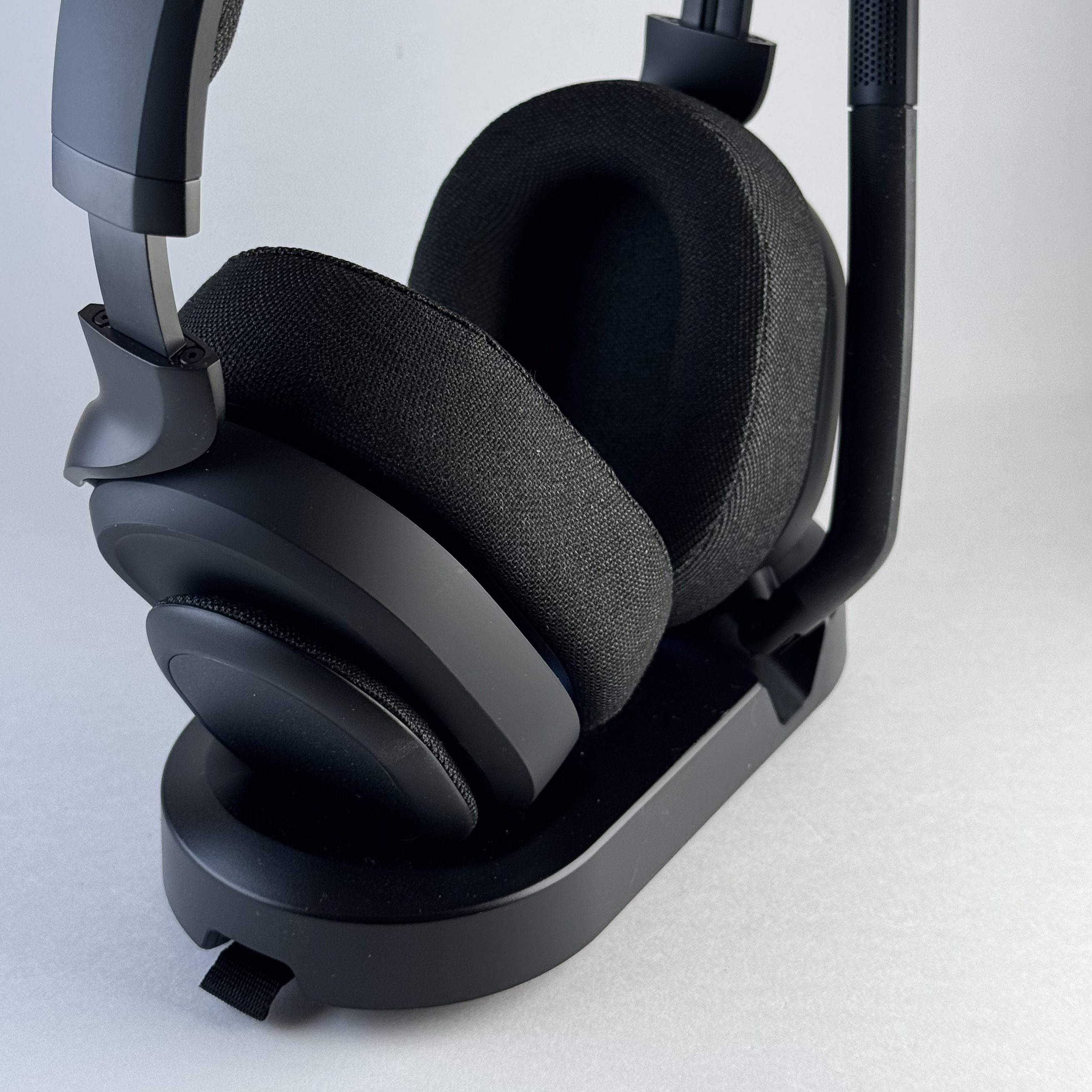
One of the biggest pluses for this product is that cradle/dock; it’s designed in such a way that it’s very easy to set the headphones down in a way that will immediately start charging, with the magnets both pulling them into place and holding them there. The divot for the mic is perfectly, helping you get the right orientation every time, and the way that they’re held means that it’s really easy to grab them at the start of a listening session. The only thing that they could easily improve on the dock is if they made it slightly heavier; if you lift the headphone too aggressively the dock can come with the headphones, and I might use some double-sided tape to hold the dock down once I’ve figured out where they’ll live, long-term.
Controls
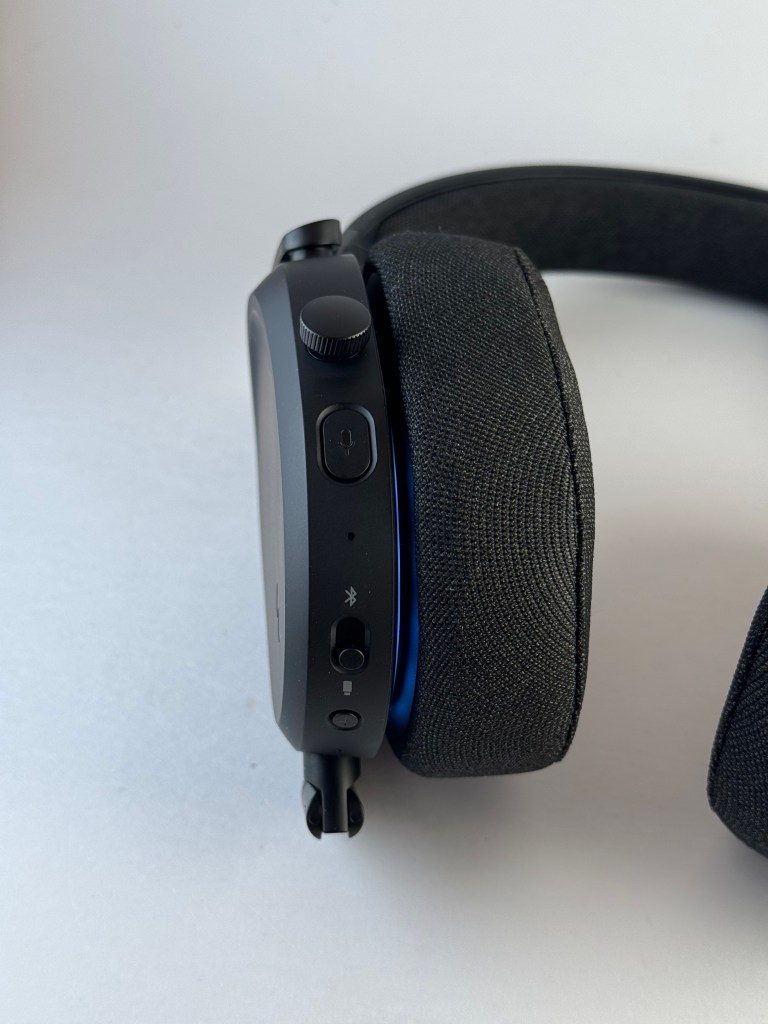
The Fractal Scape has really well-thought through controls. On the left earcup, from top to bottom, you have a rotating crown that controls volume (rotation) and pause/play/skip (pressing), a mute button for the microphone (though flipping the microphone up also mutes it), a toggle for Bluetooth vs. the wifi dongle, and a power button (press and hold to turn on or off). Tapping the power button also shows you the charge status via the RGB lights, with green indicating at least 50% charge, orange 15-50%, and red under 15%. On the front of the left earcup, there’s also a spot to slot in the 3.5 mm, foldable mic.
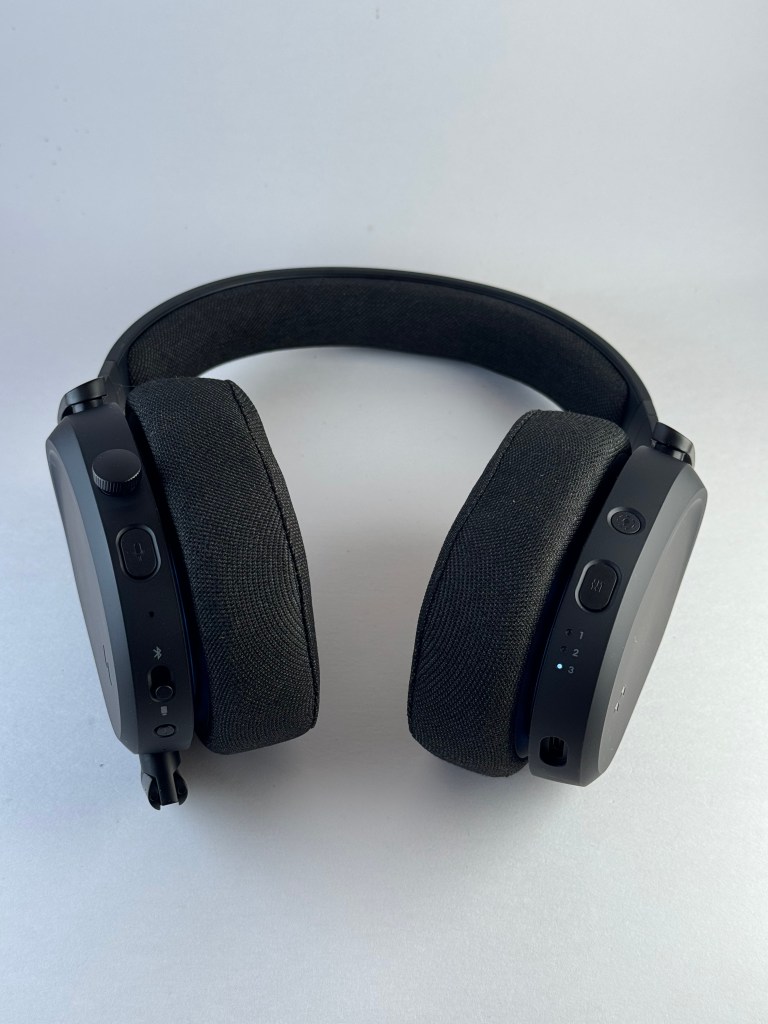
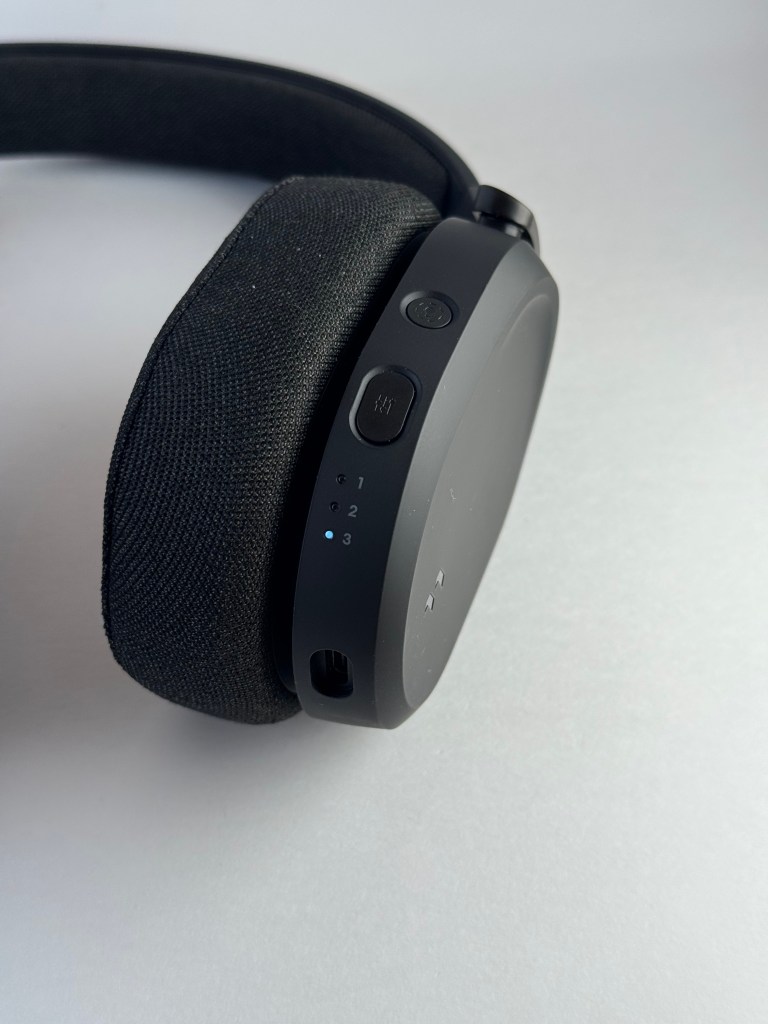
On the right ear cup, from top to bottom, you have a button that turns on and off the RGB lights, an EQ button that toggles between the three EQ modes you have set in the app, three LED lights showing which EQ mode you’re in, and a USB-C slot for charging or for playback using a USB-A to C cable.
Comfort
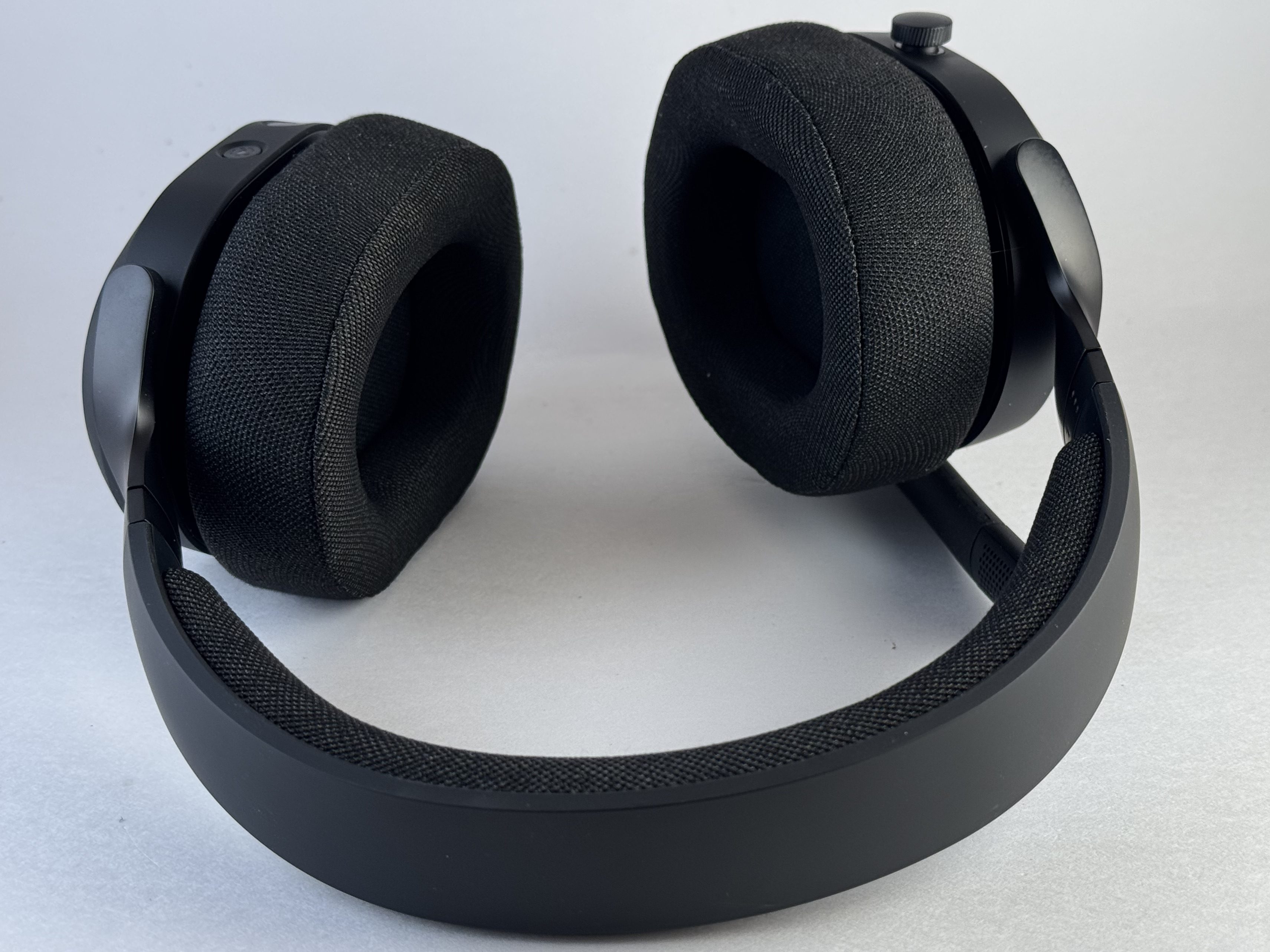
On my head, these are a pretty comfortable pair of headphones for even reasonably long sessions. They’re clampy enough that not all of their weight rests on the top of your head, but not so clampy that they place undue pressure on your temples even for a glasses wearer like me. I do wish the cups had more swivel; they have maybe a 30 degree swivel, but it’s not horizontal swivel or vertical tilt, but rather something sort of in between. The pads are pretty soft and deep enough for my ears, but I might prefer it if they were slightly larger and the padding at the top slightly thicker after a couple of hours.
Appearance
I like the way these look. They’re a pretty sleek, modern design without being visually bland in the way that the Momentum 4 or Sony XM series are. I don’t mind a judicious bit of RGB on my headphones, and I appreciate the degree of control you have over them (as well as the ability to turn it off at the touch of a button, particularly when wearing them in a very dark space).
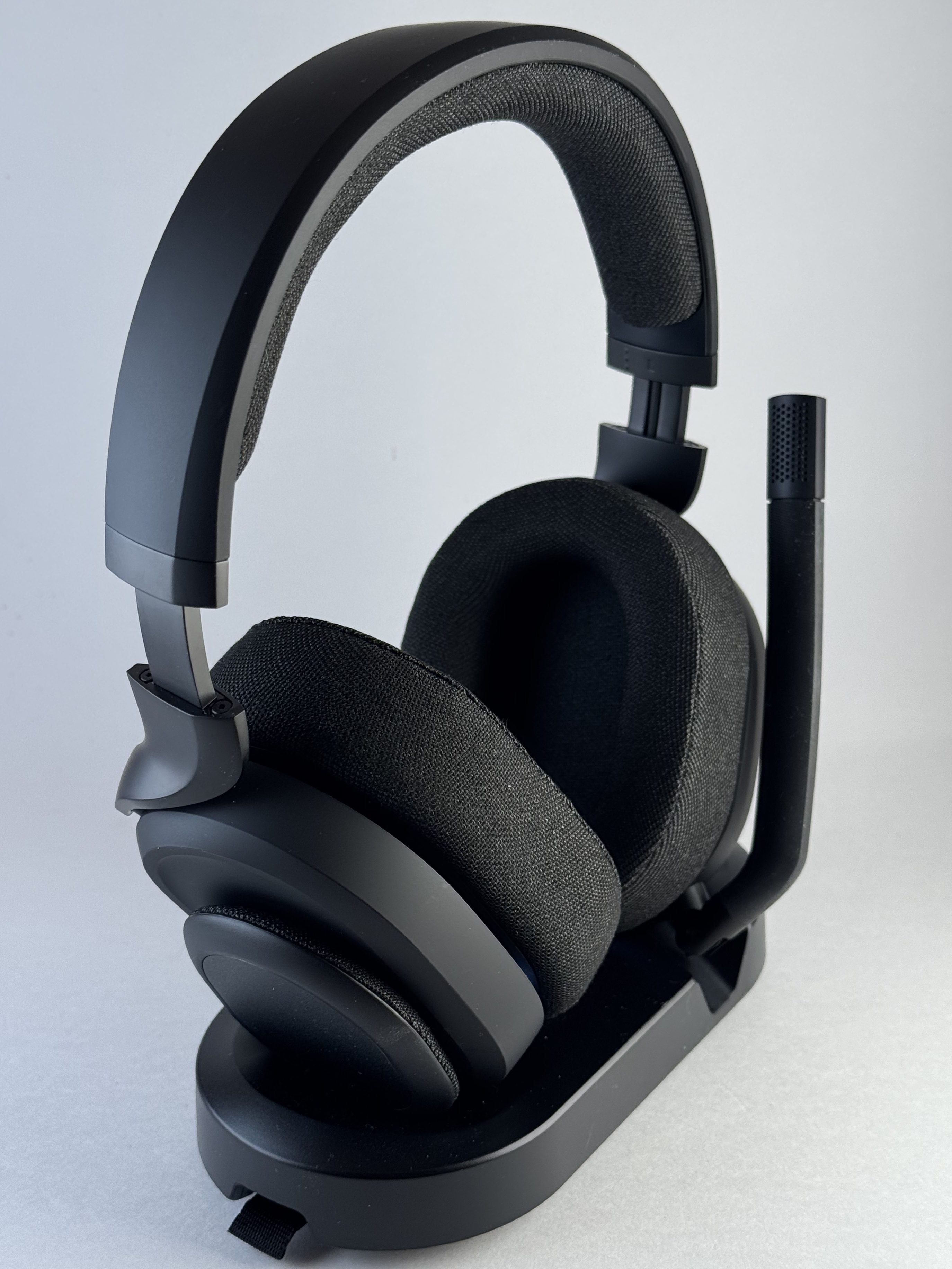
Design is always personal and subjective, but these very much feel in line with their Scandinavian roots, and in the world of gaming headphones they’re damned near austere.
Functionality
This is one of the biggest strengths of the Fractal Scape: they’re just well designed and they just work. The fact that the dongle lives in the cradle but is easily removed (and has a very clever cloth tag to ease in removal), the fact that the dock is slightly magnetic and designed in such a way that it’s hard to put the headphones in incorrectly for charging, the way the temples sit far enough off your head to be easily gripped; these things all add up to a very satisfying product. The dongle is really great for low-latency gaming, and I’m just very impressed all around with this headset. It would be great if there were an iPhone app for EQ, but honestly being able to toggle between three presets via a button on the headset is plenty for virtually all of my use cases.
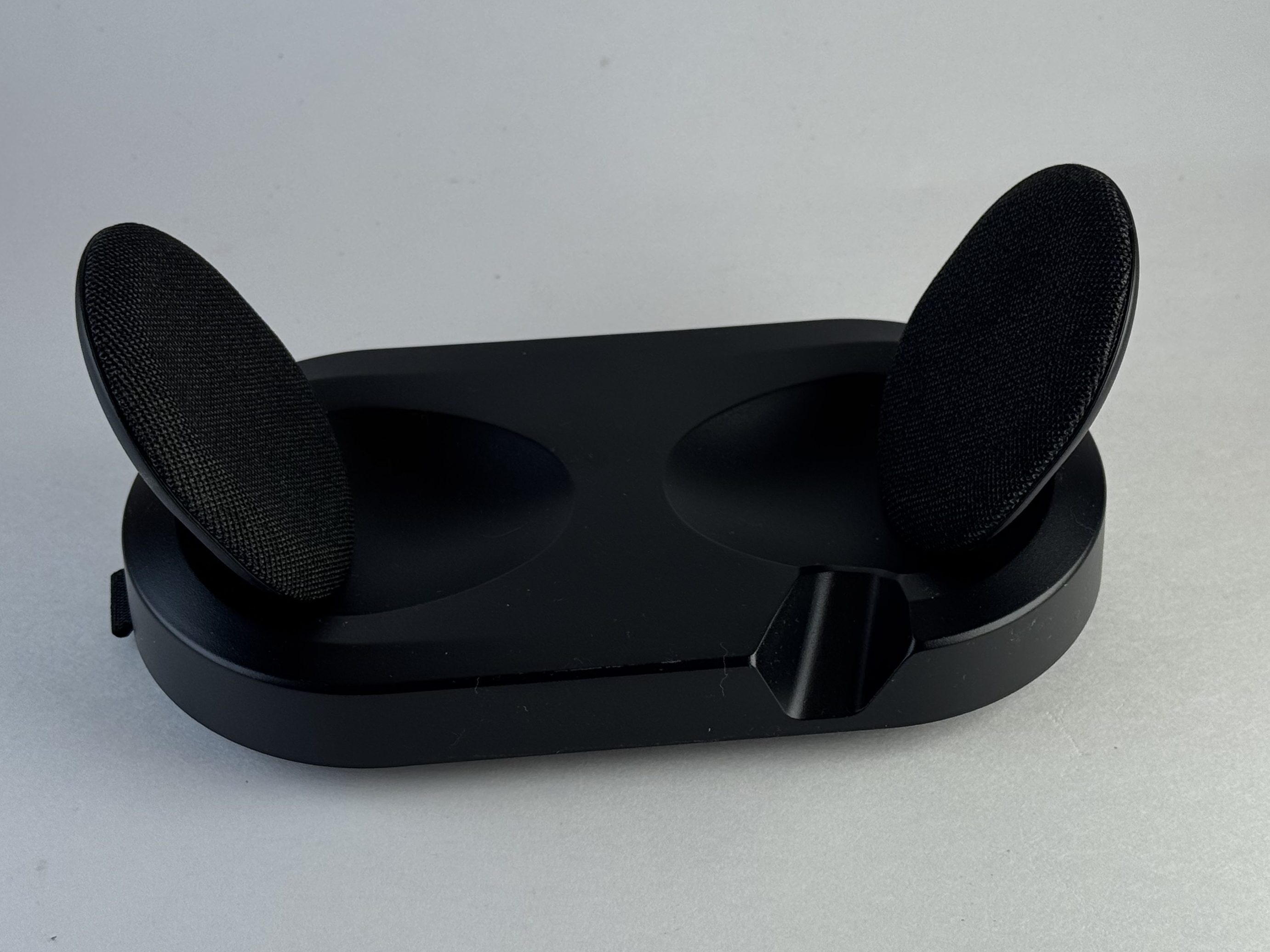
Oh, and it HAS PHYSICAL BUTTONS. I cannot overstate how much I appreciate physical buttons. Sennheiser, pay attention!
Value & Comparisons
I’m going to compare these to a couple of gaming headsets and one inexpensive closed back. I haven’t had a chance to spend time with the HyperX Cloud IIIS (the other new, hot gaming headset on the market this year), but I hope to in 2026.8
Audeze Maxwell
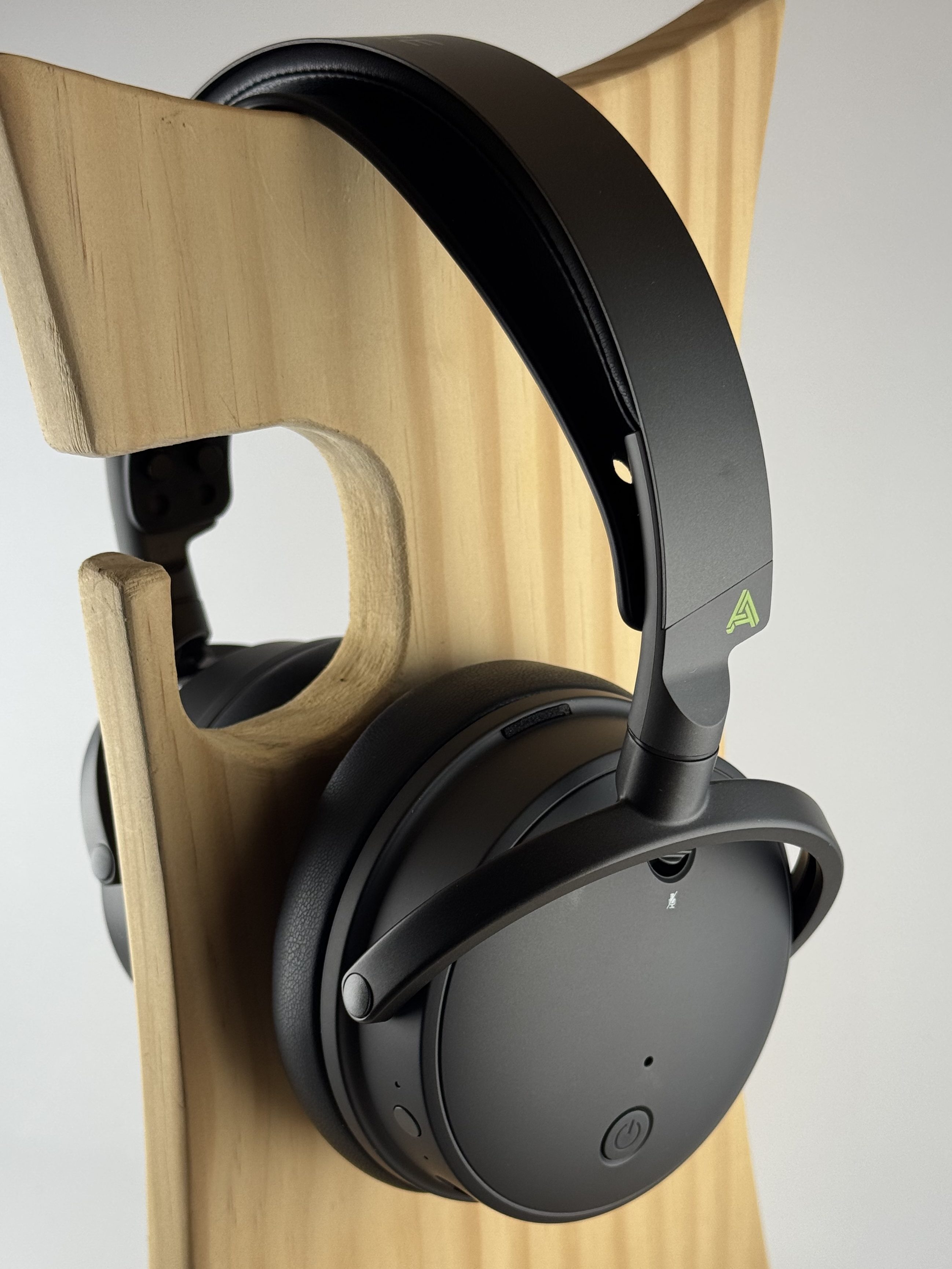
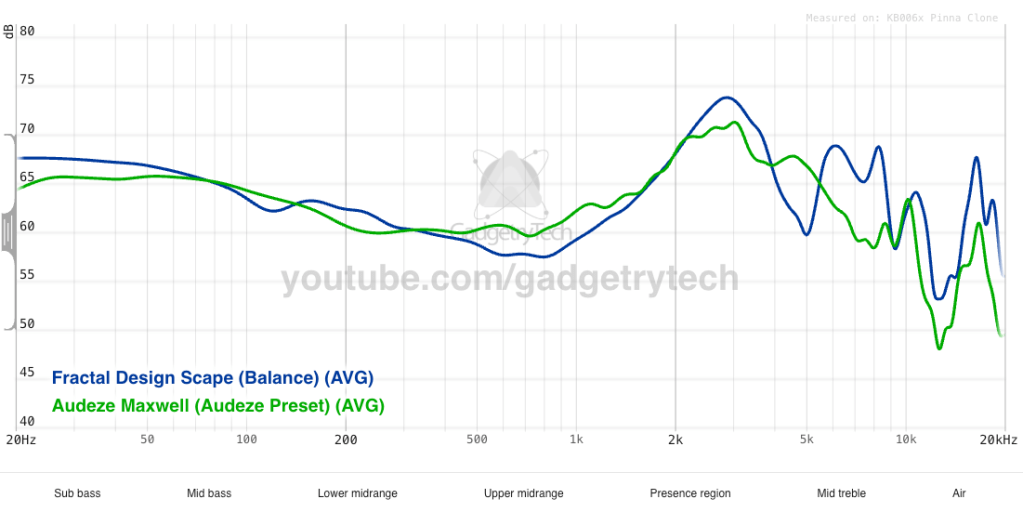
I’ll be honest … I didn’t love the sound of the Maxwells right out of the box.9 I was actually pretty convinced at first that I had a defective pair, based solely on the fact that I heard almost no bass from them. Once I got a little EQ applied via the app (though dear god that app is AWFUl on iOS; it takes five or ten minutes to load in some times, if it loads at all), the sound quality improved a lot. I think, anecdotally, that I very slightly prefer the EQ’d sound quality on the Maxwell for music, though they’re very similar in tune, but the difference is so small that I don’t think I care about it very much for gaming (and I’m not going to use either for music very often, and never for critical listening). They’re also so heavy and uncomfortable over long periods of time that I don’t think I’m likely to ever prefer wearing them.
The kicker here for me is the cradle and its design. The fact that the Scape can live in their cradle most of the time, connected to my Mac Studio, and I can easily grab the fully-charged headphone and the dongle and walk out to my living room to connect to my Playstation or Switch is pretty amazing. The Maxwell’s dongle will work, but requires finding it and moving it to the correct device. Embarrassing disclosure: I, a functional adult with responsibilities and decision-making authority, had to spend twenty minutes this afternoon figuring out where the damn dongle was. This is an organization problem on my part, rather than an Audeze problem, but it’s still a problem and I don’t think I’m the only intermittent gamer out there. My Maxwells also didn’t have a charge this morning when I wanted to start this review because they’re used so intermittently. Oh, and they’re 50% more expensive at MSRP (and more than twice as much at today’s Black Friday/Cyber Monday 2025 prices).
But for the fact that my Maxwells work with my Xbox and these do not, I’d probably sell the Maxwells tomorrow and move over to these full time for gaming. As it is, I’m struggling to envision a time when I’d grab the Maxwells over the Scapes.
Fiio FT1
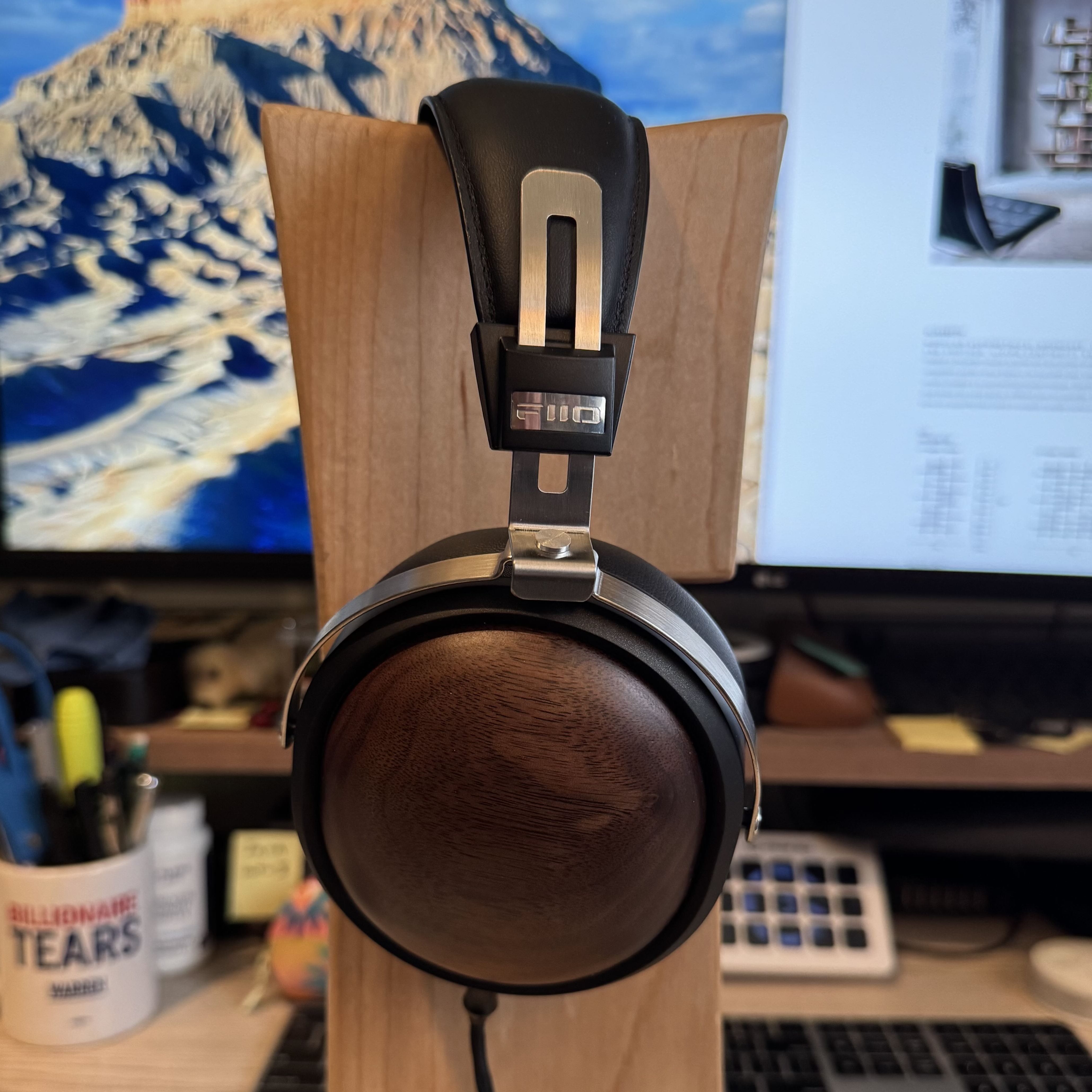
This is a really interesting comparison for me, and it’s a lot closer than I expected it to be.10 The FT1 have been my budget closed back pick as long as I have had them, and I still stand by that. But the Scape is awfully close to dethroning them, especially at their current $140 price.
I think I slightly prefer the sound on the FT1 over the Scape, overall. The Scape has slightly cleaner bass as EQ’d than the FT1 (though the FT1 takes EQ pretty well too), but I prefer both the mids and the treble tune on the FT1. On some tracks, the Scape feels a lot more immediate and intimate, but there are definitely tracks where they feel more distant so it’s not a consistent phenomenon for me. I think they have a similarly wide soundstage, but the layer and instrument separation in space is noticeably better on the Scape and for gaming, that’s probably enough to sell me right there.
If I were grabbing one of these for music, I’d go with the FT1. For gaming, I’m going to go with the Scape, and for pure convenience there are a number of situations where I might grab the Scape even for music.
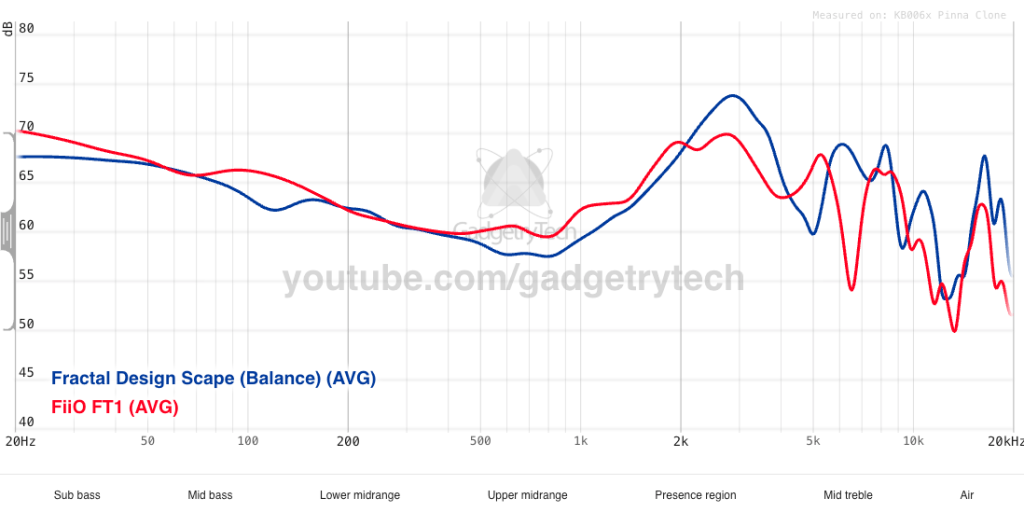
When you take into account price ($140 for the Scape, $160 for the FT1), plus the fact that getting the best out of the FT1 likely requires at least a $10 dongle DAC while the Scape comes with everything it needs, I start to lean towards the Scape in a lot more situations. If you already have a good DAC/amp solution on your desk and that’s where you plan on using these headphones, I’d probably lean back towards the FT1.
Both are great headphones with strong use cases, but for me the FT1 is going to get a lot less use given the other options I have on my wall.
Sennheiser Momentum 4
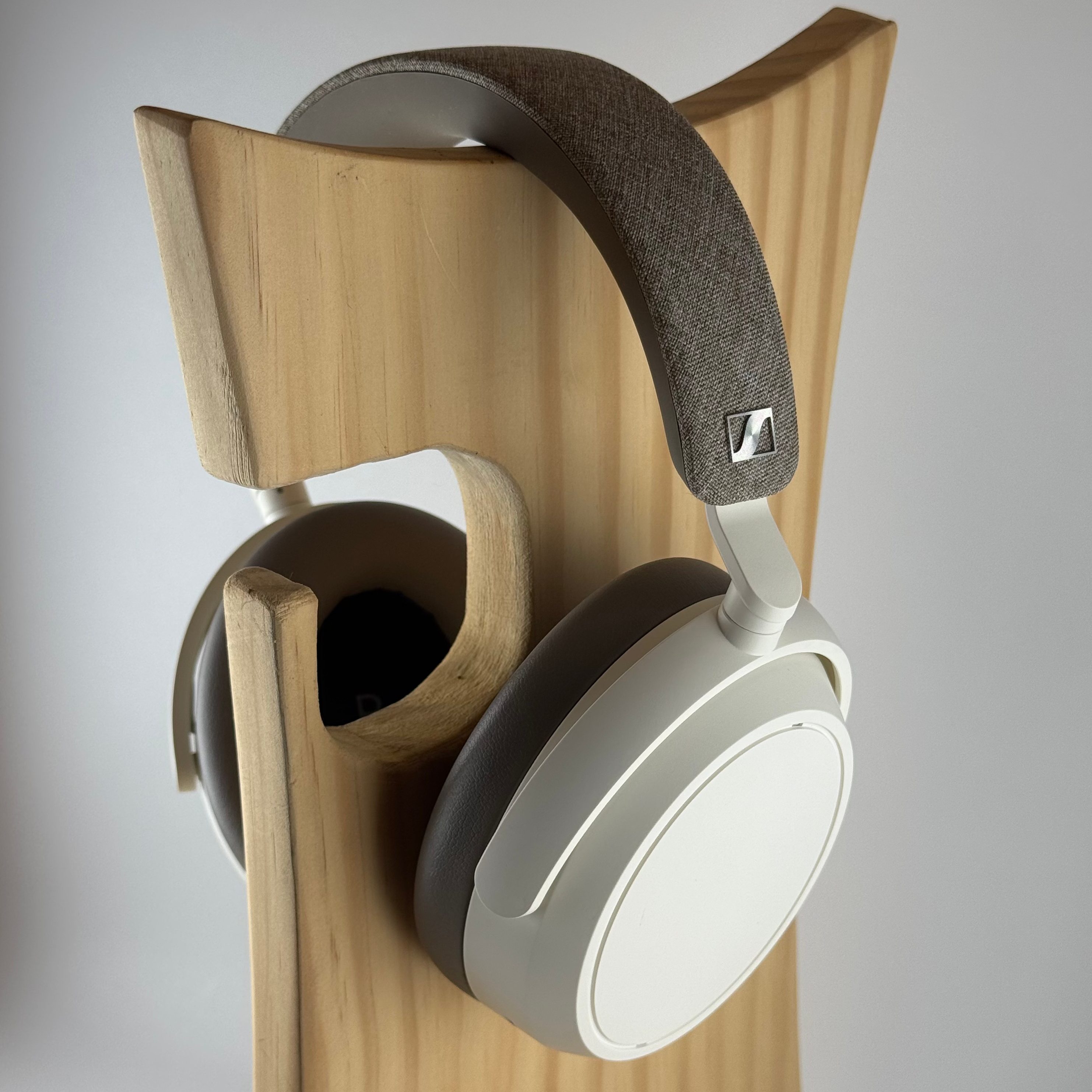
I think the sound comparison here is pretty even; the Momentum 4 is my pick for sub-$250 ANC headphones for sound quality after a little in-app EQ, but the Scape are really impressive-sound wise. Certainly for gaming the M4’s latency is disqualifying, but for music, it’s pretty even. The kicker here for me might just be the limitations of Bluetooth. With modern codecs the lossless vs. lossy Bluetooth thing is much less of an issue, but the wireless is just a better protocol for almost everything else. I can wander all throughout my house with the Scape on my head and still get consistent playback, but if the M4 are connected to my phone and I leave it in my office while I walk the thirty feet to my front door to get my mail, I’m going to get distortion artifacts (best case scenario) or disconnected (worst case scenario).
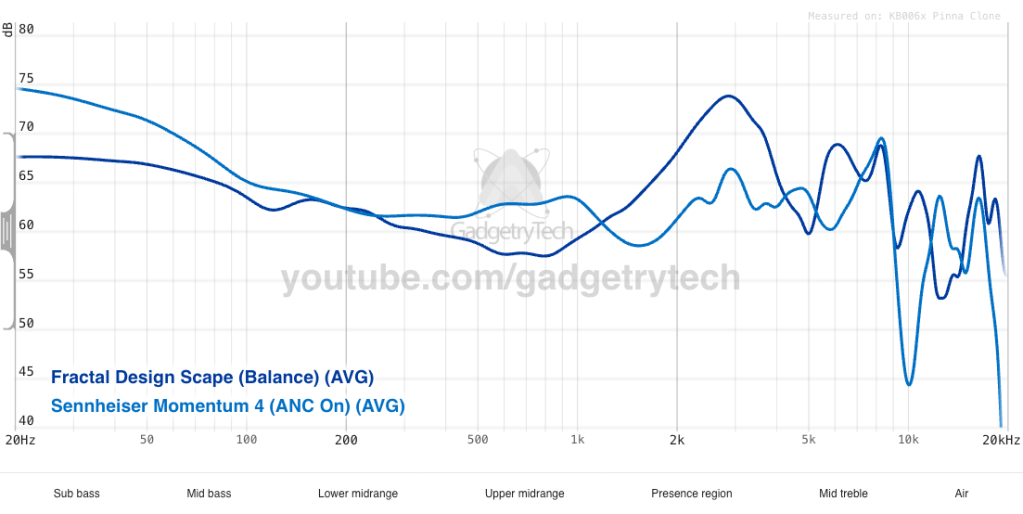
The big differentiator here is ANC; if you’re wearing them out of the house, or live in a noisy environment, the M4 are the better choice for music. If you’re gaming, or don’t need ANC, the Scape is the clear winner.
Microsoft Series X Headset
I’m a weirdly big fan of the Series X headset (I think it’s now just called the Xbox Wireless Gaming Headset?). I got mine back when the Series X first released, and I used it on a daily basis for years to play Destiny and other games on the Xbox Series X. It’s really, really great when you’re playing on an Xbox. The audio decoding works really well, there’s minimal delay, and the integration with ATMOS for Xbox is genuinely impressive.
If the Scape were Xbox compatible, I’d never use the Series X headset again. As good as it is (even for music!), the Scape is better in every way except Xbox compatibility. If you’re a PC gamer, pay the extra $40 for the Scape. If you’re an XBox gamer, bug Fractal to either license their headphones for Xbox or to add an optical input on the cradle.
Razer Kraken
Ha. Hahahaha. HAHHAHAHAHAHAHAHAHAHAHAHA.11
Overall
The Fractal Scape are a really impressive product; frankly, I’m blown away by how much I like listening to music on them. The first time I saw Resolve’s review of them I was pretty skeptical, but color me convinced.
My only real complaint? I would really, really love an optical in, or Xbox compatibility. I don’t play games that much anymore, but when I do it’s largely on Mac, PC, or on Xbox. I’d really love to have a single set of headphones that I can use for all of those options. For the moment I live alone in a house, so I can mostly use my surround sound system for Xbox gaming, but at some point I’m likely to no longer live alone and without close neighbors, and I’d love to see a V2 of the Scape’s cradle include an optical audio in. Astro did it years ago with the connector for the A20, and that addition (or just licensing the technology necessary to be directly compatible with Xbox) would solve my only real issue with this awesome first audio product from Fractal.
Until then, unless you’re an Xbox gamer, I wholeheartedly recommend this product to you. It’s crazy to me that this is being sold for $140 right now. I’m stunned that this is Fractal’s first headphone, and there are a lot of legacy manufacturers that should take a long, hard look at this product and make changes accordingly. Razer and Astro should be quivering in their boots.
#reviews #headphones #sennheiser #6XX #anc #spatialaudio #meh #2025 #99noir #meze #sunglasses #overear #cans #hifiman #arya #stealth #editionxs #budget #hahahaha #iems #quickreview
- I score bass, mids, and treble on a two part scale: 1-5 for quantity (5 being the highest), and A-E for quality (A being best in class, E being laughably bad). For soundstage it’s also a two part scale, with the number representing the width and the letter the separation within it. ↩︎
- For comfort/fit, my scale is A-E with A being disappear entirely into the background and E being I want to tear my ears off to stop feeling these headphones on my head.
I’ve never had an E.Editor’s note: I’ve now had an E: the Koss Portapro. ↩︎ - Yeah, we can be real jerks. ↩︎
- Even the ones with really good drivers like the Turtle Beach Recon 500 were very poorly tuned as sold. ↩︎
- Based in part on the substantially better pricing this Black Friday (less than half as expensive), and the fact that Audeze is apparenlty rolling out a new Maxwell, making the OG potentially less relevant. ↩︎
- Microsoft charges manufacturers a fee to allow compatibility with Xbox, which is why the Xbox version of the Maxwell is $30 more expensive than the PS5 version. ↩︎
- AQUAmpmJwN0kskA6IwAAAAAAZmYGwGZm9j+0CwAAAAAACXERQEJgpT/nAgAAAAAAMzMTwGZmVkBJKwAAAAAAMzMTQPCnjkDtEgAAAAAK ↩︎
- And if you want to help make that happen, use the affiliate links! 😂 ↩︎
- This is probably part of why I haven’t done my review yet. ↩︎
- I appreciate coming back to the FT1 on these reviews, because it always reminds me how much I really like these headphones. I recommend them a lot, but I don’t use them all that much at this point. ↩︎
- Still haven’t heard a pair of Razer headphones worth listening to if you have any other reasonable choice. ↩︎
 Phil's Superpower of Enthusiasm
Leave a comment