
[MSRP $650 from Chord, same at Amazon, purchased used from Hawthorne Stereo in spring 2025.]

[Tl;dr: The Mojo 2 seems, at first, like a ridiculous idea. DACs and amps can’t make that big of a difference in sound, right?! Except, it seems, when they do. I’m not saying the Mojo makes your gear better; but I’m pretty confident in saying that it will get the very best out of almost anything you run with it, and the degree of separation and layering you get from complex music is really quite something.
I love it. It’s my new favorite DAC/amp, and could replace virtually anything I own in the space in a heartbeat.]
Cost-agnostic: 10 out of 10 Denalis
Cost-sensitive: 9 out of 10 Denalis1
Intro. I haven’t done any DAC (or DAC/amp) reviews before, and there’s a simple reason for that: while I can hear a difference between some DACs, with some headphones, some of the time, the differences are pretty subtle and hard to really categorize. In some cases, I can’t hear a difference between DACs even when I know which one is in use, let alone blind. This is the logic behind my philosophy regarding not using a dedicated DAC until you reach the $200-250 range in headphones, and why I wouldn’t recommend spending more than half to a third as much on a DAC as you do on your speakers or headphones.
Chord DAC/amps are pretty unusual in the modern hifi ecosystem. Most DACs on the market are using one of a handful of DAC chips made by major manufacturers like AKM, ESS, Texas Instruments, etc., and they’re all doing a pretty similar process. By contrast, Chord relies on off-the-shelf field programmable gate arrays (FPGAs) running custom-developed code. I’m not going to say that this approach is necessarily *better*, per se, but it’s definitely different. And in a field where a lot of the competition follows one path and ends up with pretty similar results, I can appreciate Chord’s willingness to do their own thing and stick with it. And for me personally, it produces some pretty great results.
I first heard about the Mojo on a Darko.audio review in 2022. Over the last four years, it’s regularly popped up on reviews and in recommendations from audio reviewers who I appreciate. At that point I was mostly focused on loudspeakers and would never have considered spending this kind of money on a DAC/amp, in large part because I really enjoyed the onboard DAC of my Devialet super-integrated amp and had no desire to swap it out.
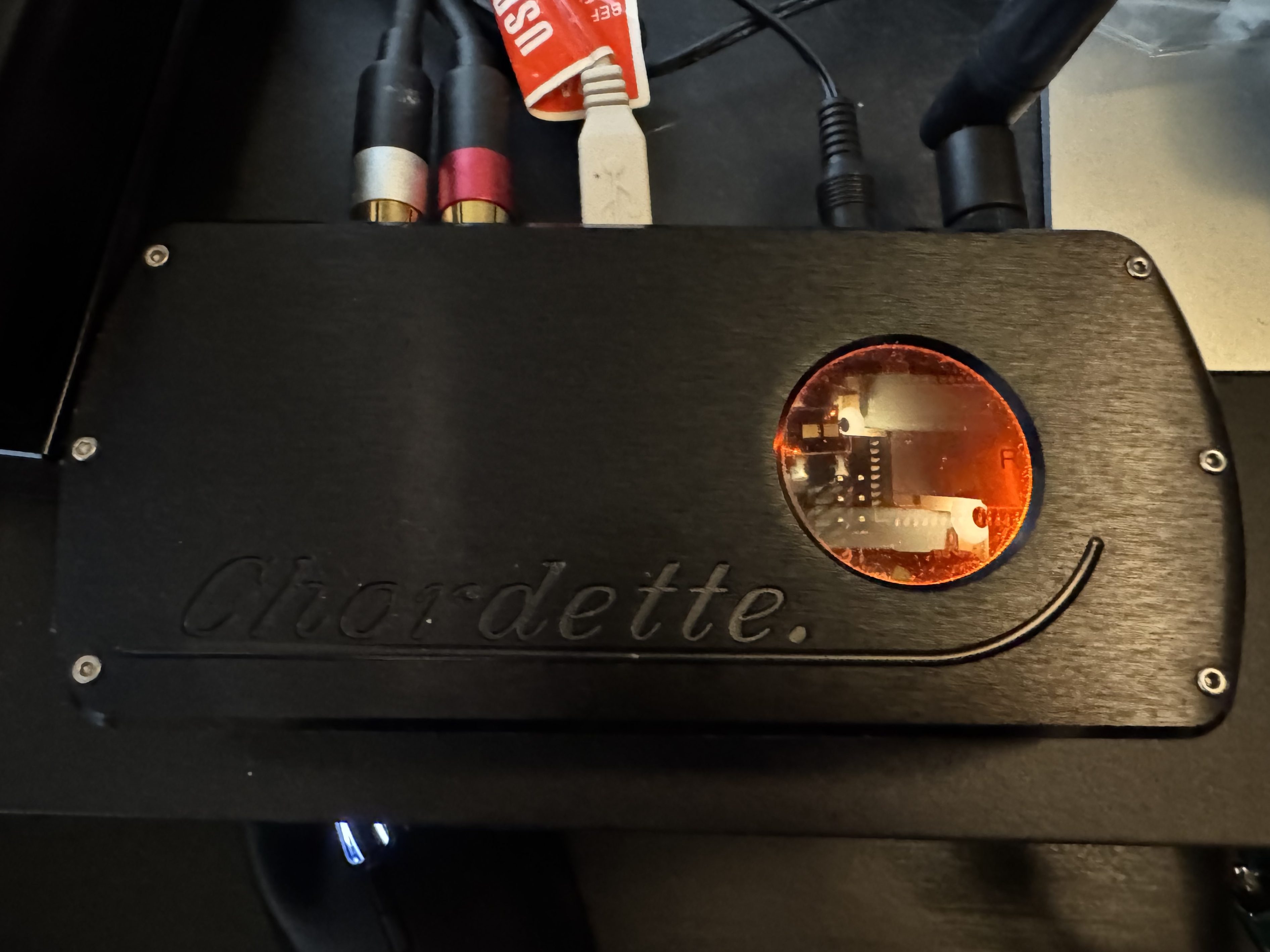
Back in like … February? One of my favorite local-ish hifi shops, Hawthorne Stereo in Seattle2, popped up with a used Chord Chordette Gem, a fifteen-year-old DAC that was one of the first commercial audiophile products incorporating Bluetooth and Apt-X. It was, and is, one of the more fun and distinct sounding DACs I’ve ever heard, and it rekindled my interest in Chord and unusual DACs. A month later, a lightly-used Mojo 2 popped up for a very reasonable price, so I made the trek to Seattle to give it a listen.
This is going to be a different style of review, because DAC variations are subtle. I really expected this to be a short review, but it turns out I have a lot to say about the Mojo 2, so … I apologize in advance.
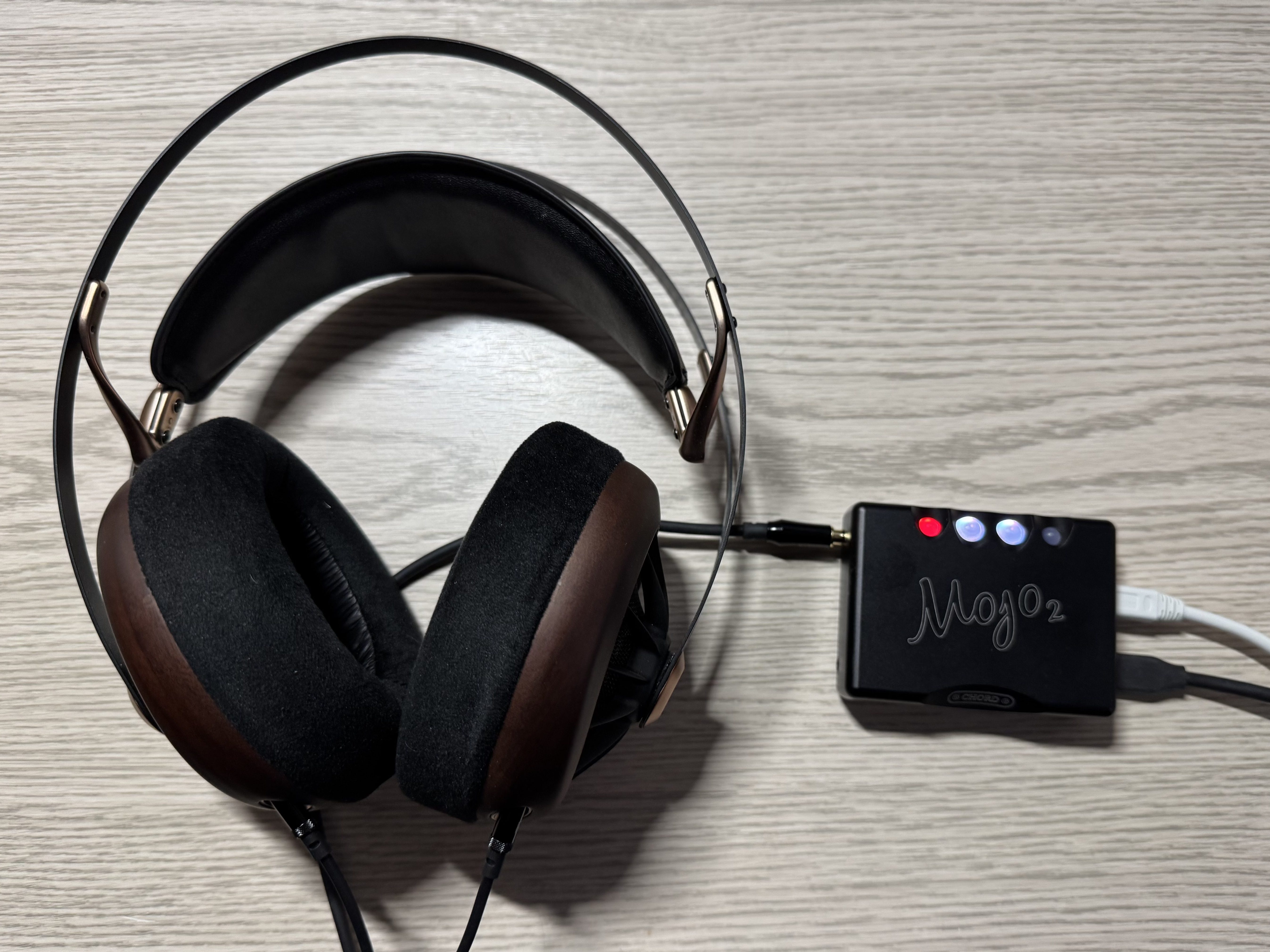
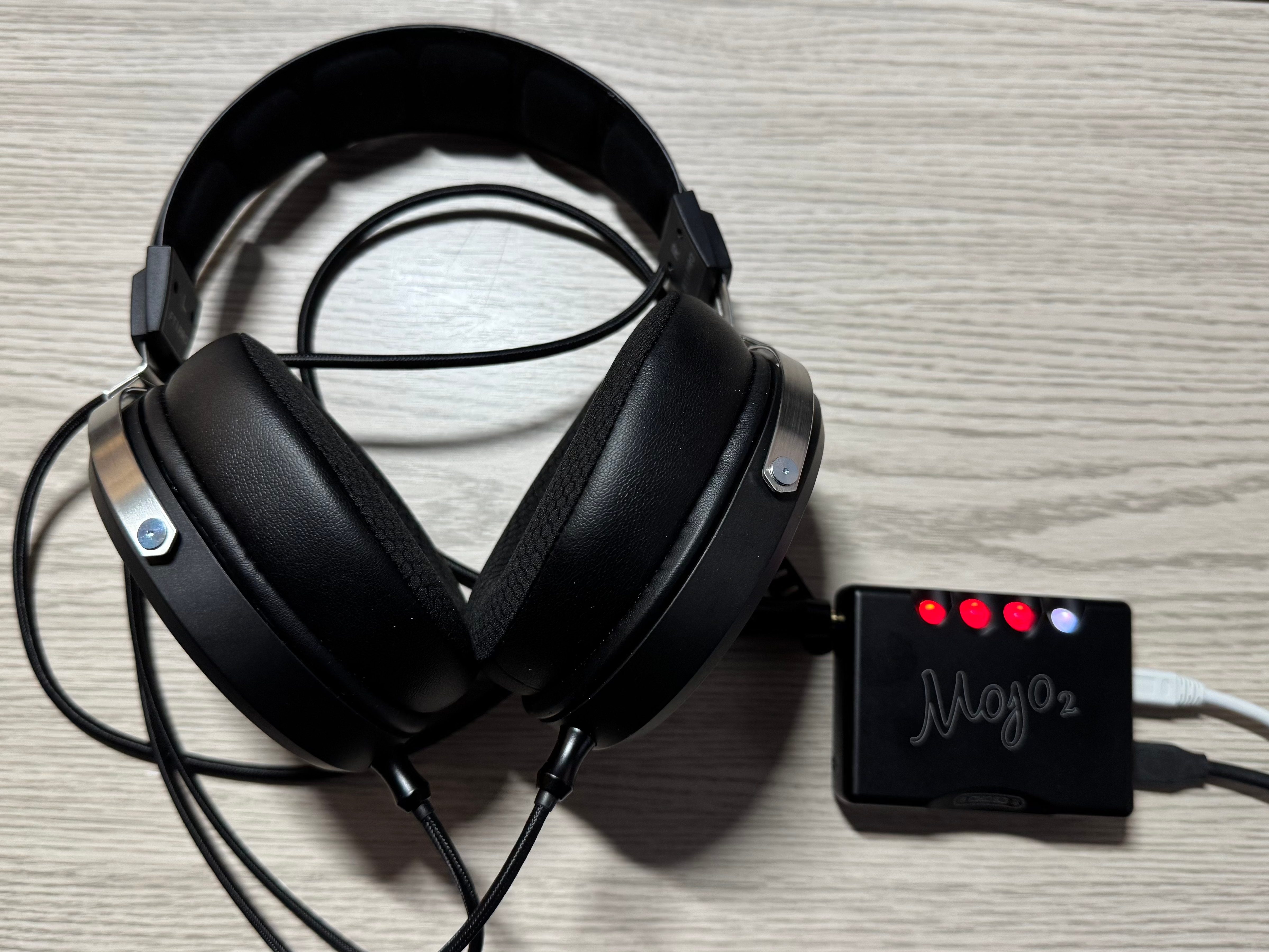
[Review note: Based on my philosophy of resource allocation in Headfi, I should test these with headphones in at least the $500 range, so I’ve been doing quite a lot of listening with the Arya Stealth (current MSRP $599, originally $1499) and the Meze 109 Pro (MSRP $799), but because I’m currently working on a review of the Fiio FT1 Pro (the open backed companion to the FT1 I recently reviewed, with an MSRP of $220), I’ve also done quite a lot of listening with both the FT1 and FT1 Pro. The Mojo is also an excellent system at low volumes, so I’ve been listening with IEMs as well.
Except where otherwise noted, testing was completed with the Mojo 2 plugged into my Mac Studio via USB-C and used as a Roon endpoint, with the Mojo connected to power via USB mini, listening to the Meze 109 Pro.
My torture testing lists: Apple, Tidal, Spotify.]
The basics. The Chord Mojo 2 is a battery-powered, USB-C capable DAC/amp designed and built in the UK. It eschews the modern trend of using mass-produced DAC chips, and instead relies on a custom-programmed FPGA. It is powered by either its internal battery OR a mini-USB, and accepts a variety of inputs (USB-C, mini-USB, coaxial, optical) and provides two identical single-ended 3.5 mm outputs. It can be used as a DAC, a DAC/amp, or when combined with Chord’s Poly unit, effectively a low-powered integrated headphone amplifier.
Sound. My overall takeaway on the Mojo is not that it lets me hear things that other DACs don’t, but rather that because of the way it spaces instruments out (both in space and in terms of layering), I hear things that I don’t otherwise.
As an example, Sound Garden’s “Superunknown” was one of my favorite albums in high school (an era in which I listened to my favorite albums over and over and over again), so I’ve probably listened to it, conservatively, a couple of hundred times. “Fresh Tendrils” is one of my favorite tracks on that album, so I’ve probably listened to it several hundred times more than the rest of the album. There’s a whole funky, jangly guitar countermelody around 2:16 that I’d never heard until I spun up the 20th anniversary remaster the other day. I was so surprised to hear it that I assumed it was new to the remaster, and I went back and pulled the original recording. Nope. It was there the whole time.
Now that I know that counter-melody is there, I can hear it when I listen to the track with other DACs/amps. But, because it’s relatively subtle and can get buried in a complex mix, it never registered in my brain as a counter-melody. The superpower of the Mojo 2 is that it does an incredible job of separating out the layers in music and letting each instrument/person sound distinct, even when they’re in a sonically-busy frequency on a particular track. It’s not necessarily a significant increase in resolution (though it’s also really good at resolution), but rather in the way it can separate out complexity in any given frequency range.
Bass/mid-range/treble. I’m not sure that I can isolate specific, consistent effects on bass, mid-range, or treble with the Mojo 2 compared to other DAC/amp combinations. Which is really what you want with a DAC, right? Or at least what I want; I don’t want my DAC to color the sound of my music; I want a faithful reproduction of the tracks, and I’ll use my choice of headphone or EQ (or amp, to a much lesser extent) to drive the general tuning of my experience.
The words that I keep wanting to fall back on are control and precision. Each note feels precisely calibrated and clean; nothing lingers too long or gets muddied with other things in the mix. “What Did I Do” is just this side of clinical in terms of how exacting the reproduction is. The throbbing on “Limit to Your Love” is SO clean and precise, and the dueling guitars in the middle of “Garcia Counterpoint”, which I normally distinguish based on location in the soundstage have *very slightly* different timbre through the Mojo. I’ve never noticed that before. On the beginning of “Angel (Blur Remix)”, there’s a very subtle bend in the accent of each of the bell tones that I don’t think I’ve noticed before, and it’s so consistent that it has to be in the mix.
The takeaway is this: on challenging tracks that overwhelm some systems and slide into muddiness, the hallmark of the Mojo 2 is clarity. Base doesn’t get muddy, mids don’t get veiled, and treble doesn’t go sharp or flabby.
The soundstage/stereo separation is truly exceptional. My general belief is that soundstage is mostly driven by your headphones/speakers and the actual media you’re listening to, but the way that the Mojo separates layers and instruments and places them in space is unique. I’d be pretty surprised if it could *create* soundstage in a headphone that does it poorly, and the Mojo harshly punishes poorly-mastered or mixed content, but it certainly allows you to get the very best out of whatever you’re listening to. The rotational soundstage on “Love Can Damage Your Health (Laid Mix)” is distinctly better via the Mojo, particularly with cross-feed enabled (more on that later). There’s also a cymbal pattern starting around 1:45 that runs through the rest of the track with an interesting mid-pattern pan that I’ve never noticed that’s particularly pronounced around 2:45.
Noise floor. The noise floor is non-existent on the Mojo. Even at full volume, there’s zero hiss on any IEM or headphone I’ve tried with them.
Cross-feed. The Mojo 2 has a function buried in the color-driven menus to adjust the cross-feed, i.e. the amount of each channel that is slightly delayed and fed into the other channel to simulate hearing speakers (because when you listen to speakers, your left ear hears the left channel but also the right channel, just slightly delayed). In theory this should create a more speaker-like experience, particularly with open-backed headphones. It’s a very cool, slick system, though I want to spend some more time with it. My hope was that it would move things forward in space so it feels like sitting in front of the music instead of in the middle of it (or maybe even create a phantom center effect?), but so far I haven’t had that experience. At this point I think the cross-feed creates a more immersive experience to my ears, but I want to play around with it more.
The dynamics are clean and controlled (yeah, I know I keep using that word, but … it fits). Notes are accented pleasantly where it makes sense, and not where it doesn’t. Nothing is punchy or thumpy or shouty, except where that’s a deliberate choice in the source.
[Editors note: Man, as I’ve been cycling through headphones and writing this review, I just keep getting pulled out of it by details I’ve never heard before in songs I know well and love. It’s … impressive. While I very carefully don’t watch/read reviews while I’m working on my own to avoid influence or groupthink, after I’m done I go watch some others to see what I missed or where we agree/disagree. Darko describes this as a lean-in DAC as opposed to a lean-out DAC, and I think he’s 100% correct.]
Headphone compatibility. The Mojo plays pretty well with almost all of the headphones I’ve tested with it, which is a pretty broad range from $20 IEMs through my ZMF Bokeh closed.
Mid-fi headphones. The Mojo sounds extraordinarily nice with the Meze 109 Pro. I think the Mojo might tend a little towards the clinical side, so the warmth and buttery Meze magic really compliments that tendency. I also think the Mojo really brings the best out of the 109s, really leaning in to the 109’s ability to beautifully reproduce quiet music and silence in the midst of tracks. Ditto with the ZMF Bokeh Closed; just really brings out the best qualities of the Bokeh without overemphasizing any of the weaknesses.[iii]3

Budget-ish headphones. I’m also really delighted by how good some of my inexpensive open-backs sound through the Mojo; I really wondered if it would be so resolving and discerning that it would make me grab only for my higher end stuff, but I’m genuinely impressed by how good the relatively inexpensive Fiio FT1/FT1 Pro and Senneheiser x Drop 6XX sound via this system. To me, the 6XX is a relatively amp-sensitive headphone, but I think the Mojo produces the best bass I’ve ever heard from them, and the richness and depth I get out of the FT1 Pro is … exceptional. If I were starting from scratch, I wouldn’t necessarily buy the Mojo to pair with one of those headphones in the $200 range, but if you’ve already got one …
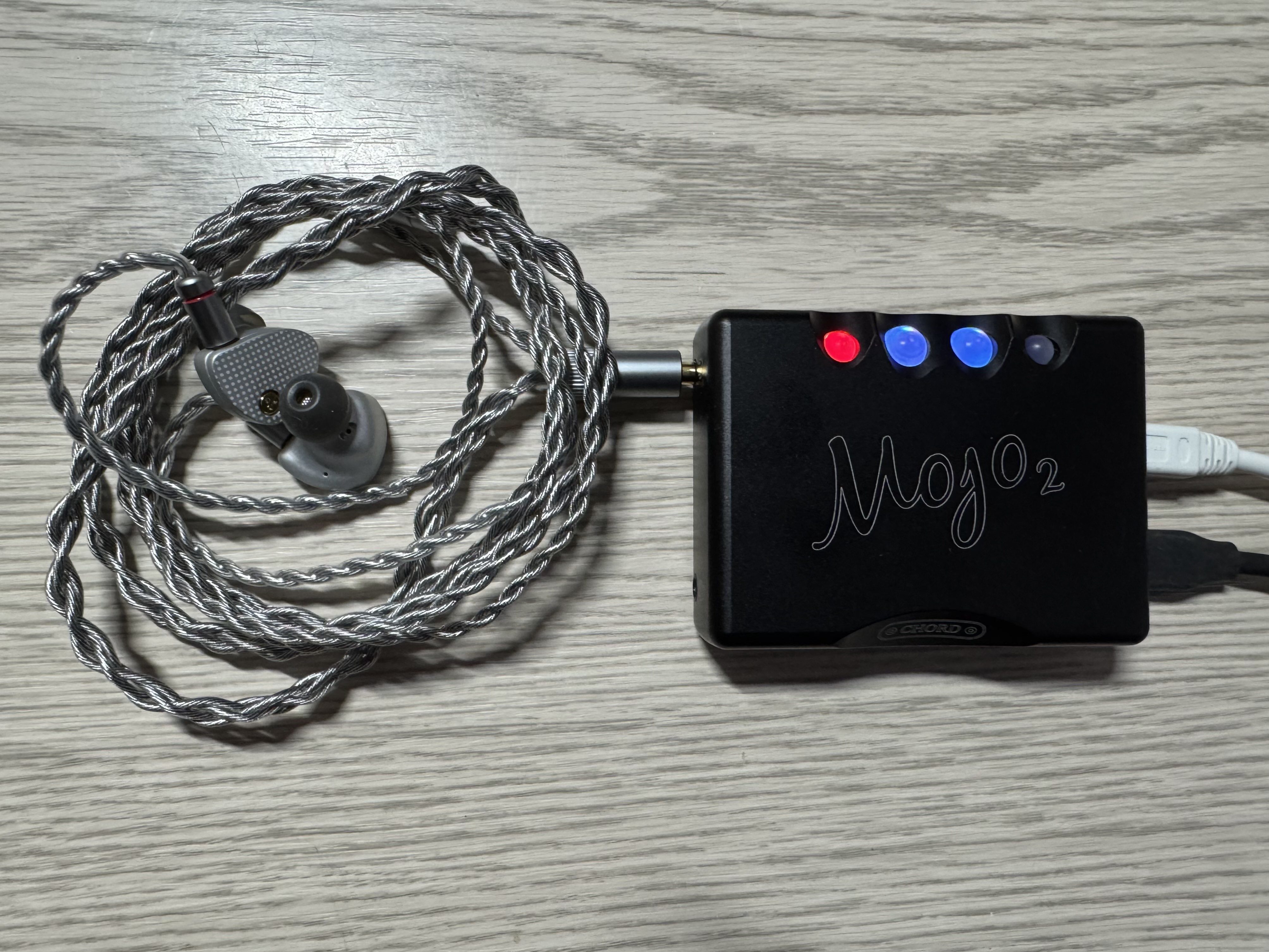
IEMs. One of the surprising strengths of the Mojo to me is how well it plays to IEMs; because the volume range is so wide, and because the volume changes are so incremental, I’m able to get a really nice, comfortable volume even with pretty sensitive IEMs. The Mojo is also dead silent; even with it cranked up to max volume there’s no audible hiss.
Definitely the best, most full sound I’ve ever gotten from the Dunu Titan S (my favorite sub-$100 IEM so far), and the Mojo sounds exceptional even on the $20 Tangzu Wan’er 2s. A couple of the synth sounds on FC Kahuna’s “Hayling” sound so far out to the left that I swore at first that they were something in the environment around me until I paused and heard them stop too. Also holy hell the bass on “Easy.” I think this is my new favorite way to listen to IEMs. Does it feel slightly ridiculous to use a $650 amp to drive a $20 pair of headphones? Sure. But also it sounds amazing
The only IEM I’ve had any issues with is my Campfire Audio Holocene, which intermittently pop in the left earbud, but I’m guessing that’s a mechanical issue or a fault with the IEMs rather than a Mojo issue. And even with them, I’m hearing fingers sliding on strings on “Garcia Counterpoint,” something I’ve never heard before.
A cautionary note. The only cautionary note I’d offer on the Mojo 2 is that with a really resolving, objective headphone like the Arya Stealth, especially ones that are already a little prone to brightness in the treble, the Mojo’s crazy layer separation and reproduction can really lean into that tendency. As an example, the high synths on Fleetwood Mac’s “Seven Wonders” (from the fantastic “Tango in the Night” album) can be a little too sparkly (and bordering on harsh) with the Arya; it’s probably the pairing I’m least likely to come back to. Clinical + clinical = too clinical for my taste.
Equalization/EQ. One of the ways in which the Mojo 2 stands out from a lot of other DACs/amps is that it’s capable of a relatively sophisticated set of on-board EQ adjustments. If you learn the ways the menu works (or consult the manual), you can adjust each of four frequency bands to 19 different settings, from +9 dB to -9 dB. I haven’t played with these very much; I tend to do most of my listening through Roon (at home) or Roon Arc (everywhere else), and Roon gives you access to a pretty robust set of software-based parametric EQ settings that can be applied with the click of a single button,4 whereas EQ through the Mojo 2 requires understanding the complex menu system (more on this later). That said, it’s nice to know that if I was playing with a new set of headphones in the world, or my Roon server was temporarily unavailable, I could make some manual adjustments to the sound profile (and it’s a level of detail I haven’t seen on any DAC/amp I’ve personally tested.
Use cases. One of the strange downsides of this device is that it’s so versatile, I think I may end up spending a lot of time plugging and unplugging it just because it’s a pretty excellent all-arounder.
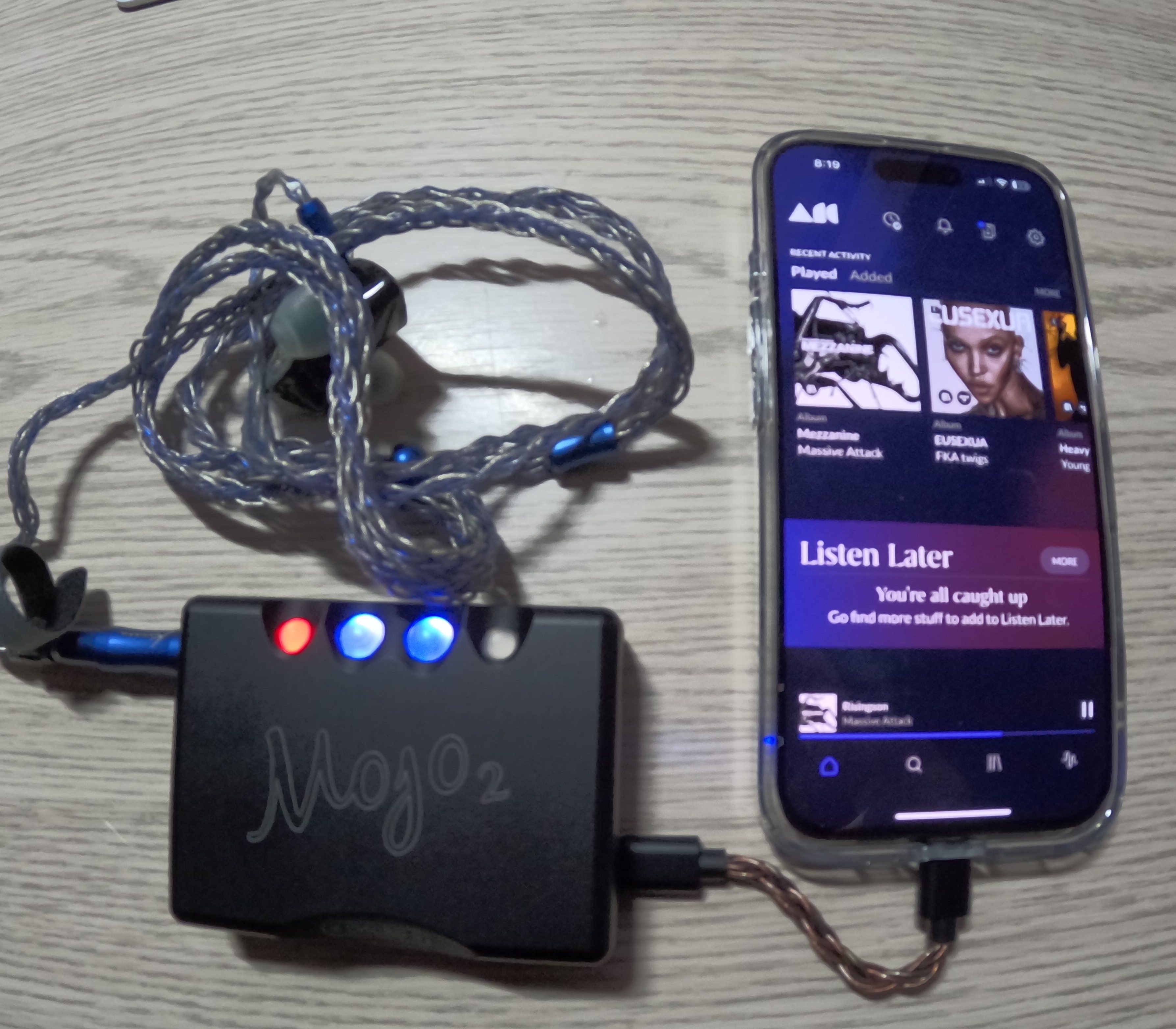
As a mobile DAC/amp. I originally bought the Mojo thinking I would carry it with my phone for listening while I’m out and about. The battery is certainly capable of supporting this kind of use, at around 8 hours of playback according to Chord (and most reviewers seem to agree that’s accurate). After a few weeks with it, I’m thinking this is not likely to be a major use case for me; it’s kind of awkward to use this way, and I don’t necessarily want to have a three-component, two cable system in a pocket (especially in the summer). It’s not a large unit, but it’s a pretty dense one. While the sound quality is definitely better with this than with the Fiio BTR17 Bluetooth DAC, the convenience of having my headphones connected to the BTR in one pocket, my phone in another, and the ability to use a volume dial instead of having to figure out by touch which of the four identical buttons is the volume up/down button, is real. This is not going to be my major use case.
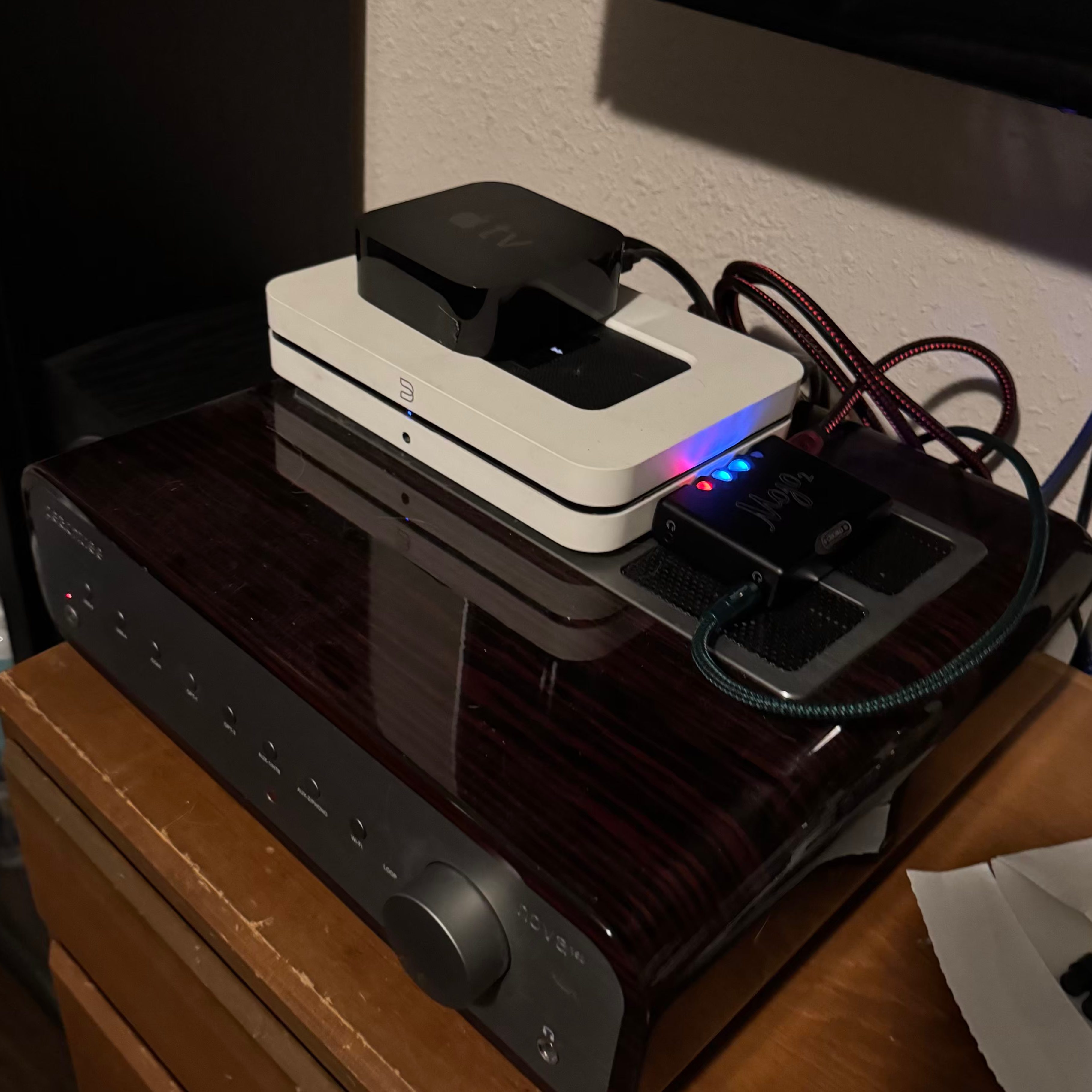
As part of a hifi rack. This is actually a pretty great use case, by all reports. John Darko talks about using it as part of his hifi rack, and it excelled at that use case for him. I think I’m less likely to use it that way just based on convenience. I want to be able to carry this with me (more on that shortly!) and having to remove it from my hifi rack every time I want to go somewhere is probably not in the cards for me. Besides, my main hifi amp is a super-integrated with a great streaming setup and a good internal DAC; I’m not super inclined to run digital out into the Mojo and then analog back into the same amp, though I might run extra cables to let me use it sometimes in my desktop near-field speaker system, feeding the PS Audio Sprout 100 sitting on my desk. I might be more inclined to use this in a hifi rack if I got the companion Poly streamer (or if I had two of them!).
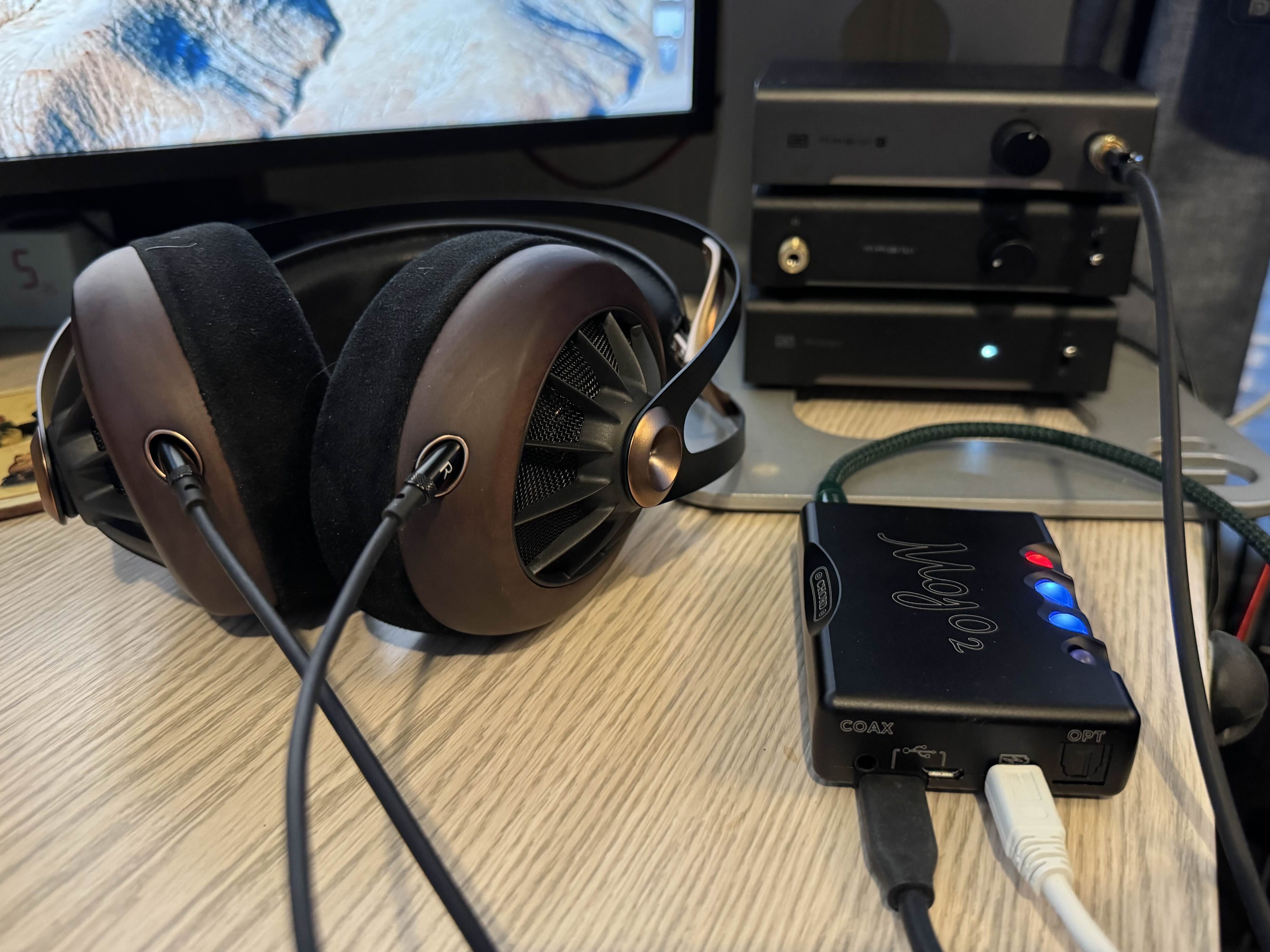
As a desktop system. For pretty much any pair of headphones I own, the Mojo makes a pretty great, complete desktop system when plugged into a computer or phone. It can pretty easily replace any of my Schiit stacks or the Topping stack on my gaming rig, and pretty clearly outperform any of them sound-wise. Particularly with the Poly added on, it could be a pretty damned great Roon endpoint permanently installed on a desk. It also can function purely as a desktop DAC, plugging in to a desktop amplifier.
As a mobile desktop system. I think this may actually be the real sweet spot for the Mojo 2 for me; it’s so small and portable that it would be easy to throw (carefully!) in my laptop bag if I was going to be working somewhere other than my home office. A headphone reviewer recently picked it as part of his $1,000 coffee shop system, and that feels right. The battery lasts eight hours, so virtually anytime I want good quality music out in the world I could pull it out, plug it into a phone or a computer, and listen to excellently reproduced music. I just ordered a foam insert for a small Pelican to make a hardshell case for it for this purpose, and I can see that being my primary use case for the Mojo 2.
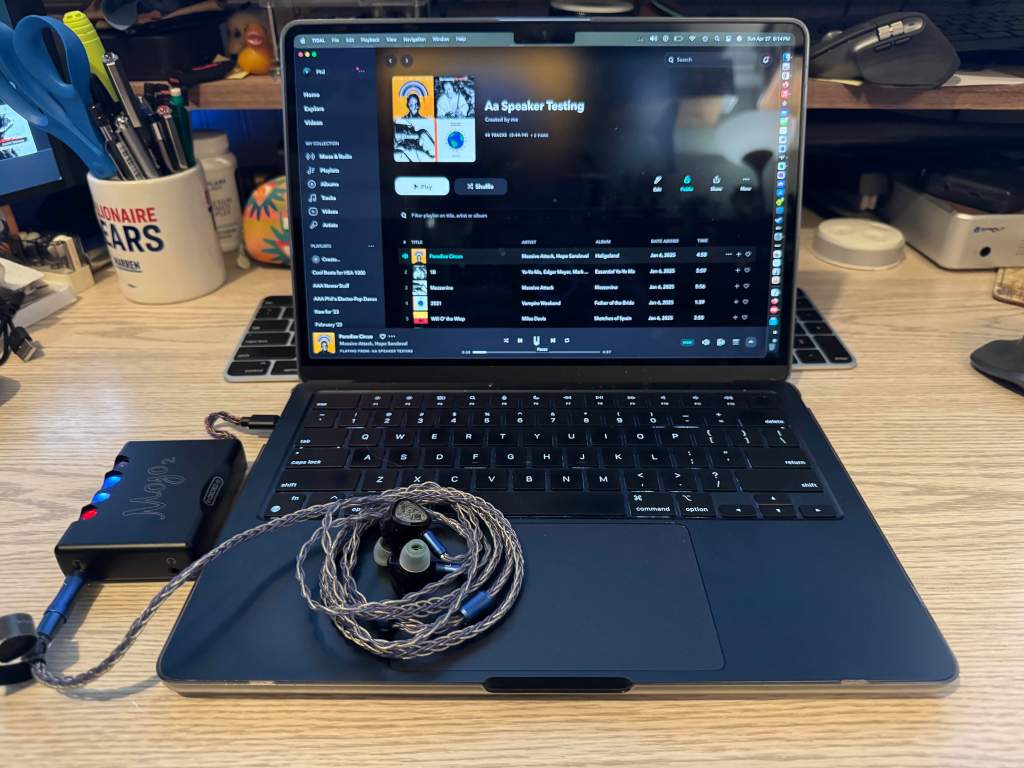
All of these are valid use cases where the Mojo 2 could shine; for me, I think it’s going to be really a mobile desktop system for me, and I’ll be curious to revisit in a few years and see if that holds true.
Controls. This is maybe my one real gripe with the Mojo 2; ALL interactions with the Mojo are accomplished via four LED buttons on the side: Menu, +, -, and Power. The Mojo has an incredibly sophisticated menu … but you interact with it entirely through those four buttons (really, just three because the power button is, unsurprisingly, a power button). It’s actually an incredibly clever system; the menu button’s light color and brightness tells you which menu you’re in, the +/- buttons toggle through the options, and power closes the menu. BUT, it’s a great proof of the idea that clever =/= useful or practical in a lot of cases. In order to use these features, *I* at least have to have the manual close to hand, or Google it.5 Maybe over time I’ll memorize them, but I’m going to guess I don’t use the EQ or crossfeed adjustments enough to get consistent with them without a cheat sheet. In fact, I should write a note on my phone on how to do the stuff I think I’ll come across regularly …
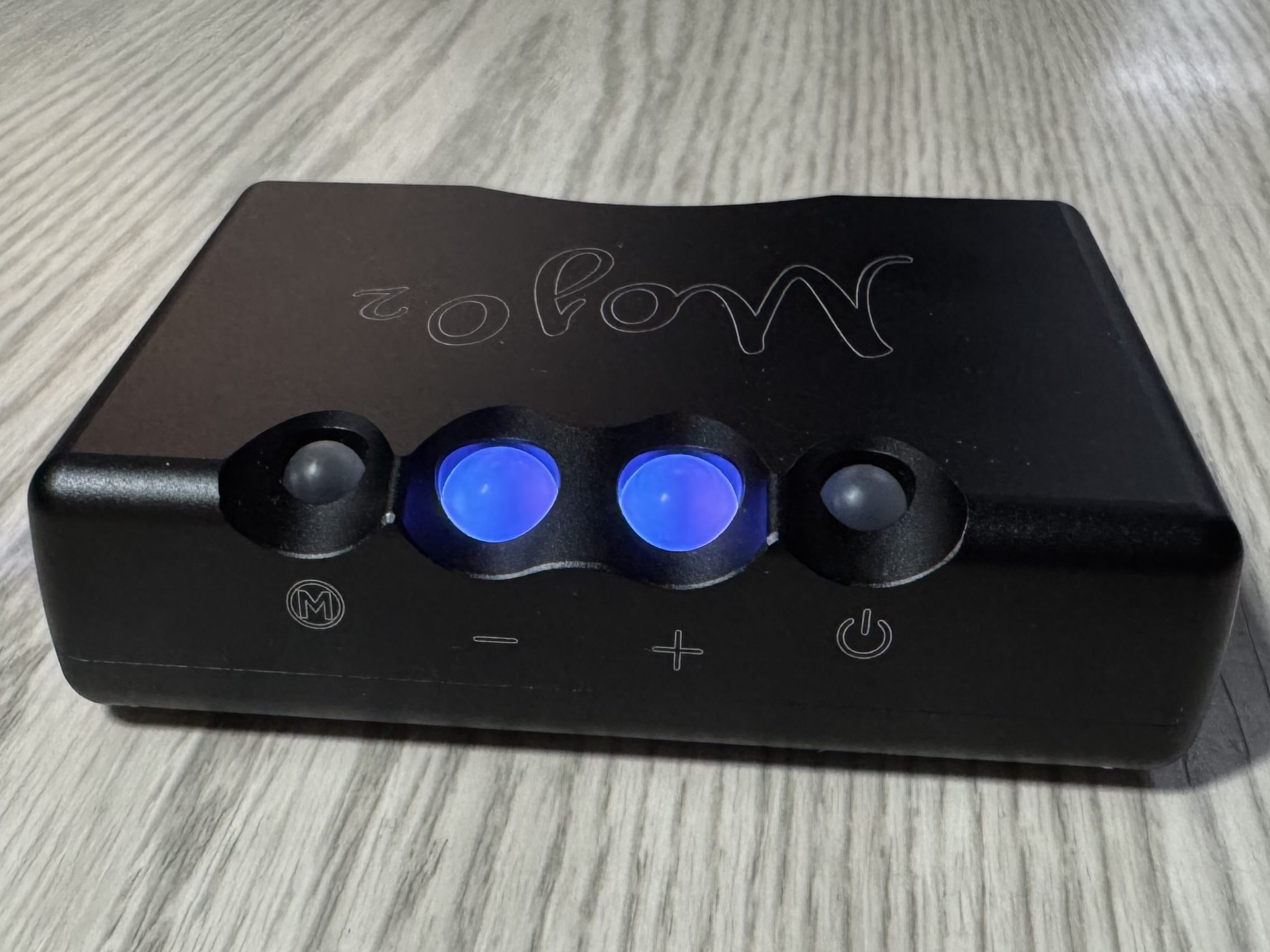
Volume controls are pretty good, and they have both a pretty small adjustment increment and a very wide range of power. As much as I would prefer a volume dial (I bought the Fiio BTR17 for walking my dog just because I wanted a dial), the buttons are reasonably sensitive and pressing and holding down one of them continues to apply the appropriate effect (holding down “+” continually increases the volume).
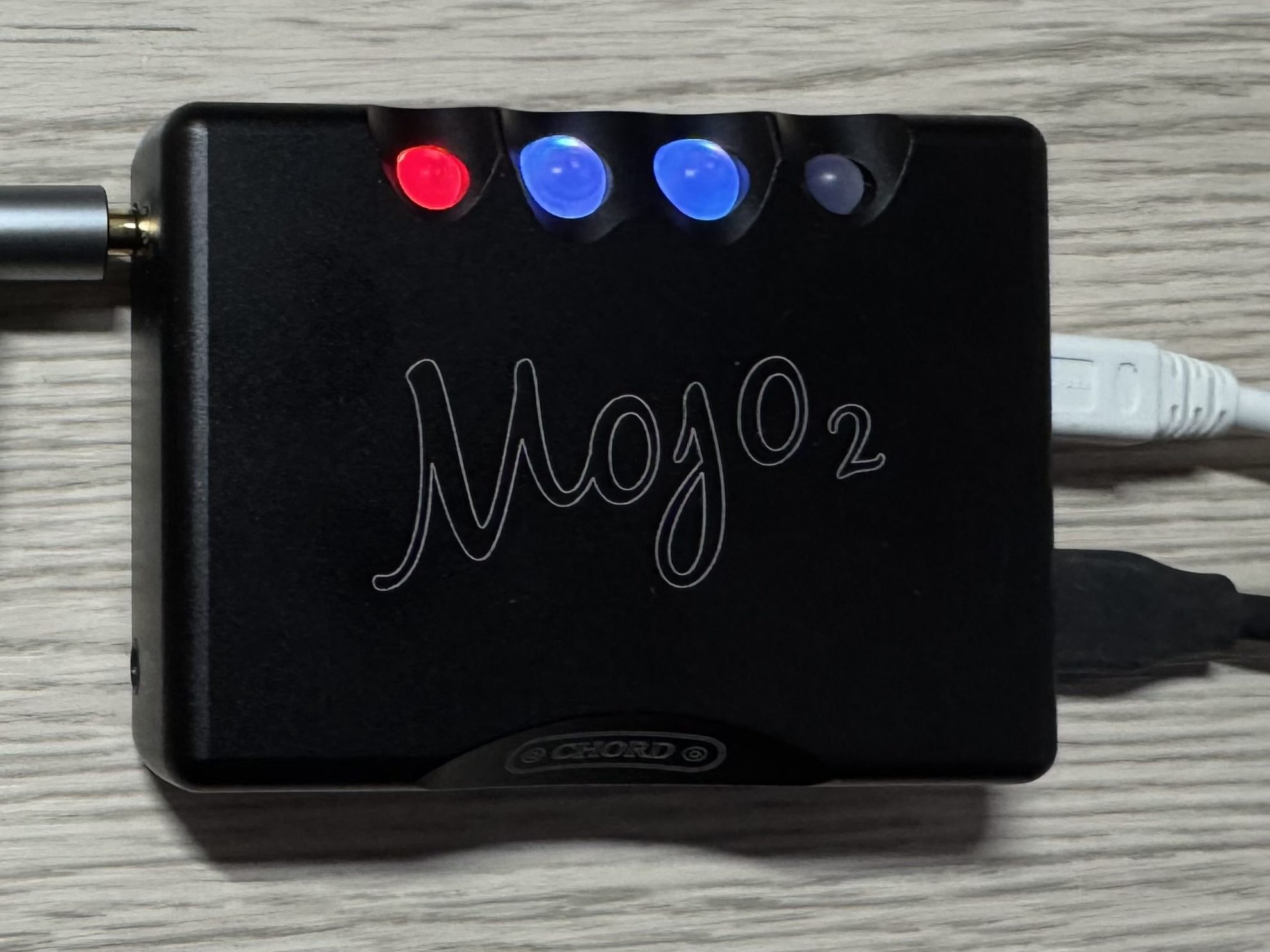
Chord has also done a good job making the LED buttons communicate a reasonable amount of data. When the Mojo is turned on, the Menu button indicates which volume range it’s in (unlight for low, lit white for high), the power button color indicates the sample rate of the music it’s playing (red = 44.1 kHz, blue = 192 kHz, etc.), and the +/- buttons cycle through the various color options to show you where you are in the volume range (if you memorize the colors; it starts unlit at zero volume, then goes through red/orange/yellow through the blues etc. as the volume increases, then resets to unlit and starts over when you cross into the high volume range).
When the Mojo is turned off but connected to power, the menu button color indicates how quickly it is charging, with brown indicating that it needs to be charged overnight and then colors from red through purple showing how fast it’s charging. Purple indicates “intelligent desktop mode”, which essentially means that charging is paused to preserve battery life while it’s used as a powered desktop system. There’s also a small LED under the charging port whose color indicates battery status, from blue (75-100%) through red flashing (0-2%), with purple meaning intelligent desktop mode.
All in all, the buttons could be described as pithy; they convey a lot of information but require a lot of familiarity or a cheat sheet to interpret.
Connectivity. Input. The Mojo 2 offers four inputs: 1) a USB-C port (this is new from the OG Mojo), 2) a mini-USB, 3) a coaxial audio port, and 4) an optical audio port. There’s also a second mini-USB port for charging the internal battery. You cannot manually select the input you’re using; the Mojo 2 will intelligently select whichever device is receiving signal. If more than one are, it will default to this order of priority: Micro-USB, USB-C, coaxial, then optical.
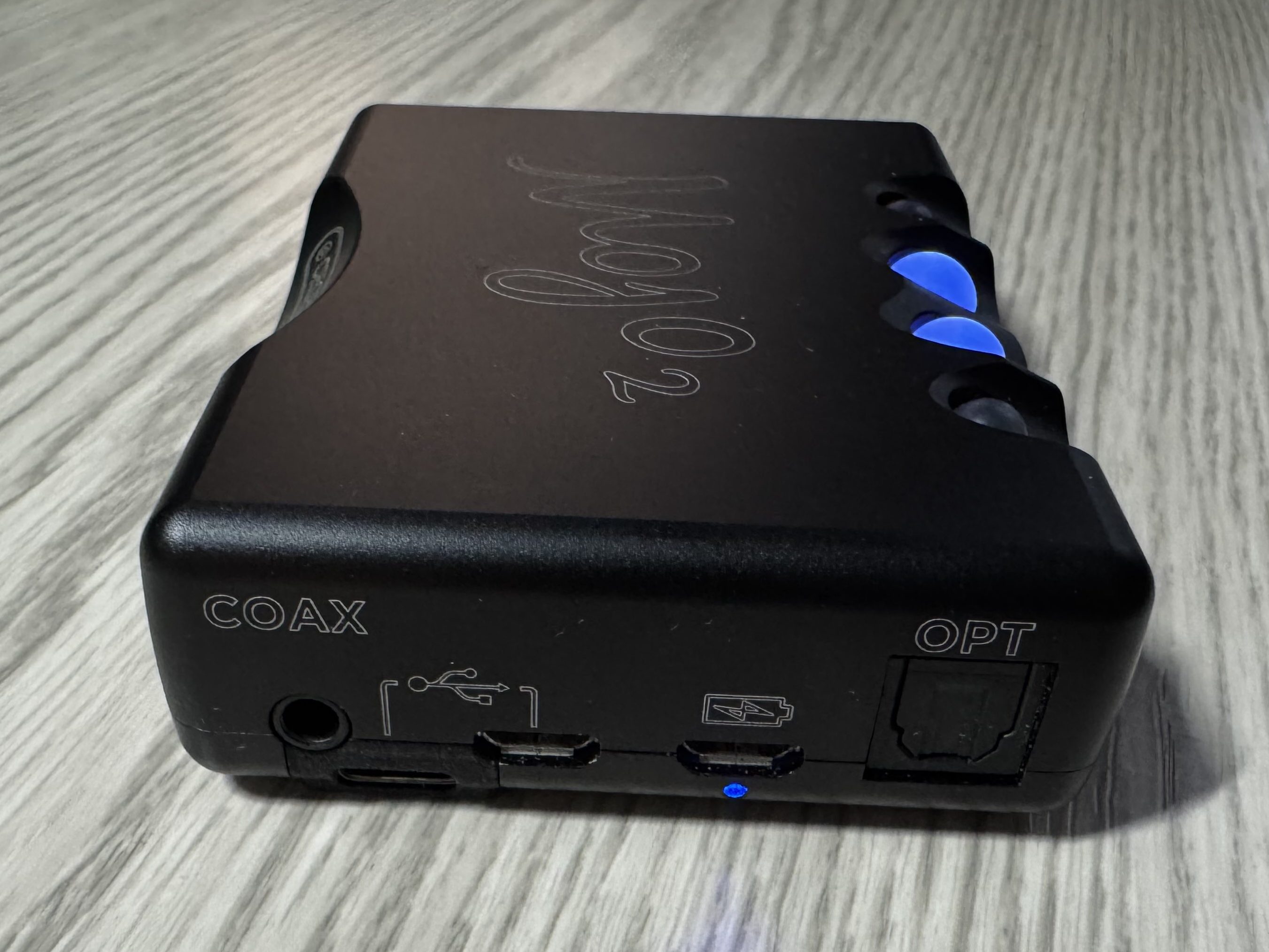
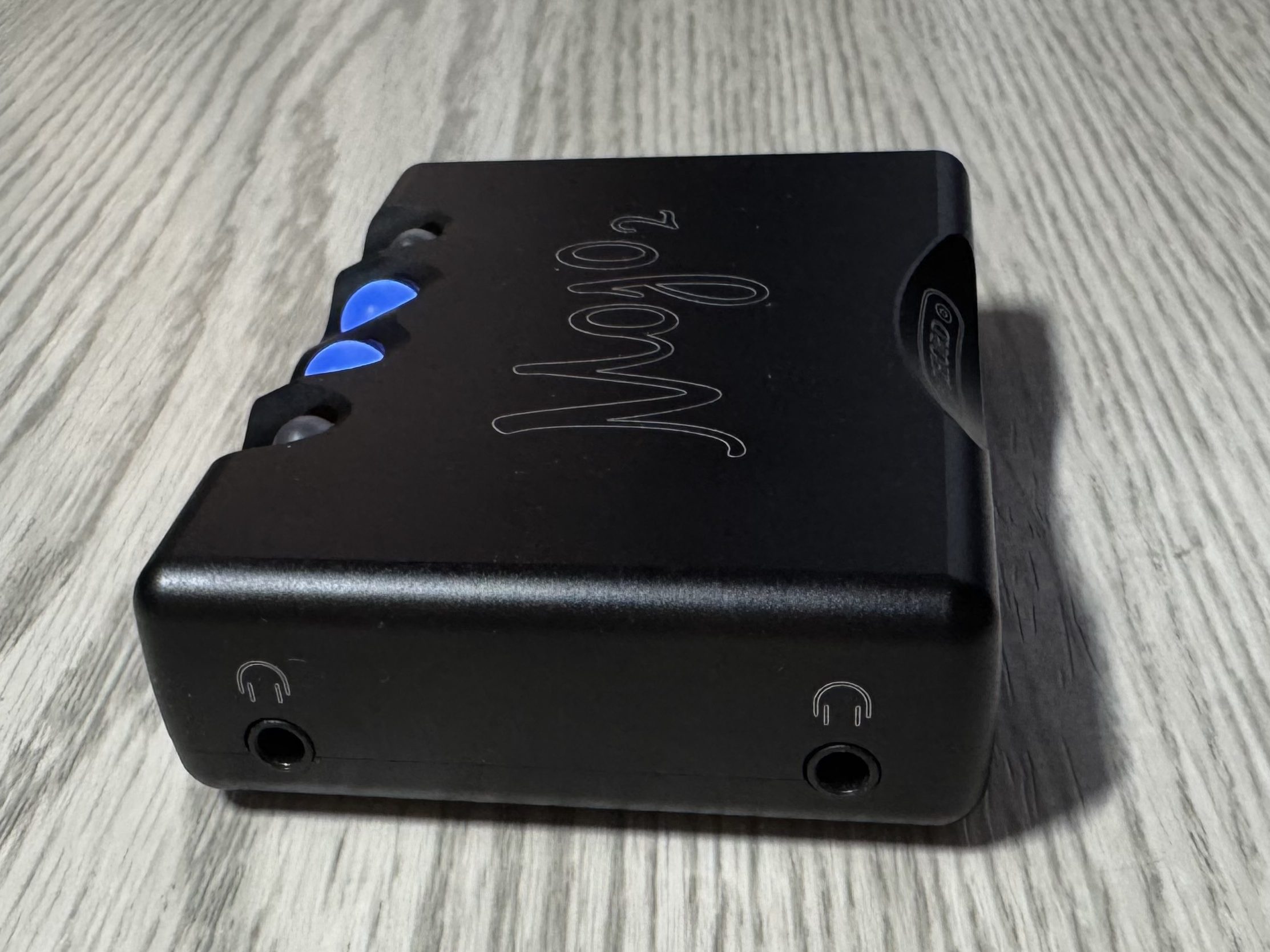
Output. There are two output ports, both 3.5 mm and without independent volume controls; the volume is set for both ports. The Mojo also doesn’t have a balanced output option; it’s all single-ended, all the time. I would really rather one of these be either balanced or a single-ended, line-level output to allow use as a pure DAC; other than A/B’ing headphones with identical impedances and sensitivities, I cannot imagine a scenario in which I’m using two headphones plugged into it at the same time, but maybe I underestimate the degree to which my girlfriend would like to listen to my music. Hope springs eternal.
Charging. The only port that the Mojo 2 can charge from is the charging mini-USB, not the USB-C port. It’s a little disappointing to be unable to charge and listen through a single cable, but I understand why Chord didn’t want to entirely redesign the architecture of the Mojo when they released the Mojo 2 with the added USB-C; I’m just glad that it has the USB-C connection so I don’t have to carry mini-USB cables with me if I’m just going out for a few hours with it and only want to listen.
Construction. The Mojo 2 is milled out of aircraft aluminum, with most of the sensitive bits (buttons, inputs, etc.) recessed slightly so they should be relatively durable. I don’t love the USB-C port’s proximity to the edge (it protrudes slightly, making me think that they added it on the outside of the OG Mojo to avoid having to do any rework), but it’s fine sitting on a desk or briefly in a pocket.
Appearance. I mean … it’s a black box with four bubble lights that glow different colors depending on what you’re doing with it. You’ll probably either think it looks great or looks goofy, and I could make that case either way. Personally, I think I like it?
Value/Comparisons. I don’t have any similar equipment in even close to the same price range, so comparison will have to be to traditional DAC/amp stacks. I have two in the same general price category (at MSRP, not necessarily what I paid for them); my main Jotunheim 2/Modius stack (MSRP, $620 + cables) and an original multi-bit Bifrost/Asgard stack ($850 at original MSRP; I paid $450 in January of 2020 shortly after they released the balanced Bifrost 2/64).
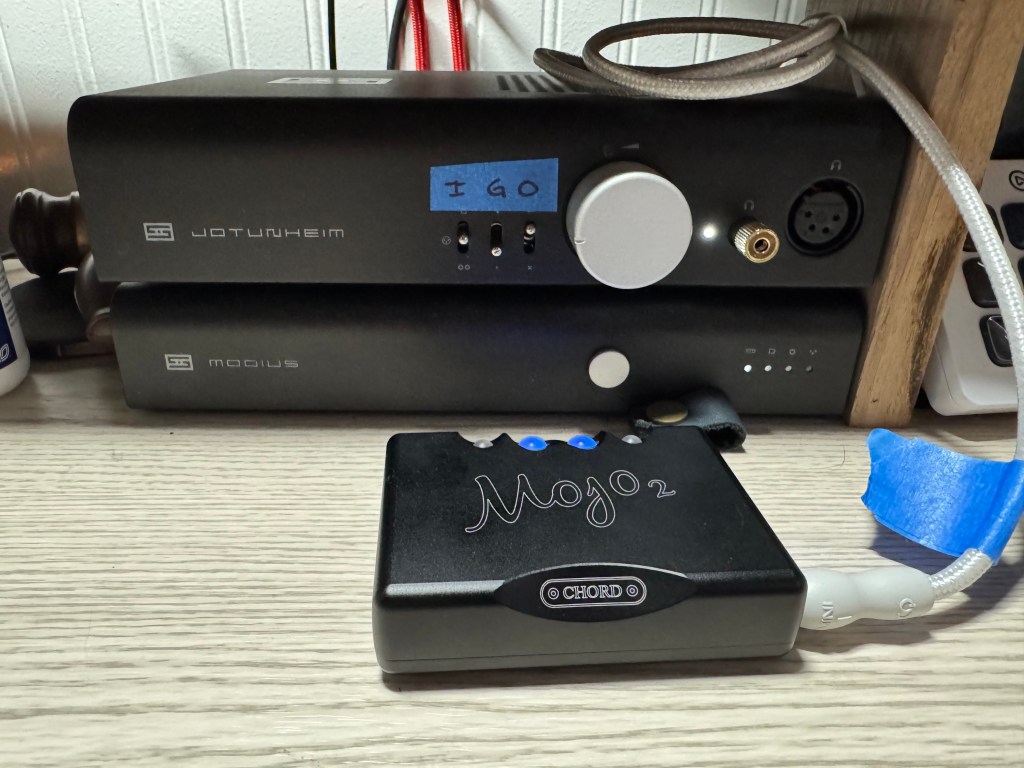
Sound quality/compatibility. The Mojo wins on resolution and layering and it’s not particularly close. I really like the Jotunheim/Modius setup, particularly running balanced, but I’m hearing things with the Mojo 2 that I’ve never heard on albums that I have spent a lot of my life listening to. I’m personally a little iffy on the Bifrost’s multibit; it’s fine for most headphones, but I really don’t like the way it sounds with the 6XX for whatever reason, and I spent a lot of the last five years thinking it was broken or defective because of how bad it sounded with them. I might feel differently about the comparison if I had truly hard-to-drive headphones that required a lot of power, but even with the 6XX I’m barely making it to the top half of the volume range on the Mojo.
Flexibility/controls. The Mojo is purely single-ended and lacks a physical switch to choose the input. By contrast, both the OG Bifrost and the Modius have physical switches on the front to let you choose between the three or four inputs, respectively. As far as the amp stage goes, both the Asgard 2 and the Jotunheim offer physical volume knobs, gain switches, and 6.5 mm headphone jacks, in contrast to the Mojo’s pair of 3.5 mm. The Jotunheim also offers an XLR output, as a balanced amplifier. Both also offer pre-amplifier outputs, with the Jotunheim including the option to turn off the pre-amp and swap between balanced & single-ended input.6
Conclusion. For a pure, entirely stationary, desktop setup, I think I prefer the Jotunheim 2/Modius stack, but it’s not about the sound. I really like physical dials, and the Jotunheim’s is VERY satisfying. And honestly, the Mojo can be a bit distracting when I’m trying to work. The Jotunheim is also a perfect pre-amp for either active speakers or a power amp for a near-field desktop setup, and I really love the flexibility to be able to run balanced when I want to (and, honestly, I mostly use the Jotunheim pre-outs to drive an Apos Gremlin, a delightful, ridiculous little tube-amp that only accepts balanced input).
For literally everything else, I prefer the Chord Mojo 2. Particularly anytime I’m hot-desking or working from any place other than my home office desk, I’m likely going to be carrying the Mojo 2. And if I’m working at my desk for a couple of days in a row, there’s a reasonable chance that I’ll be setting the Mojo up for temporary desk work anyway. It’s just so good at driving everything I want to listen to, and does so with a minimum of cables and setup. Set it on the desk, connect one USB-C cord, and plug the headphones in to get top-tier headfi sound.
$650 is a pretty high price point, particularly in the crowded DAC/amp market, but with what you get for that price, it doesn’t seem unreasonable. I still stand by my general guidelines of upgrading your headphones before a DAC or amp, and that you should probably spend half or less on a DAC and amp then on those headphones, but man. This is a great piece of equipment, and because I’ve got it, I’m going to use it with everything.
Overall. I’m thoroughly impressed with the Mojo 2. It’s everything I hoped it would be and more; I get why it receives so much praise from hifi reviewers around the internet. I’m really intrigued by the Poly attachment, but the cost seems … prohibitive for my use case, and the reviews decidedly mixed in any but the most electrically quiet environment. Maybe I’ll find a used one someday …
There’s definitely a learning curve with this device, and a fair amount that you need to do in order to really get the best performance out of it. But it rewards that in terms of flexibility and capability. Even if you never learn how to use any of the functions and just plug it into a computer or phone and slap a pair of headphones on, you’ll get really incredible sound. And not only that, you’ll really be getting the very best out of whatever headphone you’re using; the 109 Pro has never sounded so good. Neither have the FT1/FT1 Pro or 6XX, and even the Arya Stealth is really at its best outside of a few specific treble-y sections of songs.
This is my new favorite DAC/amp, and the only reason I’ll ever use anything else is for feature set and convenience, not quality of sound. It’s just that good. It’s great for a portable DAC/amp, and great for a DAC, and great for an amp.
#reviews #headphones #sennheiser #6XX #anc #spatialaudio #meh #2025 #99noir #meze #overear #cans #hifiman #arya #stealth #editionxs #budget #hahahaha #fiio #ft1 #closedback #beyerdynamic #dt770
[v] I’ve now stashed the .pdf several places; I’ve been trying unsuccessfully for months to track down a manual for the Chordette Gem and have had zero luck, so now I’m a little paranoid about manuals.
[vi] I should really review the Jotunheim 2 at some point; it’s a great little amp, even if I think it doesn’t really shine running single-ended.
- Should this be a 10/10? Probably. I just can’t bring myself to mark a $650 item as a 10/10 cost-adjusted. ↩︎
- Incidentally, I’m pretty sure Hawthorne Stereo is where my dad bought my mom the Sansui receiver in her basement, and the Allison Six bookshelf speakers sitting in my closet back in the mid-70s. ↩︎
- Though I will note that with some kinds of EDM, the Bokeh’s bass via the Mojo can become a little overwhelming. ↩︎
- Either by setting them manually, creating your own presets, or using a large number of community-developed presets for most major headphone models through OPRA. Seriously, it’s really slick. ↩︎
- I’ve now stashed the .pdf several places; I’ve been trying unsuccessfully for months to track down a manual for the Chordette Gem and have had zero luck, so now I’m a little paranoid about manuals. ↩︎
- I should really review the Jotunheim 2 at some point; it’s a great headphone amp, even if I think it doesn’t really shine running single-ended. ↩︎


Leave a reply to The Bose Quietcomfort SC; a Solid ANC Offering – Phil's Superpower of Enthusiasm Cancel reply