
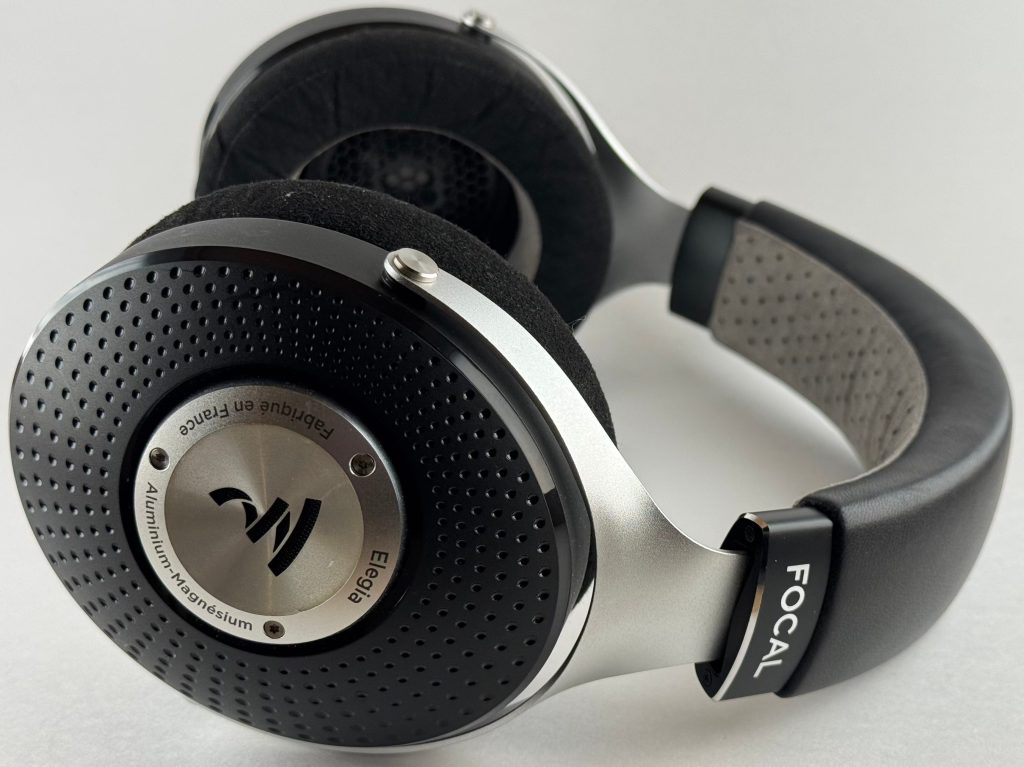
[ORIGINAL MSRP $890, frequently listed around $300 as of June 2025. Purchased used from r/AVExchange for $190, like new but missing an adapter.]

[Tl;dr: The Focal Elegia are a really excellent throwback to Focal’s days gone by. These are the closed backs I have been using the most, and will almost certainly continue to be for the forseeable future (though the ZMF Bokeh Closed will always have the closest place in my heart). If you can find them around $300-350 and are willing to do a little EQ’ing, they represent immense value and a lovely introduction to the joy that is Focal’s headphones.]
Cost-agnostic: 9 out of 10 Denalis
Cost-sensitive: 7 out of 10 Denalis (MSRP), 8 out of 10 Denalis (at $300)
Intro to the intro
As introduced in the iFi Uno review, I’ve decided to lean into a new feature here at Phil’s Superpower of Enthusiasm, Quick Reviews! There are a number of things that I’d love to get quick notes down on for my own edification/memory, but that I don’t want to spend the 10-15 hours I devote to most of my (overly?) in-depth reviews. Some of these will be things that aren’t in production anymore (so it’s less likely anyone will read a review), or are extra niche, or are things that I didn’t particularly like but want to be able to point people to my reasoning, or that are in a category I don’t spend a lot of time with (like IEMs).3 Next up: the Focal Elegia.
Intro
I have appreciated Focal’s products since my dad, mid-cancer treatment, ordered himself a pair of the Focal x Drop Elex that he never really ended up doing much with, so he lent them to me. I then inherited them after he died. I don’t listen to the Elex as much as I should; they’re fantastic headphones. I keep calling them the Super-6XX (high praise indeed!), and I really need to do a quick review of them. Maybe that’ll be next? When the Elegia was released it was so far beyond my fiscal means that I didn’t really pay much attention.
I’ve been on a bit of a journey with closed-backs, from hating them to being surprised/impressed to wanting to experience a bit more quality/luxury. I’ve got a few more closed backs to do reviews of, but I wanted to start with the Elegia. The Elegia is pretty close to a closed-back version of the Elex. It has been out of production since 2020, but keeps popping up used on r/AVExchange and a pair has been sitting at Hawthorne Stereo for months. They also have … pretty mixed reviews, not uncommon for closed-backs (especially Focals), but I’ve seen a couple of people talk about how good they can be with a little judicious use of EQ. When a like-new pair popped up for $190 on AVExchange, I decided to take a shot.4
Review notes
Testing rig: Based on my philosophy on the allocation of resources in headfi, except where otherwise noted I’m going to primarily be testing these with a Schiit Mimir/Jotunheim 2 stack, running balanced and connected via USB-C to a Mac Studio running the Roon client.
EQ: As noted in the Bathys review, I mostly prefer to test headphones with their default tuning, assuming that most people won’t take the time or make the effort necessary to use a third-party EQ. If ever there were a product I was tempted to break that rule for …5
Volume: Here are the volume settings I use with the Focal Elegia (unless otherwise noted, running via Roon with no headroom management, playing Daft Punk’s “Face to Face”):
- Mimir/Jotunheim 2 (Mimir has a -15 dB pregain applied via Forkbeard): low gain, 10:30 (balanced); low gain, 11:45 (single-ended)
- Modius/Magnius: low gain, 9:15 (balanced); low gain, 11:30 (single-ended)
- Modi/Magni: low gain, 8:45
- E30/L30: lowest gain, 10:30
- Chord Mojo: white, blank, blank, red
- North American Apple dongle via iPhone 15: 45%
- Apple dongle via Mac Studio: 55%6
My torture testing list: Apple, Tidal, Spotify.]
The basics
The Focal Elegia is a passive, closed-back headphone. It’s the closed-back version of the much-loved Focal Elex, but was much less well-received when it released. Focal stopped production on them in 2020, but there’s a pretty vibrant used market online. The Elegia is a 35 Ohm, 105 dB/mW headphone, making it reasonably easy to drive. As a part of the older, larger family of Focal headphones, they weigh in at 410 grams, making them almost a third heavier than their modern cousin, the Focal Azurys.
Originally marketed as a high end closed-back option, the Elegia was pretty quickly superseded by much better received options from Focal and doesn’t even get included on many closed-back tier lists in lieu of Focal products like the Celestee, Radiance, Azurys, etc.
Sound
The Elegia are, admittedly, an unusual tuning. Closed backs often focus on emphasizing bass, and frequently (at least in my opinion) struggle with harshness in the treble. The Elegia is a bit different, with a pretty moderate (but VERY clean) bass response and a sparkly but not harsh treble response. Some people don’t love their timbre in the midrange (metallic seems to be the preferred adjective), but I really like the way vocals in particular are presented. They’re also really good at silence (one of my measures of a good pair of headphones); on “What Did I Do?” you get pauses between notes and well-reproduced fingers sliding on the strings.
I think these are potentially the best-resolving closed-back headphone that I’ve experienced. They’re the kind of headphone that you keep thinking you’re hearing things in your environment (in my case, naughty golden retriever noises or my house shifting) and then you realize that they’re actually just part of the track you’re listening to.
The soundstage/stereo separation is pretty good left to right; the placement in space is consistent and reasonably wide. The toms on “Thunder Lightning” track beautifully left to right. There’s not a lot front to back, though, with the guitar riff at the beginning of “Love Can Damage Your Health (Laid Mix)” really just panning left and right.
The dynamics are really excellent; both the bell tones and the treble chimes in “Angel (Blur Remix)” are clear and nicely punchy, and the bass notes warble just so.
Bass is extraordinarily clear and precise; my knock on a lot of closed backs is that they’re overly bassy, muddy, or thumpy (or all three!). One of the reasons that people don’t necessarily love the Elegia is that they buck that trend; they’re all about the right amount of perfectly tuned bass instead of kicking you in the stomach. The cello notes on “What Did I Do?” resonate beautifully and cleanly, and the Elegia is probably my favorite presentation of the bass line around 2:50 in “Out of my Hands.”7 This is not to say that they can’t rattle your brain: “Limit to Your Love” gives you a very satisfying but not headache-inducing brainwobble. It’s not quite as nimble as some other closed backs, and you do lose a little detail and occasionally notes on the baseline on “Got ‘Til It’s Gone”, but overall bass is a real strength for these headphones.
The mid-range is very well done, especially for a closed back. Justin Hicks’ vocals on “What Did I Do” are beautifully natural and clean, though sometimes vocals on other tracks like “Cold War” can get a little bit of a metallic edge. Jill Scott carries through on “Calls”, and Amelia Meath’s voice floats through “Coffee” (both are tracks where the female vocals can easily get lost in busy instruments). The guitar solos on “Garcia Counterpoint” are also very nicely balanced, and the synth warbles in the left track around 1:15 are spot-on.
The treble is a little spikey at higher frequencies, but rarely unpleasant. The guitars on “2021” are sharp but not harsh, and Miles Davis’ trumpet on “Will O’ the Wisp” is clear without edging into sharpness. Weirdly, I find myself EQ’ing the Elegia’s tuning up slightly around 3k Hz and 8k Hz, very unusual for me.
EQ
While I don’t talk about EQ very much in my reviews, I’m going to make an exception here because these headphone’s very few flaws can be easily corrected via a four-band EQ profile. I snagged this one from Audio Science Review’s Amir, and while I’ve tried a bunch of variations with it, it continues to be exactly what I want from these headphones.
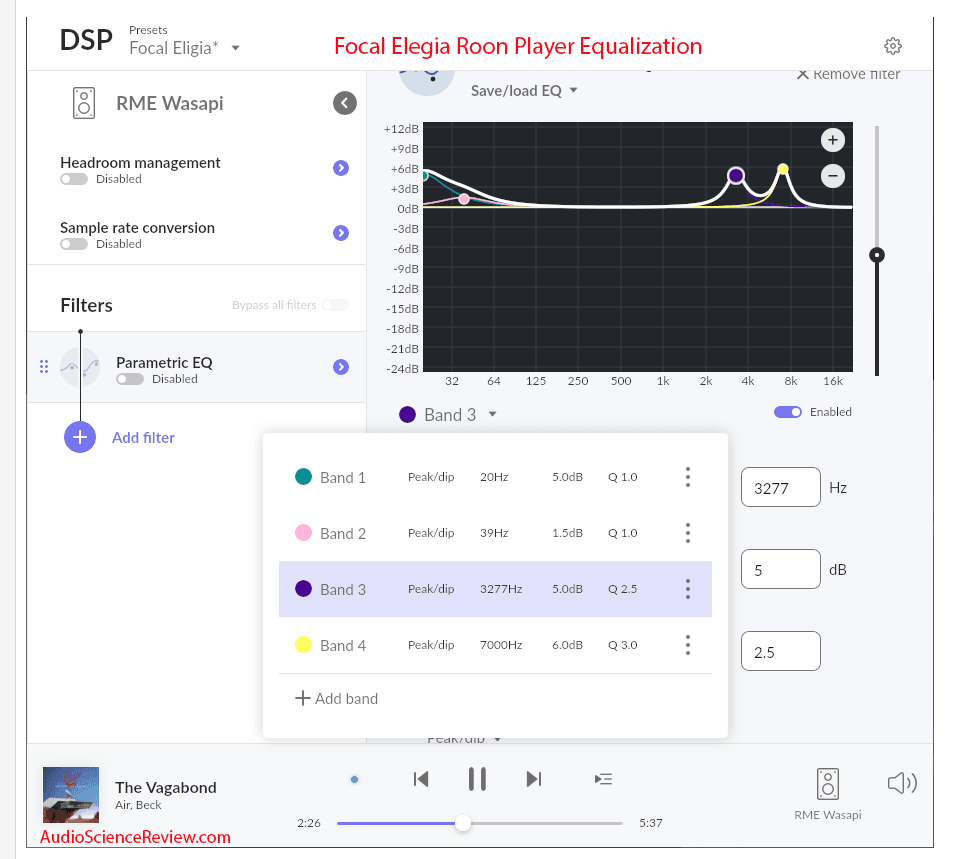
Adding a touch more bass and filling in a couple of dips in the treble results in a really pleasing overall sound profile that I can listen to comfortably for hours, across a variety of genres.
Amplifier compatibility.
The Elegia sound pretty good with every amplifier that I tested them with, though like most headphones I particularly enjoy them with a little bit of tube effect, either running from the Apos Gremlin or the tube-mimicking solid state Nitsch Piety. I mostly listen to them balanced, but that’s honestly more of an aesthetic thing than a sound-quality thing.8
Noise canceling.
The Elegia have pretty good passive isolation; unlike the Azurys, I cannot hear my fingers clicking on my Apple Magic keyboard if I’m listening to music.
Controls.
None; the Elegia are passive headphones.
Build.
Comfort.
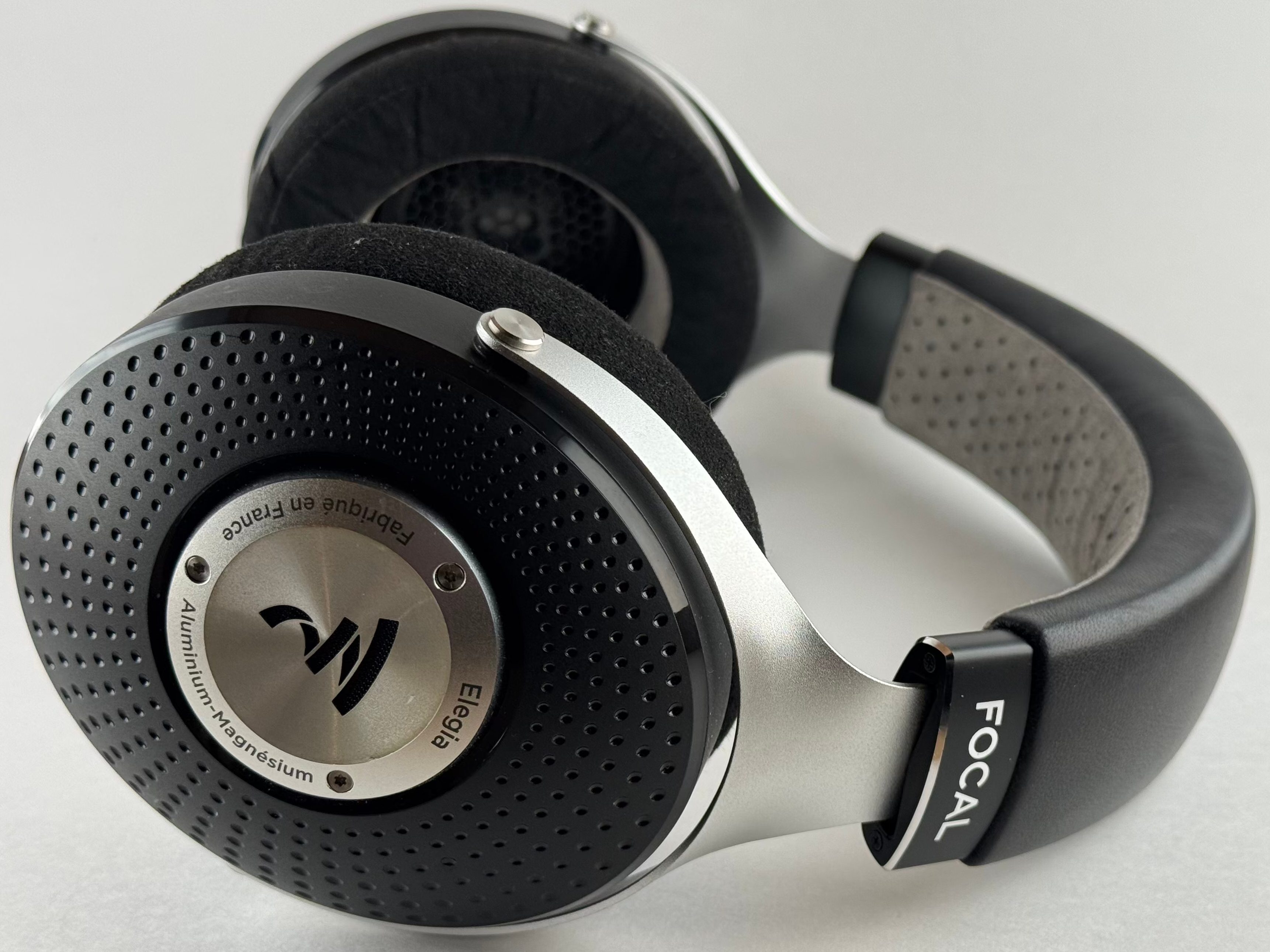
Like their open-back sibling the Elex, I personally find the older, larger form factor Focals very comfortable. The cups are large enough to comfortably fit my ears, and when properly fitted the weight is nicely distributed across the top of my head and ears. They can definitely be a bit warm, as a closed back, but even in the peak of summer they weren’t uncomfortable in my office. I do wish they had the swivel yokes from the new, smaller Focal form factor (Azurys, Bathys), but they fit my head well even without.
Construction.
These are some of the best built headphones I own; they feel like premium headphones in a way that a lot of the others don’t. They’re solid, feel like they would survive a drop, and don’t move around on my head while listening.
The Elegia come with an old-style, slightly oddly-shaped, semi-rigid case, and I believe should have come with both a single ended 3.5 mm jack (with a screw on 6.35 mm adapter) and a balanced cable; the used version I received had only the 3.5 mm cable.
Connectivity.
The Elegia, as an old-style Focal headphone, featuring a double-entry 3.5 mm connection making them easy to mix and match cables with. Like the Elex, they do have thick-barreled connectors, meaning that while you can use cables from things like Hifimans, most Mezes, and Fiios with the the Elegia, the Elegia’s cables are only usable on headphones with either non-recessed jacks or those with recessed jacks designed for large-barreled connectors.
Appearance.
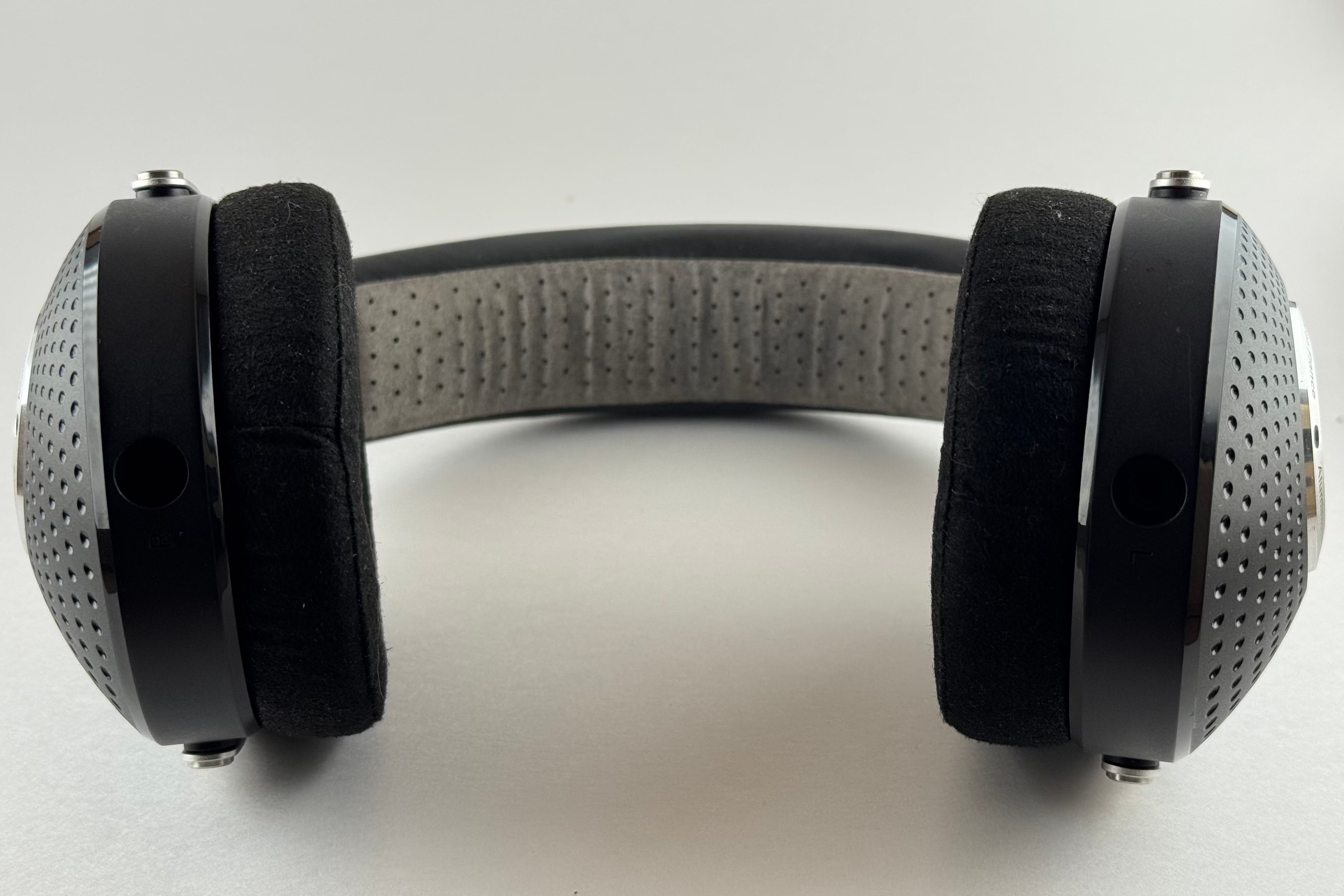
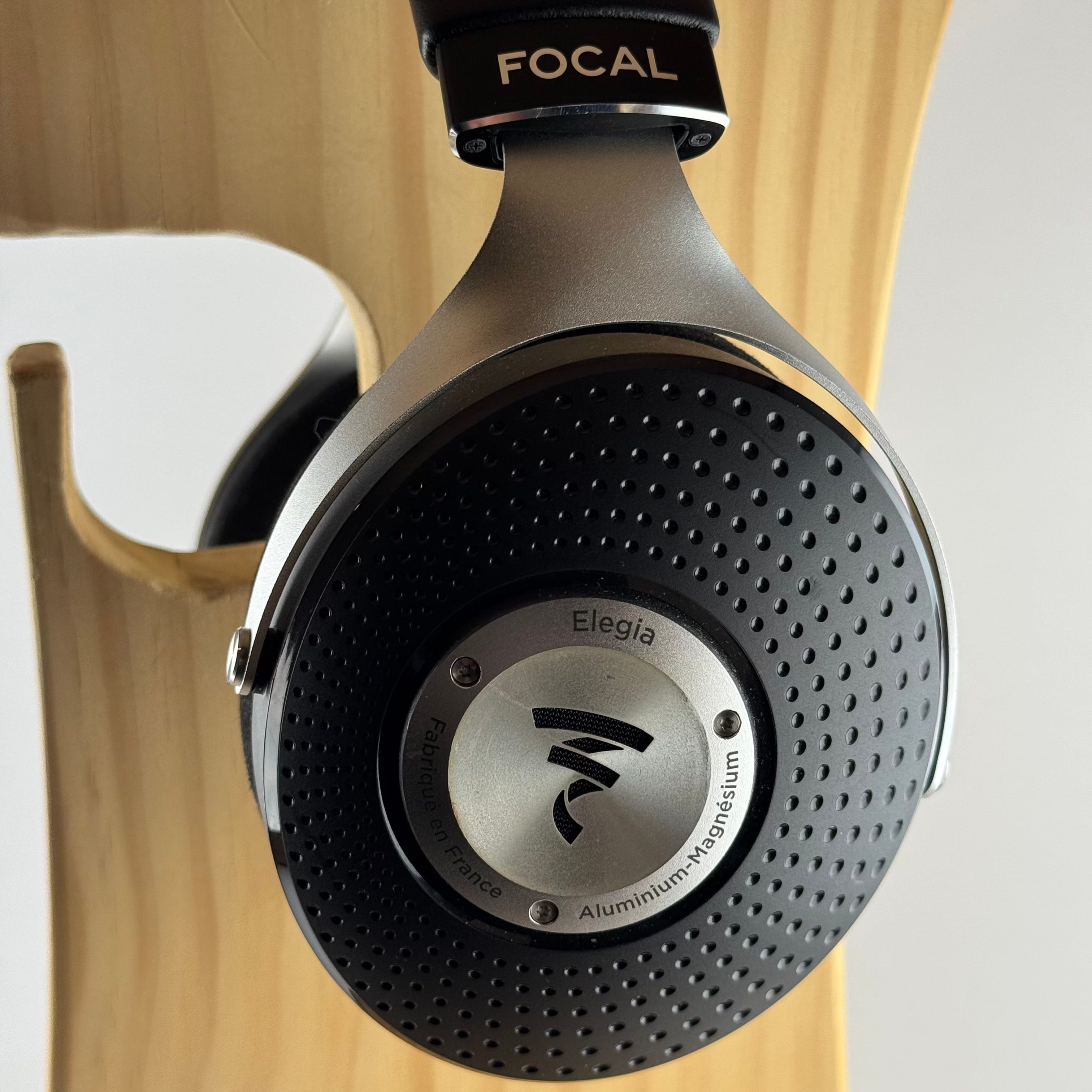
I like the way most Focals look, and the Elegia is no exception. I think the black and silver is quite striking, and the black Focal logo on the cups is nicely recessed into the headphone. They’re slightly less trypophobia-inducing than the Azurys, but still textured enough to give you a decent grip on them with one hand.
Value/Comparisons
I understand why people were reluctant to pay almost $900 for these in 2018, but … I honestly think I like the way these sound more than the ZMF Bokeh Closed, which I paid substantially more for. $900 is definitely well into diminishing returns territory, with the FT1 running you $160 or so and the excellent Dan Clark Audio Aeon x Closed around $500 (review forthcoming). At the $300 they’re often available for? They’re a really good value. At the less than $200 I paid? I’d buy another pair at that price now to have a backup/pair to leave in my office (if I ever go back in).
Beyerdynamic DT 770 Pro (250 Ohm edition)
Dan Clark Audio Aeon x Closed.
This collaboration with Drop retails at $499, and I picked up a moderately used pair for $225. Out of the box, I might slightly prefer the Aeon’s tuning and sound quality. With EQ, I prefer the Elegia. I also much prefer the design and build quality of the Elegia; while the Aeon is a nice looking and apparently durable design, they feel flimsy enough that I am always worried about dropping them.10 At retail, I think I would take the Aeon at $499 over the Elegia at $890. For what I paid, the Elegia represent a substantially better value.
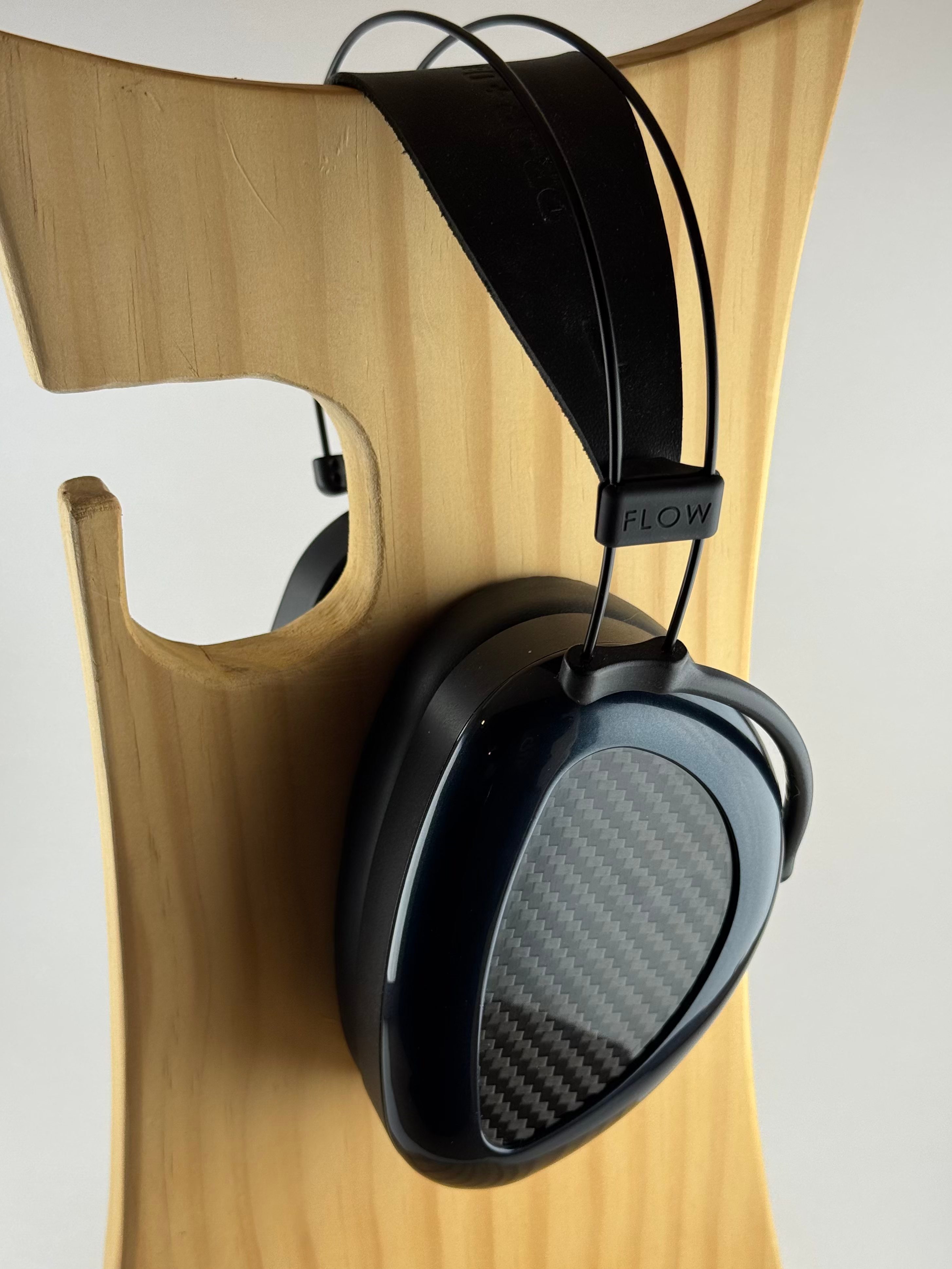
Fiio FT1.
I am on record as loving the FT1, and six months after my review I haven’t changed my mind; they are certainly the best value in modern closed backs and probably in headfi, period. I continue to recommend them whole heartedly as a better option than a lot of headphones that are more expensive, but at the end of the day … they can’t compete with a used Elegia at a $300 price point. As good as the FT1 are, the Elegia have better resolution, tuning, and comfort, and they blow the FT1 out of the water on all of the build quality and durability considerations. But then, they retailed for six times as much, so we would certainly hope they would.
I would buy the FT1 for $160 before the Elegia for $89, I think, but it would be close. And at the prices the Elegia are available? If you know enough to evaluate a used pair, that’s my recommendation.
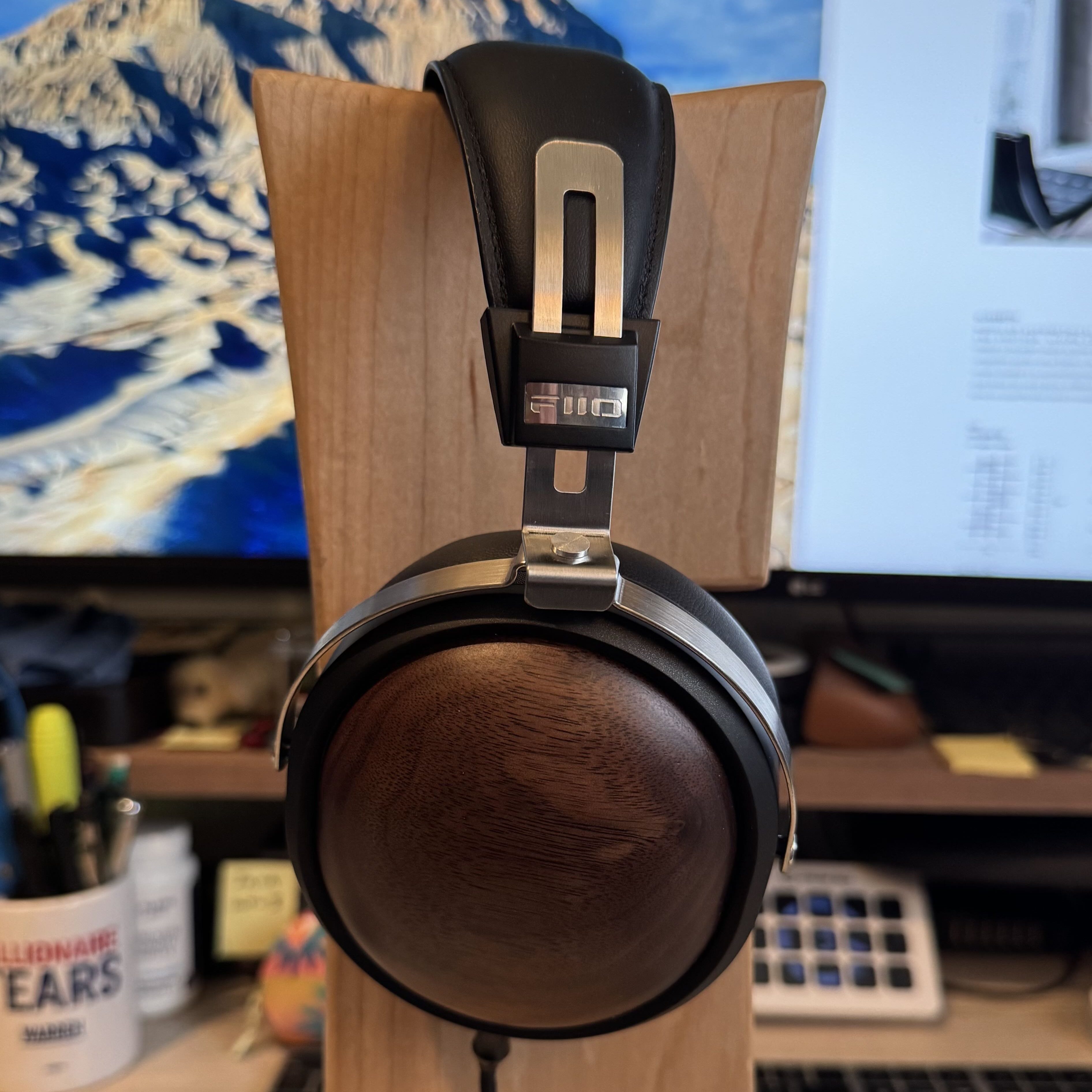
Focal Azurys
I genuinely like the Azurys, but I struggled a lot with their $600 price point. In my review I said I thought they were a reasonable value around $335/350, and I stand by that, but the Elegia are better in pretty much every respect except maybe comfort for some people (they’re like 100 grams lighter). At anywhere near the same price, I’d pick the Elegia.
In fact, I’m pretty sure I’ll be selling my Azurys in the near future because with the Elegia on my desk, they’re getting zero use and I don’t see that changing.
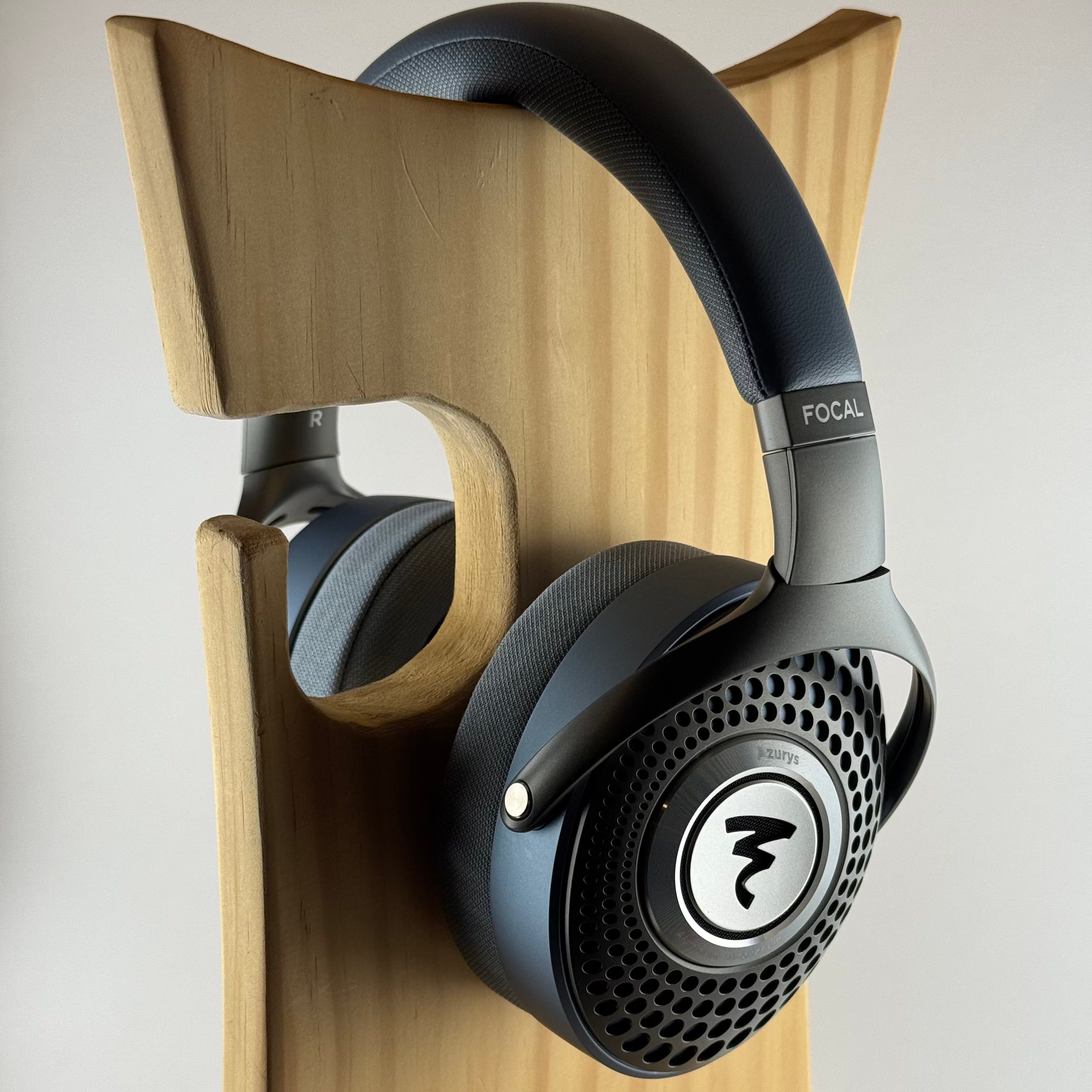
Focal Bathys.
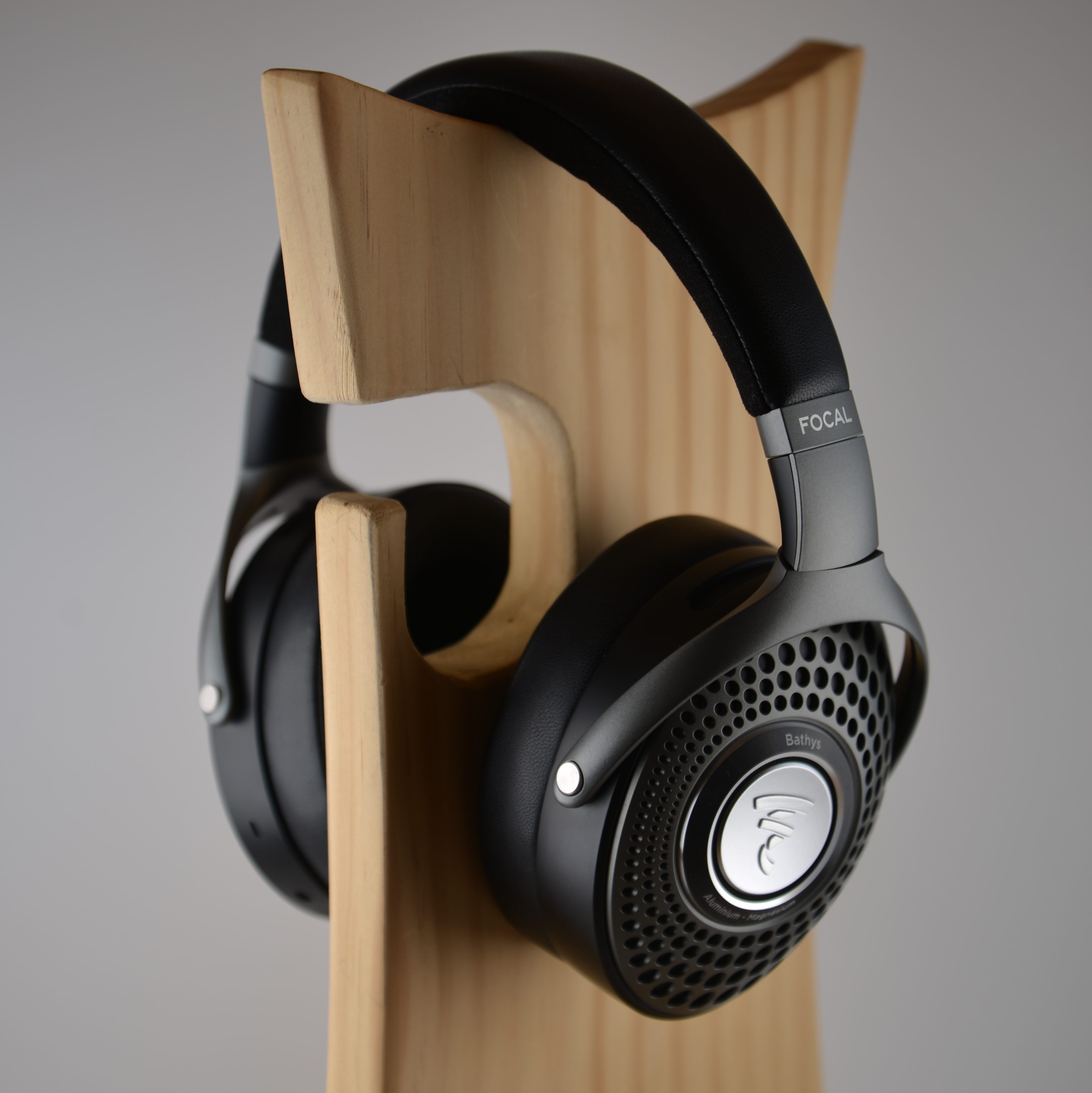
I really enjoy the Bathys, and I view them as complimentary rather than competitive with the Elegia. The Elegia are definitely a desk headphone for me, while the Bathys are more of an out-in-the-world headphone. At a point where I had a permanently assigned desk in an office, I might bring the Elegia in to live at that desk but at least at present the Bathys are also my “going into the office” headphone running in DAC mode. If I had to choose between them, I would choose the Elegia because most of the things I want the Bathys for can be covered by something like the AirPods Pro 2, while there’s basically nothing in my collection that directly and meaningfully competes with the Elegia. Certainly for $190, the Elegia are a better value than the Bathys, but in a vacuum I might take the Bathys over the Elegia if they were the same price.
ZMF Bokeh Closed.
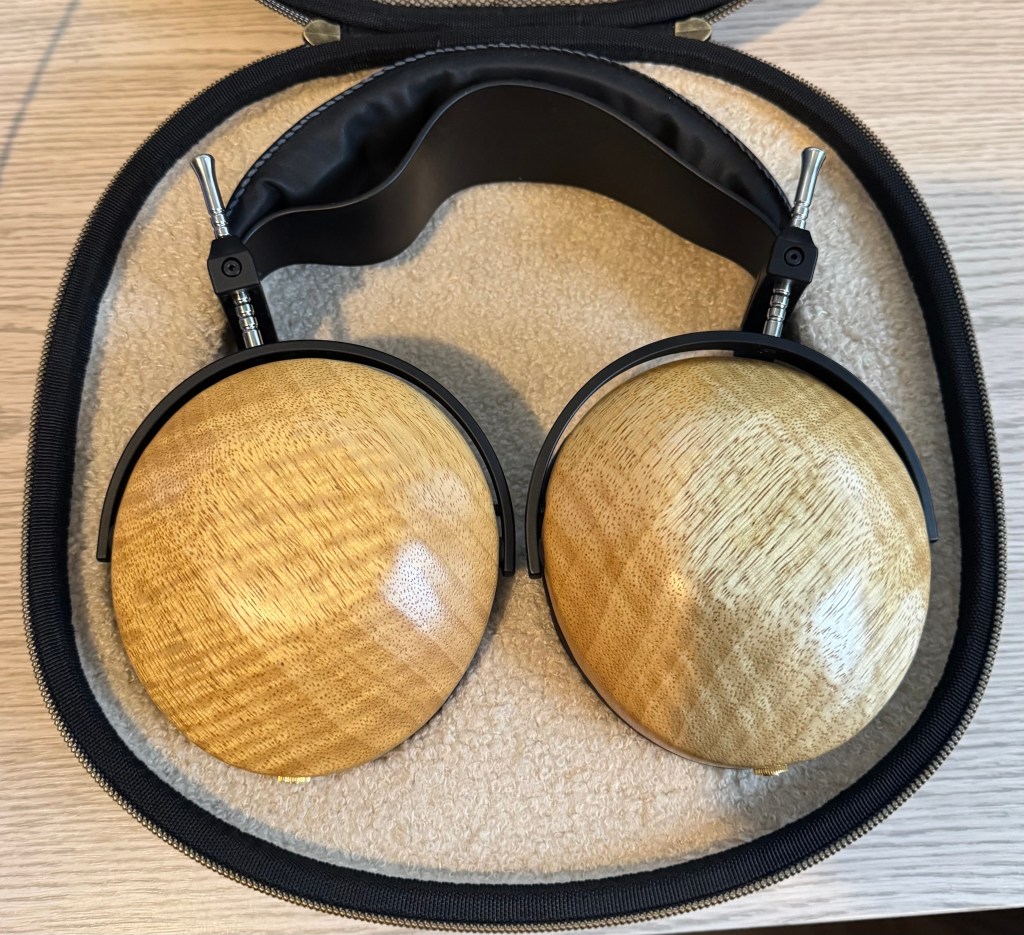
I really need to do some more A/B’ing with these two; they’re definitely the two most premium headphones in my collection. I think that I might VERY slightly prefer the sound quality of the Elegia, though everything else about the Bokeh is better (comfort, aesthetics, build quality, etc.). I think I will end up using the Elegia more, though, just because I’m not very worried about damaging the Elegia based on how much I paid for them, whereas I’m constantly concerned about scratching the black limba cups on the Bokeh.
If you can afford the Bokeh Closed, buy the Bokeh Closed. If you can’t, the Elegia are probably the slightly better headphone for actual listening.
Overall
I really, really like the Elegia. They’ve become my default closed back headphone, a category I wasn’t sure I would ever have. I would never have bought them at MSRP (hell, I couldn’t have afforded them back when they were at MSRP), but with their ready availability on the used market, I’m giving them a strong recommendation. If you can find a pair in decent condition under $400 and want a good pair of desktop closed backs, I commend the Elegia to you. Especially if you have and like the Elex; these are the next best thing to a closed back Elex.
#reviews #headphones #sennheiser #6XX #anc #spatialaudio #meh #2025 #99noir #meze #sunglasses #overear #cans #hifiman #arya #stealth #editionxs #budget #hahahaha #iems #quickreview
- I score bass, mids, and treble on a two part scale: 1-5 for quantity (5 being the highest), and A-E for quality (A being best in class, E being laughably bad). For soundstage it’s also a two part scale, with the number representing the width and the letter the separation within it ↩︎
- For comfort/fit, my scale is A-E with A being disappear entirely into the background and E being I want to tear my ears off to stop feeling these headphones on my head. ↩︎
- Though I still aim to not spend much time or brainpower on things I don’t like, generally. Sometimes it’s nice to be able to copy/paste when someone asks me why I don’t like or recommend a thing. ↩︎
- By contrast, Hawthorne stereo (normally a pretty reasonable place for used gear) wants almost $360 for their pair. ↩︎
- As you’ll see, I really like these headphones, but they’re probably my favorite closed back with some light, 4-band EQ. ↩︎
- Once I remembered to turn off the -10 dB headroom adjustment I auto-apply to the Apple dongle in the Mac Studio. 😂 ↩︎
- Can you tell I really love this headphone? ↩︎
- What can I say? I like the chonky XLR connector. ↩︎
- I know some people like them but … those people are wrong.
Just kidding. (mostly) ↩︎ - Not unlike the Arya, really. ↩︎
 Phil's Superpower of Enthusiasm
Leave a comment