

[ORIGINAL MSRP $330 for the Xbox version ($300 for the Playstation/PC version). Purchased from Amazon for $329 in June 2025]
[Tl;dr: The Audeze Maxwell are a really good pair of headphones purely from a sound quality perspective. They are, however, let down by their software (both on board and on a mobile device/desktop) and general design. When they are working, they’re great. Getting them set up, though, leaves much to be desired. In a world where the Fractal Scape is 30-60% cheaper, I’m hard pressed to recommend them to anyone who doesn’t need the ability to connect to an Xbox. It’s a little disappointing, because they really do sound good; they’re just annoying enough to use that I’d rather grab something else for my own use cases.]
Scores:
Cost-agnostic: 6 out of 10 Denalis
Cost-sensitive: 5 out of 10 Denalis
TABLE OF CONTENTS:
Intro to the Intro
This is a “quick” review. There are a number of things that I’d love to get quick notes down on for my own edification/memory, but that I don’t want to spend the 10-15 hours I devote to most of my (overly?) in-depth reviews. Some of these will be things that aren’t in production anymore (so it’s less likely anyone will read a review), or are extra niche, or are things that I didn’t particularly like but want to be able to point people to my reasoning, or that are in a category I don’t spend a lot of time with (like IEMs). Today, the Audeze Maxwell, here not because it’s not worthy of a full post but because Audeze reportedly has a new version coming in 2026.
Introduction

Early this summer, I happened to watch a year-old video on the Headphones Show Youtube channel about a gaming headset. I normally skip these kinds of reviews; I’ve had a lot of gaming headsets over the years, and I’m old enough to remember the bad times, when gaming headsets were awful, poorly tuned headphones with RGB and celebrity endorsements (*cough* Razer *cough*) but that were a necessary evil for most consoles. They were barely worth playing games with, let alone listening to music.
I was pretty surprised to see Resolve, a reviewer who has historically shared some of my prejudice against gaming headsets, heap praise on the Audeze Maxwell, and at the same time, I was coming to terms with the fact that I was likely to have to sell my house and go back to being an apartment dweller in the near future, so I decided to take a shot on the Maxwells.
I will admit that up front I was … unimpressed. Out of the box and connected via Bluetooth (more on this later!), I found them to entirely lack bass, to the point where I assumed that I’d gotten a defective unit. I eventually managed to get the app working long enough3 to apply a bass-boosted EQ profile, and I started to understand what people love about them, and they ended up in my review stack. And then a whole string of higher priority things popped up, and I’m just now getting around to these … shortly after the existence of the Maxwell 2 was leaked, and with very little availability for the OG Maxwell online. C’est la vie!
My testing method/philosophy.
My torture testing list: Apple, Tidal, Spotify.]
The Basics
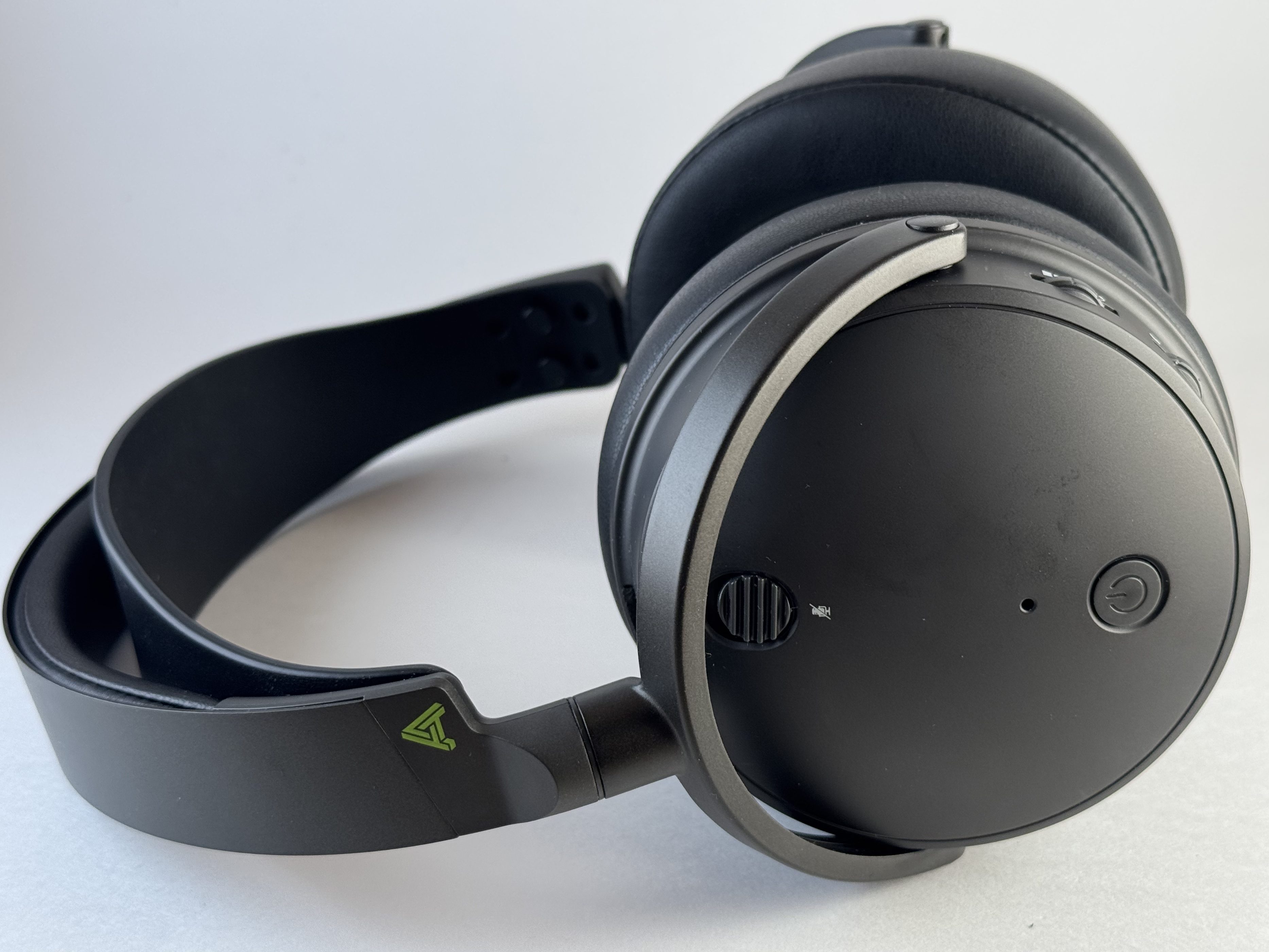
The Audeze Maxwell is a wireless, non-ANC closed back, planar magnetic headphone from renowned audiophile manufacturer Audeze.4 There are two versions of the Maxwell: one that is compatible with Microsoft’s Xbox One console (“the Xbox version”), and one that is not (“the Playstation version”). The Xbox version is $30 more expensive, but in Audeze’s defense that’s because of a licensing fee that Microsoft charges for access to the technology to let them work with the Xbox.5 Both versions are VERY heavy for a headphone, especially a gaming headset, weighing in at a beefy 490 grams. They’re also moderately challenging to drive passively, with an impedance of 70 Ohms and a sensitivity of 103 dB/mW.
The Maxwells can be connected to a source four different ways: 1) via Bluetooth, 2) via the USB-C dongle, or 3) via a USB-C cable (though both Bluetooth and the dongle appear to take priority over a physical connection), or 4) a 3.5 mm aux cable (which takes priority over everything else).6

EQ: The Maxwells offer a 10-band EQ system through either a phone app or a MacOS/Windows app, which offers six curated EQ profiles and up to four presets you can adjust to your own taste. I don’t know why they didn’t just implement full parametric EQ, but the bands they let you adjust at least seem pretty reasonable, unlike some of their competitors.7 And, the profiles are set and stored at the device level, so you don’t have to redo them every time you connect to a new source which is really, really nice (even if the only way to change them on the device itself is somewhat lacking, unlike the Fractal Scape).
The App. I’m going to take a moment to talk about how very, very terrible the Audeze software is all around. Because it is very, very terrible. Across all platforms. Installing it took several tries on a Mac and a gaming PC (the installer kept hanging), loading up the EQ screen on the phone can take several minutes of apparently frozen screen, and I cannot, despite my best efforts, get the dongle to update on a Mac.8 I’m not a luddite. I like computers. I have a bunch of them, and I’m no stranger to troubleshooting. This app is, hands down, the worst. audio. app. ever. period. I’d take Sonos’ janky-ass app over it. I’d rather deal with the Razer RGB-laden monstrosity. It’s just plain bad and Audeze should be ashamed of themselves over it. Which is a bummer; the headset is mostly great otherwise.9

The connection to the app via the dongle, on a Mac at least, really sucks. It’s constantly dropping off of the Audeze app, and creating custom presets is a pain with the connection disappearing regularly.
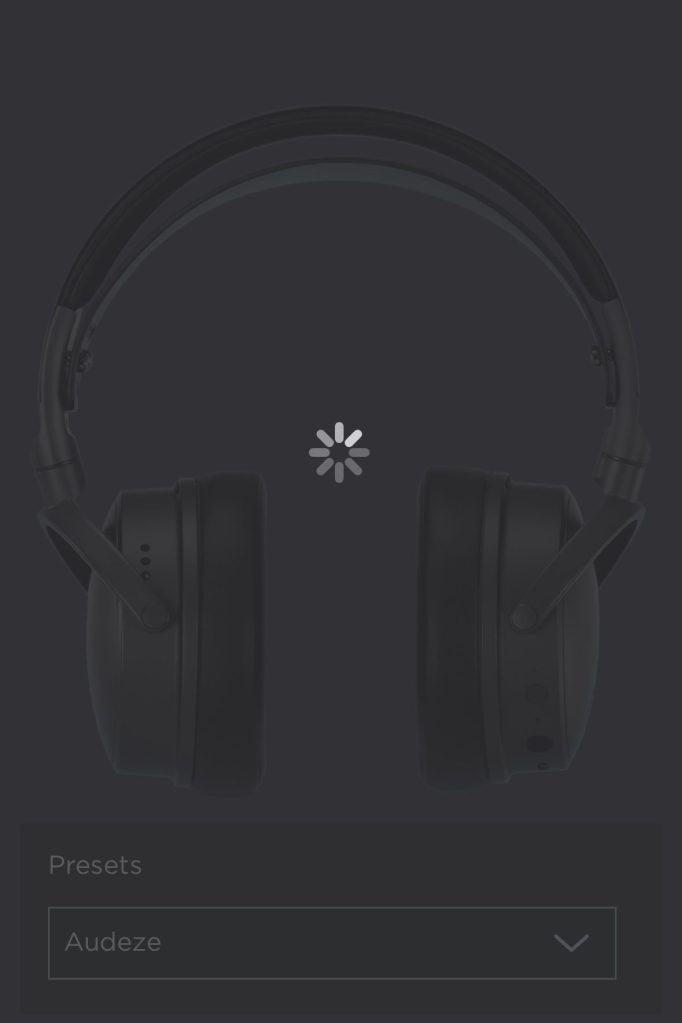

Genuinely, they should be so, so ashamed.
Controls. The controls on the Maxwell are all physical buttons, which I really like and appreciate in a world of touch sensors. On the left ear cup, from top to bottom on the back you have a volume wheel (scroll for volume up and down, press and scroll for next/previous track, double press and scroll for EQ presets), a mixer wheel (scroll to change chat vs. game volume, press and scroll for sidetone adjustment, and double press to turn off sidetone), the 3.5 mm port, the USB-C port (charging and DAC mode), the boom mic port, and a button to turn on/off “AI noise reduction.” The power button is on the outside of the left ear cup towards the bottom (press to turn on, press and hold for 3 seconds to turn off, while turned on press to pause/play), and there’s a slider on the outside towards the top for muting/unmuting the mic. No controls on the right cup.

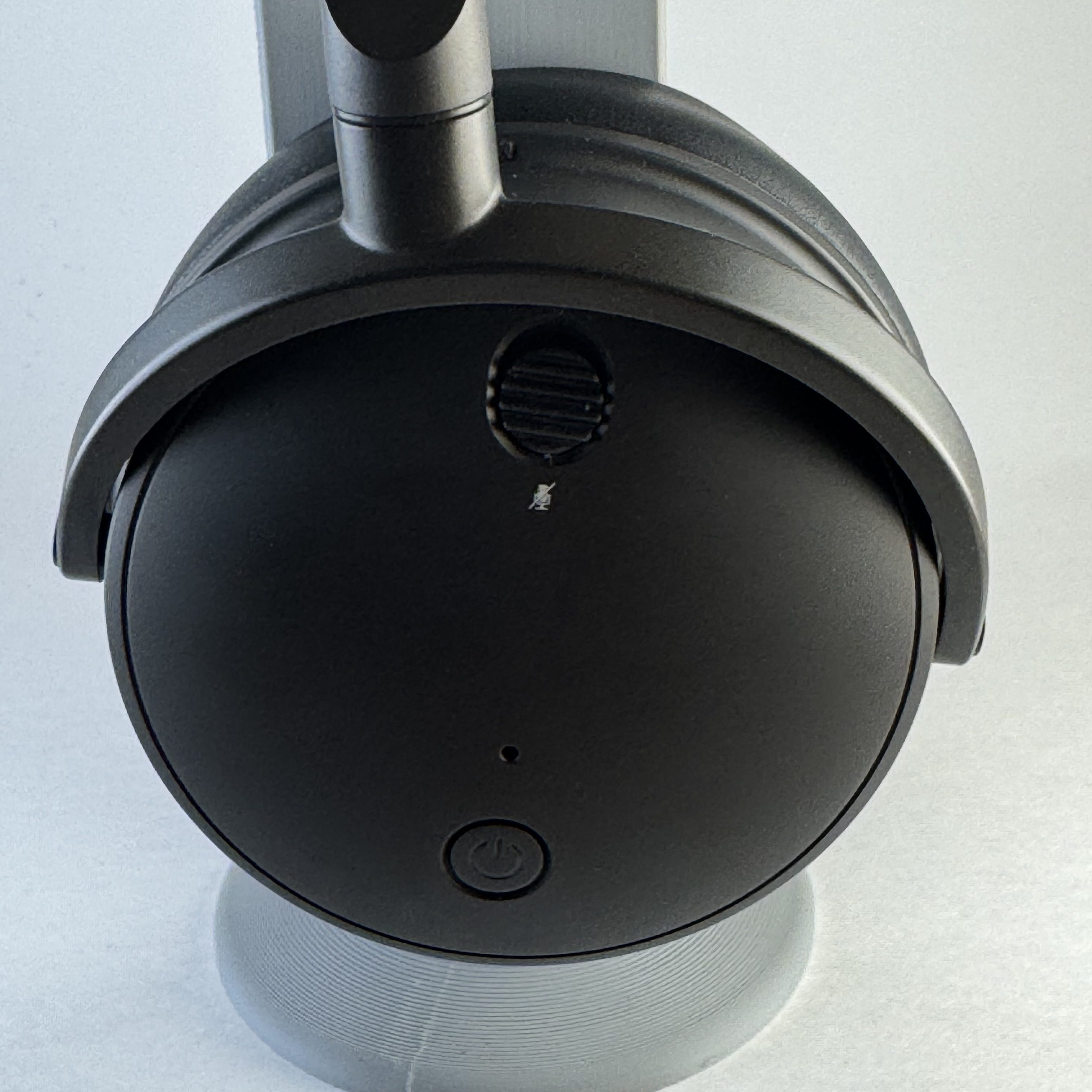
I find the scroll wheel to be a bit laggy, particularly when connected via the dongle, but acceptable.
I do wish they’d adopted the standard Apple (maybe other things?) multifunction button system (click to pause play, double click to skip forward, triple click to skip back, etc.) like B&W and Sennheiser rather than splitting pause/play and track advance/previous across the power button and scroll wheel.10 I also find pressing and then spinning the wheel less-than intuitive, and I would prefer controls on the right as a right-handed person, but the controls overall are perfectly fine, and, as I noted, physical buttons. Woohoo.
Sound
I’m going to start by talking a little bit about EQ and connectivity, as the tuning seems to be different depending on how you’re connected to the Maxwell. When I first put them on, connected via Bluetooth on my phone, the default tune (“Audeze” in the app) sounded really hollow, almost entirely lacking in bass even by my standards.11 That was correctable in the app by applying either a manual bass boost or by applying the “Bass Boost” preset. Interestingly enough, when connected to the dongle plugged into a PC or Mac, the Audeze setting is perfectly nice. I don’t know if this is just my unit, or common across the product, but be aware that if you want to use this via Bluetooth you might need to make some adjustments.12
Because this is a quick review, I’m going to just review the sound from the Maxwells when connected to my Mac Studio via the dongle, with the default “Audeze” sound profile applied. I’ll talk a little about other things at the end.
The soundstage on the Maxwell is, unsurprisingly, pretty good. It’s a gaming headset at heart, after all, even if it has audiophile headphone aspirations and an Audeze pedigree. The soundstage is mostly side to side rather than front to back, and on a track like “Love Can Damage Your Health (Laid Mix)” it sounds like the guitar is mostly moving back forth slightly behind you. On “Chan Chan”, you get decent separation between the channels, and some reasonable instrument separation between the bass and the rhythm guitar, with the singers pretty solidly centered and the lead guitars nicely split across the channels. They don’t give quite the illusion of space between the musicians as some other planars (particularly the HE6se V2 or even the Sundara), but they’re pretty good.
The dynamic range is good, particularly for a wireless headset. Starting “It’s All So Incredibly Loud” at a reasonable volume is unpleasantly loud by the end. Microdynamics are fine, but not a particular standout. They’re better on higher notes and less pronounced on lower notes; bell tones on “Angel (Blur Remix)” are fine on the low end and pleasingly crisp and accented on the top.
Detail retrieval is decent, though it doesn’t compete with higher-end planars or some of my favorite dynamic drivers. I haven’t been particularly surprised by the detail on any specific track in my time with the Maxwells, but neither have I felt like anything was missing. Timbre is generally pretty good, if a tinge metallic at times (particularly for guitars). Vocals are generally quite clear and correct, and EQ may well fix the occasionally metallic tendencies.
Bass
The bass is decent, if not particularly crisp or clear. Busy tracks like “Love Can Damage Your Health (Laid Mix)” can get a little bit muddy, and when bass gets crowded on tracks like “Superpredators” there’s a bit of splatter. I would also like the notes to be more distinct when the bass comes in around 2:50 on “Out of My Hands” or throughout the entirety of “Got ‘Til It’s Gone.” It’s a little splattery on “Intro,” as well. In short, it’s plenty of quantity, but I would prefer a little more quality from the bass on the Maxwell, particularly in more crowded tracks.
Midrange

I think the midrange on the Maxwell is very well implemented. Vocals (male and female) are clear and timbrelly correct. Justin Hicks comes through well on “What Did I Do?”, and Jill Scott doesn’t get lost in the crowded mix in the middle of “Calls.” The mids are also excellent for dialog in gaming, unsurprisingly.
Treble
The treble on the Maxwell is well-controlled and clear. No harshness on either “2021” or “Will O’ the Wisp,” even at at higher volumes than I would normally listen. In fact, they almost feel a hair rolled off to my ears on the default setting? Totally fine, and doesn’t seem to impact the soundstage or precision of placement in space.
Gaming
The Maxwell are good for gaming. Of course they are; it’s what they were built for, and you don’t need me to tell you that. Good spatial awareness, pretty consistent placement of objects in space, and the dongle is plenty fast to not kill you too much even in a sweaty game. Plus they sound good enough that music and environmental noise in games will be well-reproduced as well. Tested both on PC (Destiny and Cyberpunk 2077) and Xbox (Expedition 33); performed well in all of them, though for Expedition 33’s score I prefer my full surround system. Reasonably enough.
Noise cancellation

This is wireless closed back so there’s no active noise cancellation (though there is some confusion on the internet due to ad copy talking about noise cancellation, which is really referring to the filtering technology built into the microphone for the benefit of the people you’re talking to). That said, it’s one of the better passive noise isolating headphones I’ve personally used. With music playing, I can’t hear myself typing on a moderately noisy Apple keyboard, and with music playing I can’t hear my fingers (or the dog in the next room) at all.
Build
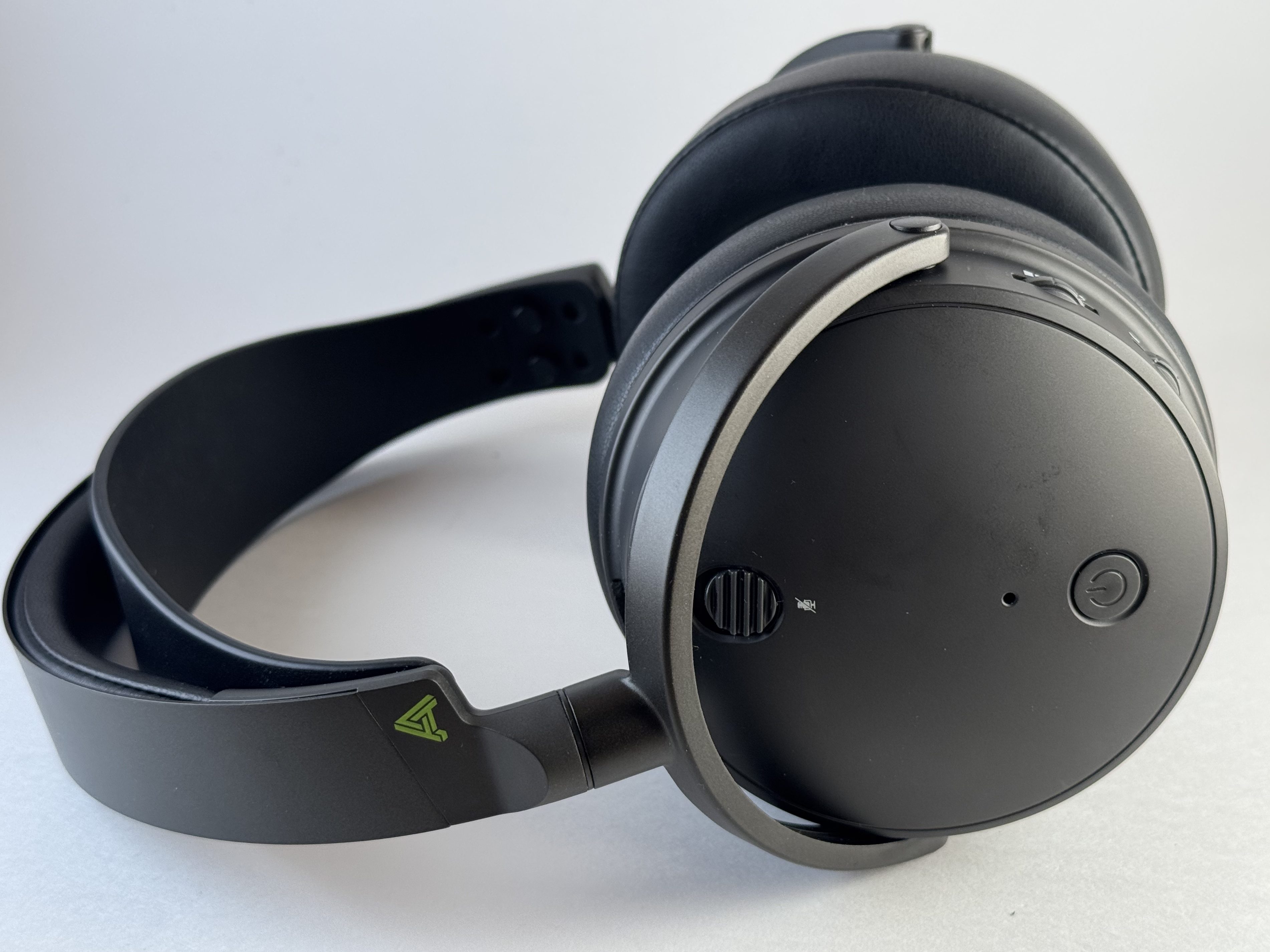
The Maxwell is a beefy boi, with a weight that makes it feel VERY substantial both in your hands and on your head. It feels like it’s built like a tank, and I’m not particularly worried about dropping them or anything that will occur during regular use.13
I actually find the Maxwell reasonably comfortable, even for longer sessions. The weight is reasonably well distributed across the top of your head via the suspension strap, though after a couple of hours I definitely start to feel a little bit of a hot spot. The clamp force is quite moderate, to the point where I might want it to be slightly higher both to bear some of the weight AND to make it less prone to slipping when looking up or down, or moving your head rapidly side to side. The cups also have good swivel (110 degrees or so, though mostly one direction), and decent tilt (around 70 degrees, probably?) which makes getting a good seal pretty easy even when wearing reading glasses or a hat (a squatchie under the suspension strap would be damned unpleasant, though, with almost half a kilo of metal on your head). And that’s a good thing, because breaking the seal almost zeroes out the bass; you’ll want to make sure you adjust them well before gaming, and pay attention to make sure you don’t dislodge them at a key moment. After a couple of hours I do notice my neck is a little stiff, but that may be more a function of being a geriatric millennial than the Maxwells themselves; just thought it was worth noting.

I think they’re sharp looking, though I would prefer if they didn’t quite so closely match Razer’s color scheme; wouldn’t want someone to think I’m using a Razer headset on a call!14 For a big, heavy headphone, they don’t stick out as much as they could,15 and I can comfortably wear them under a raincoat’s hood.
Functionality
The hierarchy of connectivity is 3.5 mm > Wifi dongle > Bluetooth > USB-C.
Bluetooth sucks. I know it, you know it, we all know it. I know why we use it, but I wish we didn’t. As noted above, when I first connected these to my phone via Bluetooth I thought they were broken due to the lack of bass. If I were ever going to use these with Bluetooth, I’d need to build an EQ profile for it. In fact, because of interference with the other uses of this headphone (see below), I’m going to leave Bluetooth disconnected most of the time.

The wireless connectivity on this headphone via the dongle is generally pretty impressive, though it’s got some quirks. I find that it covers my entire, 100-year-old plaster-walled house; I can leave the dongle in my PC and go downstairs to work on something on my 3D printers or get something from my wine/whiskey cellar without losing connection or any blips. That said, it also does …. some weird things. Occasionally changing volume via the wheel on the left cup lags, which means that if you keep trying to adjust it, you’ll get very much louder or more quiet. The Audeze HQ app (at least on a Mac) seems to regularly drop connections, but the audio playback connection seems to be fine.16 The biggest flaw with the dongle mode is that you end up in a catch-22, where you have to choose between using an exclusive audio mode on your source to avoid interruptions (at the cost of the in-built controls), or you have to turn exclusive audio mode off to use the controls (and deal with Bluetooth interruptions). And if you turn on an exclusive audio mode and disable the in-built controls, you also lose the ability to change volume outside of your music player, which I personally find pretty annoying.
The USB-C/DAC mode seems to be quite competent, though it’s hard to get the Maxwell to stick to it. It will be overridden by the dongle or Bluetooth, and if you have it running in exclusive mode (like through Roon), anytime something pings the Bluetooth connection it will stop whatever you’re listening to. If you want to use it in DAC mode, make sure you disconnect any Bluetooth connections. Quality seems fine, that annoyance aside.
The 3.5 mm. Don’t run active headphones passively. If you have to, this seems to be … fine, and it’s a moderate impedance, high sensitivity headphone so won’t take a lot in the way of power.
I’m going to largely pretend that this headset doesn’t have Bluetooth for my use cases. I don’t actually want to mix my phone’s comms systems with a game’s systems, so that works for me. Your mileage may vary, particularly if that’s part of the appeal of this type of headset.
The microphone seems to be pretty competent, though I personally find the sidetone function pretty distracting (particularly with the mic disconnected). I’ve turned sidetone off every time I put them on. Also don’t forget that there’s a physical mic mute slider on the outside of the left earcup like I did. I couldn’t figure out why my brother couldn’t hear me to the point where I gave up and grabbed a desktop mic, only to realize hours later that the headset was physically muted.
Battery life is pretty good; Audeze estimates 80 hours of playback and very anecdotally, that seems reasonable given their drain rate during my use. That’s pretty impressive, particularly for a planar. I guess we know where a lot of that weight comes from.
Value & Comparisons
Quirks and oddities aside, this is a really great gaming headset and a really, really competent closed back headphone in its own right, which is a pretty shallow market at the moment. It’s not particularly fair to compare it to most gaming headsets other than something like the Fractal Scape or the HyperX Cloud IIIS, which by all reports is another really excellent headphone despite it’s gaming pedigree (but one I haven’t gotten my hands on yet). As a result, and because this is allegedly a “quick” review, I’m going to keep the comparisons to three: 1) the Fractal Scape, 2) the Fiio FT1, and 3) the Hifiman Sundara.
Fractal Scape

This is the most direct comparison I’m going to make. The Scape is another modern gaming headset with a surprisingly good ability to reproduce music. It also comes with a dongle (but also a charging dock), a good EQ system, and surprisingly pedestrian sensibilities for a “gaming product.”
Soundwise, I think the Scape and the Maxwell are pretty evenly matched. My anecdotal sense is that the Maxwell is slightly more resolving, but I think the soundstage and layer separation is better on the Scape. Out of the box, I prefer the tune on the Maxwell ever so slightly, but both have such good EQ that that’s basically no difference for my purposes. While the Scape lacks native apps for mobile and desktop systems, the web interface for it’s settings (EQ, lights, etc.) are light-years ahead of Audeze’s truly awful apps and I’ll take having to open a browser over them anytime. The Scape also comes with true parametric EQ, and as good as the 10-band EQ on the Maxwell is, the Scape wins this hands down even without considering how easy it is to find and share new EQ profiles, and the greater ease of swapping profiles on the fly on the Scape. Add in the very well designed dock that the Scape comes with, the much lighter design, the similar comfort, and the fact that the Scape is $100 cheaper, and the Scape is the clear winner overall in my book.
The native-DSP nature of both of these devices makes measurements almost superfluous, but just in case anyone who buys these refuses to engage in EQ at all, here’s the measurements:
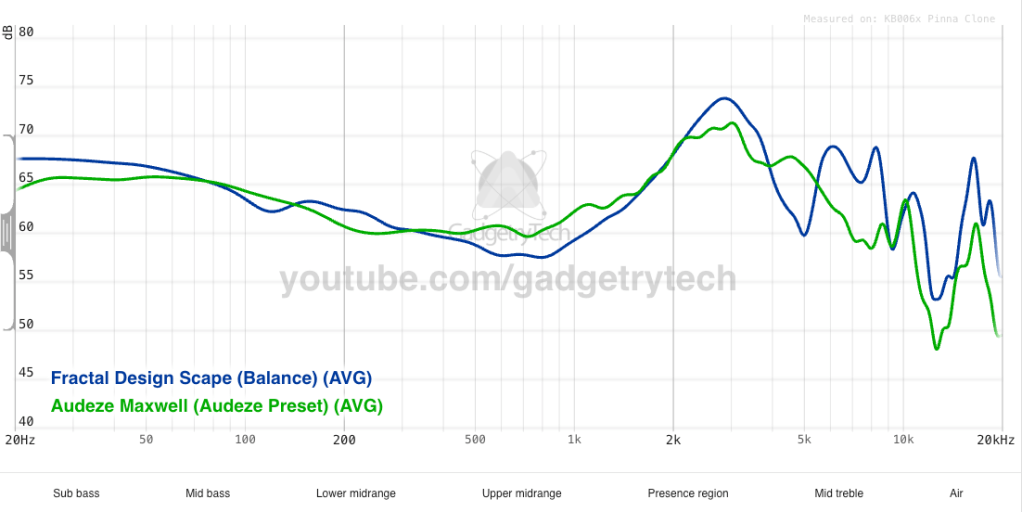
If I had to choose one of these for music, it’s going to be the Maxwell. It’s a better music tune, less v-shaped than the Fractal. But the reality is that I’m probably not going to use either for music on a regular basis; the fact that the controls are disabled when running in an exclusive audio mode and they’re not running via an amp so there’s no easy way to change volume, means that I’m going to stick to gaming with these. And, as I noted in the Scape review the other day, if the Scape were capable of connecting to the Xbox I’d probably be ditching the Maxwell in their favor, period. As it is, I think I’m going to leave the Maxwell for only Xbox use, with the Scape in my office and connected to my gaming computers.
I liked the Maxwell a LOT more before I spent time with the Fractal Scape, and I think the Scape may be displacing the Maxwell for me and maybe in the larger market.
Fiio FT1
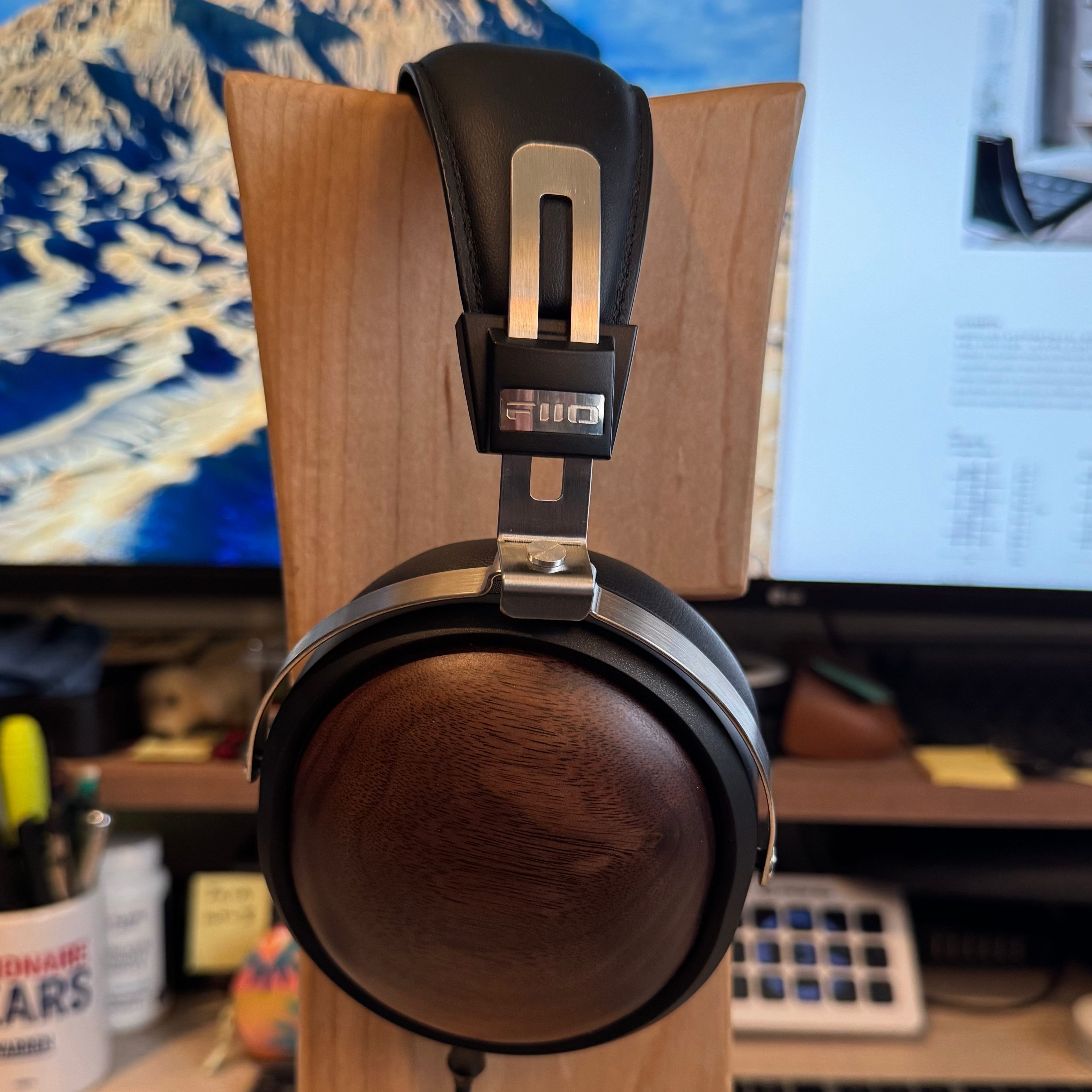
The Fiio FT1 is basically the only closed back headphone that retails under $500 that I recommend without any hesitation. It’s a fantastic headphone at any price (though not without its flaws), and the fact that it retails around $160 makes it an absolute steal in the shallow closed back market. I also happen to really like it for gaming and recommend it pretty regularly over on r/HeadphoneAdvice. Similar to the comparison in my Scape review, I find myself preferring the tune on the FT1 for music compared to the Maxwell out of the box, and they’re definitely more comfortable for long listening sessions. That said, also like the Scape, I think I prefer the ease of a wireless connection for pure gaming. I think my days of using the FT1 for gaming may be coming to a close.
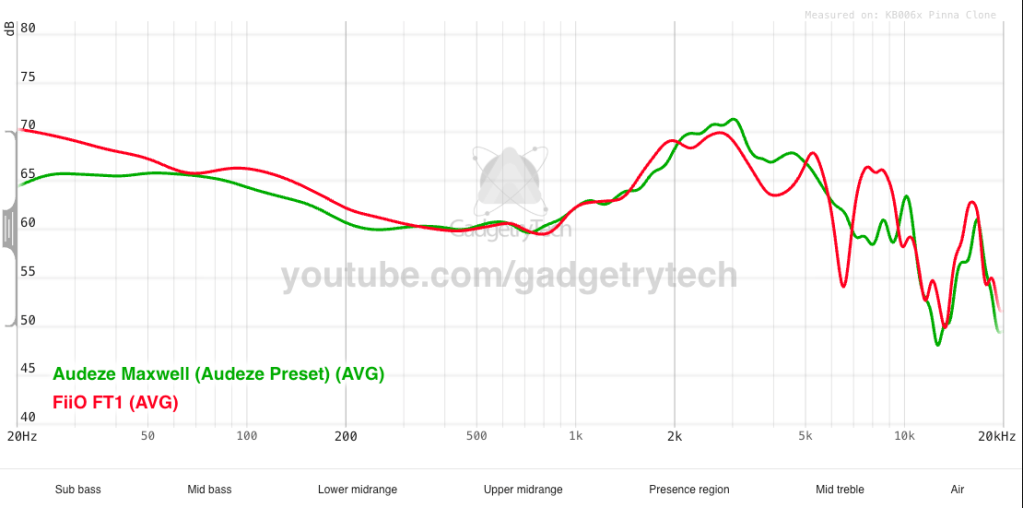
Again, if you’re using the Maxwell the right way (i.e. finding and applying an EQ you like), this graph is next to meaningless. BUT, if you’re not going to use even the in-built EQ, you should expect substantially less bass from the Maxwell compared to the FT1, along with a bit more sparkle in the upper mids/lower treble, then more treble on the very top end.
Hifiman Sundara

This seems like a mismatch at first (because it is one!), but I wanted to do this comparison because they’re pretty similar planar drivers with some of the same inherent advantages and capabilities.
The Sundara is a great example of how good a planar magnetic driver can be in an open-back headphone. Particularly at their current price point, they’re a really great headphone for music, and a decent one for gaming. In a vacuum, I’m choosing the Sundara for music and probably for gaming too, as long as I don’t NEED wireless (i.e. when I’m at a computer, probably not when I’m playing on the Xbox in my living room). I really enjoy the tuning on the Sundara, and while there’s probably an EQ profile for the Maxwell that would get CLOSE to the Sundara, the Sundara are just a little bit magical when it comes to things like guitars. And I highlight this to show the weakness of the #squigsniffer:
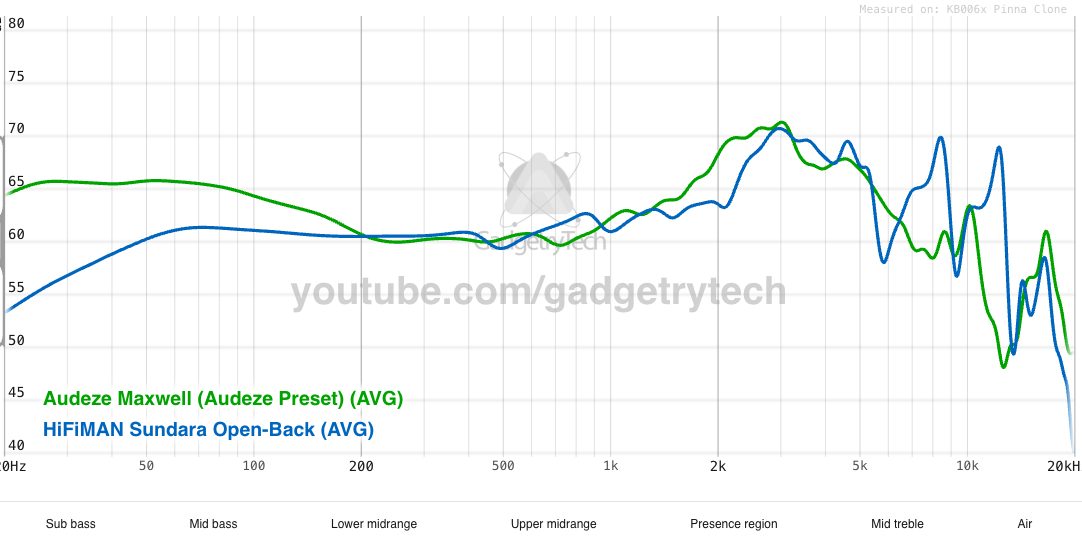
Looking purely at this graph, I would assume I’d prefer the Maxwell’s tune across bass, mids, and treble. It’s a punchier bass profile, a slightly more elevated performance in the upper mids, and a much less spikey treble, all things I look for in a headphone. And yet … I just really, really like the Sundara and prefer them. It’s not even particularly close.
Overall
The Maxwell are a really great headphone, but a poorly designed or implemented system. I appreciate the flexibility they bring to table with their really excellent EQ capability … but that capability is massively undercut but how bad their software is. I love the presence of physical controls on the headset … but they’re oddly laid out and set up, and they can’t be used on a PC without also subjecting yourself to a variety of interruptions. They’re flexible in their connectivity, but the way in which they prioritize different signals make them challenging to use on devices with a lot of notifications. Their Bluetooth functionality in theory make them capable of working well with a lot of options, but the fact that the sound profile is completely different via Bluetooth (at least on my unit!) is bizarre.
I think overall, I’m really curious to see how the Maxwell 2 turn out. This product has been on the market for a couple of years at this point, and I’m pretty disappointed by the fact that the software hasn’t meaningfully improved. I’m going to guess that the new Maxwell uses the same apps, though I’m hoping that won’t be the case. Reddit is also full of folks who have had quality control issues with their Maxwells; while mine appear to be in excellent working order, you’d hope that a few years in Audeze would have fixed the driver issues.
Purely from a sound perspective, I really like the Maxwell (via the dongle or USB-C, and even via Bluetooth after a little EQ). Everything else about them are a bit of a let down, particularly compared to products like the fully-baked Fractal Scape. The ease of use just isn’t there, which is something I expect from a gaming headset in the modern market. If I can buy a well-thought out system like the Scape and dock, or pay more for a headphone that I have to track paraphernalia for and remember to charge, as an intermittent gamer, that’s not really much of a choice.
Phil’s Matrix of Use

#reviews #headphones #sennheiser #6XX #anc #spatialaudio #meh #2025 #99noir #meze #sunglasses #overear #cans #hifiman #arya #stealth #editionxs #budget #hahahaha #iems #quickreview


Leave a Reply