
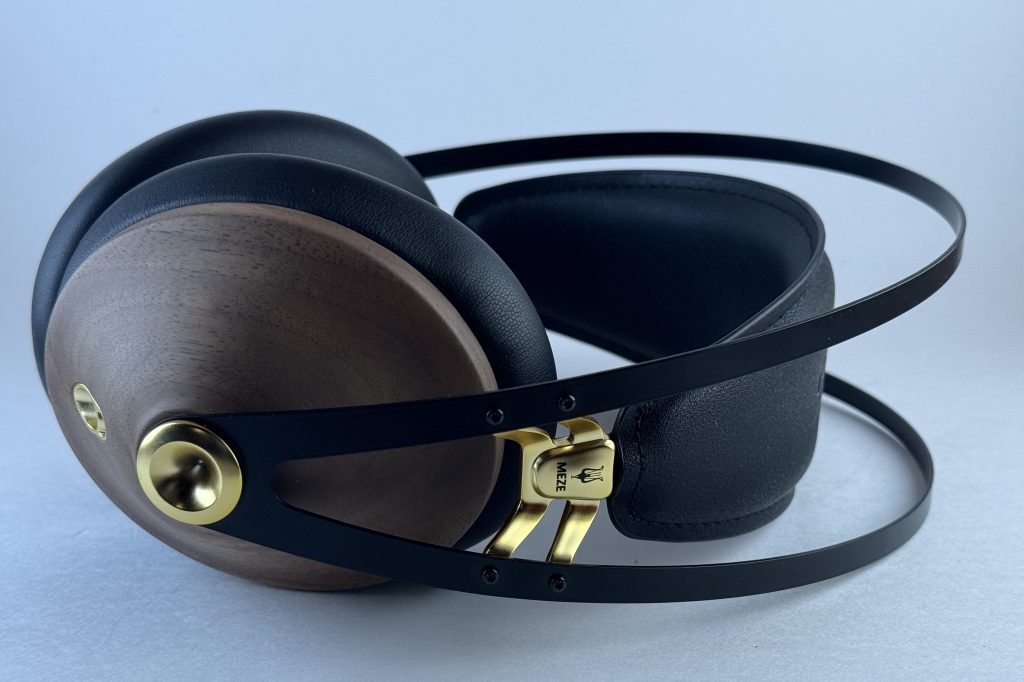
[ORIGINAL MSRP $349. Currently available directly from Meze for $349 and $349 new from Amazon in May of 2026. Purchased lightly used from r/AVExchange for $175 in April 2026.]
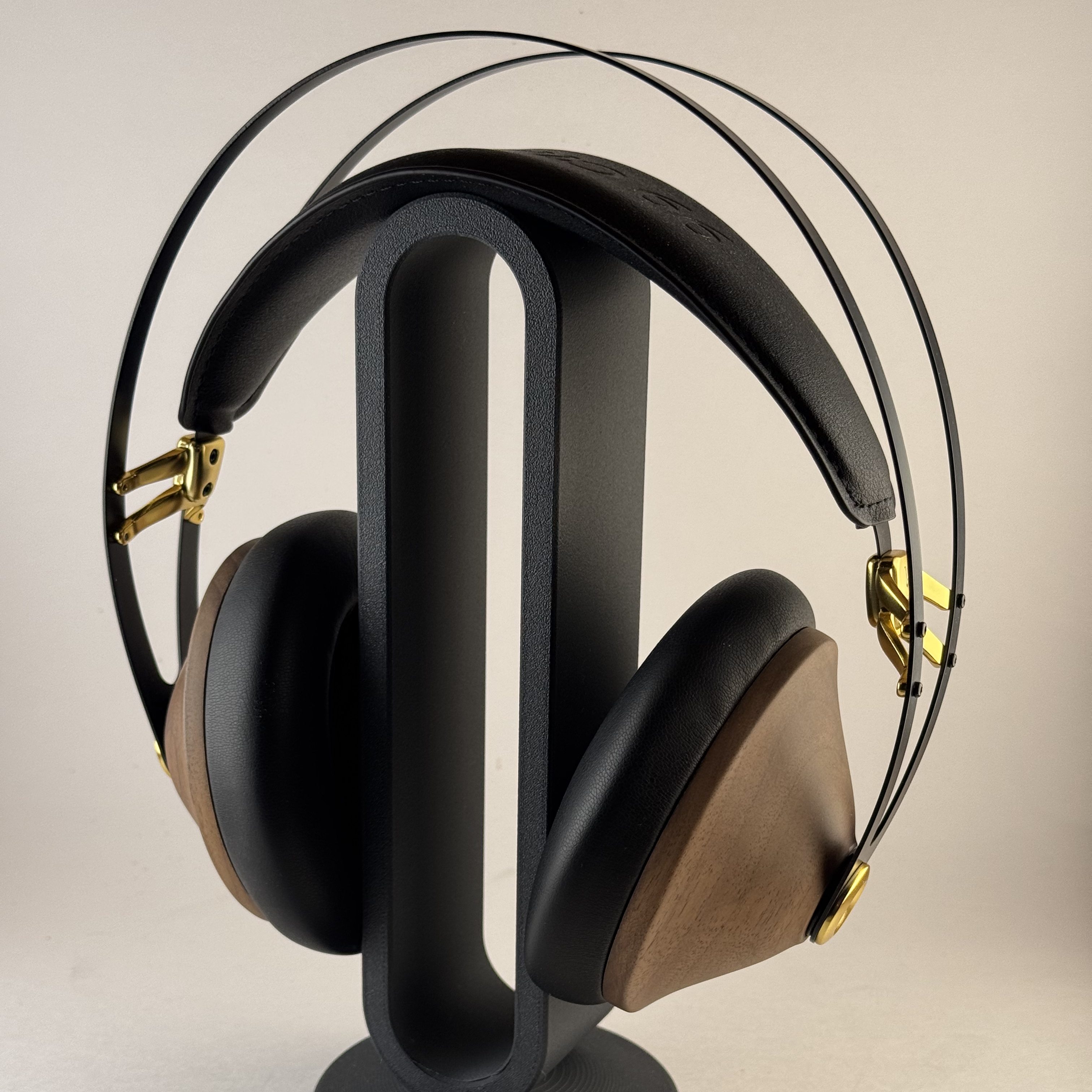
[Tl;dr: The Meze 99 Classics v2 is a really well-designed and well-tuned closed back. Though it’s not quite my cup of tea, I recommend it wholeheartedly to anyone in the market for a comfortable closed back with moderately elevated bass but who doesn’t want the kind of muddy bass cannons that a lot of the consumer-focused headphone manufacturers (*cough* Sony *cough*) lean towards. Even for a person with my general preferences, you could spend a lot more money to do a lot worse than the 99 Classics v2 in the closed back market. They’re just a little late to the party; in the last year, we’ve gone from a world in which I only recommended one closed back under $500 without serious reservations to one where I can think of at least four I really like, with or without EQ.
The 99 Classics v2 is one of only a handful of headphones that I recommend at their MSRP; it’s a pretty reasonable price for a pretty dang good headphone, and I’m just a little sad that Drop.com isn’t around anymore to release a dark colorway at half the price in a year or two.]
Cost-agnostic: 7 out of 10 Denalis

Cost-sensitive: 7 out of 10 Denalis
TABLE OF CONTENTS:
Introduction
I am a pretty big Meze fanboy, both of their industrial and aesthetic design and some of their tuning choices. My second pair of closed backs ever, and the first that I could actually wear for more than ten or fifteen minutes, was the Meze x Drop 99 Noir (originally purchased as a gift, then kept when it turned out they didn’t fit the recipient’s head at all). My first really good pair of headphones was the Meze 109 Pro, which is still my favorite pair under $1,000 and arguably the most comfortable headphones I’ve ever worn, and my favorite headphones bar none are the absolutely stellar Meze Empyrean II.3 I also picked up a pair of Meze Strada in March and they’re also sitting in my “to review” pile, but generally I’m a fan of their (admittedly weird) tuning.
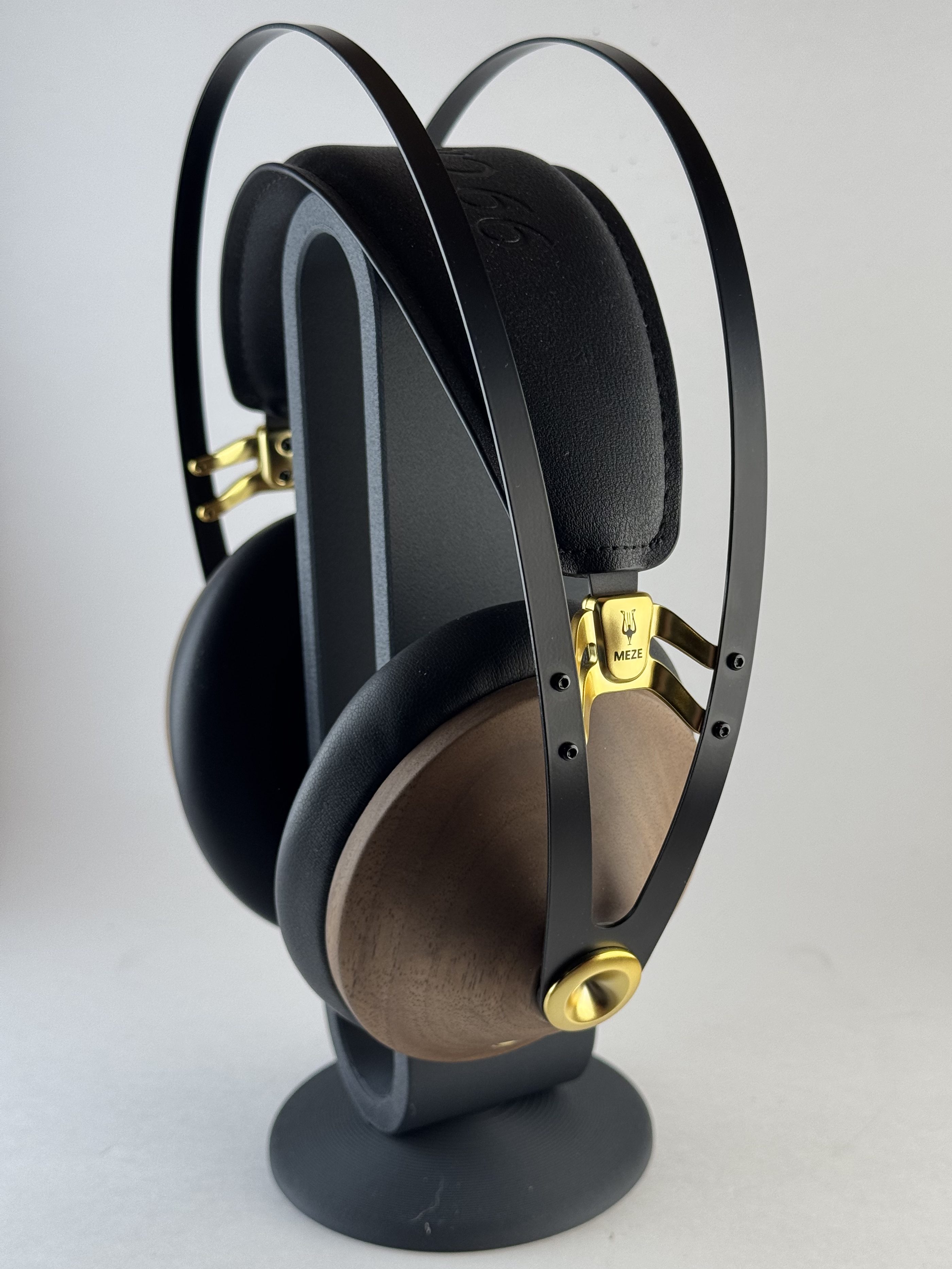
Overall, I’ve had a pretty mixed experience with passive, closed back headphones and historically mostly stuck to active noise cancelling headphones for my acoustic isolation.4 I enjoyed the 99 Noir up front, but over time as I experienced more and more competently tuned headphones, they started to lose their luster (and in particular, the microphonics on the headband and cable really started to bug me). I tried the generally well regarded Beyerdynamic DT 770 Pro, and it took me only a few weeks to make the connection between putting them on and the raging headaches I was having almost every day.
Basically, until I tried the Bokeh Closed in 2025, I was pretty sure that I just wasn’t going to be comfortable wearing most closed backs. The Fiio FT1 was the first closed back that showed me that affordable closed backs could be great, and I’ve tried a few others since then that I really like (particularly the Focal Elegia, Azurys, Beyerdynamic DT 270 Pro,5 etc.). I’ve got a few other closed backs reviews coming up in the near future: the DT 270 Pro, Focal Celestee, Sennheiser HD 480 Pro, and that Meze Strada (plus a few that I could do mini reviews on like the Hifimans Audivina, HE-R9, and Sundara Closed). When Meze announced these in late 2025, I was intrigued; a less wonky version of the 99 Classics/Noir?
Clearly, I need another pair of headphones like I need a hole in my head. But when a pair of these popped up on r/AVExchange for $200 (and after hearing some pretty high praise for their tuning choices), I decided to make an offer at $170. To my surprise, he countered at $175 and we struck a deal. For that price, they were worth a shot, particularly with the Strada review in the queue and a couple of other value-ish closed backs coming up.
Review notes
Testing rig
Here’s my basic testing protocol.
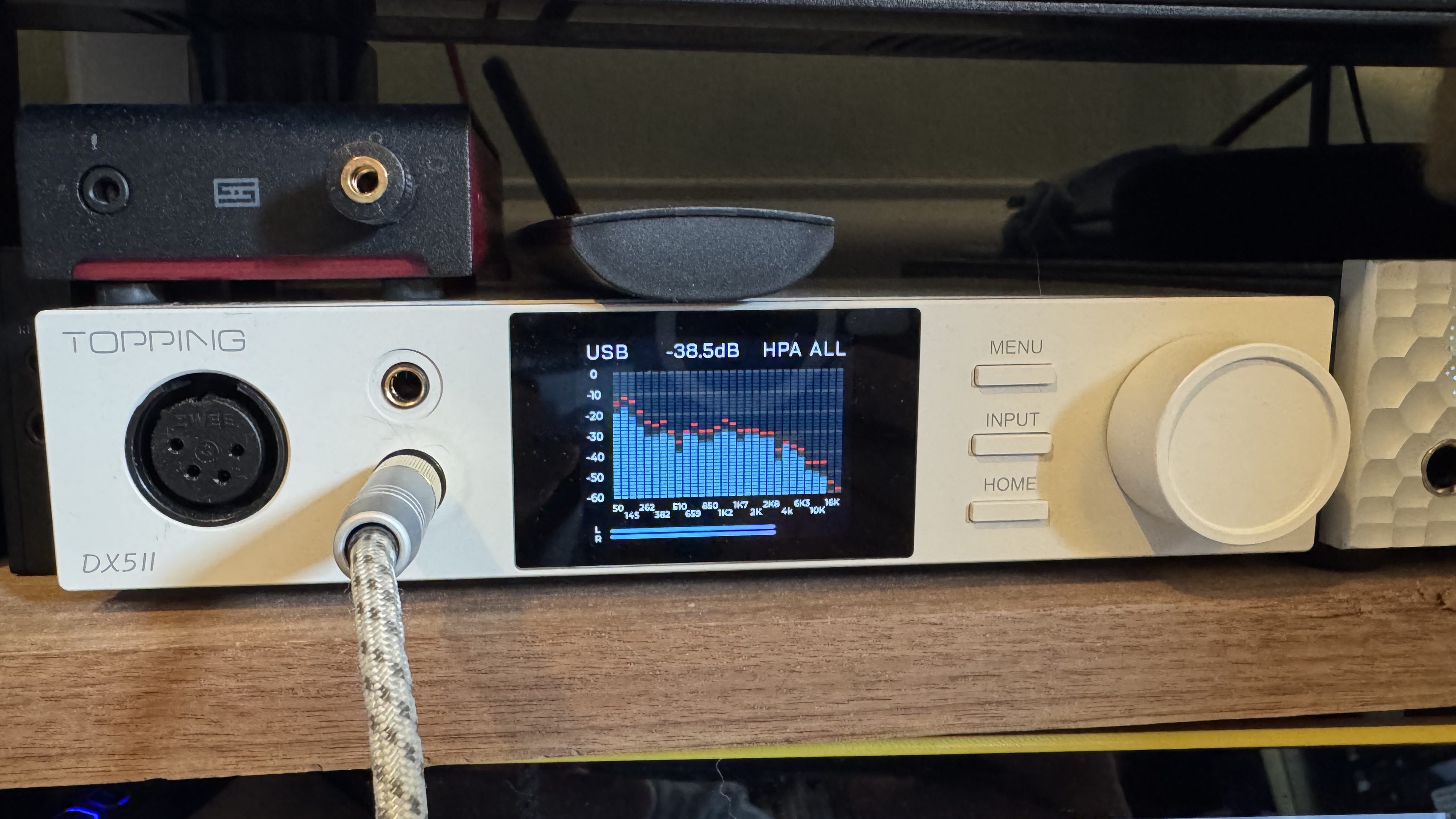
Based on my philosophy on the allocation of resources in headfi, except where otherwise noted I’m going to primarily be testing these single-ended6 via the included 6.35 mm-terminated Meze cable or a 2.5 mm Meze upgrade cable I got for $20 over the holidays (with a cheap 6.35 mm adapter) running into a Topping DX5 II, connected via USB to a Mac Studio running the Roon client (though I did a bit of listening via the Schiit Hel2, using my new Meze Boom mic cable).
EQ
As noted in the Bathys review, I mostly prefer to test headphones with their default tuning, assuming that most people won’t take the time or make the effort necessary to use a third-party EQ. The Meze 99 Classic v2 sound pretty good to me out of the box; I have felt zero need to apply any EQ for any of my listening with them. There are some … oddities in the frequency response, but they’re both 1) not big enough to be worth a lot of time trying to balance out and 2) pretty narrow and specific enough that they’d be annoying to try to address.
EQ Update
EQ Update: After completing the listening and comparisons for this review, I did feel the need to spend some more time working on an EQ profile to round out some of the quirks.
This is a new enough headphone that Oratory1990 (my usual go to for a place to start on EQ!) doesn’t actually have a recommended profile. I started with auto-EQ from Squig.link from my own measurements of my own pair of 99 Classics v2, which (unsurprisingly!) sounded terrible, but gave me a place to start. And I spent a couple of days tweaking each band; the original profile had me dropping that 66 Hz band by almost 5 dB and cranking 3.7 kHz up almost 12 dB to fill in that dip. That sounded weird, so I fiddled with everything a bit. Here’s what I came up with:
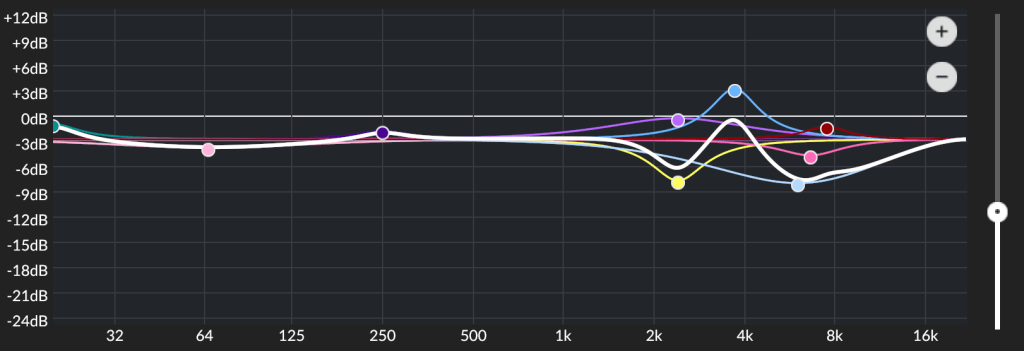
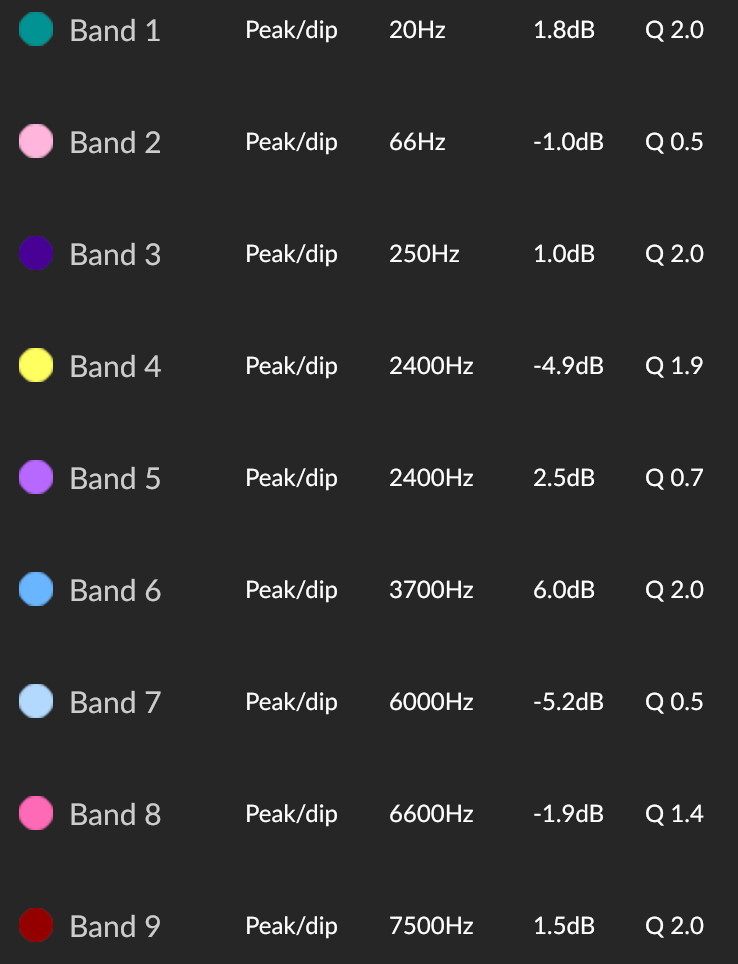
I’ll update this actual measurements when I get my rig back, but here’s what Squig.link thinks this EQ looks like applied to my particular pair of headphones:
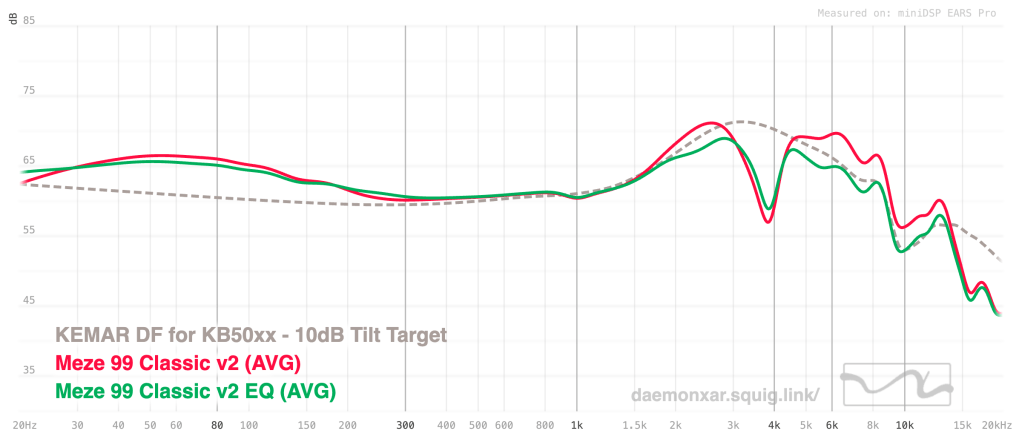
While I think the 99 Classics v2 sound pretty good out of the box, I definitely like this EQ profile substantially more. It retains some of the interesting character of the headphones (bass, timbre, mostly relaxed treble) and sands off just a few rough edges.]
Volume
Here are the volume settings I use with the Meze 99 Classics v2 (unless otherwise noted, running via Roon with no headroom management, playing Daft Punk’s “Face to Face” from Tidal):
- Apos Druid/Gremlin: 10:30 (balanced, 4.4 mm)
- Chord Mojo: white, off, off, red
- Dongles (tested on an iPhone 15 via Apple Music):
- Apple: 45%
- Crinear Protocol Max (max internal volume): 60% (single-ended)
- Fiio KA11: 33%
- Fosi DS2: 40% (single-ended)
- JCALLY JM6 Pro: 50%
- Holoaudio Bliss (KTE): -40 dB (Low-Z, single-ended), -44 db (low-z, balanced 4.4 mm)
- Mytek Brooklyn Bridge: 34%
- Schiit:
- Hel: 9:15
- Mimir/Jotunheim 2 (Mimir has a -15 dB pregain applied via Forkbeard): low gain, 10:00 (balanced); low gain, 11:00 (single-ended)
- Modi/Magni: low gain, 8:30
- Modius/Magnius: low gain, 8:30 (balanced); low gain, 9:00 b(single-ended)
- Topping DX5 II: -36 dB (single-ended), – 41 dB (balanced)
My torture testing list
The Basics
The Meze 99 Classic v2 is, unsurprisingly, the 2026 updated new version of the Meze 99 Classic (released in 2015, and updated at some point shortly thereafter with a different set of pads). Along the way they release two alternate version of the 99 Classic, the plastic-bodied 99 Neo in 2017 and the blacked out, dark-stained walnut-cupped, Massdrop-branded, 99 Noir in 2019. They are all passive, dynamic driver closed-back headphones from Romanian headphone manufacturer Meze (where the cups appear to be CNC’d, though they appear to be largely assembled in China unlike Meze’s higher end headphones).
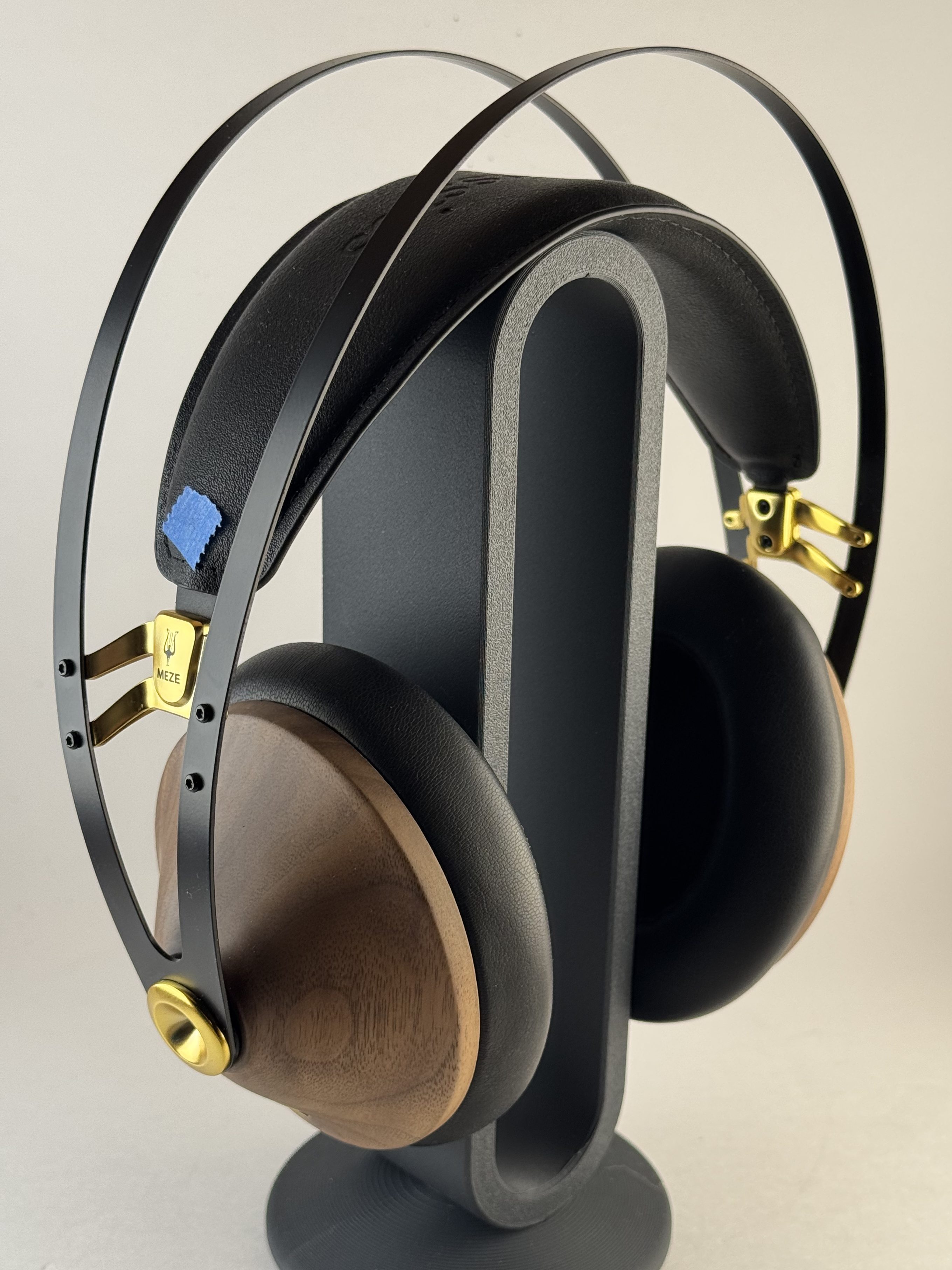
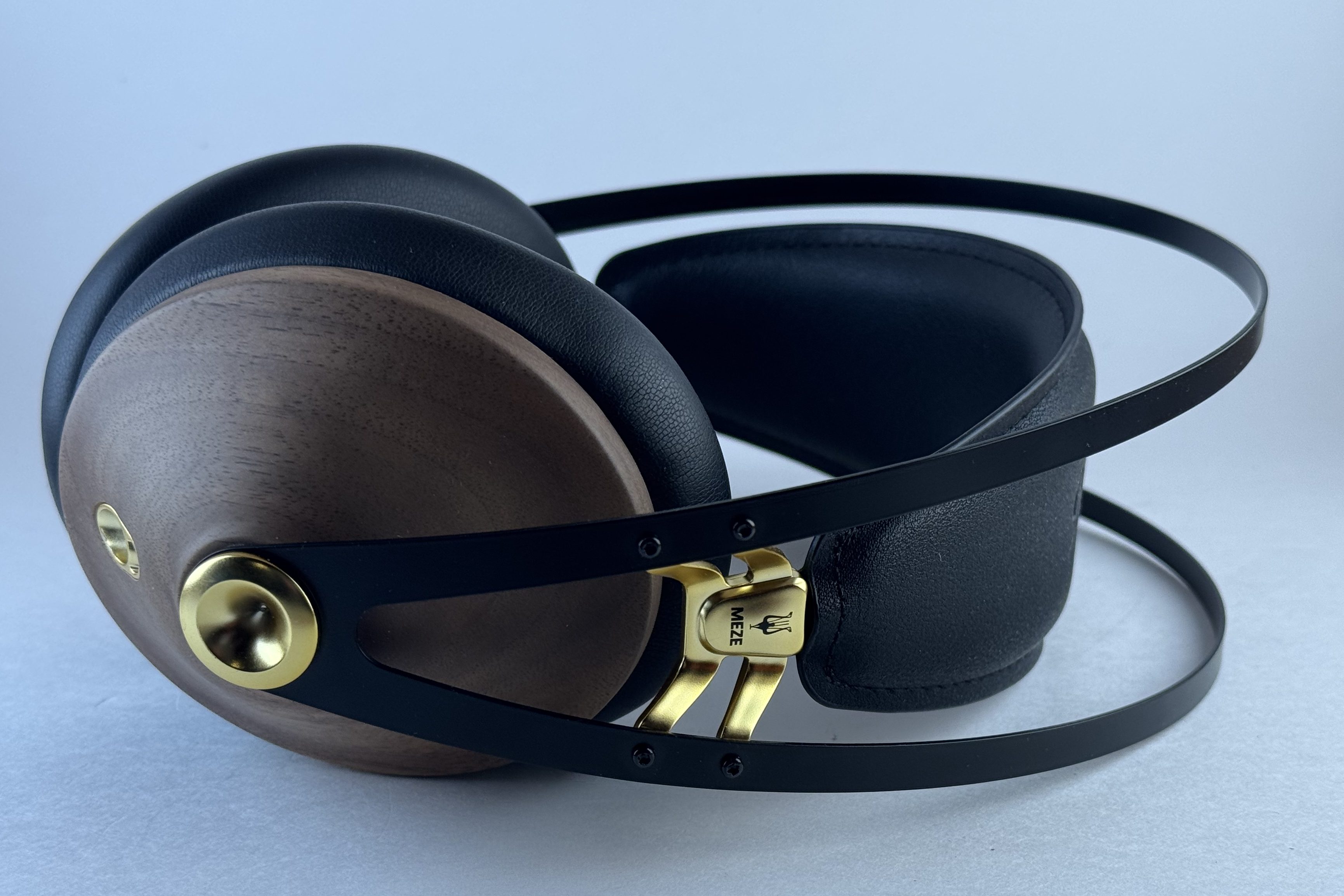
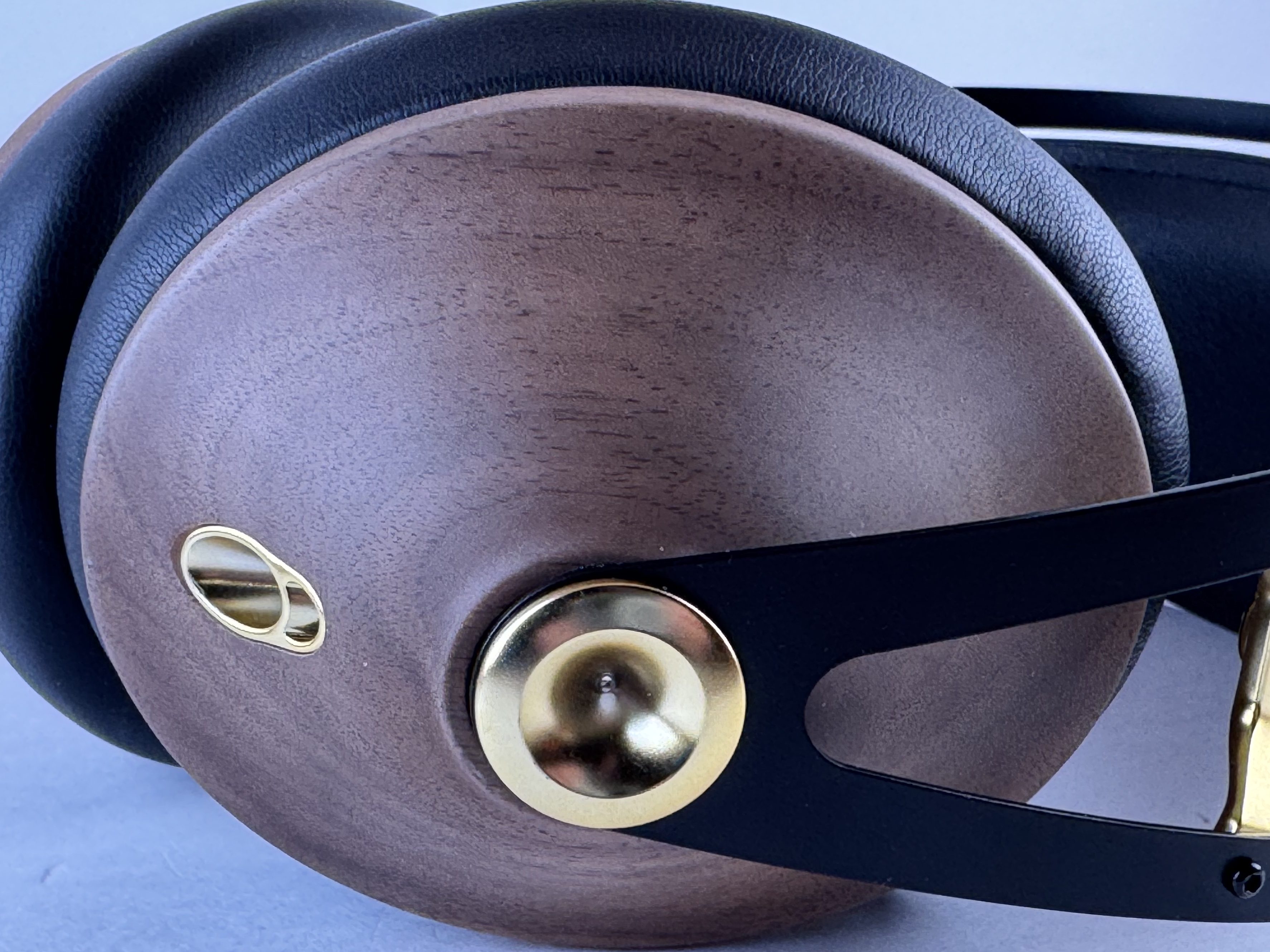
The 99 Classic v2 is, like most Mezes, relatively easy to drive at 16 Ohms of nominal impedance and a sensitivity of 103 dB/mW, making them compatible with almost anything, from a dongle to most devices that still have a 3.5 mm audio jack. Also like most Mezes, the Classic v2 is beautiful, well made, and generally very comfortable. It also comes in a nice package, with the headphone, a nice semi-rigid case, a pair of tuning discs (which I didn’t get from the prior owner), a nice almost 2m cable terminating in 3.5 mm plug with a non-threaded 6.35 mm adapter, and a USB-C adapter (aka a dongle DAC7). They’re not quite as light as the Sennheiser 6XX series, at 290 grams without the cable, but they’re plenty light particularly considering how solidly built they are.
Sound
[Review note: I didn’t get the dampening discs that Meze ships with the 99 Classics v2 from this pair’s original owners, so all notes here are with the drivers without the additional damping. It’s my understanding that adding the dampening moves the tuning back towards the original 99 Classics’ tuning, so perhaps it’s for the best that I didn’t get them with my pair.]
I’m pleasantly surprised by the sound on the Meze 99 Classic v2, though I suppose I probably shouldn’t be, given the generally positive reviews they appear to have received in the community. I initially really liked the Meze x Drop 99 Noir8 … until I spent time with more competently tuned closed backs. I commented in the update to my review that in a world where the Fiio FT1 is $150-160, I couldn’t recommend the Noir for anything other than aesthetics, and I stand by that. Spoiler alert: the v2 is a MUCH better tuned headphone, at least to my ears.
Overall, this is a headphone with generally well-balanced ranges, though I think the balance between them might benefit from a little tweak here or there and there are a few percussion related oddities.
For reference, this is what my unit looks like on my measurement rig:
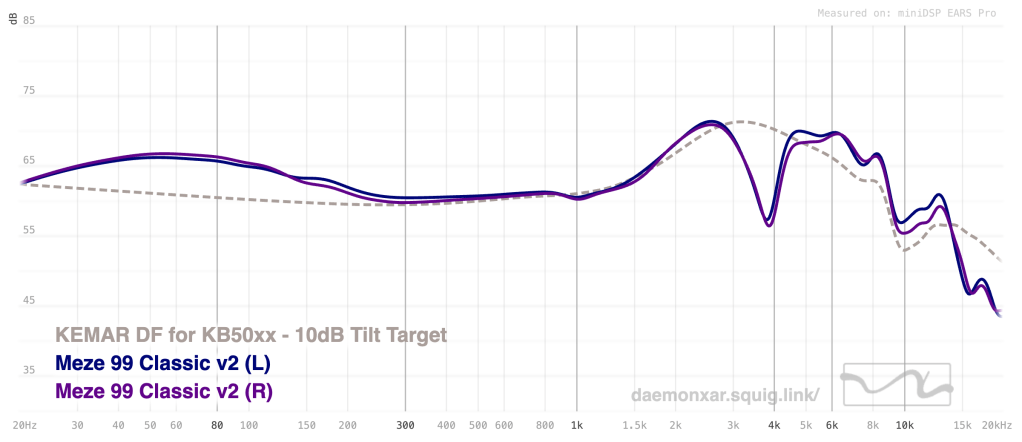
This is a pretty remarkably close channel matching, period, and particularly for a closed back. So cheers to Meze for that. I definitely hear that 4 kHz dip, though, and that’s going to be the focus when I start to play with EQ on these.
Technicalities
The soundstage on the 99 Classics v2 is pretty decent for a closed back headphone; the left-most guitar on “Chan Chan” is pretty far out to the left, though at least on that track the right side9 feels much more pulled in. Layer and instrument separation is generally pretty good, but I’m pretty sure I occasionally hear instruments (particularly guitars) slipping into that 4 kHz dip and disappearing; at least when I correct via EQ those instruments pop back into place. The front-to-back staging is decent as well, with the guitar at the beginning of “Love Can Damage Your Health (Laid Mix)” moving distinctly in a circle around your head rather than panning.
The dynamics are good. Setting the volume at the beginning of “It’s All So Incredibly Loud” had me reaching for the volume control around 2:30. The microdynamics are really quite good; the bass bell tones on “Angel (Blur Remix)” are nicely accented and crisp (though missing a bit of the warble after the initial attacks), and the treble tones are well-defined if perhaps a hair less accented than on some other headphones. (Again, this may come down to that 4 kHz dip). Same with “What Did I Do?”, with both nice impact on the bass notes AND on Justin Hick’s voice. You don’t get quite the kind of punch you do on something like a Focal, but it’s pretty damned good anyway.
Overall, the detail and resolution of the 99 Classics v2 is good, not great. Part of that is probably due to tuning choices they made. Meze was clearly going for a pretty relaxed sound signature on these, and they achieved it, at the cost of at least perceived detail. Good hiss and fingers sliding on strings on “What Did I Do?”, though, so the details aren’t that marred by those choices. I wouldn’t use these for critical listening, but then … these aren’t the kind of headphone I’d use for critical listening anyway.
It’s also worth noting here that occasionally there are issue with the 99 Classics v2’s timbre. It’s not super common, and I haven’t been able to nail down what causes it, but on some tracks it skews a little on the jangly, metallic side. “I Against I” is an example, as is “What Did I Do?”, where at the end Justin Hicks’ voice takes on a slight metallic tinge. Ditto the end of “Limit to Your Love.”
Bass
The bass response on the 99 Classics v2 is definitely elevated, but not so elevated as to be problematic; it’s emphasized but without losing too much precision and crispness. The bass slips in smoothly on “Out of My Hands” around 2:48, then gently crescendos over the next minute or so (though it starts to get a little muddy around 3:00). “I Against I” and “Superpredators” definitely edge into muddiness as well, but it’s not any worse than a lot of headphones I like (including some more expensive closed backs). They do pretty well with the bassline on “Got ‘Til It’s Gone,” losing only a few notes here or there at the bottom, and the brainwobble on “Limit to Your Love” is satisfying, if not quite as distinct as on some other pairs. The 99 Classics v2 performs well on a track like “Remain Nameless,” where the syncopated bass line drives the song forward throughout. The baritone sax hits on “Easy” are damned near perfect, too, without getting honky or harsh the way that they can on some other headphones.
I think my favorite part of the bass on the 99 Classics v2 is the balance between the mid bass and the sub bass; I used to think that my problem with a lot of closed backs (particularly in the wireless/ANC space) was the bass, but at this point I’m pretty sure it’s mostly the sub bass. I’ll talk about this a bit in the comparisons below, but one of the things I appreciate about the 99 Classics v2 is that the mid bass is really solid and present, but the sub bass rolls off just a bit the deeper you get below around 40-50 Hz. I think that’s why I perceive it as being cleaner and clearer that some competitors. Most of the music I listen to doesn’t have a lot of sub bass, but I’m increasingly convinced that too much fuzz down there doesn’t work for my ears/brain.
I noted a couple of places that the bass does get a bit muddy at times, but judicious use of EQ cleans it up pretty nicely.
Midrange
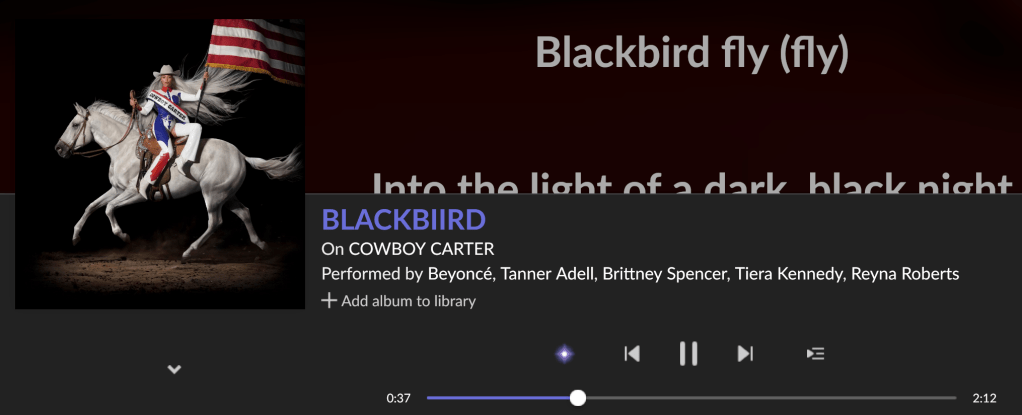
The midrange on the 99 Classics v2 is generally pretty good if a little recessed at times (and very occasionally slipping into metallic-sounding). Human vocals are nicely reproduced for the most part, with Jill Scott cutting through the instruments nicely on “Calls” (and with a nice emphasis on the counter melodies and runs she’s doing in the background throughout the middle section). Sampha sounds correct on “Like the Piano,” though in an ideal world I’d have him just slightly more forward. Cautious Clay sounds good on “Cold War,” and all the vocalists on “BLACKBIIRD” are beautifully reproduced and well-balanced throughout the harmonies.
As I mentioned above, the 99 Classics v2 does occasionally tinge just a bit metallic, and the midrange isn’t immune to that. In particular, at the end of “What Did I Do?” Justin Hick’s voice takes on a little coppery edge that I don’t love. I’m curious to see if adjusting the midrange –> treble transition via EQ will clean that up. [Editor’s note: it mostly did not.]
Treble
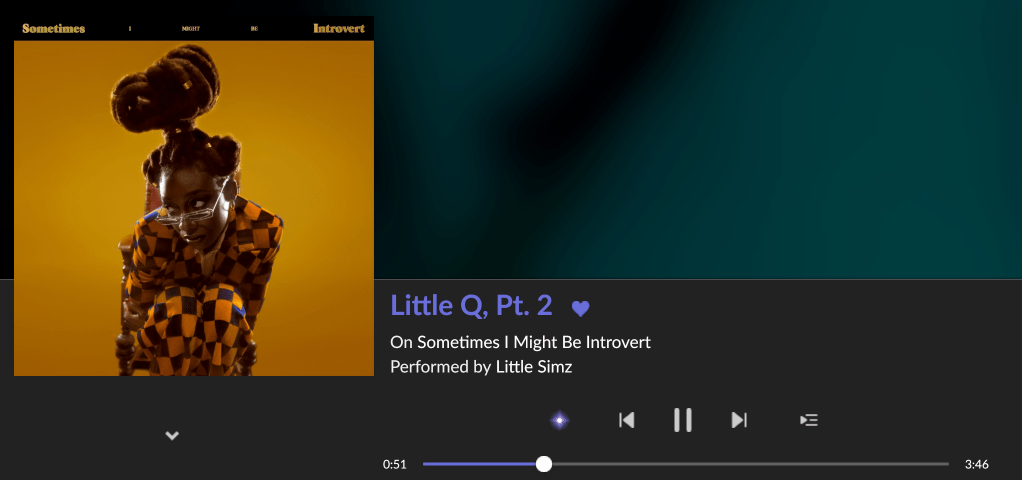
Interestingly, the treble on the 99 Classics v2 is probably my least favorite bit of their performance. Normally I hear a headphone described as relaxed and I get excited, but for whatever reason on my head, the treble has a number of artifacts that I find pretty unpleasant. In particular, claps (and especially disproportionately loud or ones close to the mic) are sharp and harsh on my head10; this is a problem in Domonique Fils-Aime’s “Birds,” “Paradise Circus,” and even around 2:30 on “What Did I Do?”. I have a similar issue with the wooden percussion strikes on “Superpredators” around 1:38 (though not as much with the same instrument throughout the rest of the song) and the cymbals at the end of “Limit to Your Love.” And bits of Little Simz’s “Little Q” get a bit jangly and distracting as well.
It’s worth noting that this isn’t so bad as to prevent me from listening to the 99 Classics v2, but it is enough that I find myself turning the volume down with some frequency instead of just letting it sit at a constant volume throughout a listening session, which is more my norm. And it’s certainly consistent enough that I’m going to be using EQ with these going forward.
Even more interestingly, the things that normally bug me about treble? Totally fine. The guitar and vocals on “2021” don’t even get close to the edge of harshness, weirdly, and while the muted trumpet on “Will O’ the Wisp” gets closer even that doesn’t slip over on this headphone.
There’s clearly something specific happening on my head that isn’t occurring on the measurement rig, and I have NO idea how I’m going to figure that out via EQ.
[Editor’s note: going back and re-listening during the comparison/value writing and editing, I realized that when I was playing with the remote on the DX5 II as part of that review I accidentally reset the filter to F-1, and I was getting the same kinds of treble sharpness with the 99 Classics v2 that I noted in my Hifiman Edition XV review. After swapping to the F-5 filter again,11 both the claps and the percussion hits that were bothersome before are distinctly less sharp, though they’re still not what I would want in an ideal world. I also did experience some of the same thing on the Chord Mojo 2, as well.]
Amplifier Compatibility
The 99 Classics v2 are generally a pretty amp-agnostic device, sounding pretty good from almost everything I tried it with. The exceptions are, potentially, the DX5 II on the F-1 filter and the Chord Mojo 2, where I did experience a bit of sharpness on specific percussion instruments and clapping. As skeptical as I am about DACs/amps making a difference in general, this experience was consistent via the 6.35 mm jack on the DX5 II, and to a lesser extent on the Chord Mojo 2.
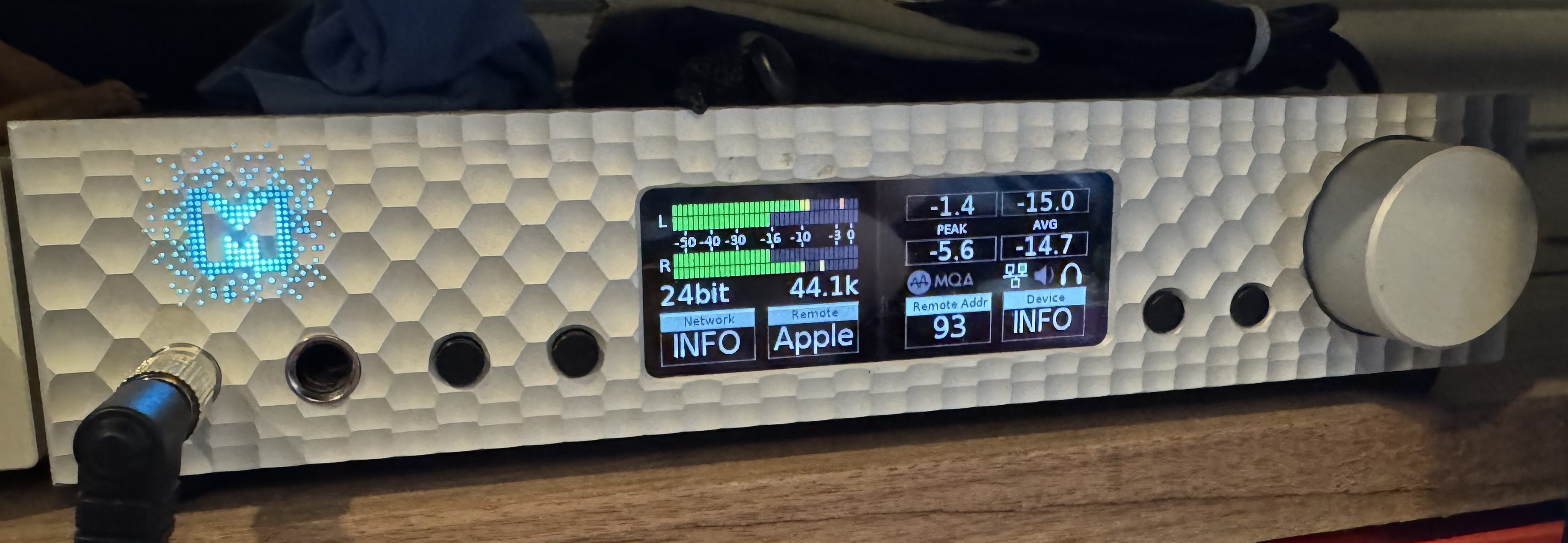
Other than that, the 99 Classics v2 performed quite well on everything from inexpensive dongles to the Mytek Brooklyn Bridge to the Holoaudio Cyan 2/Bliss (KTE) stack. They also seem to do pretty well with a tube amp like the Apos Gremlin, adding just a bit more richness and texture to the bass.
Overall Impressions
Overall, I’m pretty happy with the 99 Classics v2 and their tuning. They’re fine out of the box, but I do think they will benefit from a bit of EQ, particularly in the treble to try to reduce some of the percussion and clapping sharpness. The bass is clean and reasonably balanced (if a little elevated for my taste), the mids are good (if a little recessed), and the treble avoids most of the pitfalls that usually put me off of closed back headphones (even if it introduces a few new ones). Though I no longer have the 99 Noir around so I can’t easily do a direct comparison, it’s pretty clear to me that the choices Meze made in tuning the 99 Classics v2 were informed by their experience and feedback from the original 99 Classic, Neo, and Noir and it’s a step in the right direction in my ever-so-humble opinion.
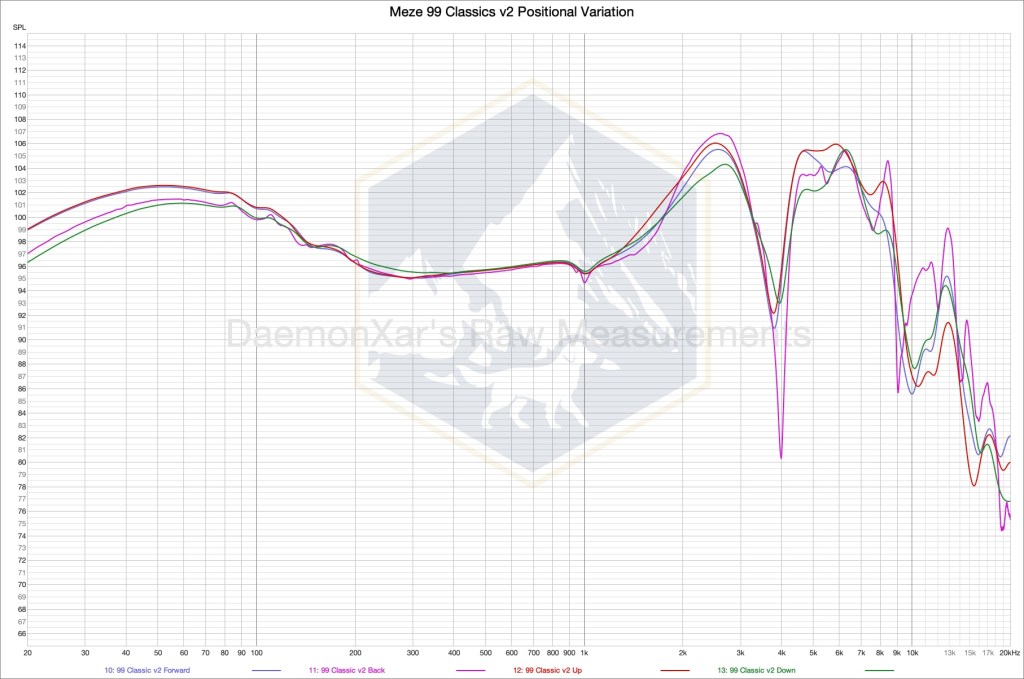
It’s worth noting that there is a reasonable amount of positional variation with the 99 Classic v2; sliding them to extreme positions (while still maintaining a good seal over the ears) can result in up to 5 dB shifts in volume at specific frequencies, and wearing them too far back in particular might induce an even stronger 4 kHz dip.
Build Quality & Appearance
I’ve long since come to terms with the fact that I’m a Meze fanboi, so it’s not particularly surprising that I’m a pretty big fan of the design of the 99 Classics v2, even if it’s the least visually interesting of the Meze headphones that I own or have owned (other than the 99 Noir, though I might prefer that aesthetic over the faux gold hardware on this pair).
Connectivity
Like their open-backed siblings the Meze 105 AER and 109 Pro, and the closed back Meze Strada, the Classics v2 use a dual entry 3.5 mm cable to connect to source gear. Like the 109 Pro and 99 Noir, and unlike the 105 AER and Strada, the Classics v2 do recess their jacks 10-12 mm, making them slightly more challenging to use with aftermarket cables but also making them likely more resistant to drop damage. The 99 Classics v2 ships with a VERY nice ~2 m cloth-covered, braided cable terminating in a 3.5 mm jack (with a non-threaded 6.35 mm adapter). It’s worth noting that not only is this a better cable than the 99 Noir’s (which was INCREDIBLY microphonic), it’s a better cable than ship with either the 105 AER or 109 Pro, and roughly on par with the the pair of cables that ship with the $799 Meze Strada. Unless you want/need a balanced cable, I wouldn’t feel compelled to budget for an aftermarket cable, though if you want one there are a number on the market that would work well.
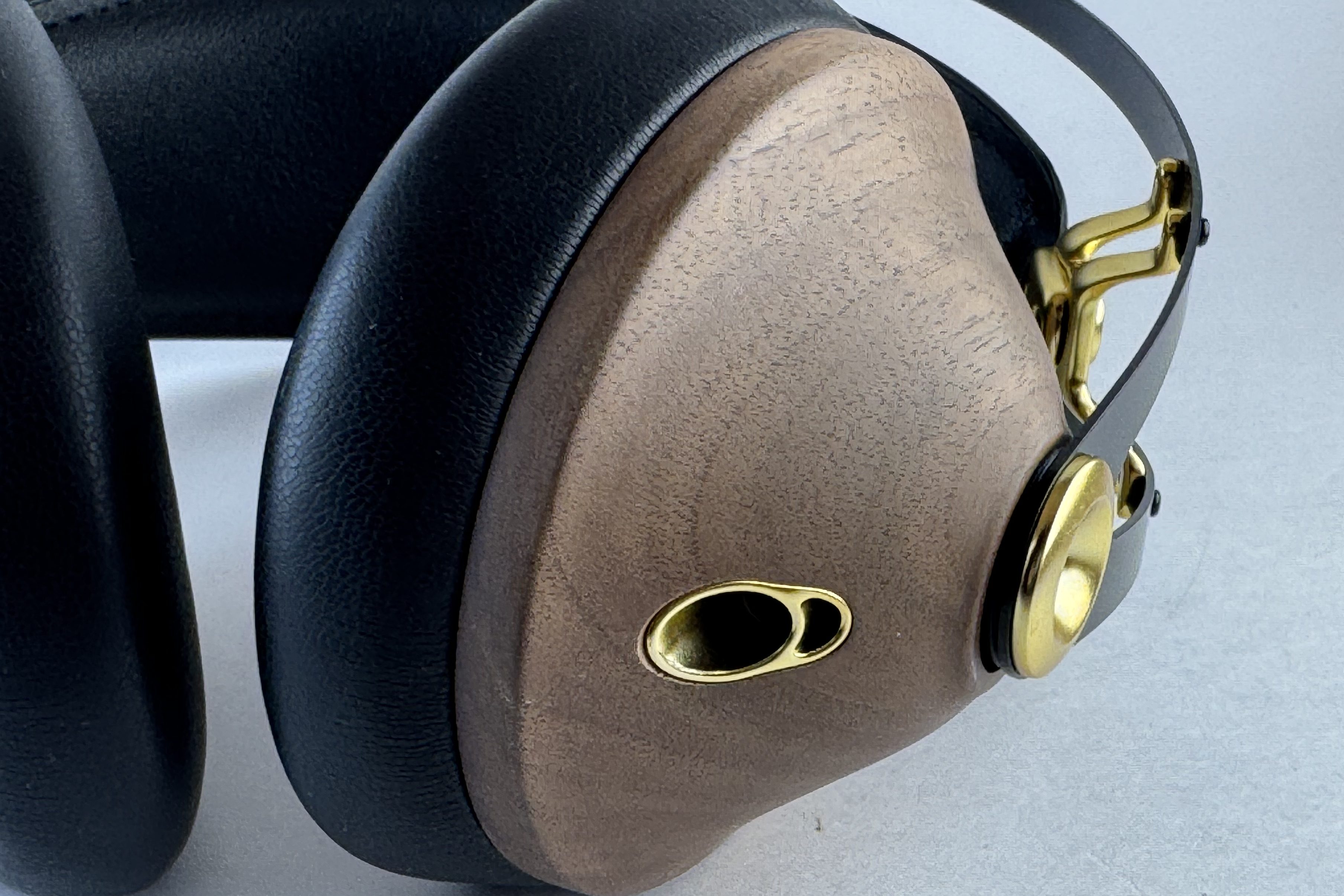
There is one super weird thing about the 99 Classics v2, and it’s that they … don’t have a right or left ear cup. They’re internally wired in such a way that regardless of which cup you plug the cables into, the right cable will be the right ear and the left cable the left ear. It’s … weird. I don’t know why I care, but it bugs me enough that I put a piece of painters tape on one cup and declared that to be the right cup. The symmetry also means that the cables dangle straight down instead of being angled slightly forward as they are on many headphones (including the 109 Pro) so they are slightly more prone to brushing against your body if you’re moving around. At least this design is less prone to microphonics than the 99 Noir!
I appreciate that Meze continues to stick with the dual 3.5 mm connection system for their non-Empyrean/Elite headphones, though I’d have loved it if they included a balanced cable with the package.
Construction
The 99 Classic v2 shares the general structure of the prior 99 series as well as the 109 Pro and 105 AER, namely a metal spring steel frame with a leather or pleather suspension strap rather cleverly attached to the frame in a way that lets it adjust a pretty remarkable distance. Like the OG Classics and the Noir, the cups are made out of CNC’d walnut.
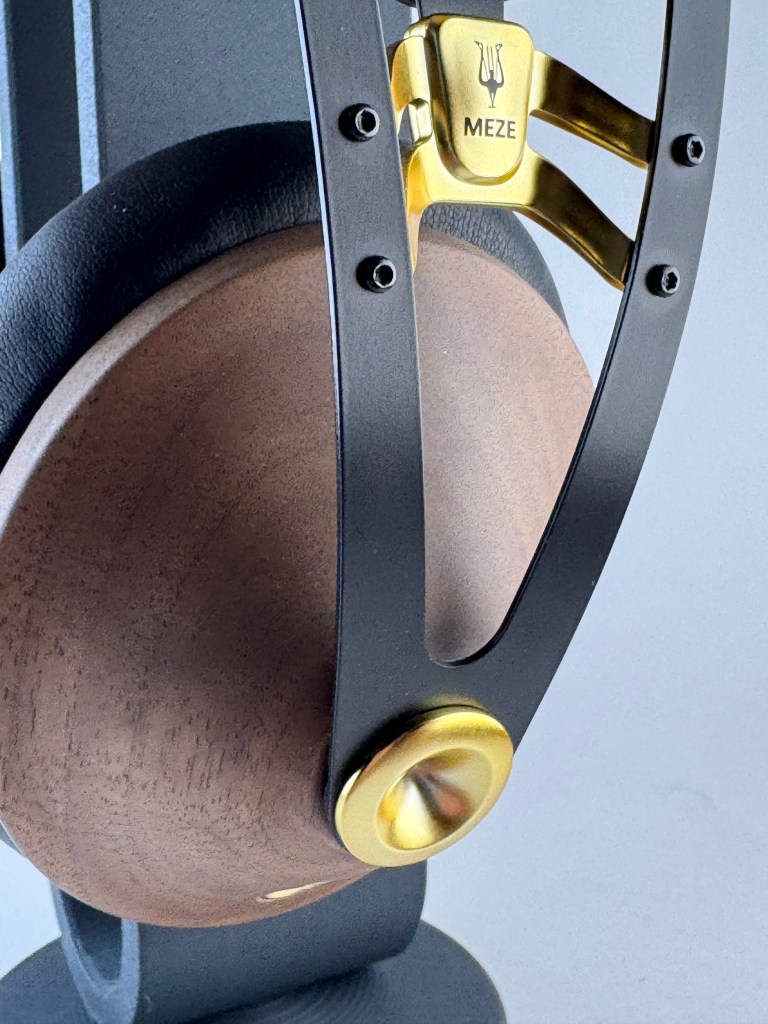
All in all, a great design that is both light enough to be comfortable (around 290 grams) and solid enough to feel very stable on the head and in the hand. And Meze fixed one of my biggest issues with the 99 Noir: that the cable and the steel frame were INCREDIBLY microphonic; to the point where I wouldn’t wear them if I was moving around at all. The frame is mostly pretty quiet, and while the cable does make a noise if you run it between your fingers I’ve not noticed any microphonics while using it normally.
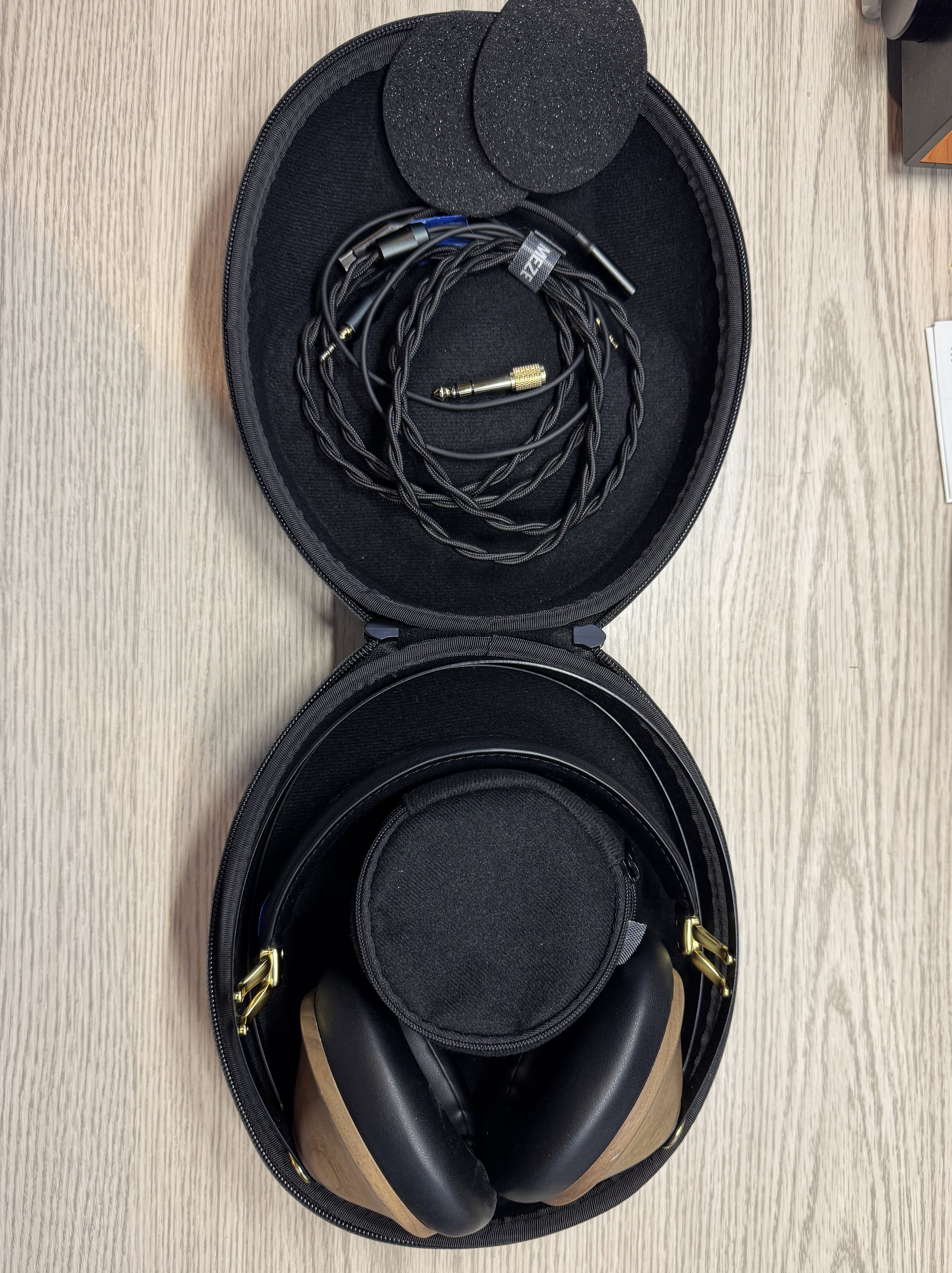
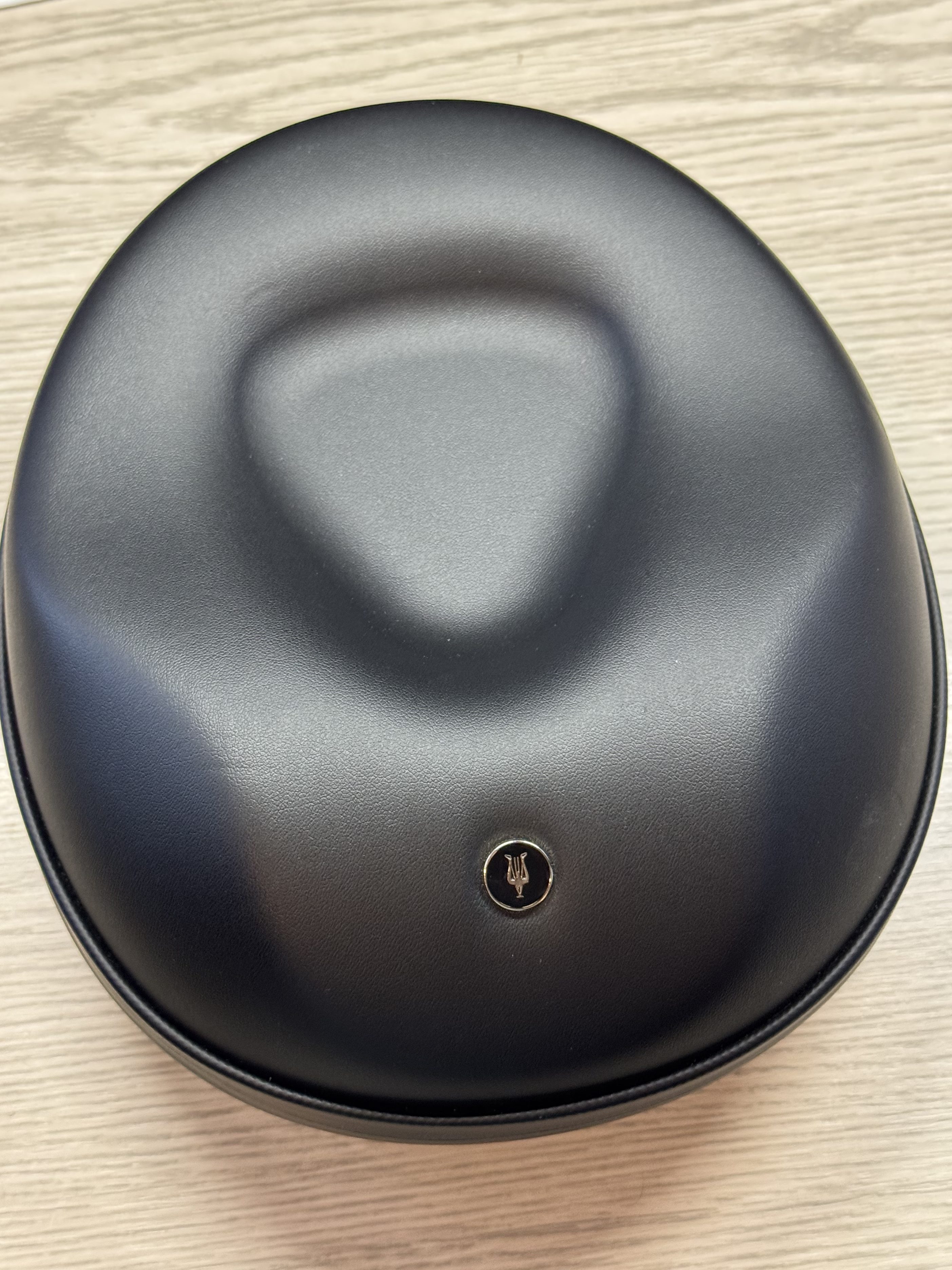
Meze also did a good job with the overall package. The 99 Classics v2 ship with a nice, semi-rigid branded case; a cloth, shaped pouch; a set of foam damping discs to insert into the pads (which I didn’t get12); the aforementioned cable and adapter; and a USB-C dongle. While I would love for Meze to include a balanced cable and threaded adapters, it’s hard to complain about this accessory package at this price point.13
Comfort
Though it shares the general design principles of the 109 Pro and the 105 AER, like the prior 99s the Classics v2 is not nearly as comfortable. They’re fine; they’re about what I’d expect in terms of comfort for a headphone in this general price range, though the cups in particular feel much less premium. This is probably more due to the closed-back nature of the headphone rather than Meze skimping on the materials; the simple reality is that you have many more options when building an open-back headphone than a closed-back one, and even the best leather is unlikely to feel as comfortable as a velour.
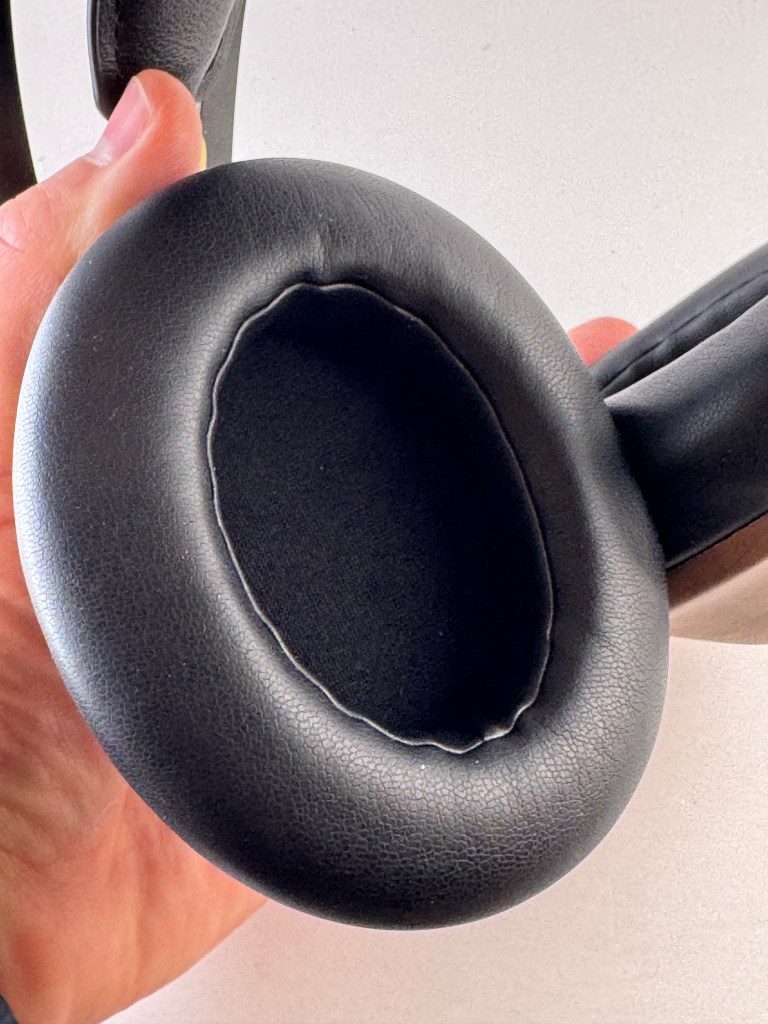
This isn’t to say that the 99 Classics v2 are uncomfortable in any way. The pads are just made out of leather (or pleather?) and are substantially firmer than the velour pads on both the 105/109. They’re also just a hair more clampy; not enough to be uncomfortable, but they just don’t disappear on my head the way the 109 Pro in particular does.
Appearance
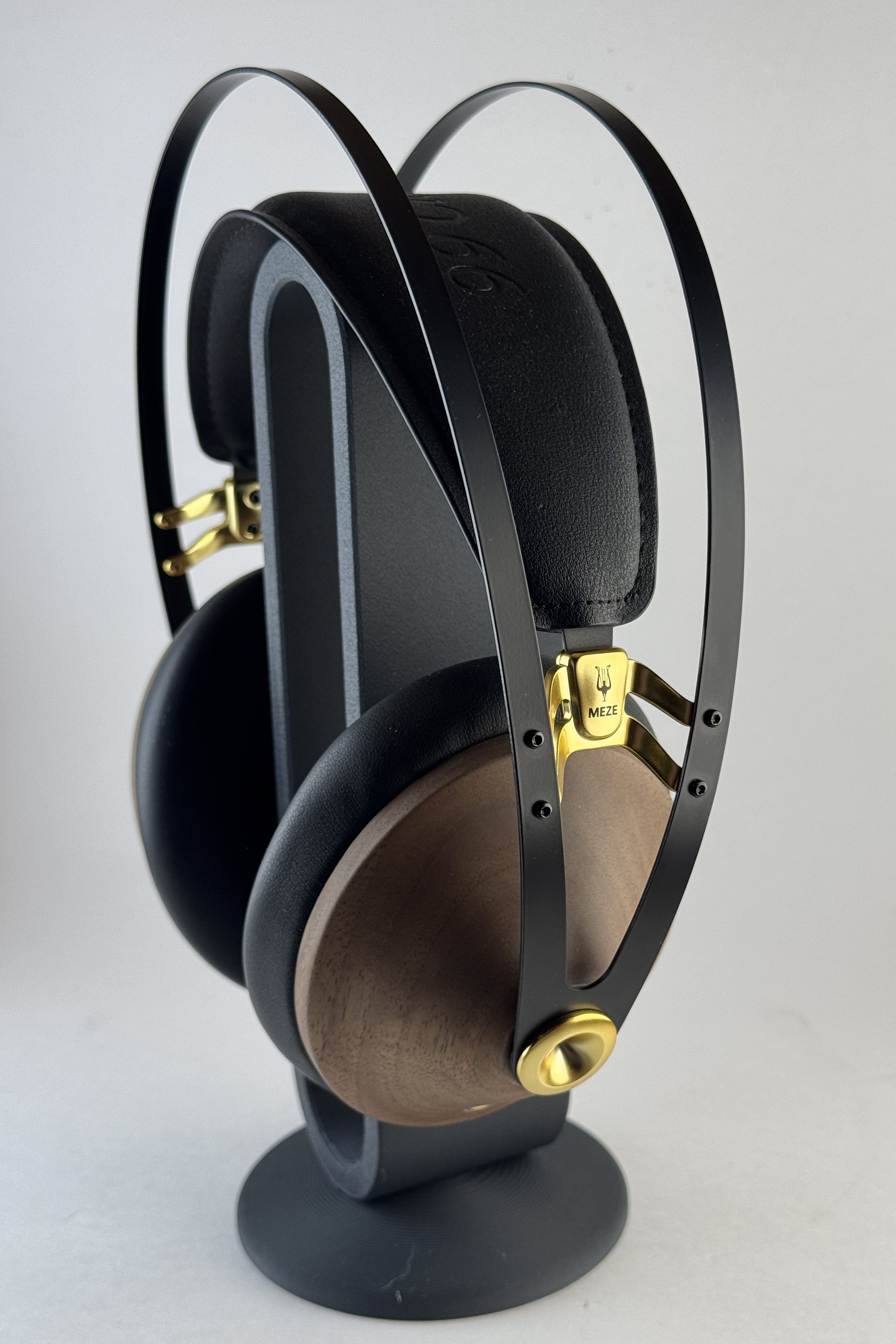
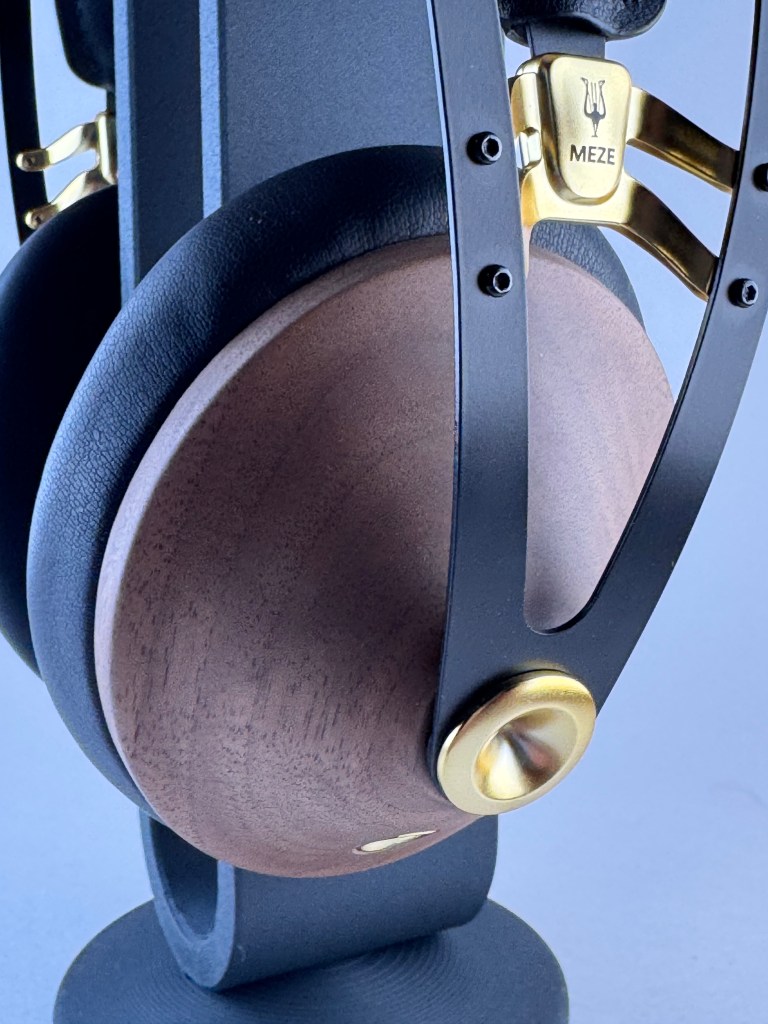
Appearance is, per usual, subjective, but I personally think they’re quite striking. I’d personally prefer the hardware on the cup and suspension mechanism be a little less bling-y, but the combination with the beautiful wood cups is a nice one. I do appreciate that they’re not stained quite as dark as the 99 Noir; overall it’s a very nice aesthetic design and set of color choices, and I appreciate a nice wood-grained headphone.
Value & Comparisons
I think the Meze 99 Classics v2 is a reasonable deal at MSRP (I know, that’s two in a row I endorse at MSRP! Am I going soft in my pre-marital bliss?). There aren’t a lot of closed backs under $500 that I recommend without reservations, and this is joining that rarified air. If all of my closed backs were lost tomorrow, I would seriously consider getting the Classics v2 at MSRP to have a good pair of closed backs sitting around (though that’s in part based on the availability of some of the others, as detailed below).
Fiio FT1
This really isn’t a fair comparison; I really, really like the FT1, but it is a $150 headphone and I’ve just told you that I think the 99 Classics v2 is a pretty good deal at it’s MSRP of $349.99. However, the FT1 is my benchmark for closed backs the way that the HD 6XX is my benchmark for open-backs. The FT1 is an excellent headphone at any price, let alone at $150, and any headphone manufacturer charging more than double that price should be able to substantially outperform it. Fortunately, the 99 Classics v2 do.
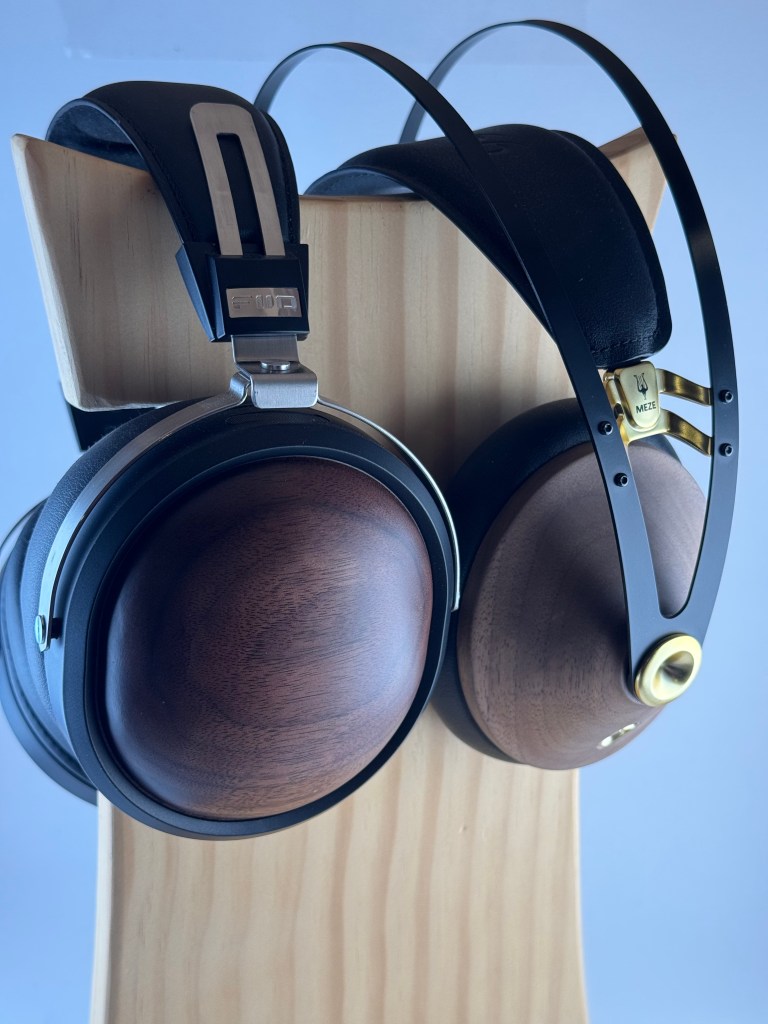
The 99 Classics v2 is a better headphone than the FT1 in pretty much every way except timbre on a few specific bits of the frequency response, particularly for male vocals. The bass on the 99 is better controlled and cleaner (albeit a little lighter in the sub bass), the mids are clearer and mostly timbrally more correct (outside of specifically male vocals), and the treble is mostly more relaxed and pleasant. The 99 Classics v2 is also better built and more comfortable on my head, and I am reasonably confident that they’re going to hold up better in the long run as well. Meze builds great products, and we have yet to see how Fiio’s budget offerings do over the course of a couple of years of regular use.
Here’s how my units measure on my rig:
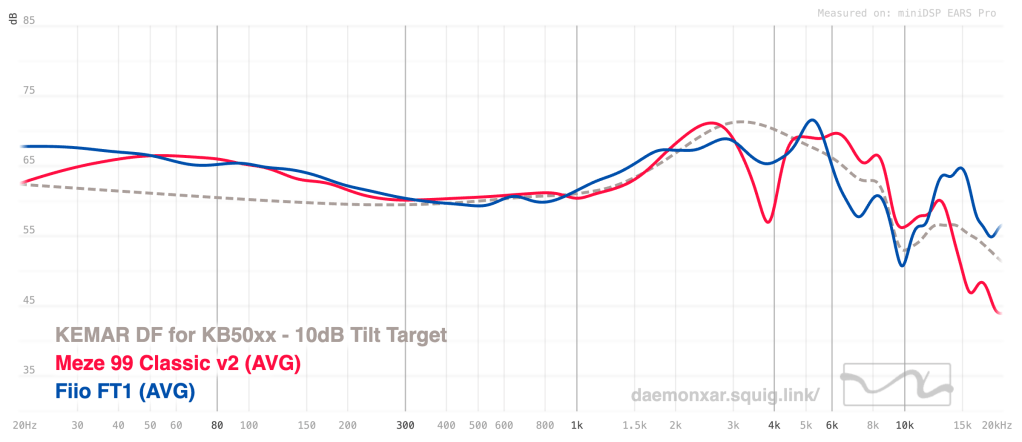
That’s not surprising. The bass sounds substantially cleaner on the 99 Classic and I place a lot of that on the more consistent bass curve and reduced sub bass. When I EQ the FT1 I tend to drop the sub bass a little bit, and this might demonstrate why it works better on my head that way.
Verdict: The 99 Classics v2 is a better headphone. Is it $200 better? Honestly, if you can afford it, I think so? I’ve long said that the FT1 is the only closed back under $500 that I recommend without reservations, and I’m delighted that 2025/26 has really changed that landscape for me. Especially if you can get them under $200, the 99s are a no-brainer over the FT1. And that wasn’t the case for the 99 Noir.
Meze 99 Classics/99 Noir
So my general philosophy is to not compare headphones that I do not physically have in my hands at the same time, as human auditory memory generally sucks, and I aware enough of my own limitations to know that definitely applies to me. I don’t have my 99 Noir anymore, so mostly I can just aim you at my review of the 99 Noir and point out that I sold it a few months ago and haven’t particularly missed it.
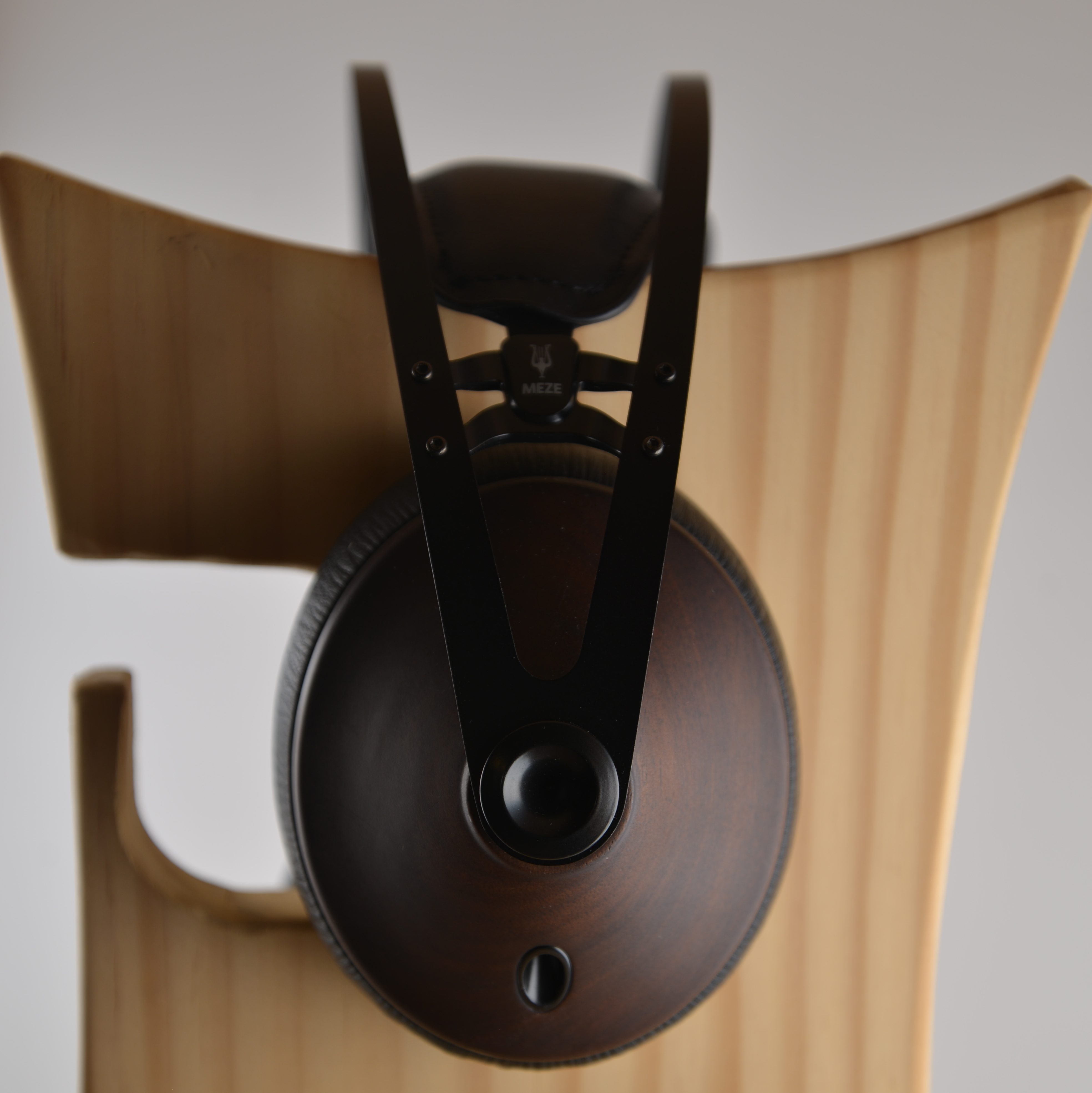
Here’s how Super* Review measured the OG Classics vs. the v2:
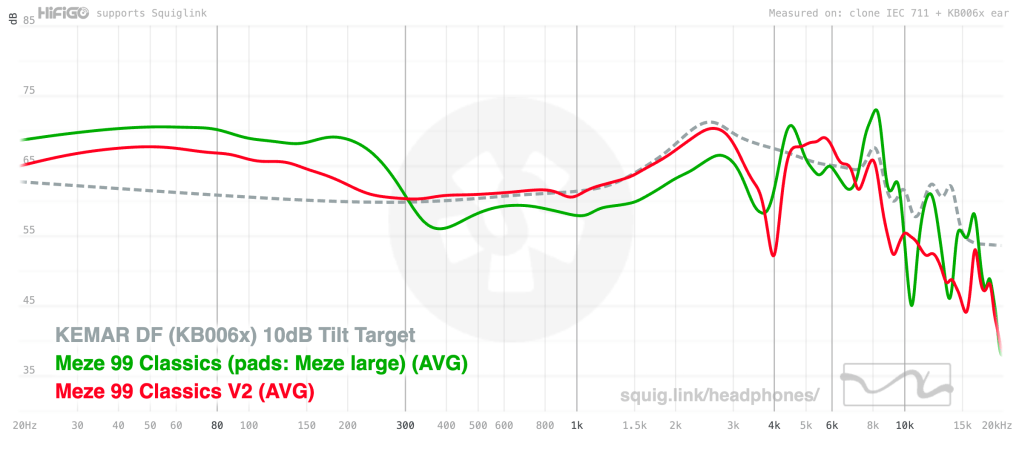
This seems to largely conform to the general opinion that the v2 is a step in the audiophile direction compared to the OG, and goes a long way to explaining why I sold the Noir and will be keeping these at least for the near term.
Verdict: Having not heard them at the same time, I’m picking the v2 over either the OG Classics or the Noir. As much as I liked the Noir initially, I cooled on them substantially when I got a chance to spend time with better-tuned closed backs … and the v2 is a better tuned closed back, at least to my ears and preferences.
Meze Strada
I’ll start by saying that the Meze Strada is, admittedly, a pretty weird tune (but one that I at least generally like). But I’m also no stranger to enjoying marmite tunes14 in the closed back space. They mostly make the 99 Classics v2 look normal by comparison, and out of the box (and for the average consumer), I’m probably recommending the 99 Classics v2 most of the time. That’s not just based on the Strada being more that twice the price of the 99 Classics v2 (though that is a factor); the 99 Classics v2 is just closer to what most people are going to be looking for in a closed back headphone.
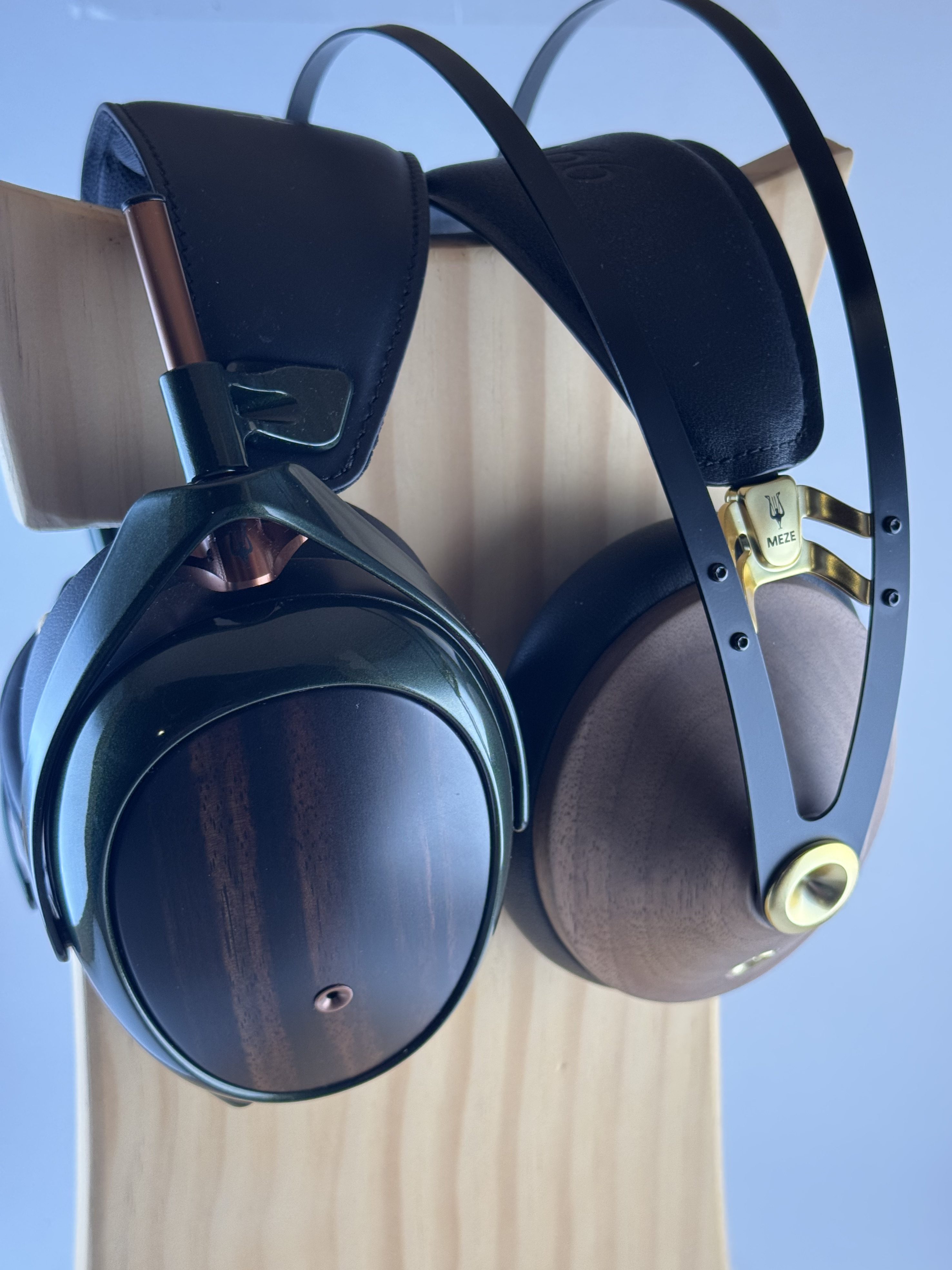
That said, when I swap back and forth quickly between them, the 99 just sound … flat? Boring? The sensation doesn’t last long as my brain adjusts quickly, but it’s there, consistently.
I realize that this contradicts what I wrote above about the 99’s relative levels of sub bass and mid bass (and I’m more or less okay with it), but there’s something about the way the Strada reaches down to the lowest frequencies that just … works for me. You really feel “Violence” in addition to hearing it. It’s also just punchier in a really pleasing way. The mids on the 99 are definitely better: much more present overall and the Strada shares the few timbral issues I have with the 99. Similarly, I’ll take the soundstage from the 99, though I think layer separation (particularly outside the bass) is much cleaner and clearer on the Strada. And I’ll take the Strada’s treble; I haven’t had any of the sharpness issues I’ve had with percussion on the 99s, and the Strada doesn’t have that weird 4 kHz cut. The Strada are also just much, much more comfortable on my head, and a much more aesthetically pleasing headphone (and not just because they more closely resemble the Empyrean/Elite/etc.).
Once you add in EQ, I’ll take every bit of the Strada over the 99. It’s possible that if I invest more time in my 99 tune that I’ll get to a place where I’m as satisfied with it as I am with my custom tune on the Strada, but after a fair amount of time working on the Strada’s frequency response I’m really happy with its performance.
A quick glance at the graphs:
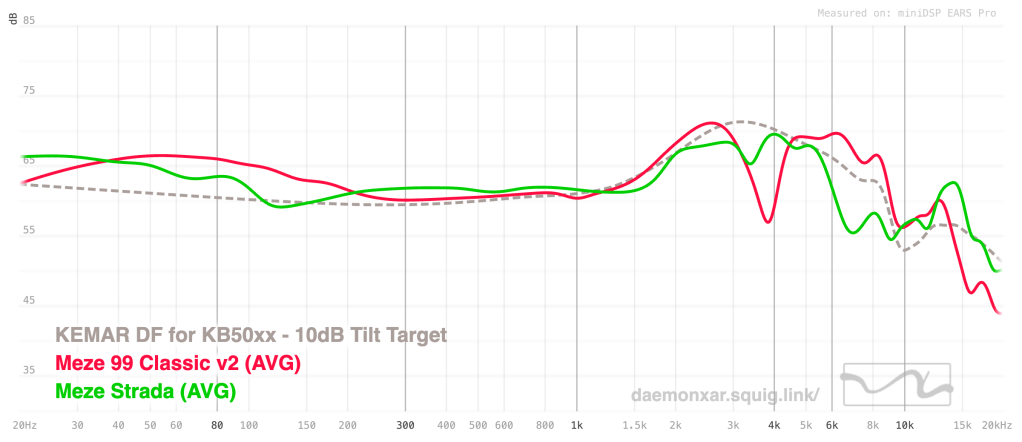
Verdict: For me, I’m taking the Strada. For most people, particularly given the $349 vs. $799 price tag at MSRP, I’m recommending the 99 Classics v2. I think the Strada is pretty clearly the better headphone, but I don’t think it’s going to be $450 better to most people.
Sennheiser HD 480 Pro
To me, this is probably the most fair looking match up; both are recently released closed backs in the same broad price range (the HD 480 Pro retails at $399, pretty close to the 99 Classics v2’s $349 MSRP). That said … the 480 Pro mop the floor with the 99 Classics v2, at least on my head. Spoiler for my forthcoming 480 Pro review, but they’re an incredibly competent closed back headphone. Incredibly comfortable, well-designed and engineered, versatile in terms of how you wear them, and just really, really good sounding. I’m going to spend some more time with them before I sit down to write my review, but at least so far I’ll take the 480 Pro’s bass (cleaner, better controlled, crisper), midrange (not quite to 600-series levels of quality but surprisingly damned close for a closed back), and treble (I don’t hear a single sharp bit on the 480 Pro on anything I’ve listened to with them, even at pretty high volumes).
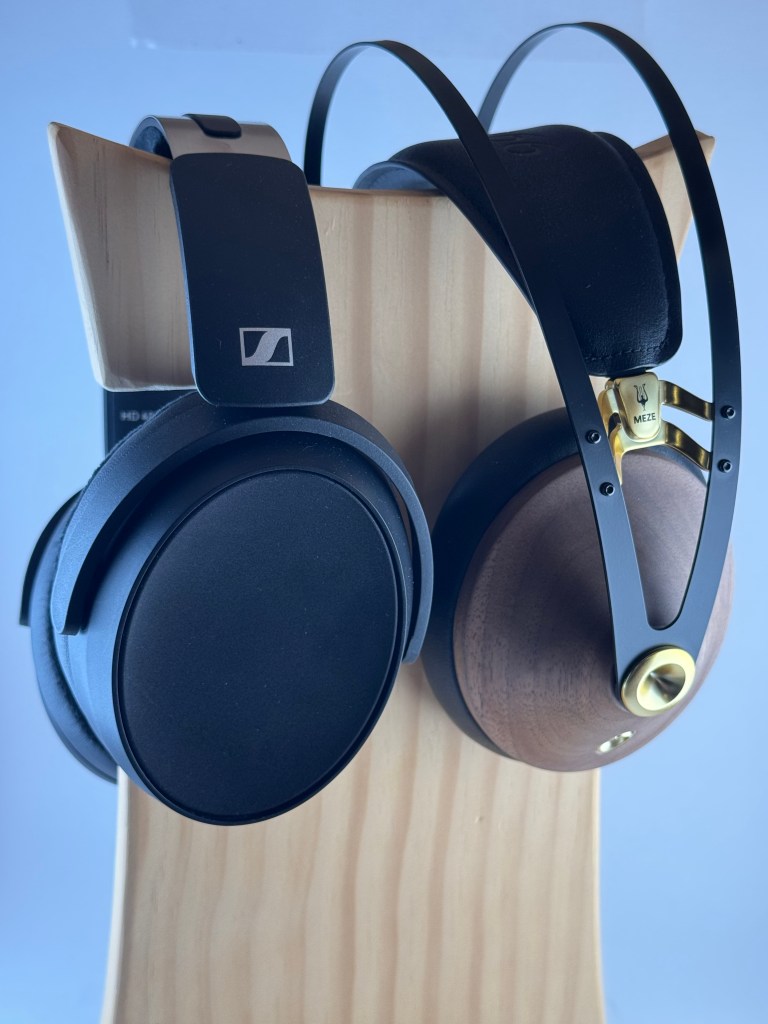
I commented above that when I swap back and forth between the Strada and the 99 Classics v2 that the 99s feel boring; this is so not the case with the 480 Pro. I might have expected a studio-focused headphone like the 480 to be a bit on the clinical, neutral side but … it’s just not. It’s amazing. I think it’s going to displace the Elegia as my favorite closed back.
The 99 is a more complete package, with a better cable (and better cable connection system), a nice case, and better accessories, but if you really want those things you can buy the 480 Pro Plus for an extra $40.15
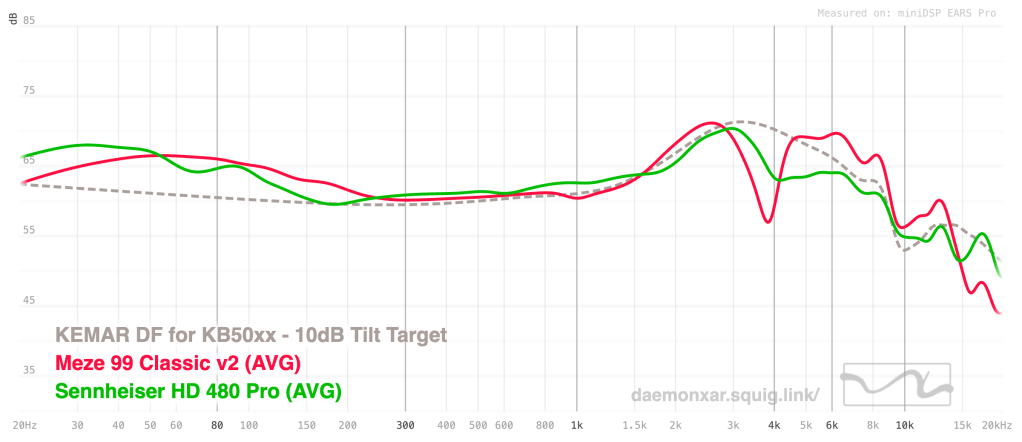
It’s funny; until right this moment I didn’t realize how similarly the Meze Strada and Sennheiser HD 480 graph. That’s going to be fun to talk about when I review them both, as they really do not sound the same on my head. But yeah, that looks about right. The sub bass on the 480 Pro doesn’t feel quite as strong as the Strada, but is definitely more solid than the 99s. On a track like “Violence” there are occasional atmospheric bass thumps as the bass line moves around and they’ve never sounded quite so immersive as they do on the 480 Pro. The 480 also lacks the 4 kHz dip, and has less of the weird treble-isms or timbre issues that the 99 does.
Verdict: For me, for you, for just about everyone (except maybe the folks who want a tuning more like a Bose or Sony headphone), the 480 Pro is the better option. If you can afford the extra $50, it’s so worth it. If you can’t afford the extra $50 … consider saving for a bit to get a better headphone.
Focal Elegia
The Focal Elegia is my favorite-sounding16 closed back headphone to date (I do fear the HD 480 Pro might unseat it soon17), even though I know it’s not a traditionally-tuned closed back. I know intellectually that it’s not particularly bassy, and I’ve even measured my own unit to make sure it’s not some outlier … but oh boy does that Focal magic slam, especially on the lower end. And for whatever reason, the old-style larger Focals just fit incredibly well on my head.
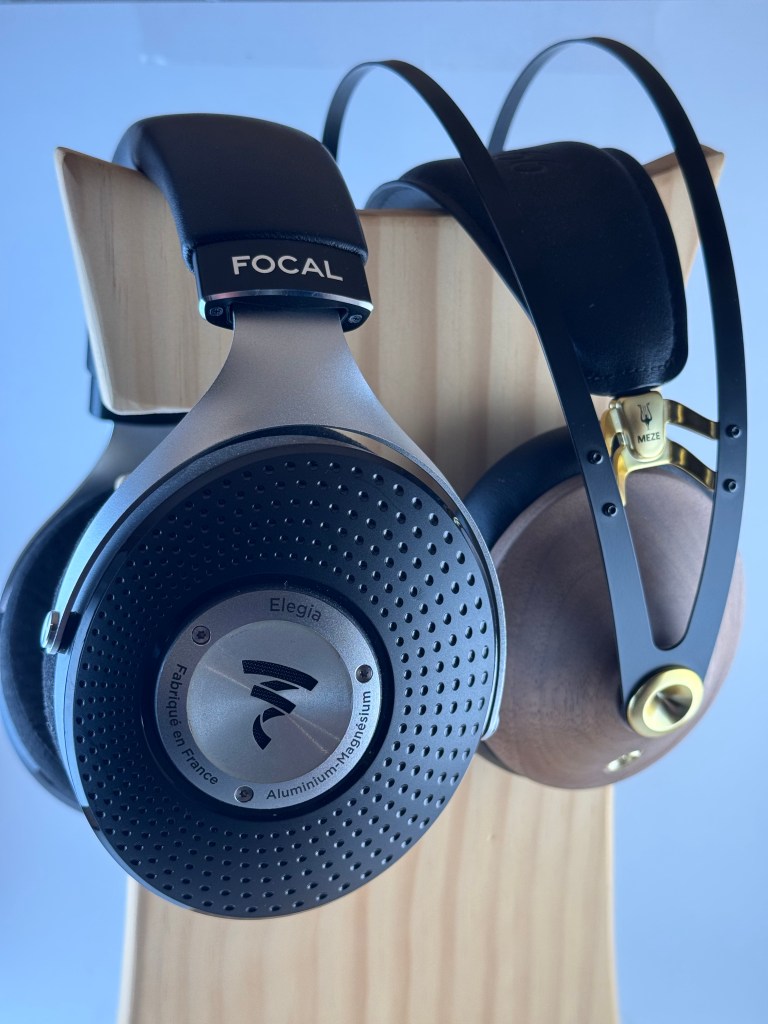
Huh, I forget sometimes how much I like the Elegia. The bass is definitely a little laid back compared to the 99, but it’s so. damned. punchy. and. clean. that I prefer it by a pretty good margin. At the end of the day, I’ll pretty much always trade quantity for quality when it comes to bass, and with the Elegia’s dynamism I’ll do it with a smile. Mids-wise, both struggle occasionally with timbre issues (male vocals in particular can shade a little metallic on both), but I feel like the transitions from the midrange to the treble and bass are better handled and more cohesive on the Elegia so I’ll take that too. And, of course, the treble on the Elegia is only rarely spike-y, and only in pretty high frequencies that aren’t as common in the music I listen to. Soundstage is pretty similar, though the Elegia has (at least to my ears) much better layer and instruments separation on a track like “Chan Chan.” It’s just a better, more resolving, more technical headphone. Which you’d expect, given the Elegia’s original almost-$900 price tag.
Here’s how my individual units match up, graphs-wise:
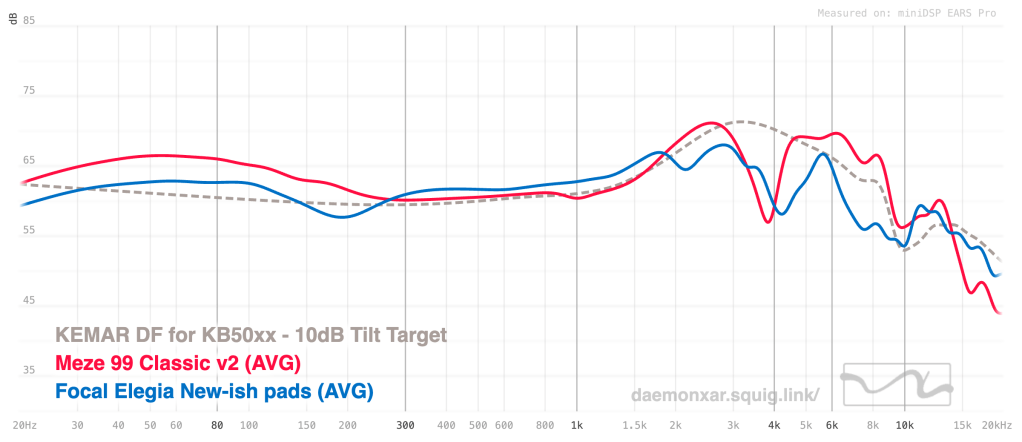
This is … actually pretty surprising to me. Genuinely, I don’t hear the difference in bass as being this big, I’m a little surprised to see that the Elegia’s 4 kHz dip is almost as big as the 99’s (even if it’s shifted up 250 Hz or so). The treble totally makes sense, but I’m also surprised by the general shape of the graphs from 1-3 kHz; the Elegia feels so much more cohesive to me that I expected it would have a more traditional (and target mirroring) mids to treble transition. A great reminder that graphs are only the beginning of the story for me.
Verdict: Elegia, obviously. Again, the 99 is probably closer to what the average person (particularly the average non-audiophile) is looking for in a closed back headphone, but the Elegia’s dynamism is just what I want out of a headphone. I need to get it back in my rotation more frequently.
I probably wouldn’t recommend the Elegia over the 99 at MSRP, but I see this pop up used pretty regularly between $200-300 and there’s no question in my mind that even at $350-400 I’m taking the Elegia all day over any of the 99 family.
[Editor’s note: while I was typing up the verdict below Dominique Fils-Aime’s “Birds” came up on a playlist and … damn. The resonance and richness of the strings, the controlled, beautiful crispness of the percussion, the timbre of Ms. Fils-Aime’s voice … yeah, easy call for me. I really love these headphones. No shade to the 99s, but the Elegia is just better.]
Capra Ouroboros
I just want to throw this in here to highlight how damned good the Capra Audio Ouroboros is for a closed back18, particularly a DIY one with 3D printed shell. As much as I enjoy the 99 Classics v2 (and I do enjoy them), I … think I prefer the sound of the Ouroboros overall, particularly the Golem-modded version.19 There are a few funky things about this headphone (the bass is occasionally a little muddy, and sometimes vocals (particularly background vocals on a track like “Drawn”) can feel a bit veiled, but damn … overall they’re a great sounding headphone. The only part of the 99s I’d take over the Ouroboros is the midrange, especially vocals; on the Ouros Snoop sounds pretty far in the background on De La Soul’s “Pain”, and I should probably work on an EQ setting for the Ouro that balances the vocals a little more.
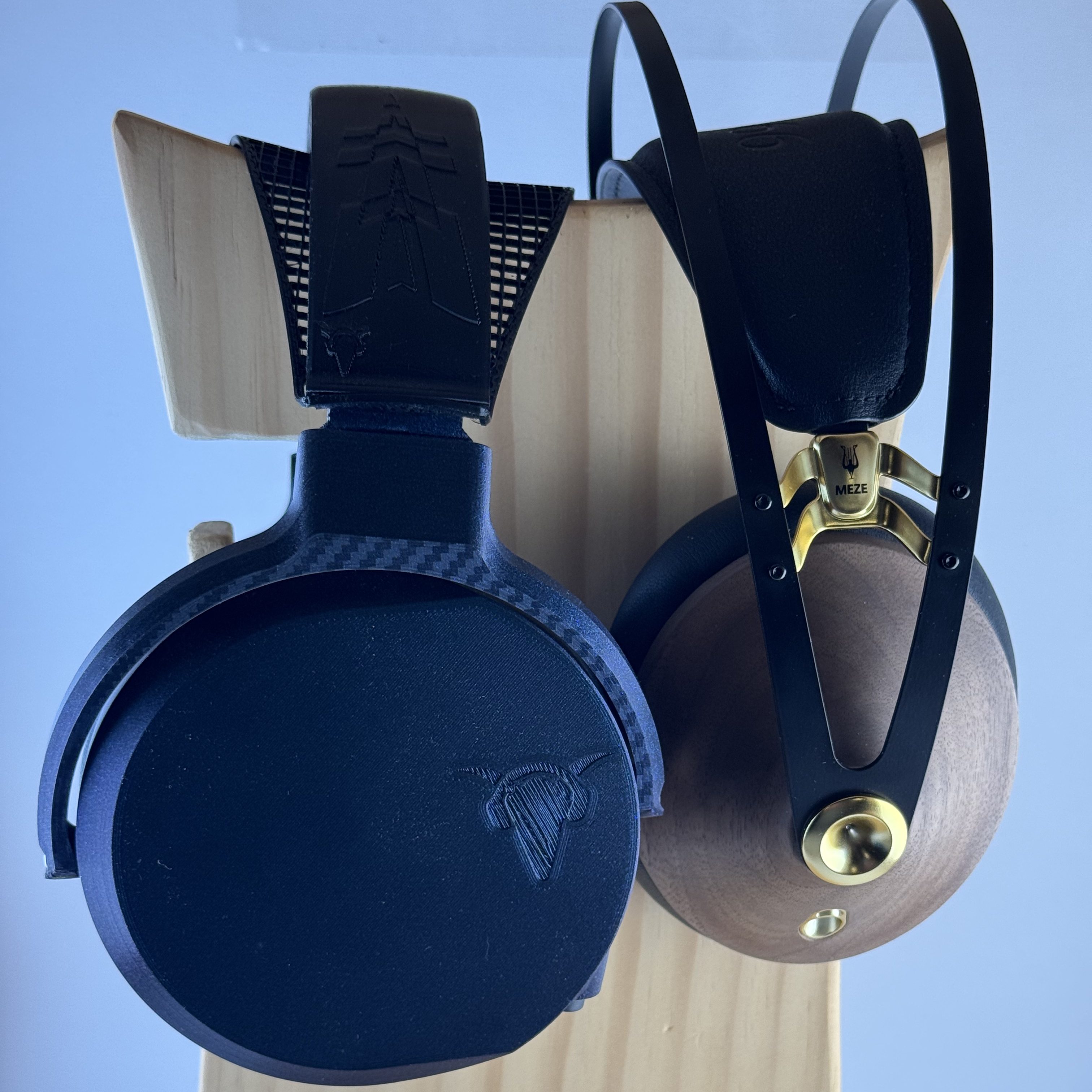
I made my first Ouroboros so that I could say that I built a decent sounding closed back. I didn’t expect to genuinely like them anywhere near as much as I do. There’s just a depth and tactility to its sound that the 99 occasionally falls short of, particularly in the upper bass and lower midrange. In comparison, on a track like “Birds” the 99s sound a little bit tinny. And that’s saying quite something for a headphone built around the drivers from a pretty terrible gaming headset.
A quick look at the graphs20:
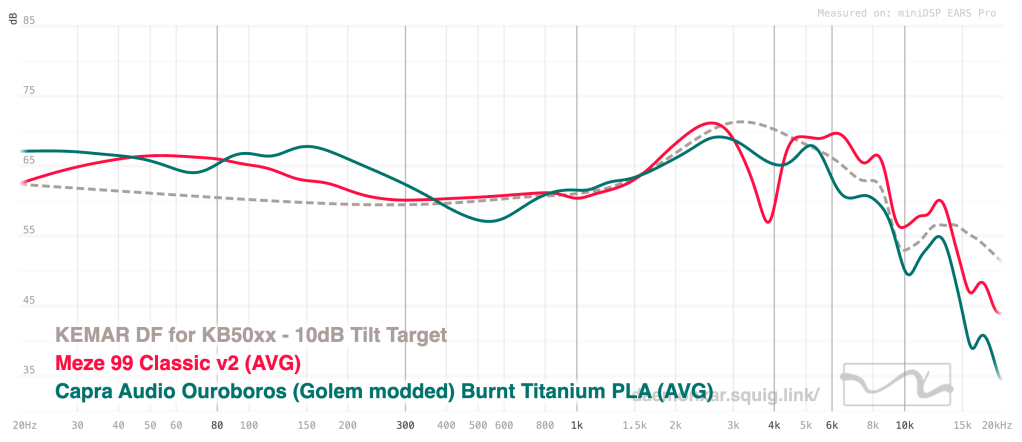
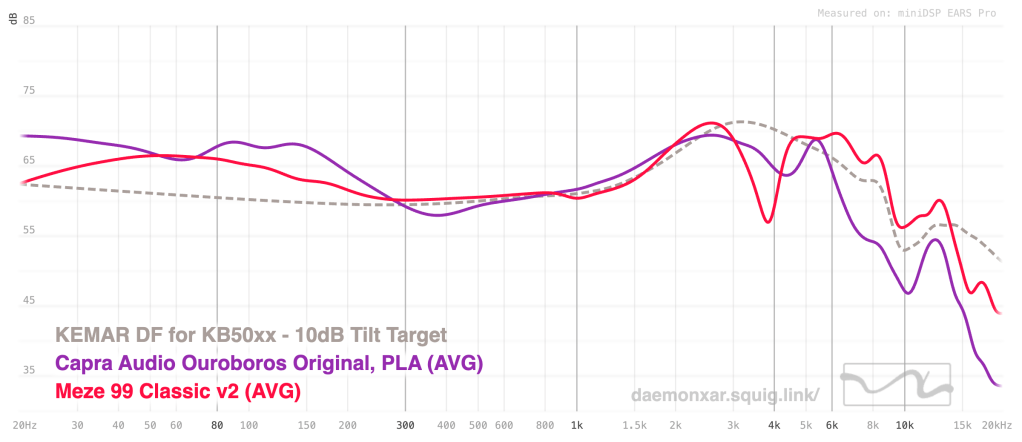
Verdict: For most people, the 99 Classics v2 is going to be a better option. For someone with a 3D printer, some basic tinkering skills, and a bit of equipment, the Ouroboros is a $60 or so replacement for the 99 that sounds pretty close to as good, and would let you redirect that extra $300 to a different and potentially more interesting pair of headphones. I’m not saying everyone should join the DIY space, but if you have even an inkling of interest, this is your sign to build a pair while you can still find their drivers out in the world, used.
Overall
I’m very impressed with the Meze Classics v2, overall. The reviews have largely been pretty positive, but they were also pretty positive in the early days after the 99 Noir’s release, and I think general opinions of that headphone have soured quite a bit since. In his recent review, Mark Ryan Sallee (aka Super* Review) noted that the original 99 Classic was consistently one of the top picks for non-audiophiles he demoed headphones for, and I get it. It’s a much more consumer-oriented tune, and that might be part of why I liked it so much up front when I was making my jump from things like Bose to more seriously-audiophile focused headphones. My tastes have definitely shifted since then, and I’m glad that Meze decided to give the 99s a more audiophile-focused makeover
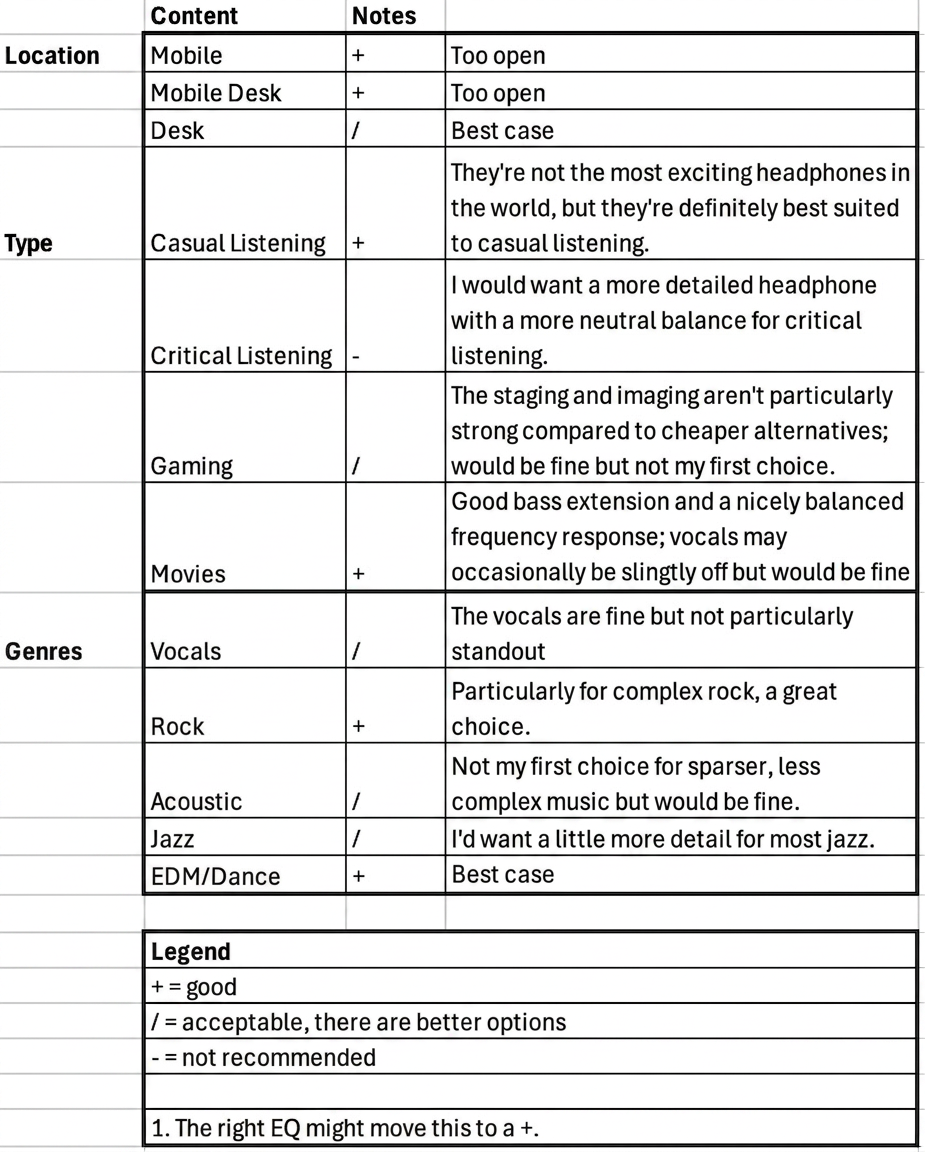
That said, while the 99 Classics v2 are a very competent and nice sounding headphone, they’re probably not for me. I’m more likely to grab something like the HD 480 Pro or Elegia when I want a closed back, or even the Ouroboros. That doesn’t prevent me from wholeheartedly endorsing them for people who want a more consumer-oriented bass tuning with a relatively relaxed treble presentation; I can see what Meze was going for with the 99s and they hit that mark quite squarely.
I’ve got a bunch of upcoming closed back reviews in the queue (Focal Celestee, Sennheiser HD 480 Pro, Beyerdynamic DT 270 Pro, etc.) so I’m going to hold on to these for a bit, but I’m guessing they won’t make my permanent collection. It’s funny … I’ve gone from a world in which there’s only one closed back under $500 that I recommend without reservations to one with at least four that I currently have in my house. Truly, an embarrassment of riches, and two years ago I probably would have loved the 99 Classics v2 and recommended them constantly.
- I score bass, mids, and treble on a two part scale: 1-5 for quantity (5 being the highest), and A-E for quality (A being best in class, E being laughably bad). For soundstage itu2019s also a two part scale, with the number representing the width and the letter the separation within it. ↩︎
- For comfort/fit, my scale is A-E with A being disappear entirely into the background and E being I want to tear my ears off to stop feeling these headphones on my head. Iu2019ve had one E: the Koss PortaPro. ↩︎
- I probably should review them at some point, but I’m not sure I have it in me to ever really recommend anyone buy a $3,000 headphone … but I also can’t bring myself to regret owning them. ↩︎
- DSP is magic, and lets smart manufacturers achieve some remarkably pleasant tunings without having to invest huge amounts in R&D. ↩︎
- A Beyer that I don’t hate? I’m shocked too. It definitely is a bit crazy bass-wise out of the box, but with a little bit of a bass attenuation … it’s a shockingly competent headphone, let alone a budget closed back. ↩︎
- I’m pretty skeptical of the audibility of any differences between single-ended and balanced (outside of a very weird and specific use case with the HD 6XX), but I often run balanced when I can because it’s the only way to use the Apos Gremlin. Also XLR is just cool. ↩︎
- I’m not going to review it here, but it generally seems perfectly competent. And that’s all I really want from a dongle. ↩︎
- Weirdly hard to find anyone who has measured them both, but general consensus seems to be that the 99 Noir were acoustically identical to the 99 Classics post-silent pad revision. I’m sorry I didn’t get a chance to measure mine before I sold them! ↩︎
- It’s worth noting that, as I’ll discuss later, the 99 Classics v2 doesn’t have a true right or left cup; they both can be used interchangeably. I find this … weirdly unsettling. ↩︎
- When I look back at my 99 Noir review I call out the claps on “Paradise Circus”; I’d love to be able to compare them. Maybe I’ll need to track down another pair at some point! ↩︎
- I haven’t the faintest clue what the filters actually are on the DX5 II, but for whatever reason changing it seems to reduce (but not eliminate) my irritation with specific bits of treble. ↩︎
- Turns out … I did. I’ll measure with then when I get my rig back. ↩︎
- And as far as I can tell, none of the Meze cables come with threaded adapters, even the ones that ship with the 109 Pro or Strada. I would love them to rethink that though! ↩︎
- See https://daemonxar.com/phils-audio-glossary/#m ↩︎
- You shouldn’t buy the 480 Pro Plus. ↩︎
- The Bokeh Closed will always have my heart overall for … reasons. ↩︎
- And I’m curious to spend more time with the Focal Celestee, as well. ↩︎
- I really should get around to doing a review for it; it’s definitely worth the time investment. ↩︎
- The difference between my base Ouro and my Golem version isn’t huge, but it’s pretty consistently a 1-3 dB drop in bass below 150 Hz, a similar bump in the mid bass to midrange transition, and a slightly more exciting treble region. ↩︎
- As always, any flaws in the measurements are solely mine, and this is particularly true of a DIY headphone where I did my best to follow the instructions (and I’ve produced several pairs that sound the same), but zero fault to Capra if I got it wrong. ↩︎


Leave a Reply