
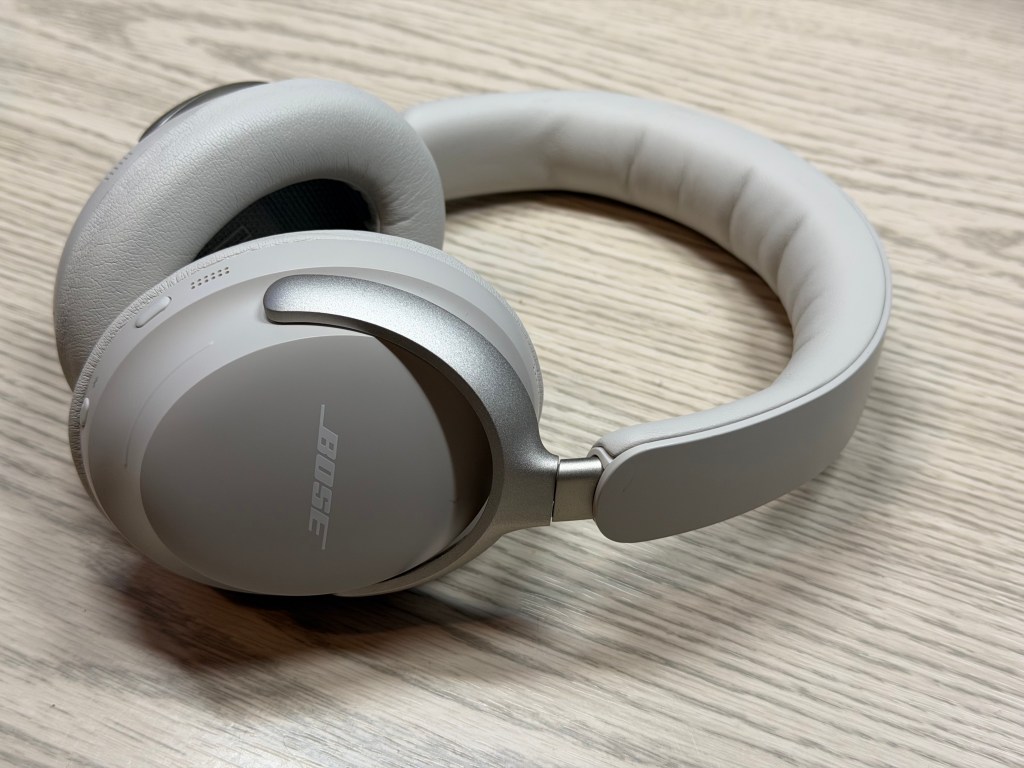
[ORIGINAL MSRP $449. Purchased from used from r/AVexchange for $125 in February 2026. Available new for $338 from Amazon or renewed for around $250 in August 2026]
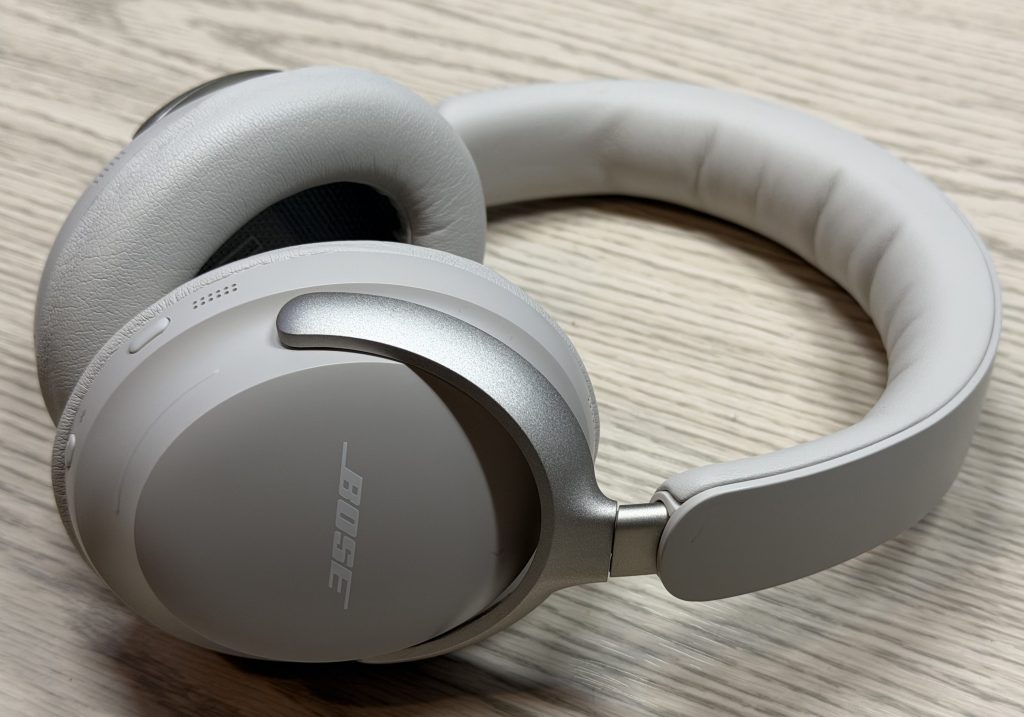
[Tl;dr: The Bose QCU are a surprisingly good ANC headphone option, even in a pretty crowded marketplace. They have the best ANC outside of the Sonys among the models I’ve heard/reviewed, and unlike the Sonys, I think they’re worth listening to (after a little bit of EQ adjustment in the Bose app). I will still take the Bathys or HDB 630 over them if we’re not considering pricing, but with the release of the QCU Gen 2 and the availability of Gen 1 renewed units, the QCU are a pretty compelling and competitive offering for travel use.]
Scores:
Cost-agnostic: 7 out of 10 Denalis
Cost-sensitive: 5 out of 10 Denalis (MSRP) or 9 out of 10 Denalis (current renewed pricing)
| Bass1 | Mids | Treble | Soundstage | Comfort/Fit2 | |
| Bose QC Ultra (original) | 5D (bass) 4B (w/my EQ) | 3C | 5D (base) 4C (w/my EQ) | 3C | C |
TABLE OF CONTENTS:
Intro to the Intro
This is a “quick” review. There are a number of things that I’d love to get quick notes down on for my own edification/memory, but that I don’t want to spend the substantial time I devote to most of my (overly?) in-depth reviews on. Some of these will be things that aren’t in production anymore (so it’s less likely anyone will read a review), or are extra niche, or are things that I didn’t particularly like but want to be able to point people to my reasoning, or that are in a category I don’t spend a lot of time with (like IEMs). Today, the Bose QC Ultra, a good headphone that’s been superceded by a later generation but still widely available, and at a substantially reduced price.
Introduction
My first experience with noise canceling was in 2009 or 2010, when my dad sent me to a big box store to buy a pair of Bose QC15 during an extended hospital stay when he got stuck with a roommate who blasted Fox News all day at ear-breaking volumes.
I was, to say the least, pretty impressed. So impressed, in fact, that I went out a year or two later to buy a pair of QC 25s for myself before a work trip. A few years after that I went to a pension law conference in San Diego and decided to splurge on a pair of QC 35 at Costco, my first ever Bluetooth ANC headphone. I ended up being underwhelmed by them (and thus returned them, thanks Costco!), but a few years after that I ended up with a pair of Bose 700s, a pair that I really liked. After I gave those to my now-wife, I tried the Bose Quietcomfort SE which was … again, pretty underwhelming and I took a detour into other kinds of ANC Bluetooth headphones. In general, as my auditory palate developed I just found the Bose house sound … boring. Better than Sony’s bassy nonsense, or B&W’s bananas treble balance, but … boring.
Enter the Bose QC Ultra (“QCU”), a more audio-focused take on a wireless headphone released in 2023.
Testing rig
Here’s my basic testing protocol.
The Bose QC Ultra is intended primarily as a wireless Bluetooth headphone, so that’s the way that I’ve been mostly listening to it. I’m mostly doing my listening to the Ultra connected to my iPhone 17 running Roon Arc. I’m also testing it primarily in Quiet mode with Immersion turned off; to me, that’s the way to get the best sound out of them.
Volume
Here are the volume settings I use with the Bose QC Ultra (running via Roon Arc with no headroom management, playing Daft Punk’s “Face to Face” from Tidal):
- Apple iPhone 17: 45%
- Apple M1 MacBook Air: 55%
- Apple M2 Ultra Mac Studio: 50%
My torture testing list
My torture testing list: Apple, Tidal, Spotify.]
The Basics
The 1st Generation Quietcomfort Ultra (“QCU”) are a wireless, active noise canceling (ANC) headphone from long-time consumer audio manufacturer Bose. They are Bose’s attempt at a more premium headset after more than ten years of mostly boring products (from an audiophile perspective, at least). They retain the form/design of the Bose 35, 45, and Quietcomfort SE/SC/etc. headphones while adding a much more audio-focused tune (or at least a tune that can be adjusted to be more audio-focused with a bit of EQ). Like most modern ANC headphones, the Ultra can be connected to a source via 1) Bluetooth (the primary, and preferred, connection method for most use cases3) or 2) via a 3.5 mm connection (which you shouldn’t do if you have any alternatives). It, bizarrely, does not offer a wired USB-C connection option. It offers three primary listening modes: “quiet” (aka maximum ANC), “aware” (aka transparency), and “immersion” (aka ANC + their own special spatial mode), and “custom” (aka dealer’s choice). You also have the ability to turn immersion on or off on any of the other modes. Spoiler: I’d pretty strongly recommend leaving immersion off pretty much always.
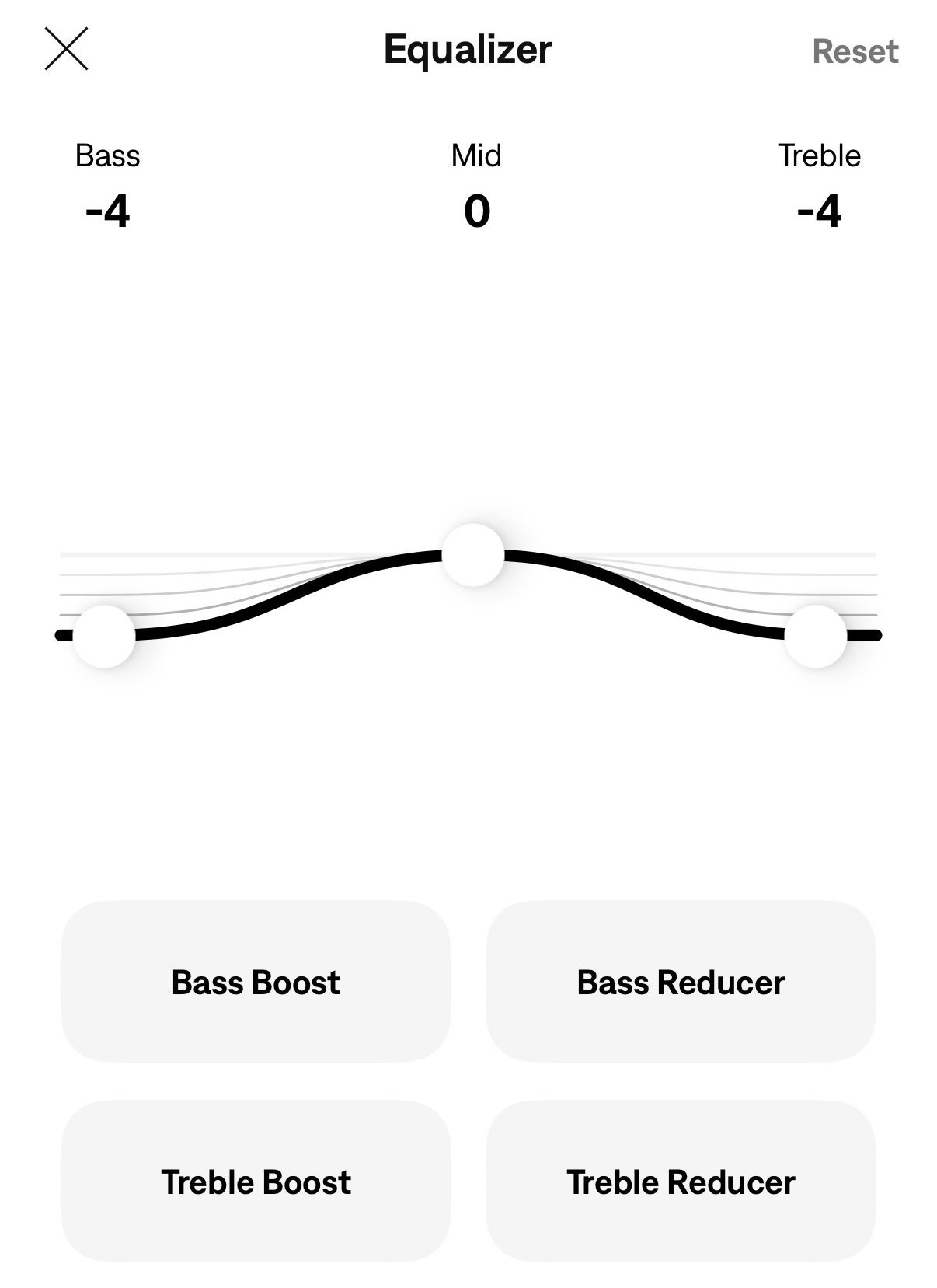
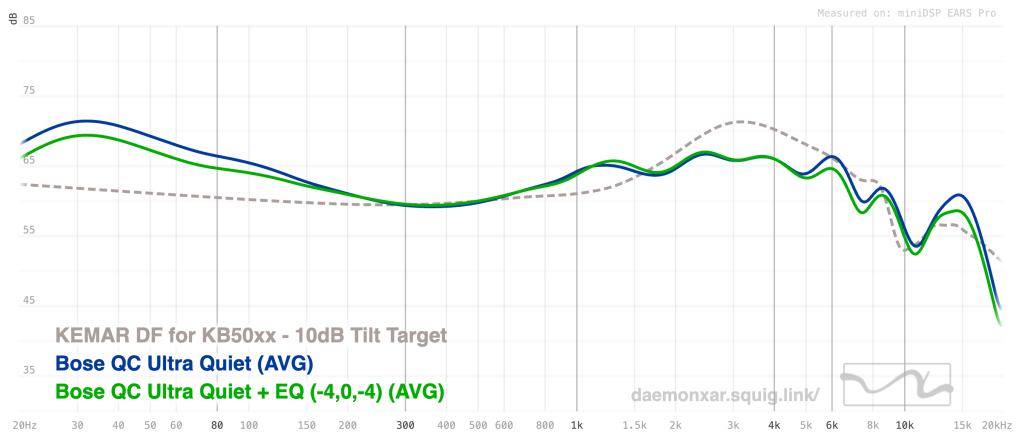
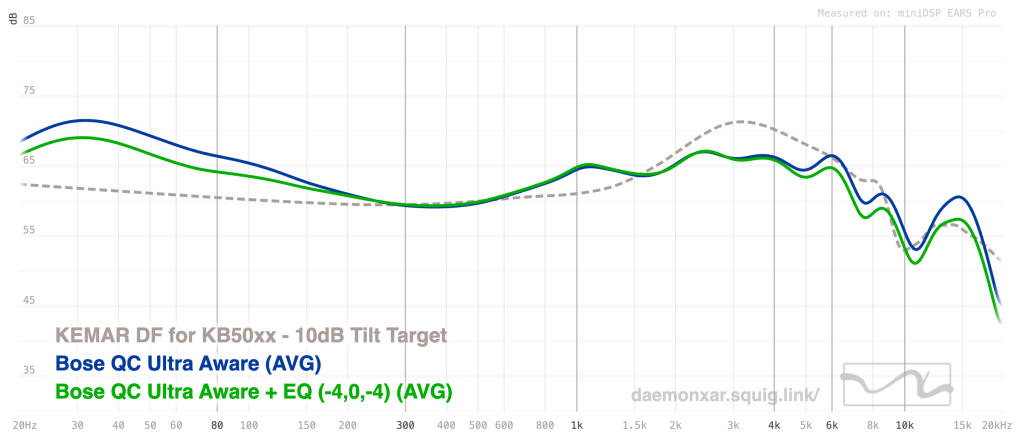
EQ: The Bose app offers a simple, three-band EQ functionality. You can select from -10 to +10 (no units provided) for “Bass”, “Mid,” and “Treble” with no guidance as to what each of those do. Bose also offers four EQ presets, bass and treble boost and reducer, though I wouldn’t personally recommend any of them. To me, the Ultra are a bit too bassy and sharp in the treble for my preference out of the box, so I’ve been adding a -5, 0, -5 EQ for my listening and I think they get the Ultra to a pretty good place, tuning-wise.
Based on measurements,4 it looks like the “bass” slider for the QC Ultra is pretty broad and runs roughly from 20-150 Hz, and the “treble” slider from roughly 4-20 kHz
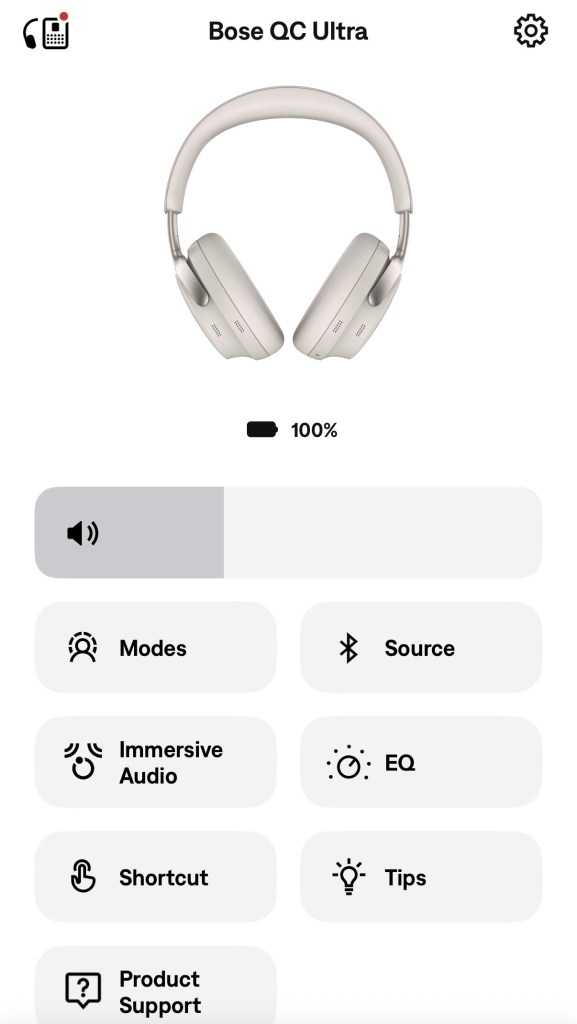
The App. The Bose app is perfectly competent, if nothing special. It gives you visual access to the modes (and lets you pick which of them you want to be cycled through by holding the multifunction button), pick your source (including multi-point functionality), toggle immersive mode on and off, apply a basic three band EQ, set your shortcut key, and review tips. It’s pretty decent for an ANC headphone app, responsive and stable. In six months of use, I haven’t had a single crash or error. It’s sad that that’s the bar … but in this space it really is.
Controls. One thing I do really appreciate about the Ultra is that it *mostly* relies on physical controls rather than the touch controls that many of its mainstream competitors rely on (Momentum 4, I’m looking at you!). On the right cup, you have two buttons on the outer rim: a relatively large multifunction button (using standard Apple controls: tap for pause/play, double press to skip forward/triple press to skip back, hold to cycle through listening modes) in the middle of the back, and a smaller button farther down to power on or off the unit (long press) or to enter pairing mode (very long press). There is also a touch slider set just outside that rim, and sliding your finger up or down will change the volume. As much as I generally loathe touch controls, this is … well implemented. Can’t use it in thick gloves, but I appreciate that the touch control isn’t something you have to use, as I can adjust volume via my phone, watch, or Siri. Also, a long hold on the slider will also trigger the “shortcut” you selected in the Bose app; I believe by default the shortcut is turned off but I have linked it to Siri.
I really do appreciate that Bose broke with convention here and decided to go mostly with physical controls. There are no controls on the left ear cup, though it does have both the USB-C charging port and the 3.5 mm jack.
The microphone appears to be pretty competent; I used it in a meeting today while sitting in a (it turns out to be) very loud coffee shop/roastery, and my colleagues reported basically no bleed through of environmental noises.
Sound
I’m going to start by saying that overall, these are one of the best sounding ANC wireless headsets on the market (which is, admittedly, like being the tallest blade of grass in a barren desert), but overall I’m pretty impressed … with one caveat: you need to use the built in EQ. Without any EQ, they’re boomy and muddy in the bass and occasionally a bit spikey in the treble. With EQ, though, they really shine.
Because this is a quick review, I’m going to try to keep it a bit brief.
The soundstage on the Ultra isn’t particularly wide. On a track like “Chan Chan” you definitely get some stereo separation and instruments aren’t clustered together a la the 3-blob effect, but there’s not very much lateral separation between instruments. The bass is slightly farther out to the left than the left channel’s guitar line, but it’s not by much. It definitely has a little bit of front-to-back staging, with the guitar riff opening “Love Can Damage Your Health (Laid Mix)” slightly rotational. While instrument separation is also competent, it doesn’t stand out. I can hear that there are two singers on “Chan Chan” but they sound like they’re standing in the same spot (just slightly left of center) instead of being distinct in space. Instruments that overlap in frequency tend to blend together a bit too. Detail and resolution are similarly fine; I rarely feel like anything is missing, but neither do I hear anything new in tracks.
The dynamic range is fine. Starting “It’s All So Incredibly Loud” at a comfortable volume gets me reaching for the volume control around 3:00. Microdynamics are reasonable, but I find myself wanting a bit more from the bell tones in “Angel (Blur Remix”), though the treble tones are closer to the level of attack and accent that I want. Timbre was generally correct throughout most of my listening (and during my intermittent use over the last six months or so), though on a track like Rihanna’s “Same Ol’ Mistakes”, Rihanna and Kevin Parker bleed together a lot instead of being distinct and recognizable.
Bass
The bass on the Ultra, as EQ’d, is really good. The bass is rich and textured on a track like Alt-J’s “3WW”, full and vibrant. It even gets down into the lower regions on a track like “Welcome to the World of the Plastic Beach,” where most headphone’s bass performance goes to die. I would say that post EQ the bass feels a little bit uneven; I’d be VERY curious to know what -5 on bass means in terms of frequency, intensity, and Q factor.
A word of caution: even with a -4 or -5 bass EQ applied, this is the kind of headphone where listening to too much bassy music for too long can be headache inducing for me. After a three hour plane flight watching movies with the Ultra, I think I might turn down the bass a little more.
Midrange
The midrange on the Ultra is fine, after EQ; without any EQ, to my ears the mids get pretty solidly lost in the emphasized bass and treble. These definitely aren’t going to be a midrange standout, but they’re perfectly acceptable. It’s difficult to tell apart Rihanna and Kevin Parker on “Same Ol’ Mistakes”, Jill Scott is present and clean on “Calls” but further back in the mix than I might want (and with her secondary runs and background vocals really disappearing in more crowded sections of that track), and Johnny Cash sounds just a little flat on “Hurt.” It’s not bad, per se … just overall lacks anything that stands out in a good way.
Treble
The treble is perfectly fine for a consumer-tuned headphone. Nothing gets particularly sharp on “2021” or “Will O’ the Wisp”, and the bells on “Coffee” are appropriately reproduced. Occasionally things in the upper mids to lower treble transition will feel a little quiet or subdued, though that may be more a function of the heavy bass (especially mid bass) profile.
Gaming
You don’t want to use these for gaming if you have any meaningful alternative. Latency is a problem (even with movies, occasionally), and you still don’t want to use them wired.
Noise Cancellation
The noise cancelation on the Ultra is really quite good, beating out everything in my current collection pretty handily. On a plane in Quiet mode, plane noises are attenuated to a mild hiss, though it doesn’t do nearly as well handling higher frequency and more intermittent noises (aka people). On Aware mode, you definitely get a lot more hissing from the plane (though they sound more like an overeager HVAC system than a jet engine, which is a plus!), and of course people are emphasized.
The QCU is a real jump up in quality over both Bose’s prior products like the Quietcomfort as well as more premium products like the Focal Bathys or Sennheiser Momentum 4/HDB 630, and I’d put them roughly on par with things like the Sony XM5-6 for ANC.
Build
[Observant readers may note some of this sounds like it’s cribbed from my Bose Quietcomfort SC review. That’s because … well, it is. The Ultra is physically VERY similar to the older Quietcomfort models in terms of build, though the software and electronics have been substantially updated, the physical form and design are nearly identical.]
Construction. Like all of the other Bose headphones I’ve tried other than the 700s, the Ultra feel reasonably cheap and plasticky and the pleather ear pads are acceptable but not great. This is reinforced by how light they are, around 253 grams (around ten grams heavier than the latest Quietcomforts). They do flex reasonably well, and I’m never worried about inadvertently breaking them during regular use. I appreciate that the cups fold flat and swing up into the headband for storage; they’re certainly easier to carry around in a bag than either the Bose 700 or the Airpods Max. Overall, they feel more like a $30 pair of headphones than a $450 pair (or even the $350 pair they are right now), even if they generally sound better than they look/feel.
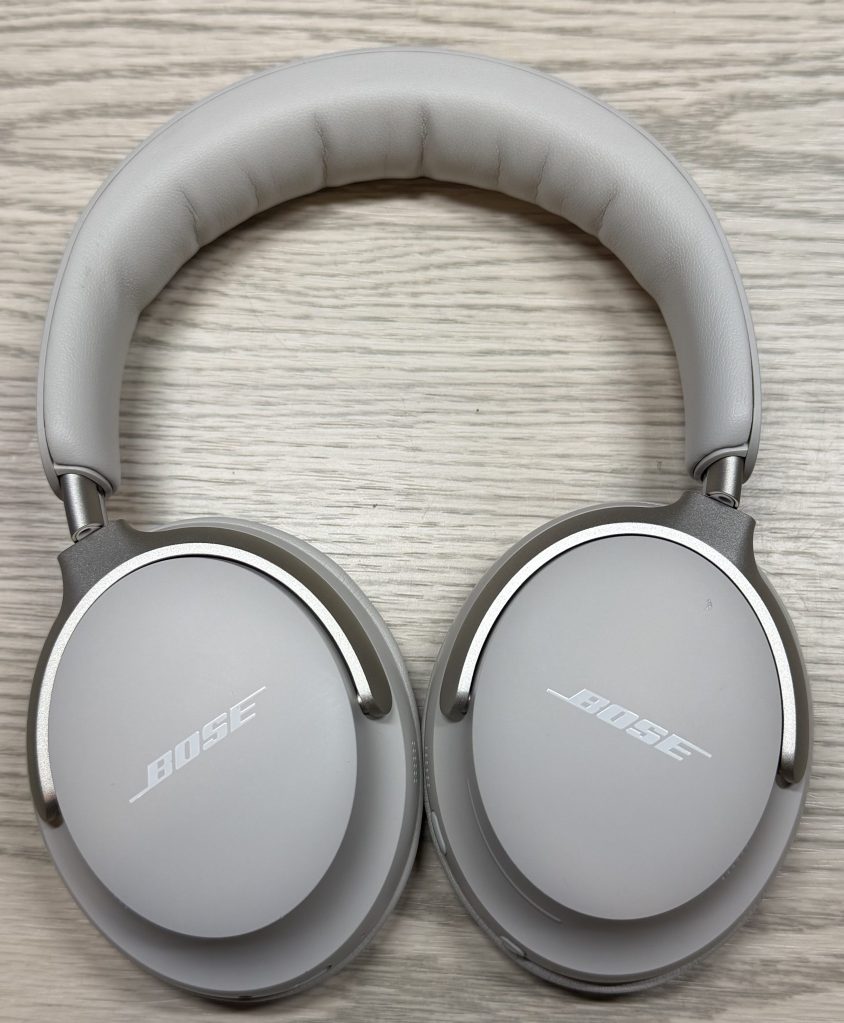
The Ultra come with a pretty nice, semi-rigid plasticky/fabricky case, a distinct step up from the soft case of the Quietcomfort SC and a nice callback to the case that shipped with the 700.
Comfort. The Ultra are reasonably comfortable headphones; they’re pretty light, and the cups are both pretty accommodating and at least feel larger than the QC25. The cups also swivel left and right at least 110 degrees (from flat to slightly beyond perpendicular, and they fold up into the band making it pretty easy to get the seal that you need for proper ANC.
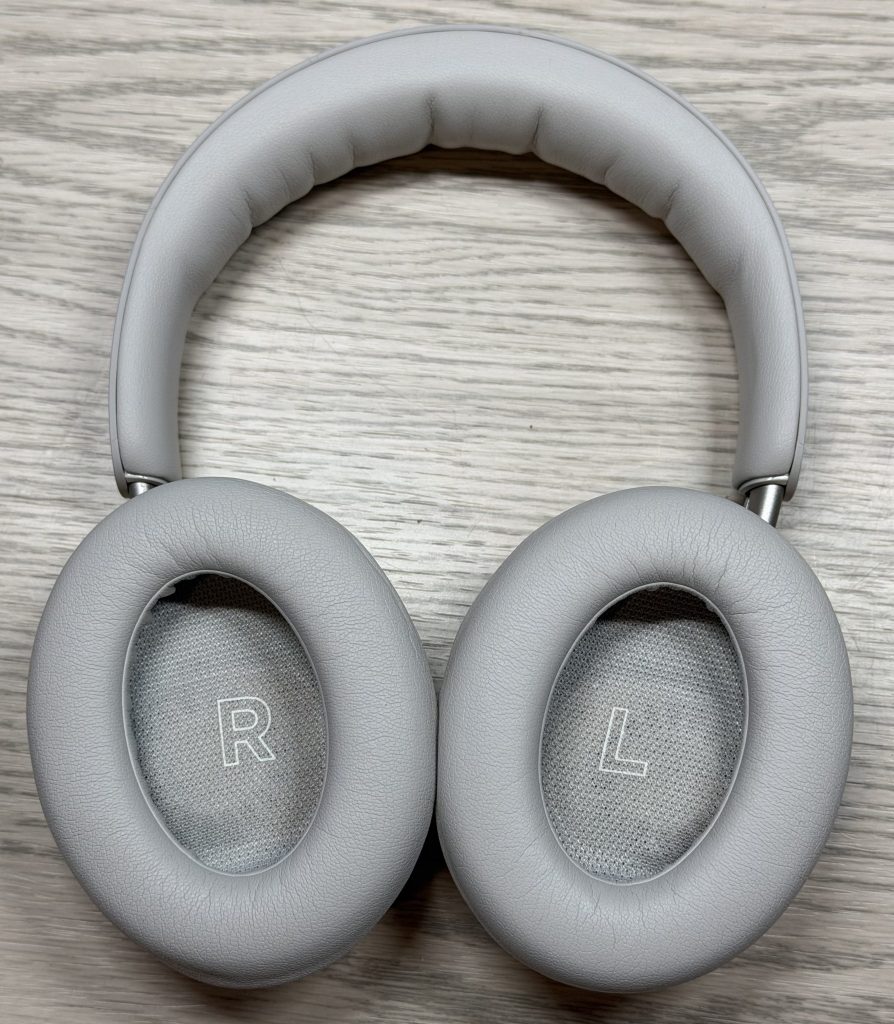
I can mostly wear these for pretty long periods without getting any hotspots, and they clamp well enough that they don’t move around when I’m working in the yard or even while shaking my head pretty aggressively. The pads even flex reasonably well while wearing glasses or sunglasses to avoid pinching and breaking the seal. The pleather on the ear cups do get unpleasantly warm when you’re moving around, but that’s true of most ANC headphones. I will say that during particularly long listening sessions, I need to be careful about how I place my ears in the cups. If I don’t, I will get an unpleasant pinching sensation after twenty or thirty minutes.
Appearance. I’ve never been wild about the appearance of the QC line and that extends to the Ultra. They’re fine, and they’re certainly no worse than the current generation Sonys or Sennheisers, but I really prefer the more organic lines of the Bose 700, the Focal aesthetic of the Bathys, or the more industrial look of the Airpods Max (or even the pseudo-retro look of the old Momentums). But these aren’t statement headphones; they’re functional and they aren’t so ugly that I won’t wear them.
The Ultra comes in a variety of colors, of which the white smoke I have is perhaps the least interesting. But again … this is not a statement headphone. They’re VERY headphone-y.
Functionality
The Bose QC Ultra (1st Gen) only has two playback modes: 3.5 mm and Bluetooth. Bluetooth is the default music protocol, but when you plug in the included 2.5 mm to 3.5 mm cable Bluetooth turns off and the headphones disconnect from any digitally-connected devices. If you plug in a USB-C cable to the headphones during playback, they will turn off and charge. If you then manually turn the headphones back on, they will stop charging. It’s a … choice on Bose’s part; you can charge, or you can listen, but you can’t do both.
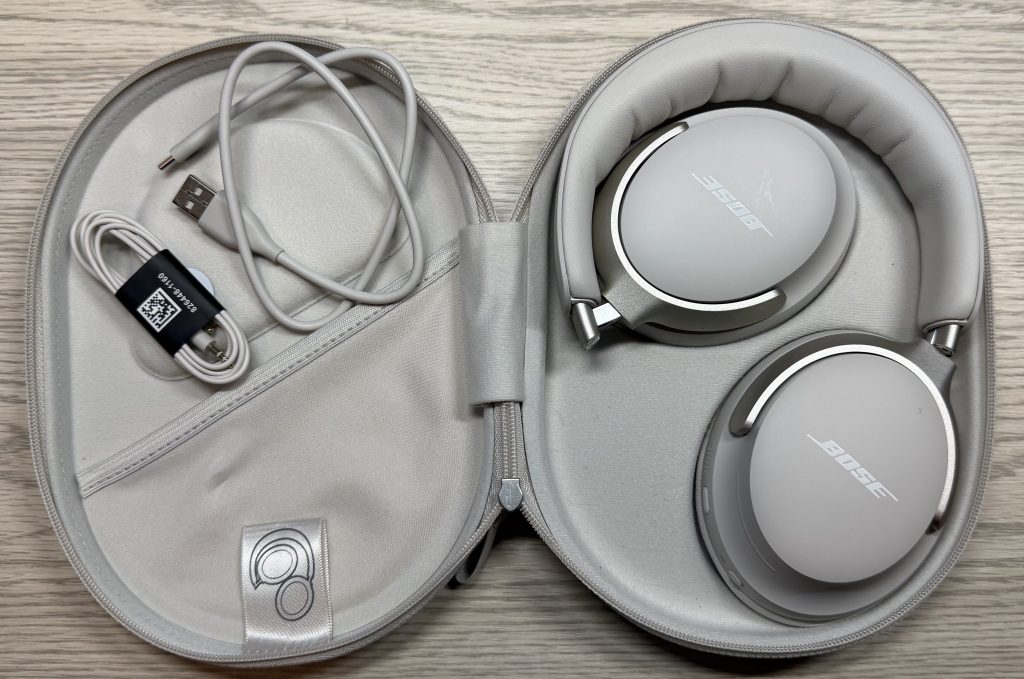
Bluetooth is the default option for the QCU. It’s a pretty good implementation of Bluetooth (as good as any that I’ve tried), which is to say that it doesn’t drop out or error very often, and has a reasonably good range (again, for Bluetooth).
It’s a real bummer to me that there is no USB-C/DAC mode with the QCU. It’s one of my favorite things about the Focal Bathys, particularly as a mobile desktop type headphone. And the fact that you can’t charge and listen makes them less useful for long-haul applications or if you’re the kind of person who frequently forgets to charge.
The 3.5 mm analog is an option with the QCU, BUT you don’t want to use active headphones passively. If you plug in the 2.5 mm connector to the headset, Bluetooth turns off, the app disconnects, and the headphones start converting analog to digital, applying DSP, and then reconverting to analog for amplification and playback. At least on my unit, the volume is turned down very low when you connect the analog cable, but the swipe volume on the back of the right earcup does work (so the amp is still active, and it’s not a truly passive experience). You cannot connect to the Bose app (Bluetooth is shut off), so you can’t adjust the EQ at all. I’m genuinely curious to measure them analog and via Bluetooth to see if there’s a consistent change in frequency response. Based on preliminary testing, the QCU appears to default to it’s baseline tuning when connected via analog cable, rather than retaining the last set EQ. I’m curious to play with that a little more to see if there’s a way to make it sticky.
If you turn off the headphones to try to get truly passive playback … they turn off and do not produce sound. So at least Bose has decided to prevent you from listening to their headphones that badly.
Battery life seems to be pretty good; Bose says 20-30 hours depending on settings and that seems about right; I used these for Denali’s walks for a few weeks without having to recharge, which is plenty.
Value & Comparisons
I’m actually a surprisingly big fan of the Bose QC Ultra (1st Gen). It’s been awhile since I tried a Bose product that I ended up deciding was worth using compared to the competition in this very crowded market; the sound quality here is good enough to satisfy even my picky ears, and the ANC is a distinct step up from something like the Focal Bathys or Sennheiser Momentum 4. In fact, I grabbed them on my way out the door for a work trip to St. Louis this week rather than the Bathys.5
But do they represent good value? At MSRP, I think they fall into the same bucket as the Bathys and the Sennheiser HDB 630: great headphones, but way too expensive. For what I paid for them, they’re a SCREAMING deal. At the $250 price point Amazon is selling renewed units, I think they are a good value pick, and in a pinch I don’t hate their current $340 new price tag.
Focal Bathys
This is a very interesting comparison to me; I came into this review expecting that I would prefer the Bathys overall. The Bathys are my go-to ANC headphone and the ones that I’ve been carrying for trips since I got them back in May of 2025. And to my surprise … I didn’t grab them for this week’s trip to St. Louis.
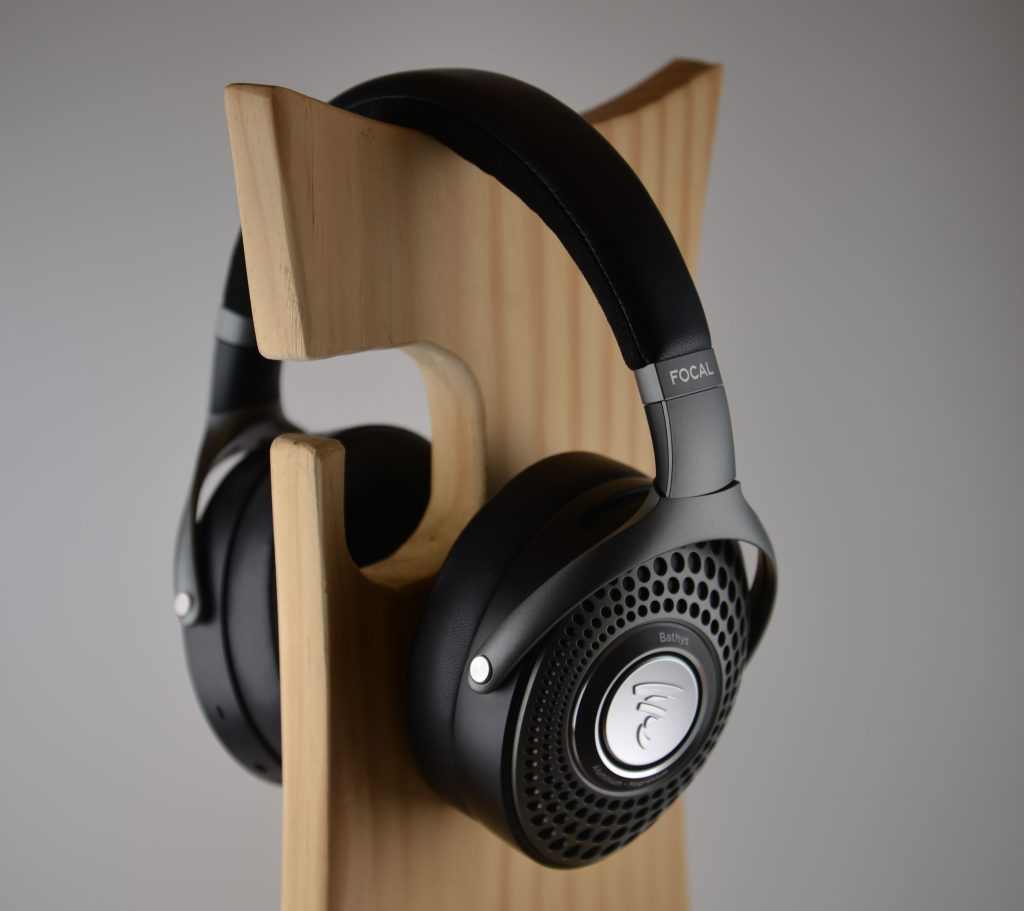
I think, overall, I still prefer the Bathys. The sound profile is definitely more to my liking, both before and after applying EQ via the onboard app. The place where I do prefer the QCU is for travel, specifically for planes. While the ANC on the Bathys is perfectly adequate, the QCU gets the volume of airplane engines substantially quieter than the Bathys does. In quiet mode on both, the QCU reduces the engines to a very low volume, high pitched hiss (that weirdly resembles the HVAC in a large office building), whereas with the Bathys it definitely still sounds like you’re on a plane. In their respective transparency modes, the QCU mop the floor with the Bathys: the Bathys pitch the engines up and become genuinely unpleasant, whereas on the QCU it still sounds mostly like an HVAC system, albeit a much louder one. The one place the Bathys seem to do better is higher-pitched people noise; it’s purely anecdotal, but I feel like I hear people talking and babies screaming more clearly with the QCU than the Bathys in both quiet and transparent modes.
The QCU’s advantages disappear in an office environment, however. In a week in the office, I found myself defaulting to Airpods Pro 2 over the QCU, whereas any time I’ve brought the Bathys to my office I’ve used them the entire time. This is both a function of how they sound (the Bathys is a better sounding headphone, even after EQ) AND the fact that the Bathys have an excellent DAC mode, whereas the QCU can only be used via Bluetooth or via the 3.5 mm analog cable. I genuinely don’t know if the QCU are resolving enough to be able to tell the difference between lossy and lossless on them (and I can’t test it, because you can’t run them lossless without running them via analog), but I know that the Bathys can take advantage of lossless via the USB-C cable and do benefit, as minimally as it may be.
Also, this is a bit silly, but the Bathys (at least to my preferences) look much better than the QCU. I don’t wear headphones because they look cool, but it’d be silly to pretend that the visual appeal doesn’t matter at all.
So:
- Sound: Bathys, though the difference isn’t huge.
- ANC: specifically for planes, QCU. For most other sounds, Bathys or pretty indifferent.
- Connectivity: Bathys.
- Appearance: Bathys and it ain’t close.
- Pricing: QCU, at least at current prices.
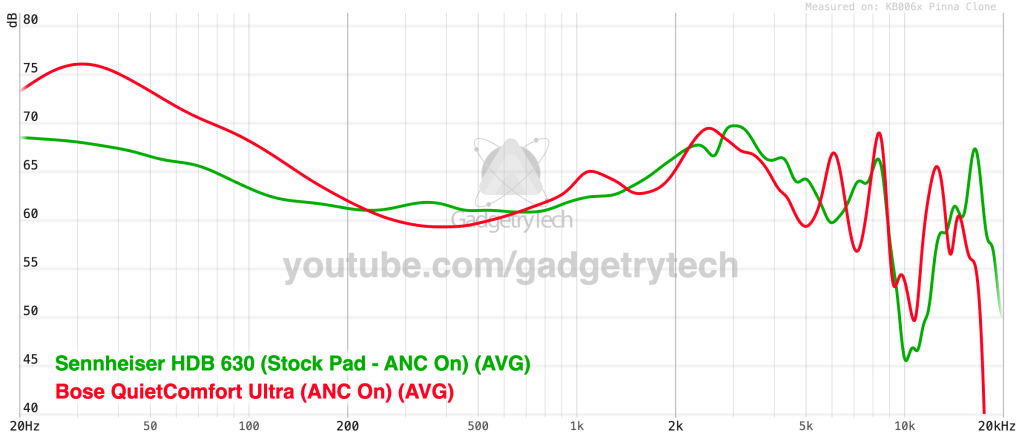
Here’s how GadgetryTech measured these two:
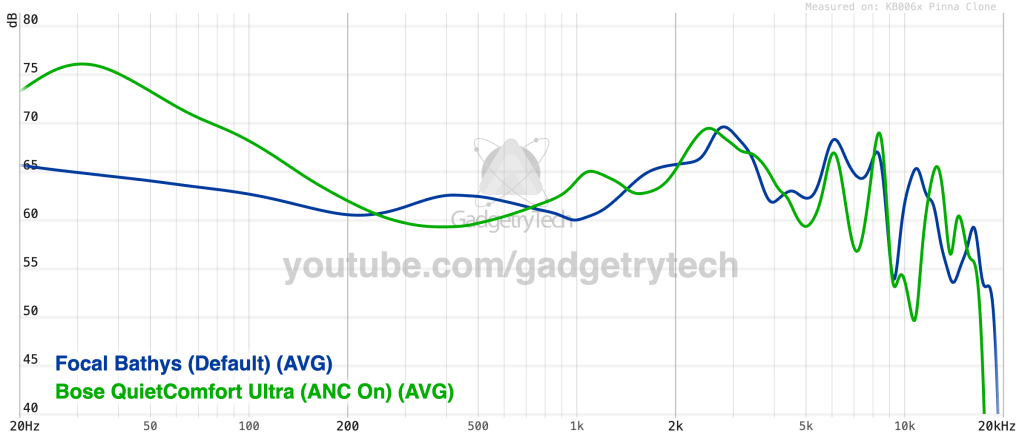
Good lord, that’s unhinged bass. There’s a reason I crank down the bass on the QCU, while I use the Bathys pretty close to stock. [This seems … exaggerated. At some point I’ll measure both on my rig and update.]
Verdict: If you can afford the price tag or find them used, Bathys for almost every application. I am genuinely curious to see which of these I grab for flights over the next few months; my general sense is that for shorter flights and on longer trips I’ll default to Bathys, but if I go visit family in Singapore I’m going to be awfully tempted to bring the QCU for the 12-17 hour flight. If you’re buying new, the renewed QCU at $250 would be awfully tempting to me, as much as I prefer the sound signature of the Bathys. If Bathys ever comes down in price, it’ll be a lot more competitive.
Sennheiser HDB 630
As I mentioned in my Sennheiser HD 480 Pro review, it’s my general policy not to compare two headphones that I don’t have in my hands at the same time, and as I noted in my HDB 630 review, I returned that headphone shortly after I published it. As much as I enjoyed them, I just couldn’t justify the price delta between them and the other things in the market. I did, however, end that review with a comment that I would probably buy another pair when they dropped to $300-350, and I still stand by that. [FWIW, that’s about where I’m coming down on the QCU too.]
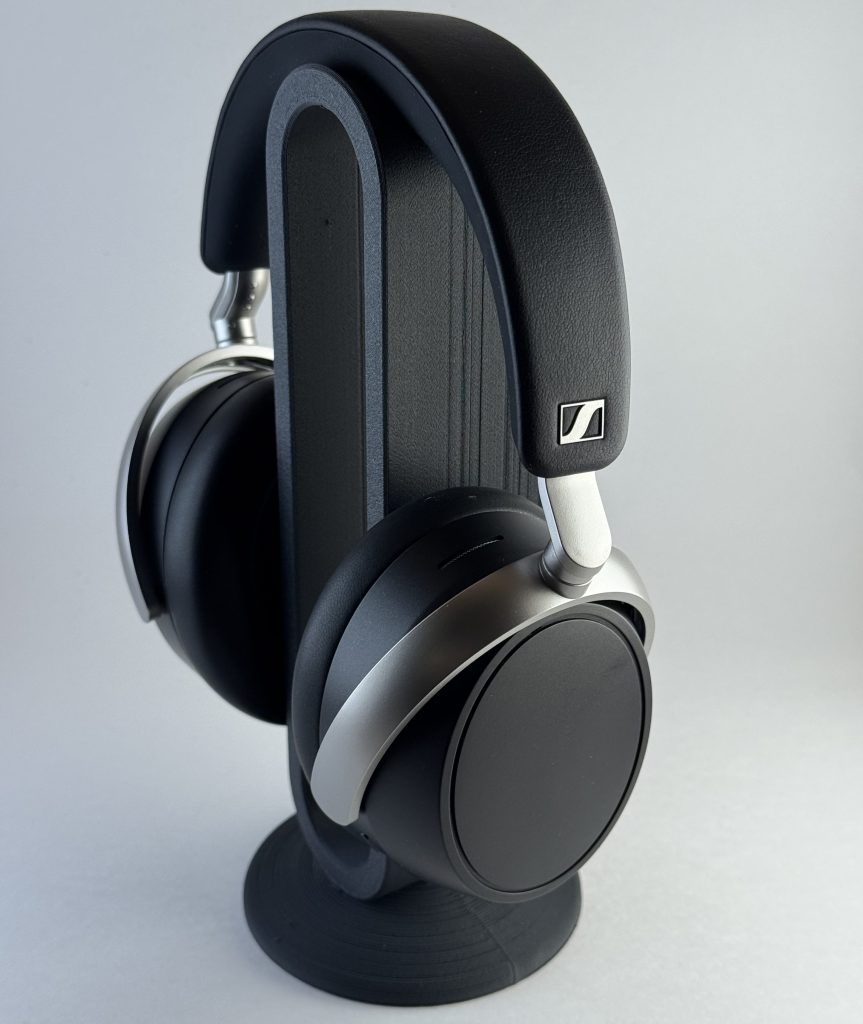
When I see a pair of HDB 630 marked down to the $350 range, I suspect I’ll buy them and do a direct comparison. As it stands, based on current pricing I’m taking the QCU here all day. I suspect that I prefer the sound profile on the 630 a bit more than the QCU, but I do look forward to coming back and verifying at some point.
I returned the HDB 630 shortly before I got my headphone measurement rig, so I don’t have measurements for mine. I’m including GadgetryTech’s measurements for anyone who’s curious, though I measured that bass hump lower on my unit of the QCU than they did.
Verdict: At current pricing, the QCU. At MSRP … probably the HDB 630, all other things being equal.
Sennheiser Momentum 4
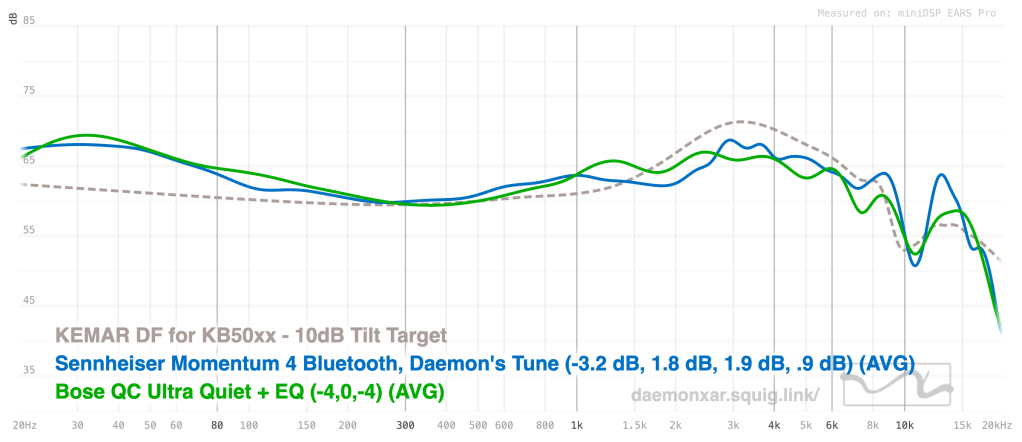
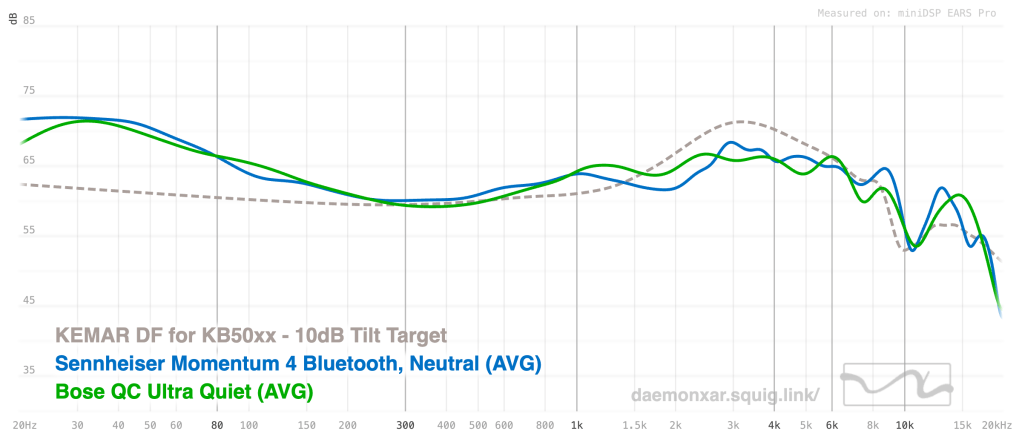
As much as I like to recommend the Momentum 4 to people in the budget bracket (sub-$300), the QCU is just a much better product. As adjusted via EQ, I think they’re pretty similar in sound quality, with maybe a slight edge to the QCU in terms of detail retrieval, though out of the box the M4 is a better sounding headphone. ANC and transparency are also substantially better all around on the QCU: it’s a better product in most ways.
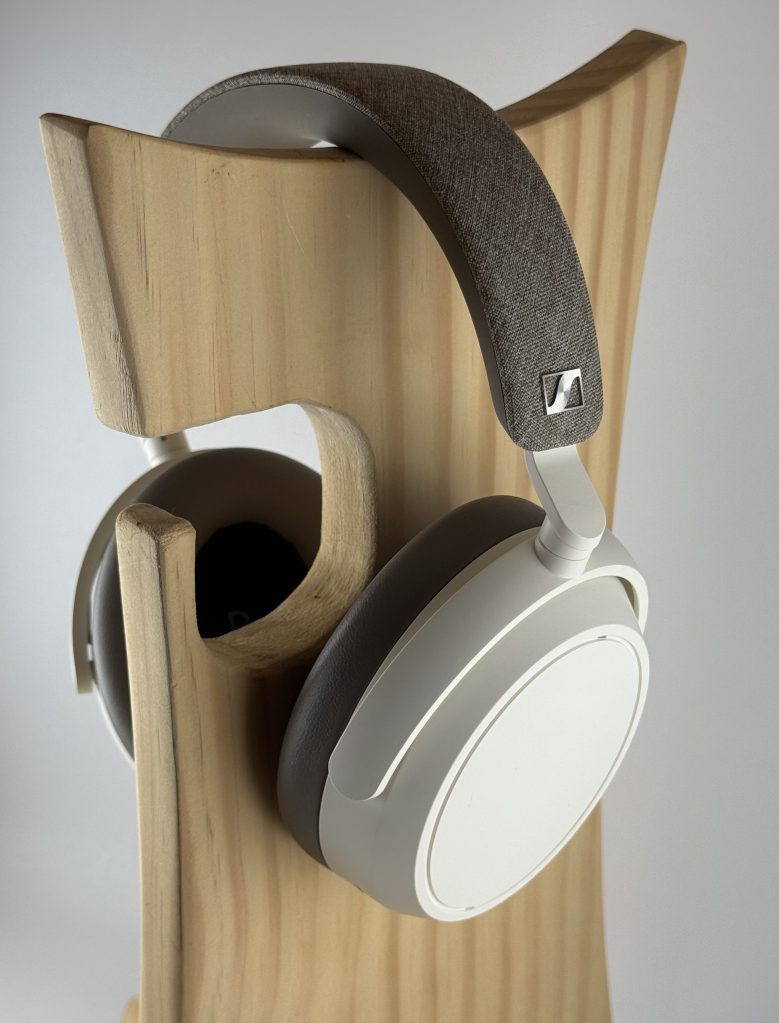
Like the HDB 630, I’m not sure I’d recommend the QCU at their original MSRP compared to the M4. They’re better than the M4, but I don’t think they’re $300 better, and I think I’d rather have the M4 and a good pair of open-backs for my non-ANC listening. At their current prices, it’s … a lot closer.
Here’s how my units measure, as adjusted via my personalized EQ:
And here’s how they measure out of the box:
Verdict: At current pricing, I’m going with the QCU. It’s better in almost every way: sound quality, ANC, transparency, etc. Where it’s not better (comfort, appearance, etc.), it’s pretty similar. The only thing I prefer about the M4 over the QCU is the ability to use it via USB-C for lossless, but as I’ve noted many times the difference between lossy and lossless with a headphone like this is minimal, if it exists at all.
Bose Quietcomfort
I reviewed the Bose Quietcomfort SE back in May of 2025 and overall I thought they were … fine. They’re really not for me, but they’re a good choice for a lot of people (particularly those with more normie audio preferences). As I noted towards the end of the review, I talked myself out of keeping them, even at the reasonable Costco then-pricing.
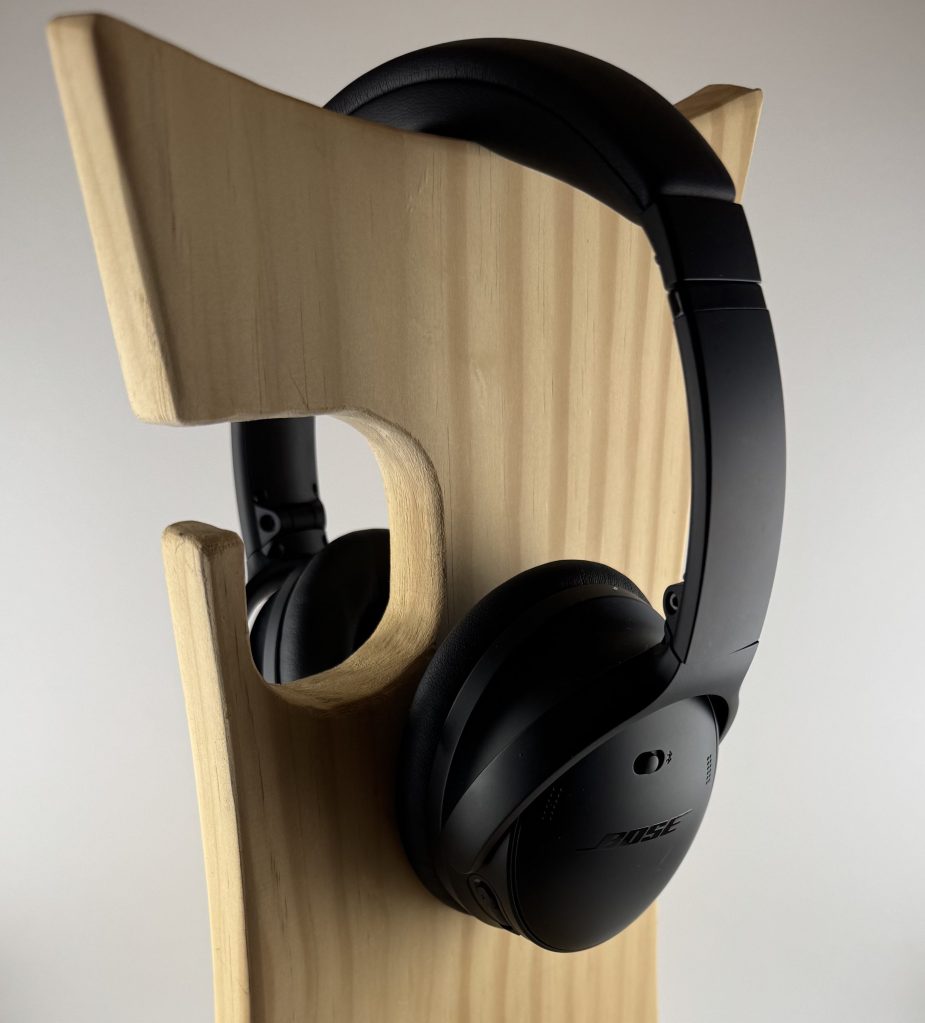
I don’t have the Quietcomfort SC/SE/45/etc. around to do a direct comparison, but I will just say this: the SC were fine, but pretty boring. Sound quality, ANC, comfort … all of these were fine, but none of them stood out. By contrast, as adjusted via EQ, I think the QCU sound pretty good, and they have great ANC. At this point the price differential is pretty small. In a world in which QCUs are retailing for $250 renewed, I can’t recommend anyone buy any of Bose’s non-Ultra Quietcomfort models.
Sony/B&O/B&W
I will say this … as bassy as the QCU are out of the box, they’re worlds better than the muddy bass cannons produced by Sony, Bowers & Wilkins, and Bang & Olufsen and I’d take them over anything I’ve ever heard from any of those companies. Despite its flaws, the QCU can be pretty easily corrected by using the software tools Bose provides (namely the app), and with some tweaking sound quality gets pretty great. None of the headphones from those companies have worked for me without the use of a third-party EQ tool (though the Px7 S2 comes … close).
The Bose QCU is a competent product that can sound good. I don’t think any of the options from these manufacturers are.
Overall
The Bose QCU are, like the Sennheiser HBD 630, a great product at a not-great MSRP. The fact that the QCU have come down in price so dramatically (particularly since the release of the QCU Gen 2, and particularly for a renewed unit) means that they really do represent a pretty great value at this point, and I whole-heartedly recommend them to anyone who is looking for a high-quality ANC headphone, particularly for people who value ANC over sound quality. For me, for my use cases, I think they suffer a bit in comparison to the Focal Bathys particularly with regards to the lack of a wired USB-C DAC mode. In my mind, the QCU is clearly a better headphone for the specific purposes of flying on an airplane, and for almost any other use case I’m going to prefer the Bathys. And I don’t spend that much of my life on a plane.
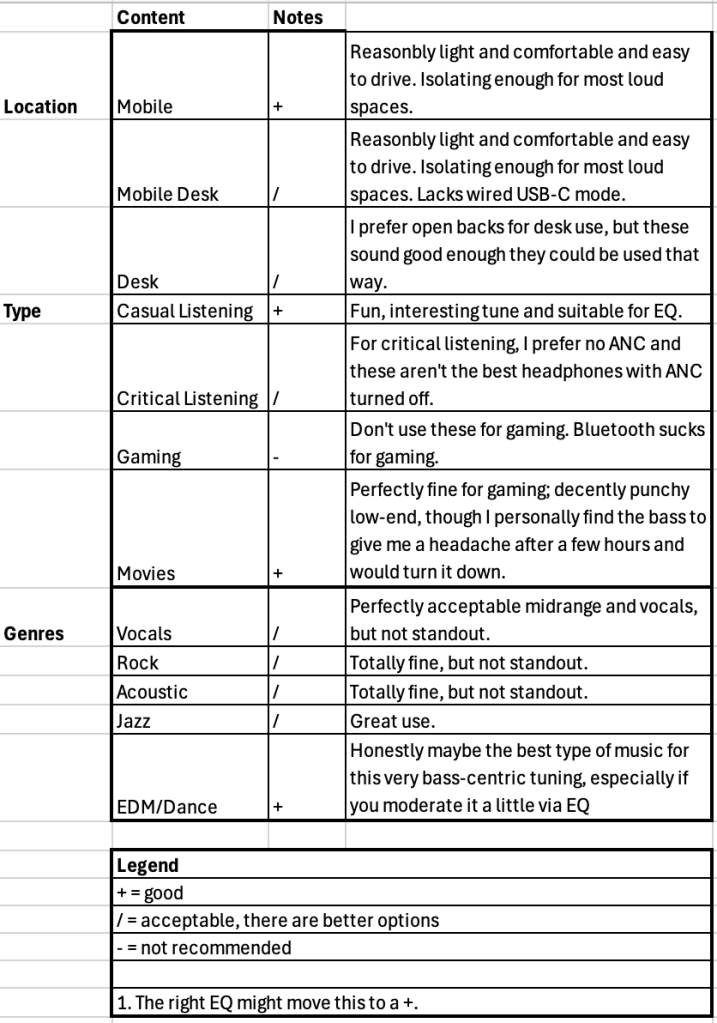
Phil’s Matrix of Use
#reviews #headphones #sennheiser #6XX #anc #spatialaudio #meh #2025 #99noir #meze #sunglasses #overear #cans #hifiman #arya #stealth #
- I score bass, mids, and treble on a two part scale: 1-5 for quantity (5 being the highest), and A-E for quality (A being best in class, E being laughably bad). For soundstage it’s also a two part scale, with the number representing the width and the letter the separation within it. ↩︎
- For comfort/fit, my scale is A-E with A being disappear entirely into the background and E being I want to tear my ears off to stop feeling these headphones on my head. I’ve had one E: the Koss PortaPro. ↩︎
- Don’t believe me? Believe Bose, on page 33 of the manual: https://assets.bosecreative.com/m/8f024ac3c0159c1/original/884885_OG_QCUH-HEADPHONEARN_en.pdf ↩︎
- You should always take measurements with a grain of salt, but that’s particularly true in this case. I had a hard time getting consistent measurements across different positions. ↩︎
- To be fair, that’s in part due to knowing that I needed to finish up this review, but I’m not feeling a lot of lacking in terms of sound. ↩︎


Leave a comment