
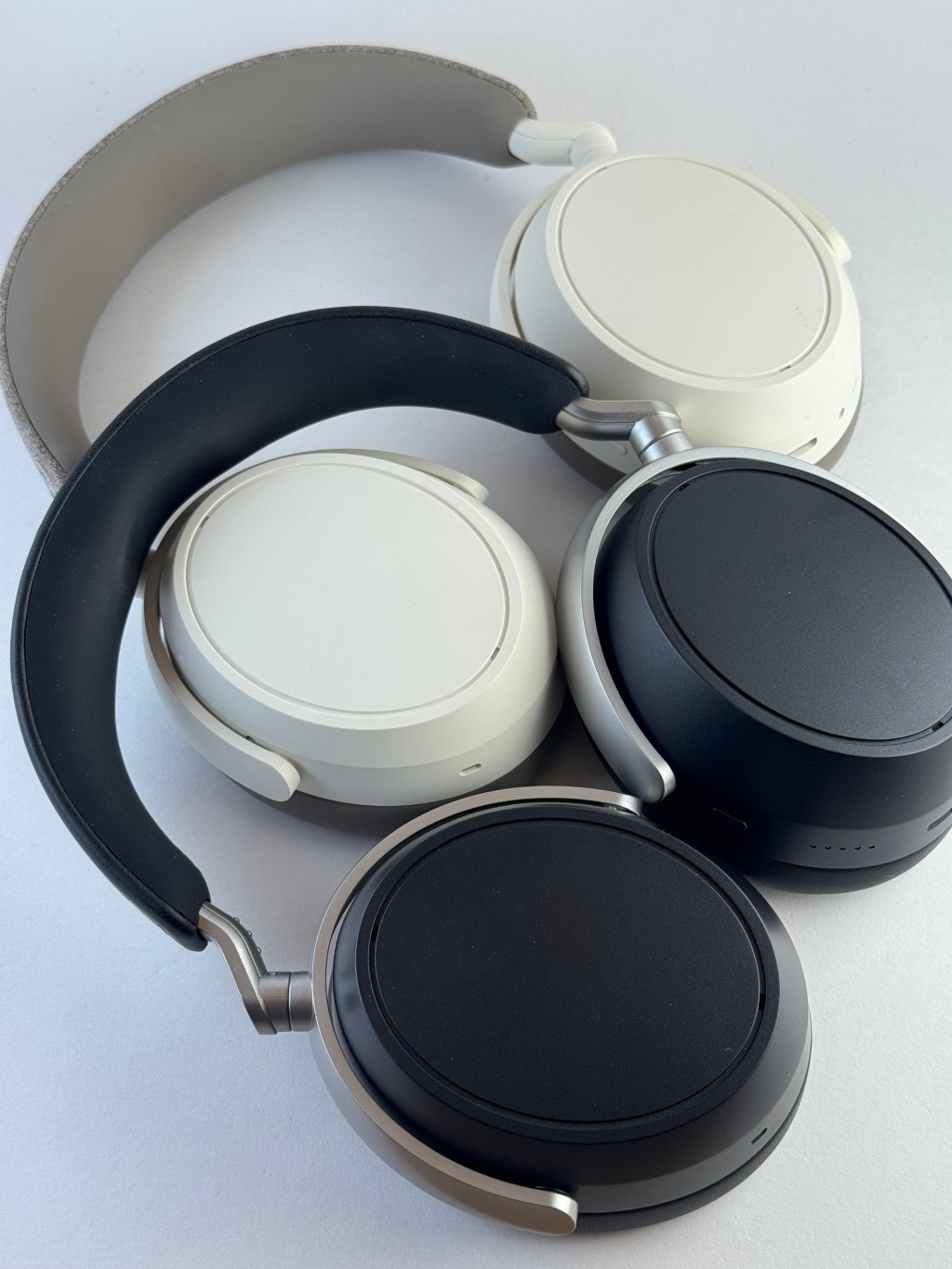
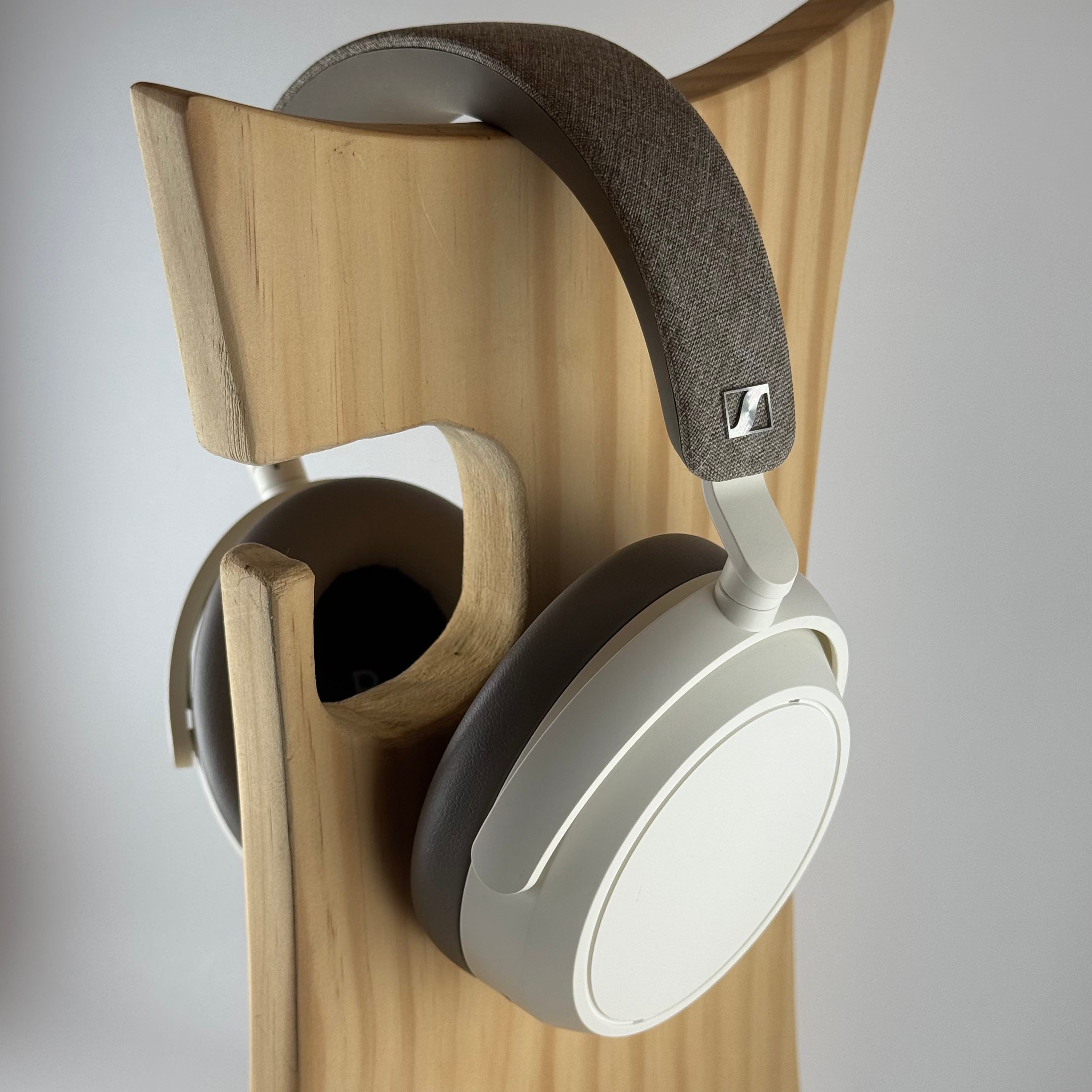
One of the questions that you see a lot in the audiophile forums on Reddit revolves around Bluetooth vs. wired connections for active headphones, particularly for consumer-focused noise canceling ones. Especially folks new to the space want to know if they should be using their Momentum 4s, their Px7/8, or their XM4-6s with the supplied 3.5 mm cable to get better sound quality over lossy Bluetooth codecs.
The short answer is: it (kinda) depends.
I say kinda because for the most part, you’re not going to do any better wired via 3.5 mm (Px7/81), and in most cases (basically every other thing I’ve tested!) you’re going to do substantially worse.
This question comes up enough that I addressed it in my Frequently Asked Questions so I’d have a quick link to grab when someone asks, and then I spent an evening a few months ago putting together a more comprehensive answer with specific examples from my collection.
Well, now I have a headphone measurement rig, so it’s worth revisiting, but with data! The question seems to come up most frequently with the Sennheiser Momentum 4, so I’m starting with it. If there’s interest, I might expand to the offerings from Bose, Sony, and B&W.2
Getting to Know the Momentum 4
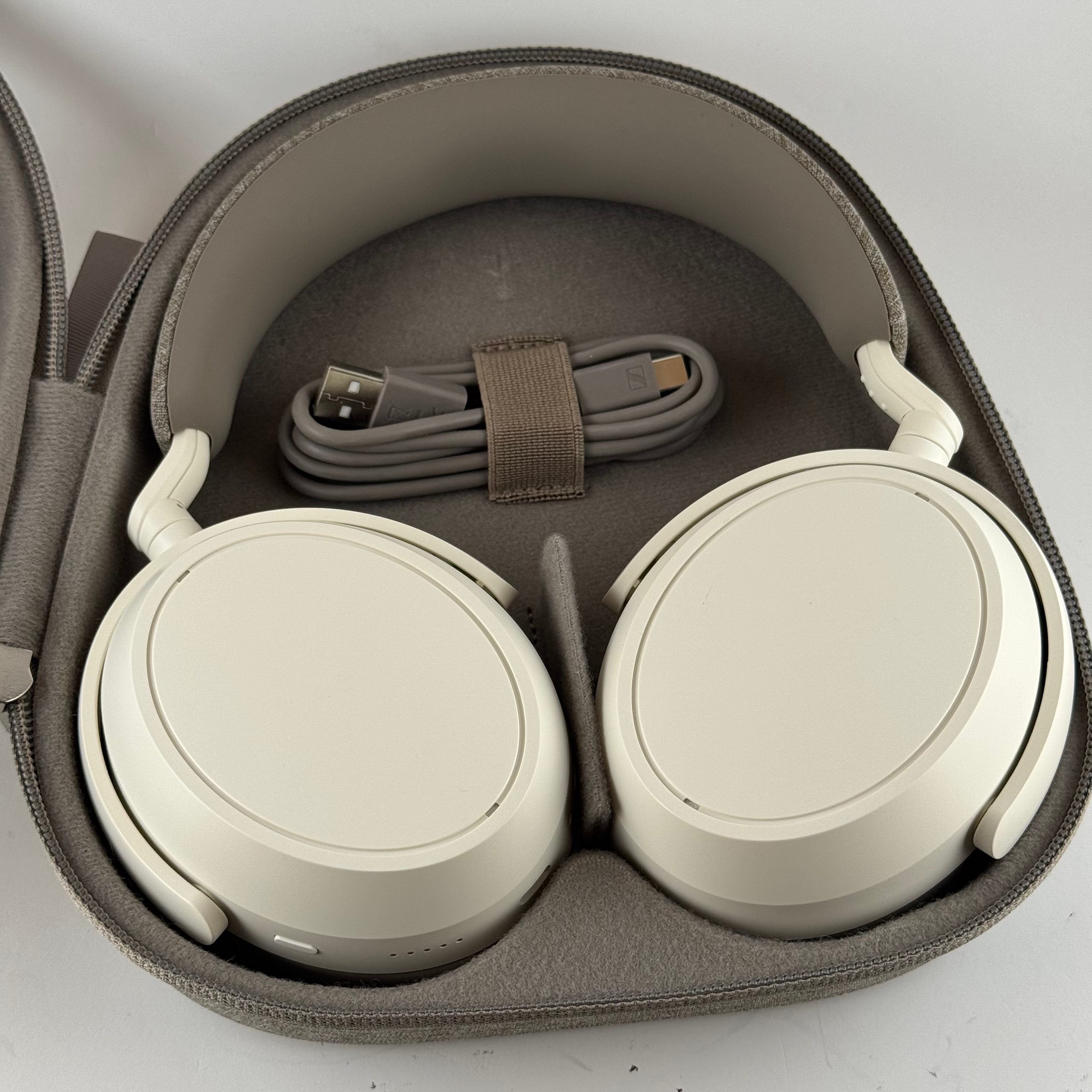
I did a pretty extensive review of the Sennheiser Momentum 4 back in June of 2025, but here’s the basics: the Momentum 4 is a consumer-focused active, noise canceling (ANC) headphone from Sennheiser. There are four ways to connect to the Momentum 4 for audio playback:
- Wired via USB-C
- Wirelessly via Bluetooth (direct connection or via a Bluetooth dongle, sold separately)
- Wired via 3.5 mm in Flight Mode
- Wired via 3.5 mm and manually turned off (or the battery dead)
Each of these have advantages and disadvantages (well, except the last, which is pretty much disadvantages all the way down). It’s worth understanding what those are, though, and the way in which they affect the M4’s sound and customizability. We’ll address them in turn.
Wired via USB-C
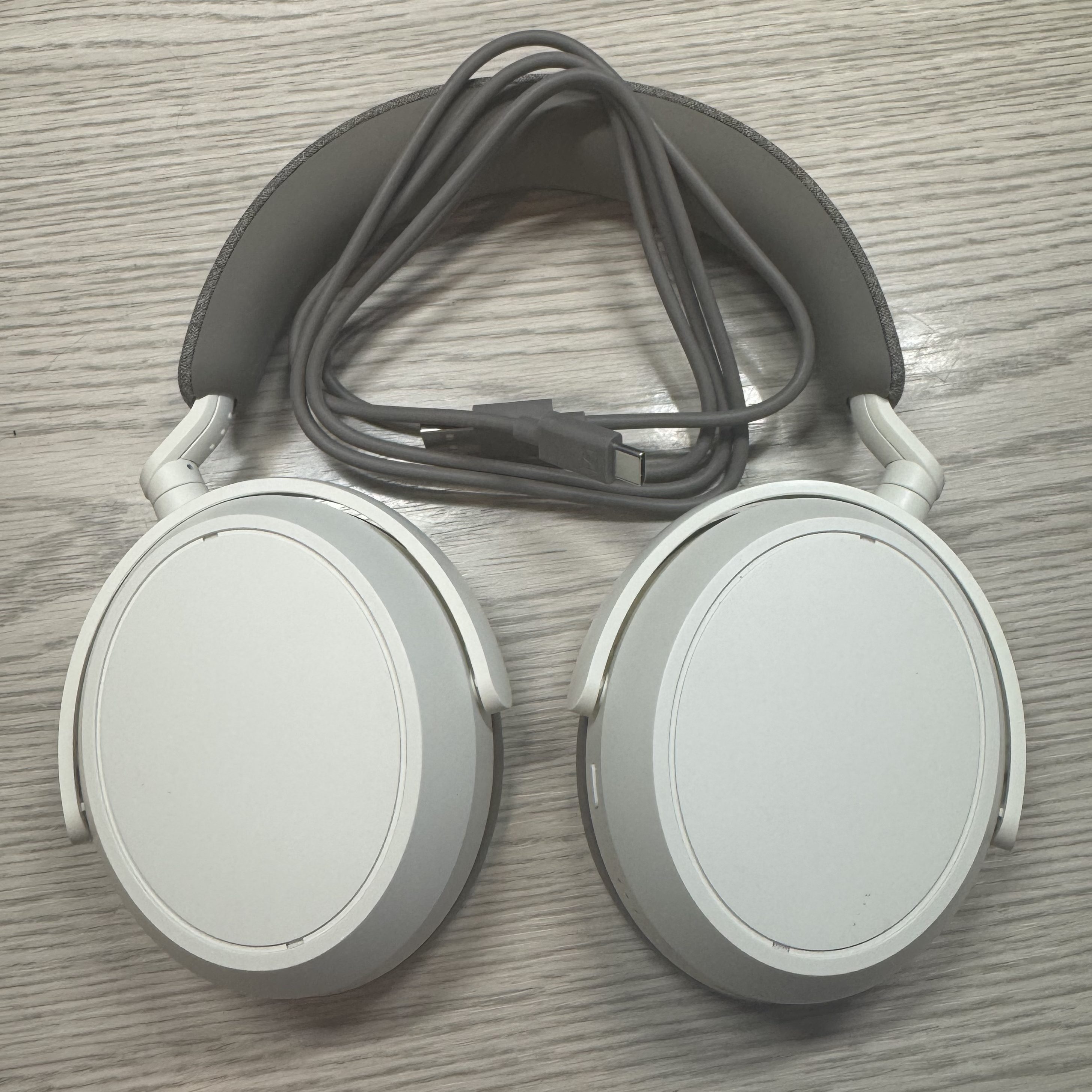
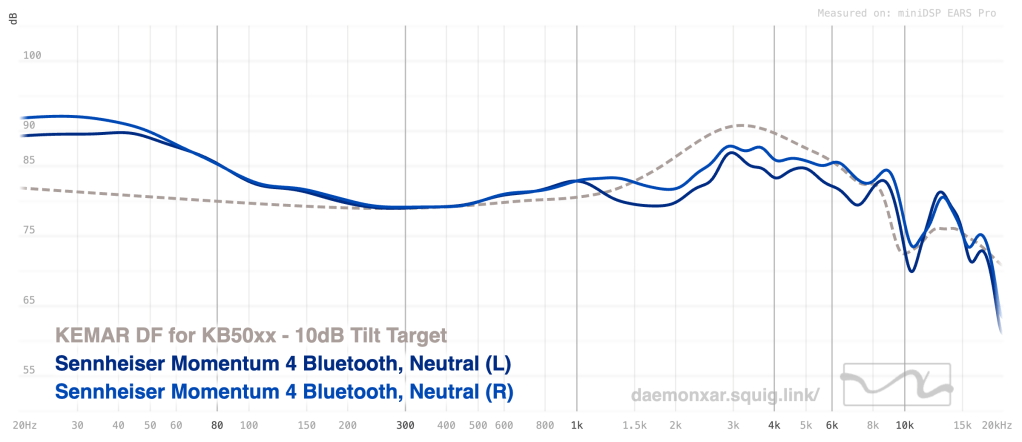
This is what happens when you connect the Momentum 4 to a source device via a USB-C to USB-C or USB-C to USB-A cable to transmit digital audio. This is arguably the “best” way to listen to music with the M4, as you have acess to the full suite of audio tools (default DSP, Sennheiser’s array of EQ options, and the five band manual EQ with … decent band selection AND Sennheiser’s Bass Boost toggle) as well as full lossless audio (up to 24-bit/48 kHz3) and active noise canceling.
Pros:
- Full access to the Sennheiser SmartControl+ app, including five-band EQ.
- Lossless capable.
- Active noise canceling is available, including adaptive and transparency modes
- Charging possible under many circumstances
Cons:
- You’re tethered to your device.
- No multipoint connection.
If you’re sitting in place and don’t mind having a cable connecting you to a source device (a phone, a DAP, or a computer, for example), this is my favorite way to listen to most modern ANC headphones. It’s the way to listen that aligns most with original design choices while giving you better potential audio quality. That said, I mostly don’t bother with USB-C for the Momentum 4. I don’t think they’re resolving enough to be able to really benefit from lossless files, and I’m mostly listening to them in situations where there’s so much background noise or distraction that I wouldn’t notice anyway. I rarely bother connecting via USB-C (unless my battery is low) and I mostly just listen via Bluetooth.4
The default tuning on the M4 isn’t my favorite (they’re VERY sub-bassy out of the box), so I apply this EQ when I’m listening via USB-C:
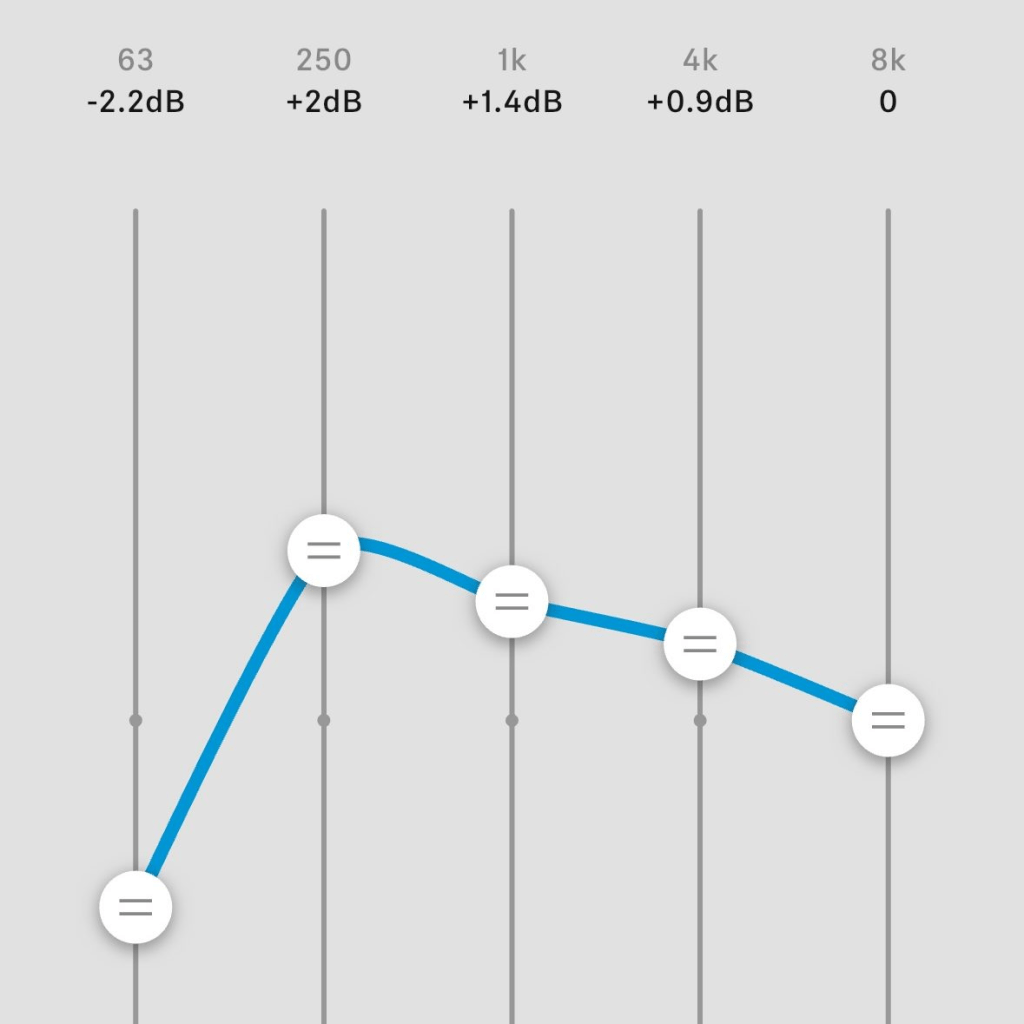
This mellows the sub bass and partially fills in the scoop between the midbass and midrange, making it less hollow sounding. It’s still bassier than I would normally choose to listen, but I find that I want some extra bass when listening in loud or congested environments, and that’s mostly where I end up listening to ANC headphones anyway. Here’s how my EQ affects the frequency response:
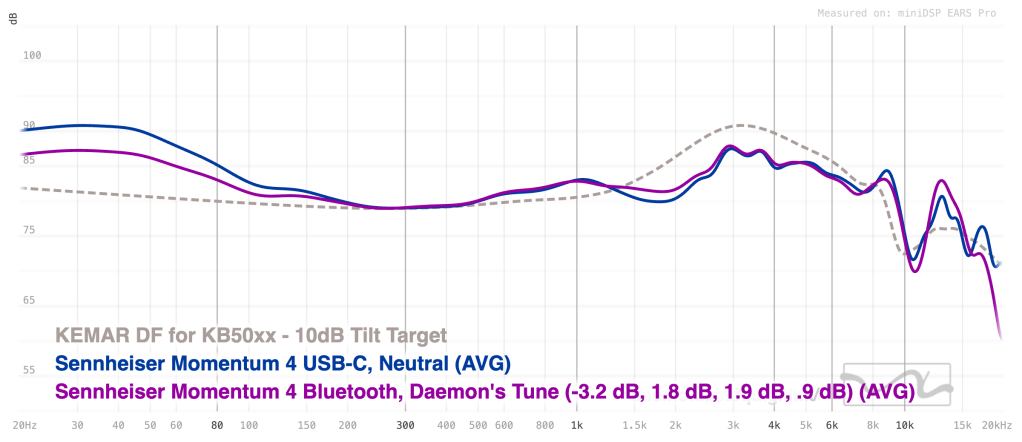
If I’m listening via Roon and have access to a full parametric EQ tool, I use a more precise and nuanced EQ profile, but this is fine for most of my regular listening and it’s what I recommend people new to the Momentum 4 who are looking for a more neutral-trending frequency response.
Verdict: Theoretically the best, practically … rarely my choice just based on convenience. Definitely your best option if you’re low on charge, though, or need low-latency audio for something like gaming.5
Wirelessly via Bluetooth
This is the default connection for the M4. You either connect your source device directly to the headphone via Bluetooth, or you connect the M4 to a Bluetooth Dongle (sold separately) and then use the dongle to connect to various devices.
Pros:
- Full access to the Sennheiser SmartControl+ app, including five-band EQ.
- Multi-point connection6
- Active noise canceling is available, including adaptive and transparency modes
- This will drain your battery faster than any of other listening modes.
Cons:
- Limited to lossy music formats, and codec support is limited7
- Latency may interfere with gaming or video playback
Like running via USB-C, Bluetooth connections default to Sennheiser’s “Neutral” profile and I would recommend using my EQ profile there as well. Here’s how that looks:
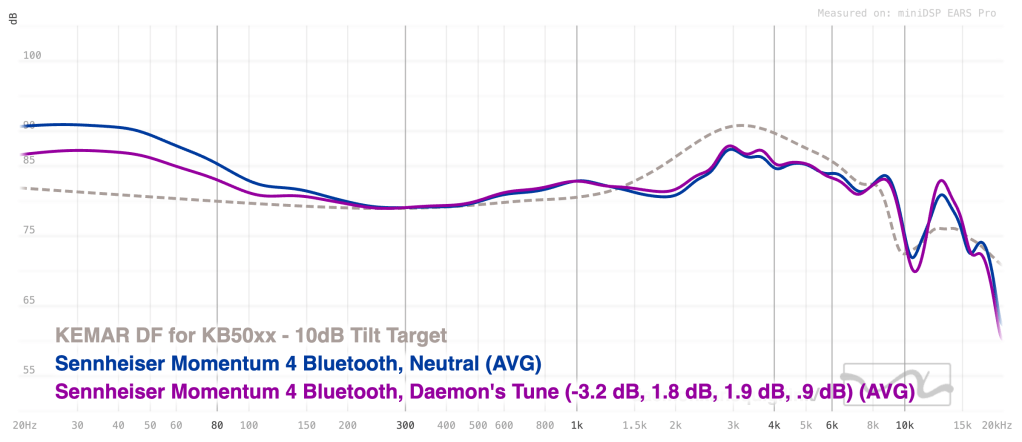
This is how I mostly use the Momentum 4; they’re not a headphone I use for listening while sitting still very often, and the benefits of being wireless usually trump the theoretical benefits of lossless when I am using them. Do I notice a difference between Bluetooth and USB-C? Honestly, even sitting in a quiet environment and listening to music I know very well … no, I really don’t.8
Verdict: This is how the M4 were designed to be used, and I think it’s how they should be used the vast majority of the time.
Wired via 3.5 mm in Flight Mode
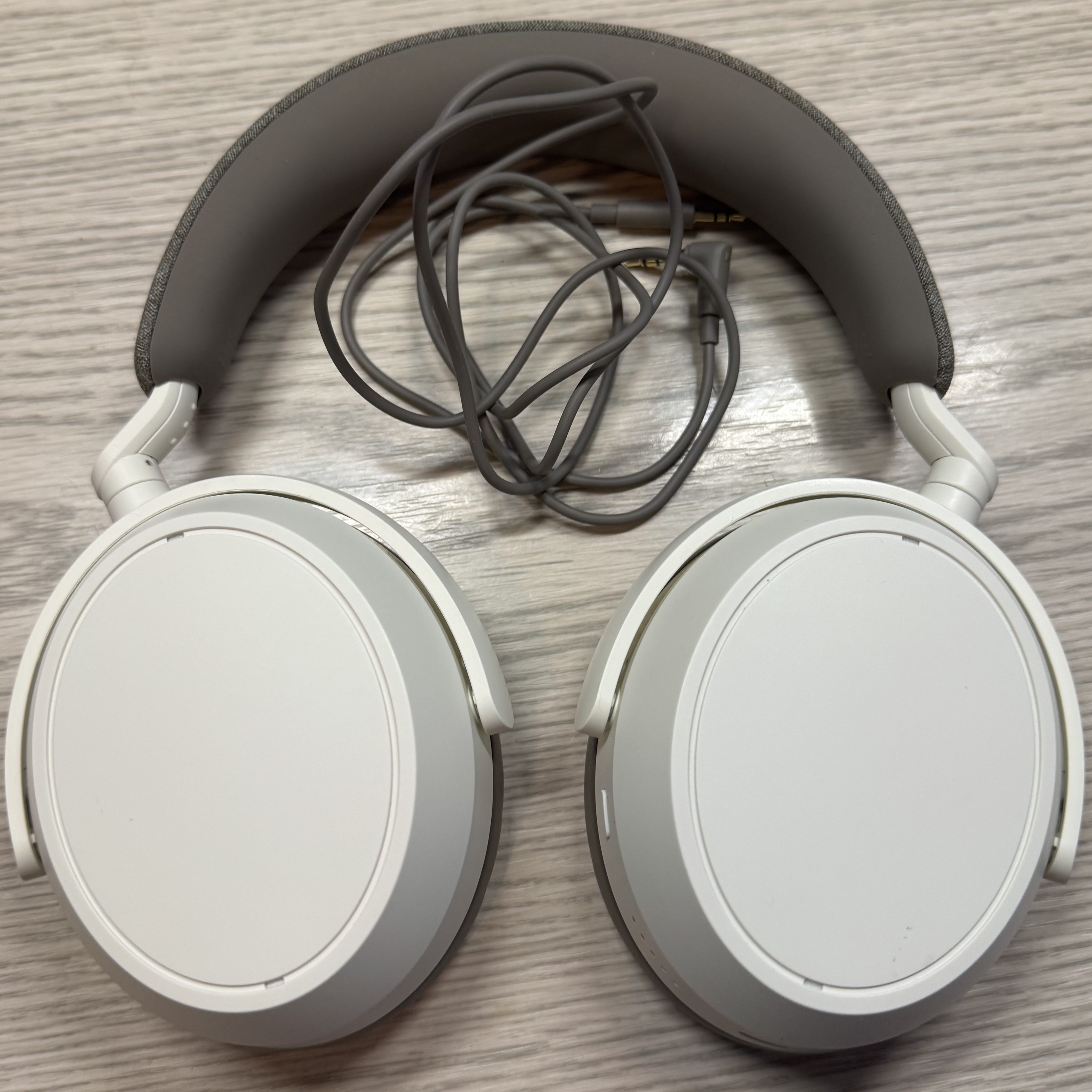
When you plug the included 2.5 mm to 3.5 mm analog cable into the M4, it turns off Bluetooth and shifts the headphone into “Flight Mode.” Analog signals transmitted via the 3.5 mm cable are converted from analog to digital using the M4’s onboard analog-to-digital converter (ADC), have the M4’s default DSP and EQ (“Neutral”) applied, and then are reconverted to analog by the onboard DAC and run through the onboard amplifiers.
Pros:
- Lossless-capable.
- Active noise canceling is available.
- You get the benefits of DSP.
Cons:
- Your M4 must have power, and listening this way will drain your battery.
- No access to the Sennheiser SmartControl+ app, with no ability to apply EQ on the headphones. You get the tuning you get.
- You’re tethered to your device.
- Your music is undergoing two additional (unnecessary) conversions on board the M4, which may impact sound quality.9
- No multipoint connection.
I commented somewhere that I thought the M4 running via analog cable and powered was roughly the same as the default “neutral” tuning via Bluetooth, with maybe a hair more treble energy, but I was willing to believe that was just in my head. Turns out … at least according to this measurement, it is just a hair more trebly (though well within the potential range of measurement error). Functionally, though, running via analog and powered on is the same as running in “Neutral” via Bluetooth (or USB-C, for that matter):
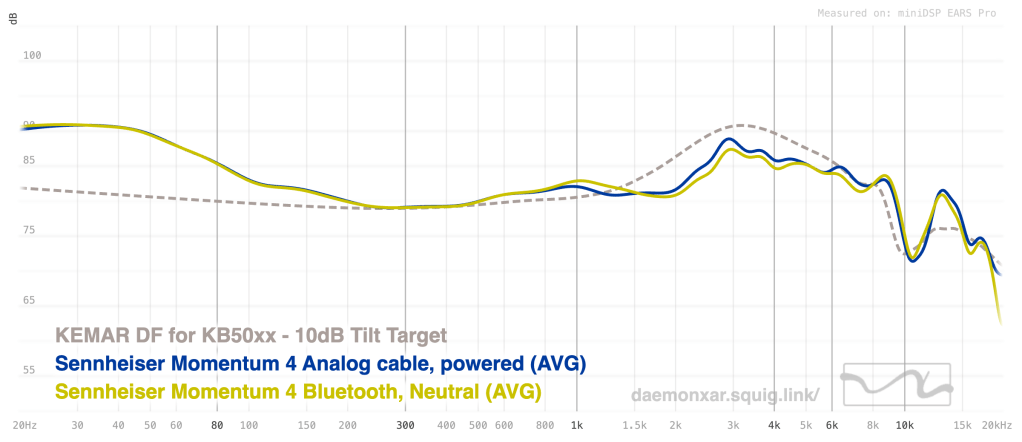
This is … not a terrible way to listen to these headphones, though I can’t think of a situation in which I would choose to use it over either a USB-C or Bluetooth connection if either is possible. (In fact, I carry a 3.5 mm to Bluetooth dongle for use on planes in the event that I can only connect to in-flight entertainment via a 3.5 mm; while I doubt that my transmitter has a particularly good ADC, I’m guessing it’s at least a good as the one built into a pair of ANC headphones as an afterthought). As noted both above and in my M4 review (and frequently mentioned on Reddit), the M4 are too bassy (especially sub-bassy) out of the box for me, and I’d rather have an EQ’d tuning and lossy files than the default tune and lossless.
Verdict: in a pinch, this is at least in the realm of acceptable tunings though it’s one I don’t particularly like and wouldn’t choose to listen to.
Wired via 3.5 mm and manually turned off (or the battery discharged)
If your battery is dead, or you plug the 2.5 mm to 3.5 mm cable in and then manually power off the M4, you get a truly passive listening experience. No DSP, no EQ, no internal amplification, no digital/analog conversion, just a pure expression of the drivers and the (frankly piss-poor) passive tuning of the M4.
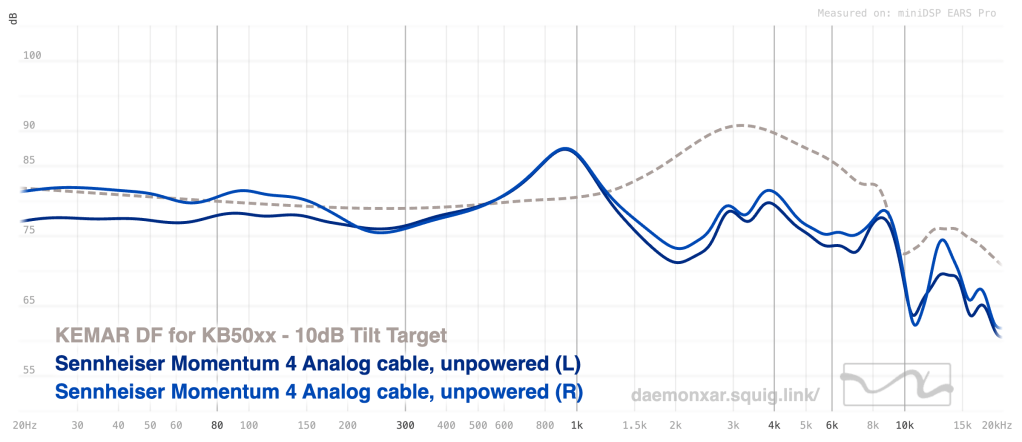
I’ve noted a few times that one of the real advantages of an active headphone is that you don’t have to spend a ton of time and energy and resources in tuning a new headphone to make it palatable: (within certain bounds) you just use digital signal processing (DSP) to adjust the frequency response to achieve whatever target you’re seeking, or at least get close enough. The result is that a lot of active headphones sound genuinely terrible without that DSP, and the M4 is definitely one of those. Here’s the frequency response of the M4, truly passively:
Pros:
- Ability to play sound when the battery is dead.
- They’re easier to drive, I guess?
Cons:
- A genuinely wonky tuning that I don’t think anyone actually likes.
- No ANC, no DSP, no EQ.
It probably goes without saying, but this is an incredibly wonky and terrible-sounding tune, and I genuinely don’t think that anyone wants to listen to this. The only thing that I think comes close to replicating that weird-ass spike around 1 kHz is the Hifiman Audivina, one of the most widely-reviled headphones in the modern market.10
It also probably goes without saying that this is a method of last resort, and no one should ever voluntarily listen to the M4 this way unless they have no other choice. Or, I suppose, if they’re just listening to a podcast that’s just people talking and where you don’t care about timbre? The only good news is that they’re relatively easy to drive purely passively, with an impedance of 60 Ohms.11
Verdict: No. Just don’t. Maybe just sit and contemplate your life choices instead of trying to listen to music this way.
Conclusion
My strong recommendation for the Sennheiser Momentum 4 is, unsurprisingly, to use them the way they were designed around being used: via Bluetooth. It’s the best mix of theoretical sound quality and convenience, and it really is the highest and best use of this device.
If you need low-latency audio OR are desperate for that extra little bit of detail you might get from running a lossless signal, the wired USB-C option is a perfectly fine one; you’ll retain basically all of the good things about running Bluetooth other than being tethered to your device, and you’ll even extend your battery life potentially indefinitely.
If you absolutely have to listen to something that only produces an analog signal (a Fiio CP13 cassette player, for example?), running 3.5 mm and with the unit powered is the better option. You’re adding a lot of additional processing to your signal chain, and you’re giving up the ability to directly control the frequency response of the headphone, but at least you’re getting a competent (if VERY bassy) performance and at least theoretically a lossless signal, assuming your source is high-enough quality.
I would strongly urge you to avoid using the Momentum 4 purely passively, connected via 3.5 mm and powered off. Is it better than nothing? Well … in some cases. Honestly it’s funky enough that I think I’d rather use almost anything (including a pair of open-back headphones on a plane, or those free earbuds Delta gives out?) but it’s possible I’m just too bougie.
- These use an analog to digital converter in their provided 3.5 mm to USB-C cable, so from the perspective of the heapdhones you’re basically just connecting it to a source via USB-C. ↩︎
- It’s also worth noting that as far as I can tell, the HDB 630 is mostly just a better software and hardware tuning of the Momentum 4, so I expect everything that is true of the M4 to be true of it (though with a better baseline “neutral” tuning). ↩︎
- Whether you will be able to hear an audible difference vs a lossy Bluetooth connection is up to you … I personally don’t think I hear one with this headphone. ↩︎
- This isn’t true for all ANC headphones, just for ones like the Momentum 4; I do carry the Focal Bathys to when I’m going into my office and I do connect those to my phone via USB-C most of the time at my desk. ↩︎
- These wouldn’t be my choice for gaming, but needs must. ↩︎
- Connect up to two devices simultaneously … though switching gets a little funky and I personally won’t use it. ↩︎
- As noted above, I don’t think this is a meaningful limitation with this headphone. ↩︎
- This is not the case for some other ANC headphones like the Focal Bathys or the M4’s big brother, the Sennheiser HDB 630. ↩︎
- And given the small number of people using this feature, I’m skeptical that Sennheiser put in a particularly good ADC; seems likely it’s more of an afterthought than anything else. ↩︎
- Though with a lot of EQ, I kind of like it for the fact that it’s semi-closed, which means you get some of the isolation of a closed-back and some of the soundstage of an open-back. ↩︎
- So you can get the shitty tuning pretty loud, even from a mobile device! ↩︎


Leave a Reply