
[ORIGINAL MSRP $799. Currently available from Amazon for $799. Purchased from a local retailer at a substantial discount.1]
[Tl;dr: The Meze Strada are a very interesting headphone. Like a lot of Mezes, they were designed to stand out; to zig where most manufacturers are zagging, and I think that they hit their mark. Whether that mark is for you … well, these aren’t a headphone I’d recommend to very many people.
Also like most Mezes, they’re incredibly well-designed and built and remarkably comfortable, and particularly if you’re willing to spend some time and energy learning how to EQ them for your own head, they can be a pretty remarkable headphone to listen to. I really enjoy them, and they’re going to be a great change of pace for me in a world of mostly either similar sounding, or bad sounding, closed back headphones. I appreciate Meze taking risks, and I think this one turned out splendidly (at least for my purposes!).]
Cost-agnostic: 5 out of 10 Denalis2

Cost-sensitive: 3 out of 10 Denalis

TABLE OF CONTENTS:
Introduction
As I have noted in a few of my other reviews, I’m something of a Meze fanboi; they make my favorite headphone under $1,000, my favorite headphone period, one of my favorite headphones under $400, and a surprisingly competent, reasonably priced family of closed backs. Their products are, mostly without fail, beautiful, comfortable, and incredibly well built. Meze also has a history of … let’s call them “interesting” tunes, particularly when it comes to their closed back offerings, and most of their headphones (including their closed backs) have been VERY expensive. Enter the Strada.
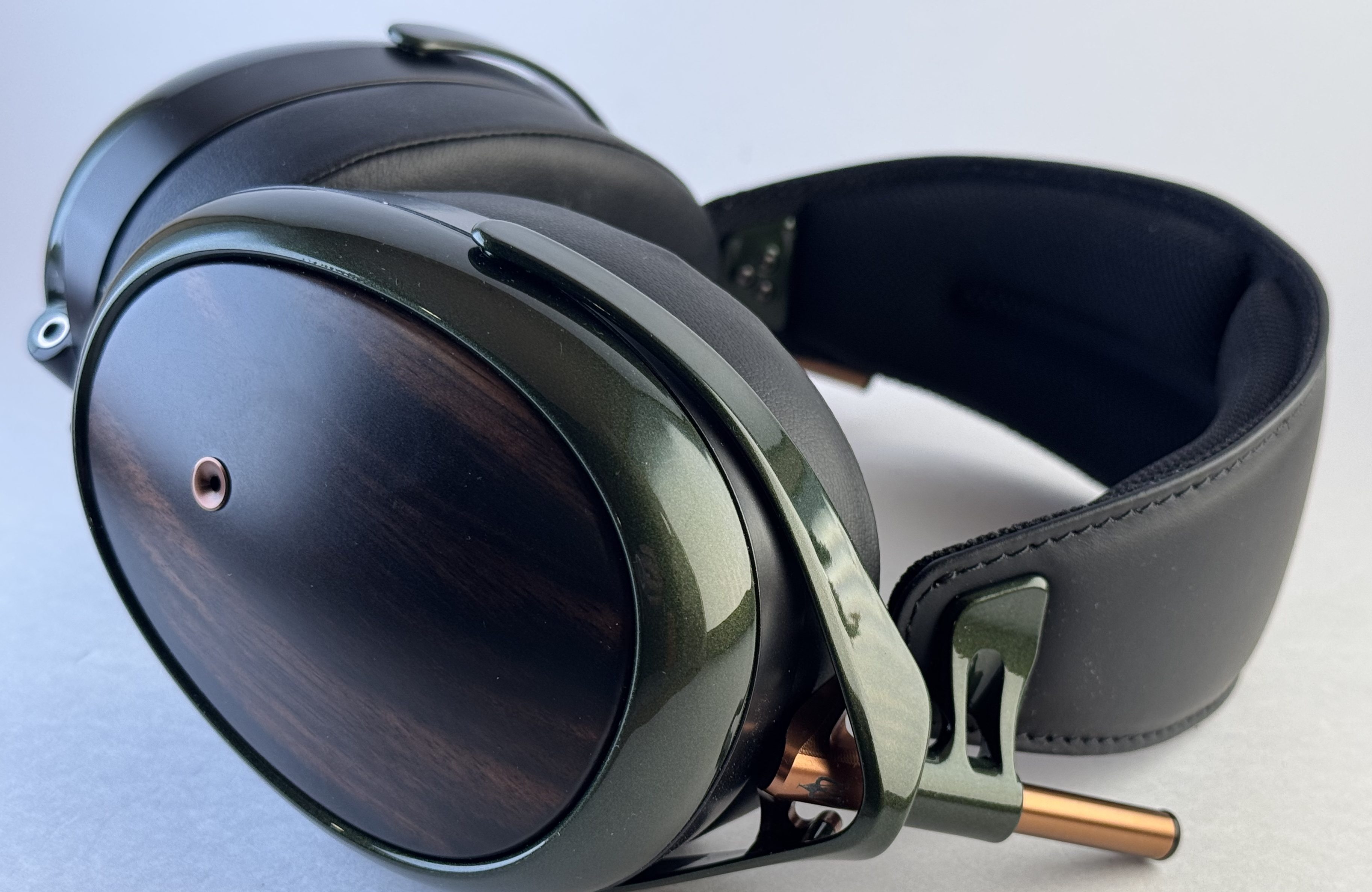
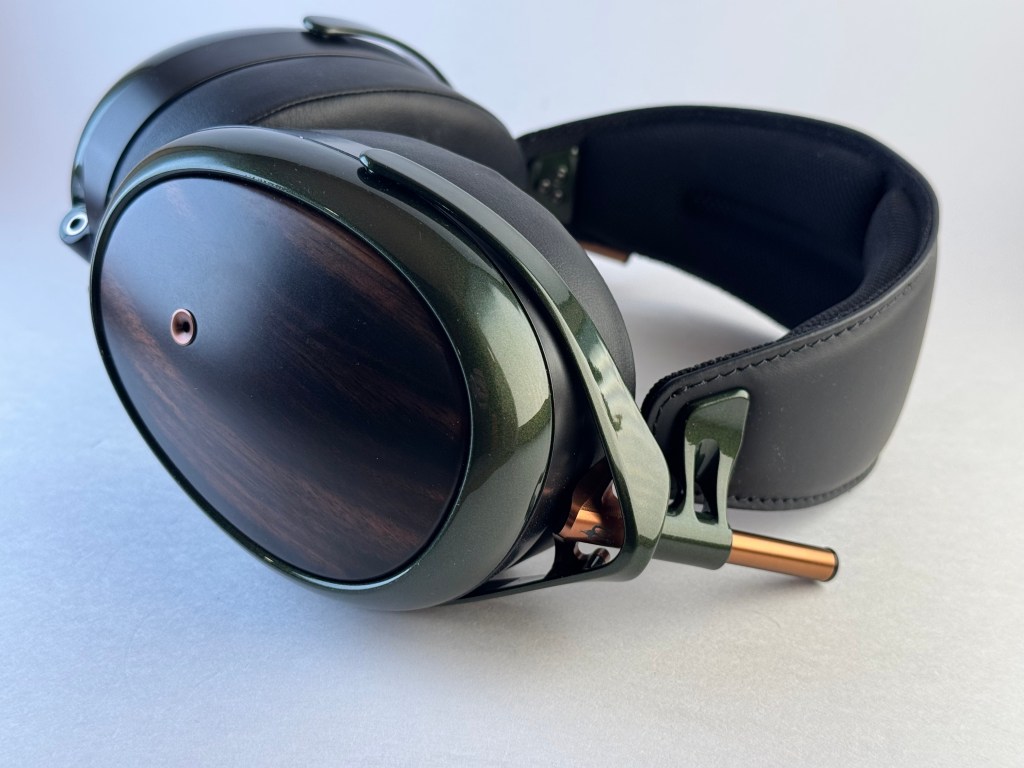
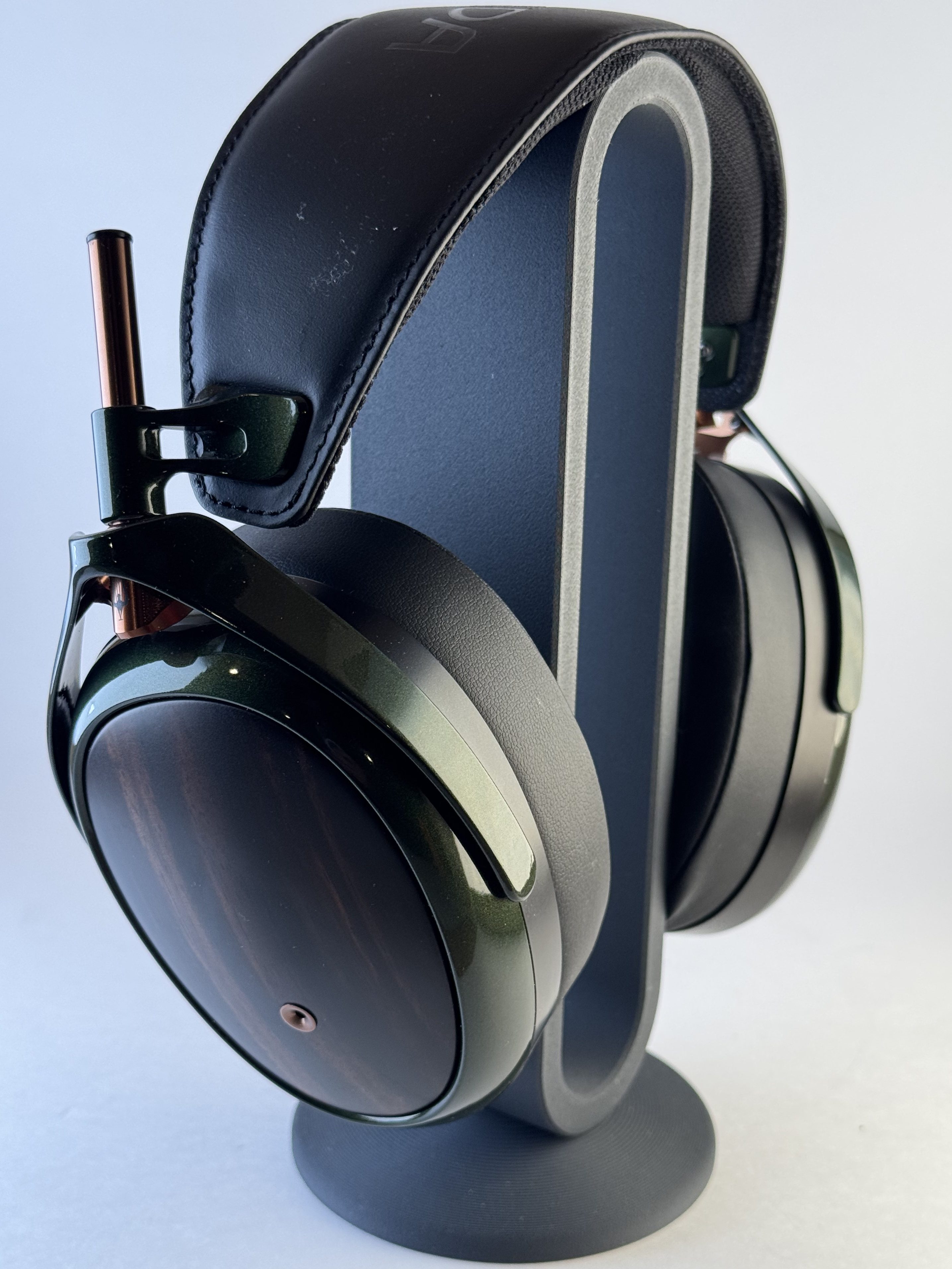
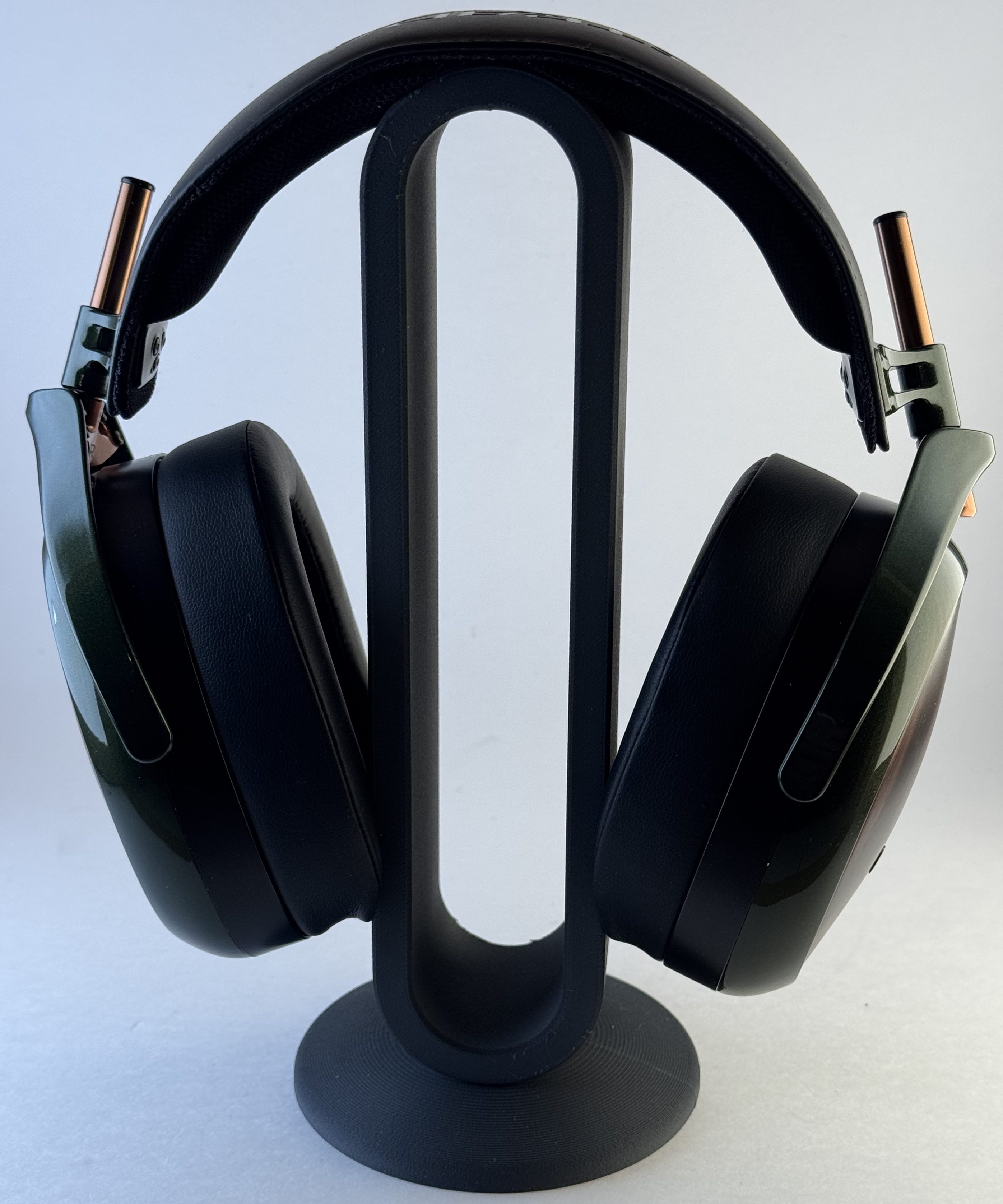
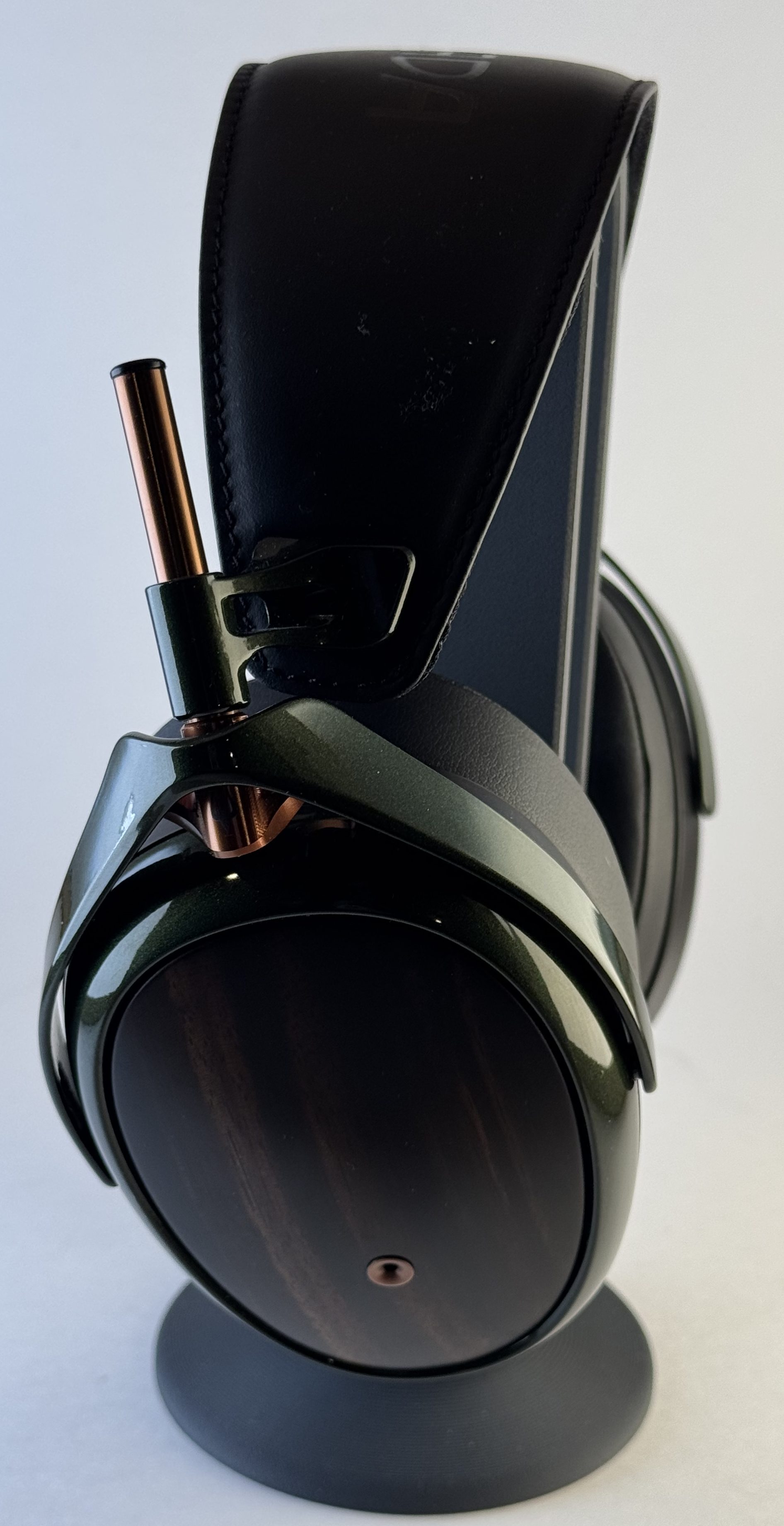
Announced in January 2026, Strada was … kinda sorta almost a more affordable closed back option above the 99 family tier. Using the same drivers as my much-loved 109 Pros, and gorgeously built in green, ebony and copper-adjacent accents. They were also relatively light, for a serious closed back, and promised Meze’s signature comfortable fit and premium build.
I was, to put it mildly, intrigued. And I was just finishing up a multi-year project closing a family member’s estate, and had a fair amount of reimbursements for the expenses I incurred while doing so coming to me … and I wanted to buy myself a birthday present.5 I reached out to a couple of local(ish) Meze dealers and asked what it would take to get one on order, and a month later they arrived in my hot little hands.
[These are also one of those pairs of headphones that are stunning in person but hard to photograph (like the Bokeh closed!); the painted magnesium is so shiny that it’s hard to light them well enough to bring out the woodgrain in the cups without getting glare off the metal parts of the chassis. They’re worth seeing in person if you get a chance.]
Review notes
Testing rig
Here’s my basic testing protocol.
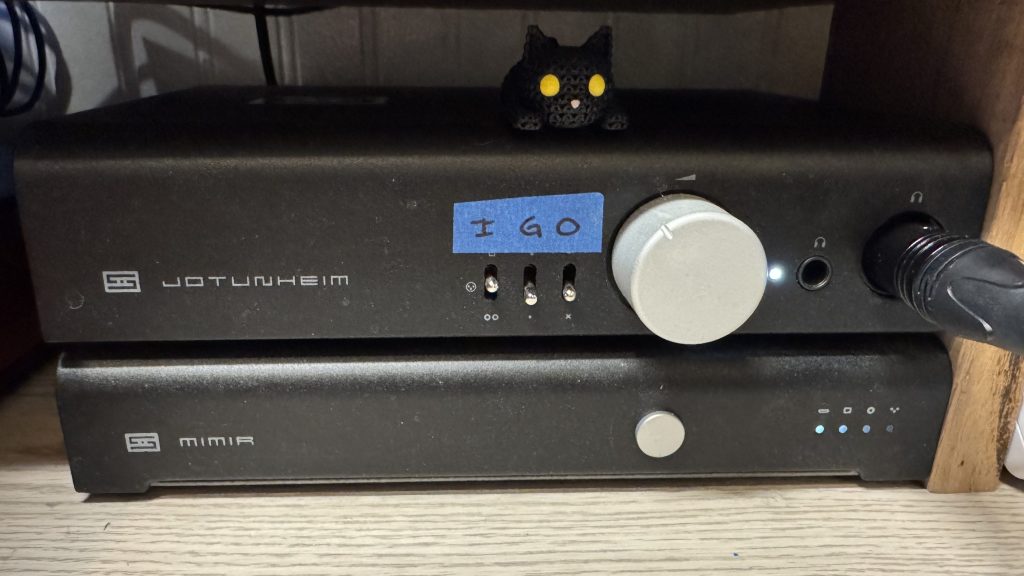
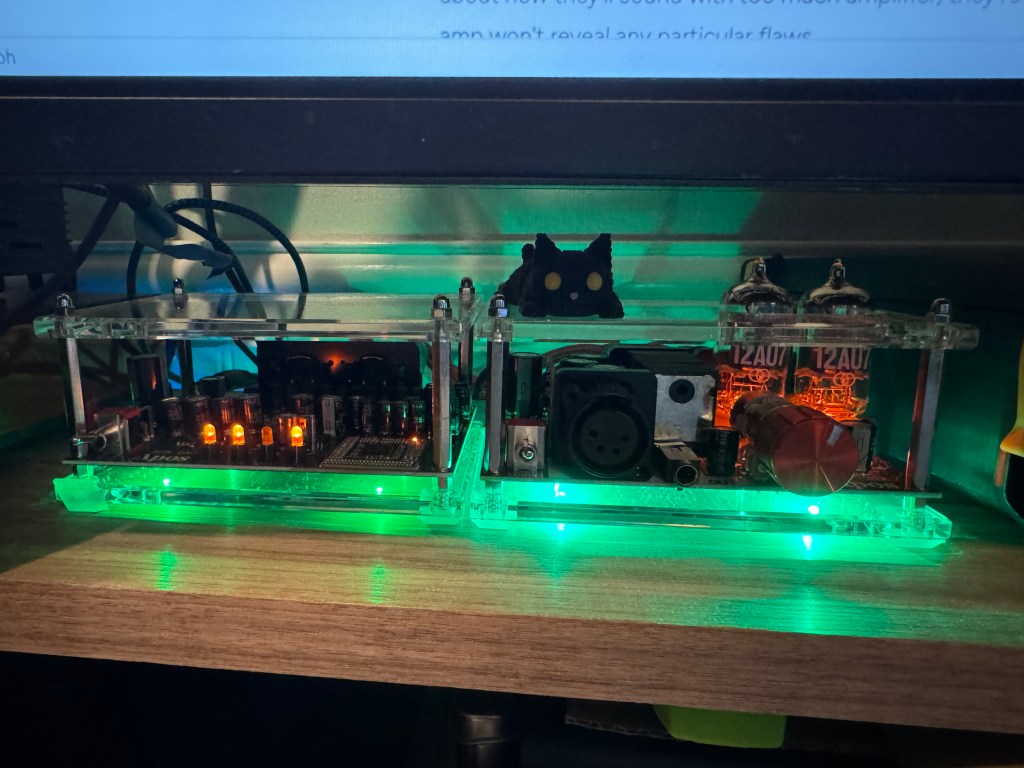
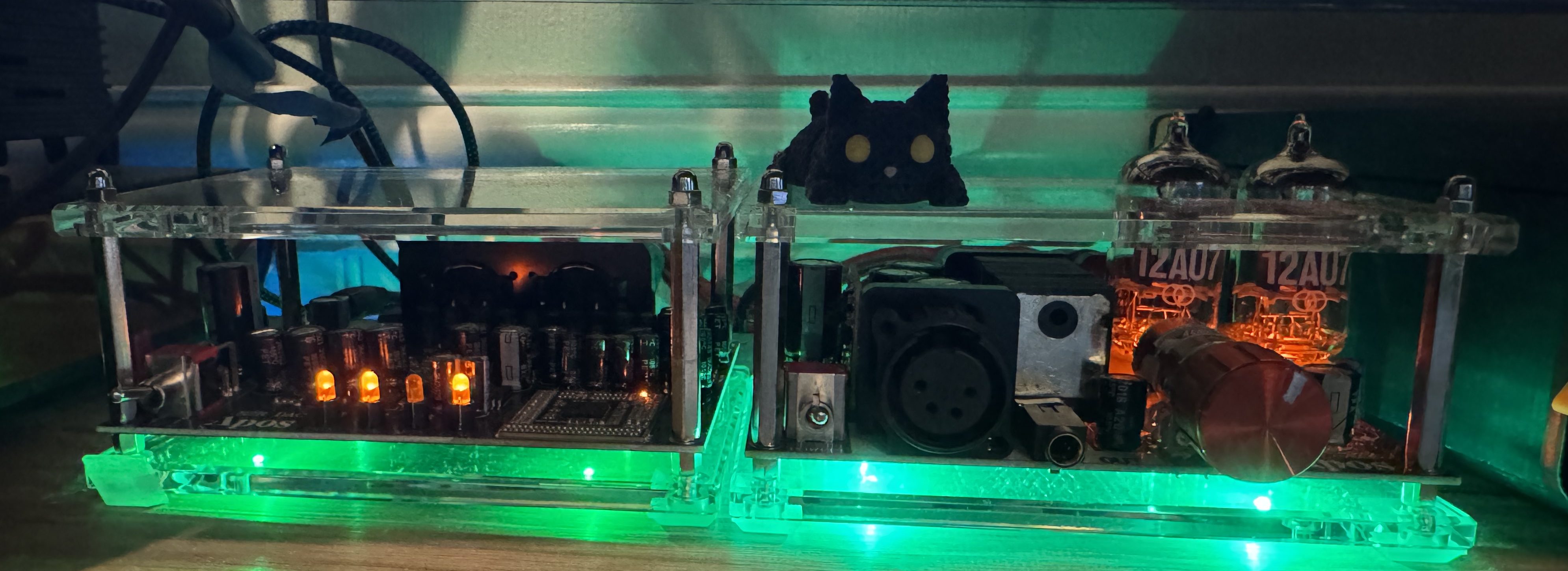
Based on my philosophy on the allocation of resources in headfi, except where otherwise noted I’m going to primarily be testing these with a Schiit Mimir/Jotunheim 2 stack, running balanced via the OEM 4.4 mm terminated cable and a Hart 4.4 mm to XLR adapter, and connected via USB-C to a Mac Studio running the Roon client. I also did a fair amount of listening with the Apos Merlin R2R DAC and Gremlin balanced tube amplifier, and using a Meze upgrade cable I snagged 80% over the holidays.
EQ
As noted in the Bathys review, I mostly prefer to test headphones with their default tuning, assuming that most people won’t take the time or make the effort necessary to use a third-party EQ. The Strada are a bit unusual, but they do work for me out of the box. I did a lot of listening to them without EQ, and then a fair amount with. While I am going to review them as they are without EQ, I mostly listen to them with EQ; they go from a good headphone to a great one.
EQ Update
Like the Meze 99 Classics v2, the Strada is a new enough headphone that my go to for EQ starting points, Oratory1990, doesn’t have a profile yet for it. So I set out to build one of my own. I started with auto-EQ from my squig.link measurements of my unit (which, unsurprisingly, sounded pretty bad), and then spent a few weeks fiddling with the bands. I’m satisfied with this for now; it corrects a few of the Strada’s quirks without too badly changing the things that make it fun and exciting.
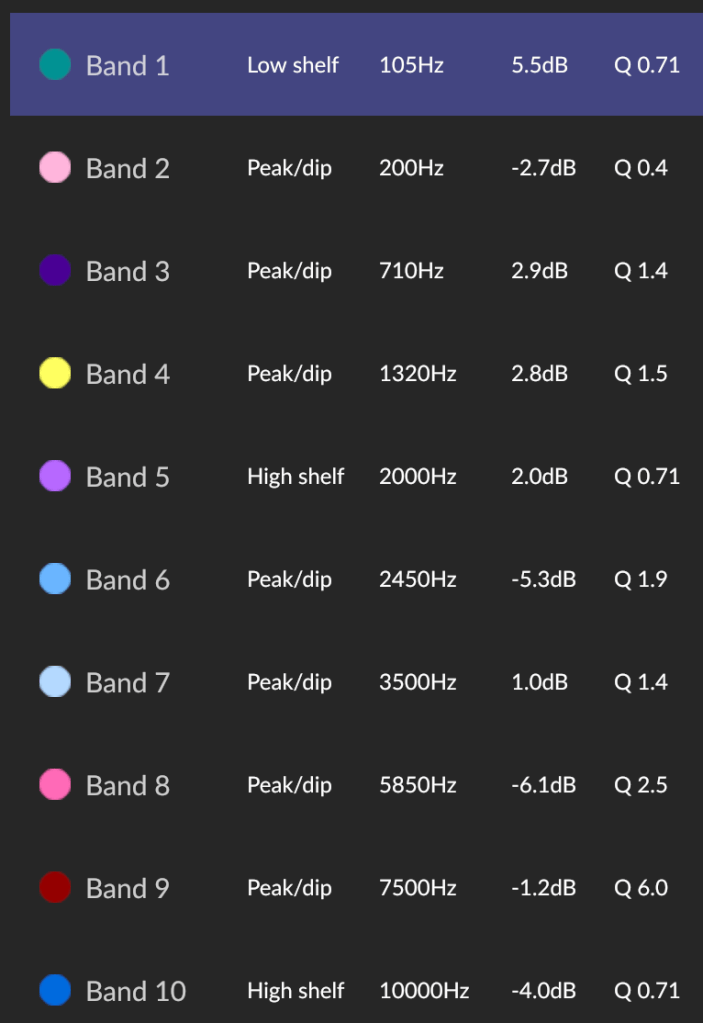
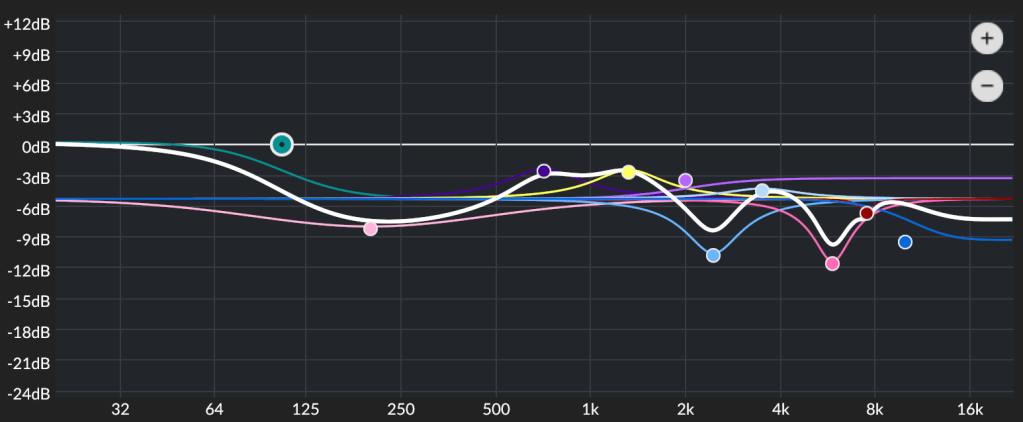
For now, this is how I will mostly be listening to these headphones. I’m very curious to see what Oratory1990 proposes for them when he gets access to a unit to measure. There’s definitely some fine-tuning to be done; as I’m writing this I’m noticing that I’m getting a little less attack and body on things like hands clapping and a tiny bit of flatness on lower pitched female vocals than I might want. It’s a work in progress.
Volume
Here are the volume settings I use with the Meze Strada (unless otherwise noted, running via Roon with no headroom management, playing Daft Punk’s “Face to Face” from Tidal):
- Apos Druid/Gremlin: 11:30 (balanced 4.4 mm)
- Chord Mojo: white, orange, orange, red
- Dongles:
- Apple: 50%
- Crinear Protocol Max (max internal volume): 66% (single-ended), 50% (balanced)
- Fiio KA11: 35%
- Fosi DS2: 33% (single-ended), 25% (balanced)
- JCALLY JM6 Pro: 50%
- Moondrop Dawn Pro: 75% (single-ended), 60% (balanced)
- Holoaudio Bliss (KTE): -29 dB (Low-Z, single-ended), -36 dB (Low-Z, balanced 4.4 mm)
- Mytek Brooklyn Bridge: 60%
- Schiit:
- Mimir/Jotunheim 2 (Mimir has a -15 dB pregain applied via Forkbeard): low gain, 11:30 (balanced); low gain, (single-ended)
- Modi/Magni: low gain, 1:00
- Modi/Piety: low gain, 9:00
- Modius/Magnius: low gain, 8:30 (balanced); low gain, 9:30 (single-ended)
- Topping DX5 II: – 28 dB (single-ended), – 35 dB (balanced, 4.4 mm)
My torture testing list
The Basics
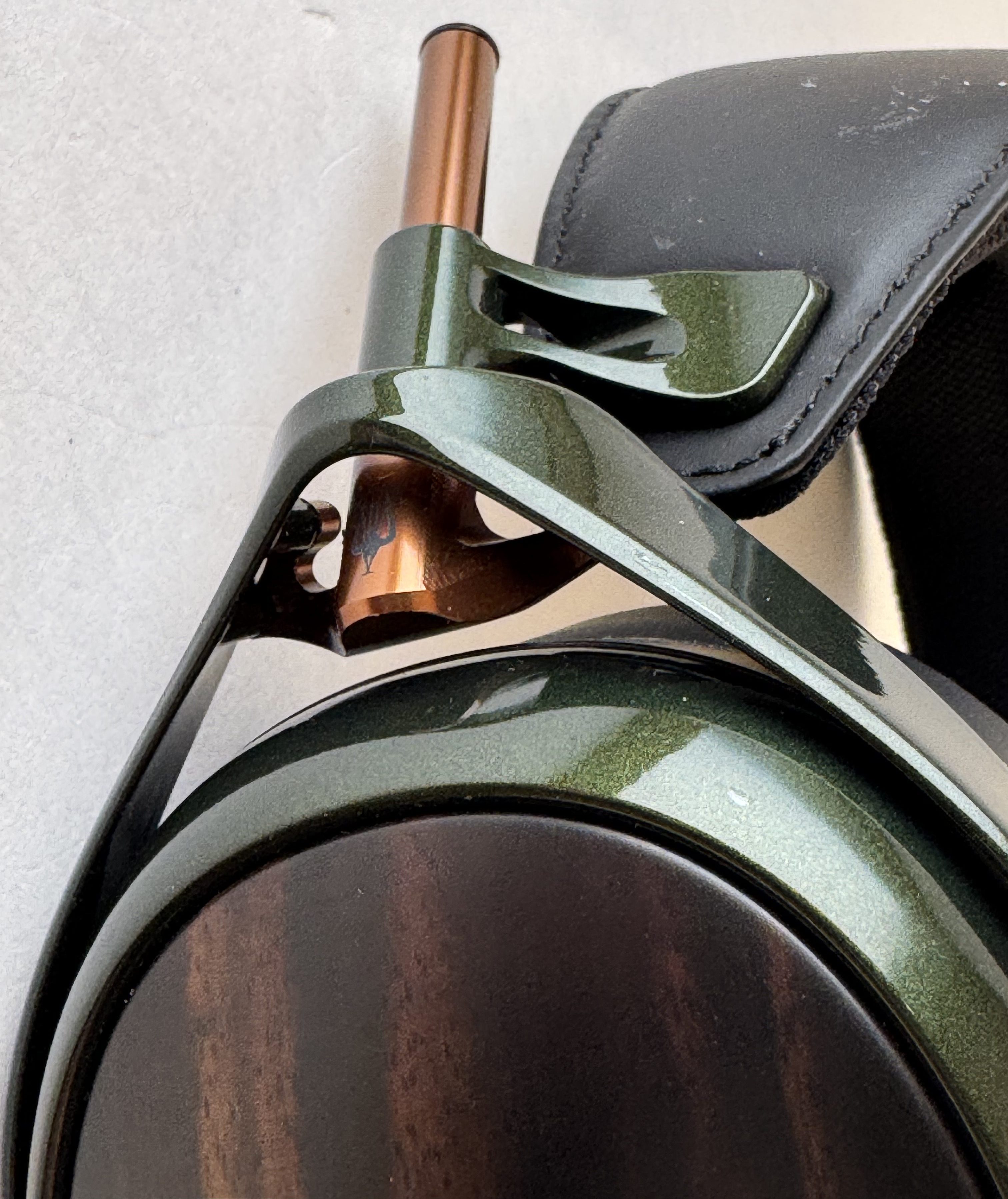
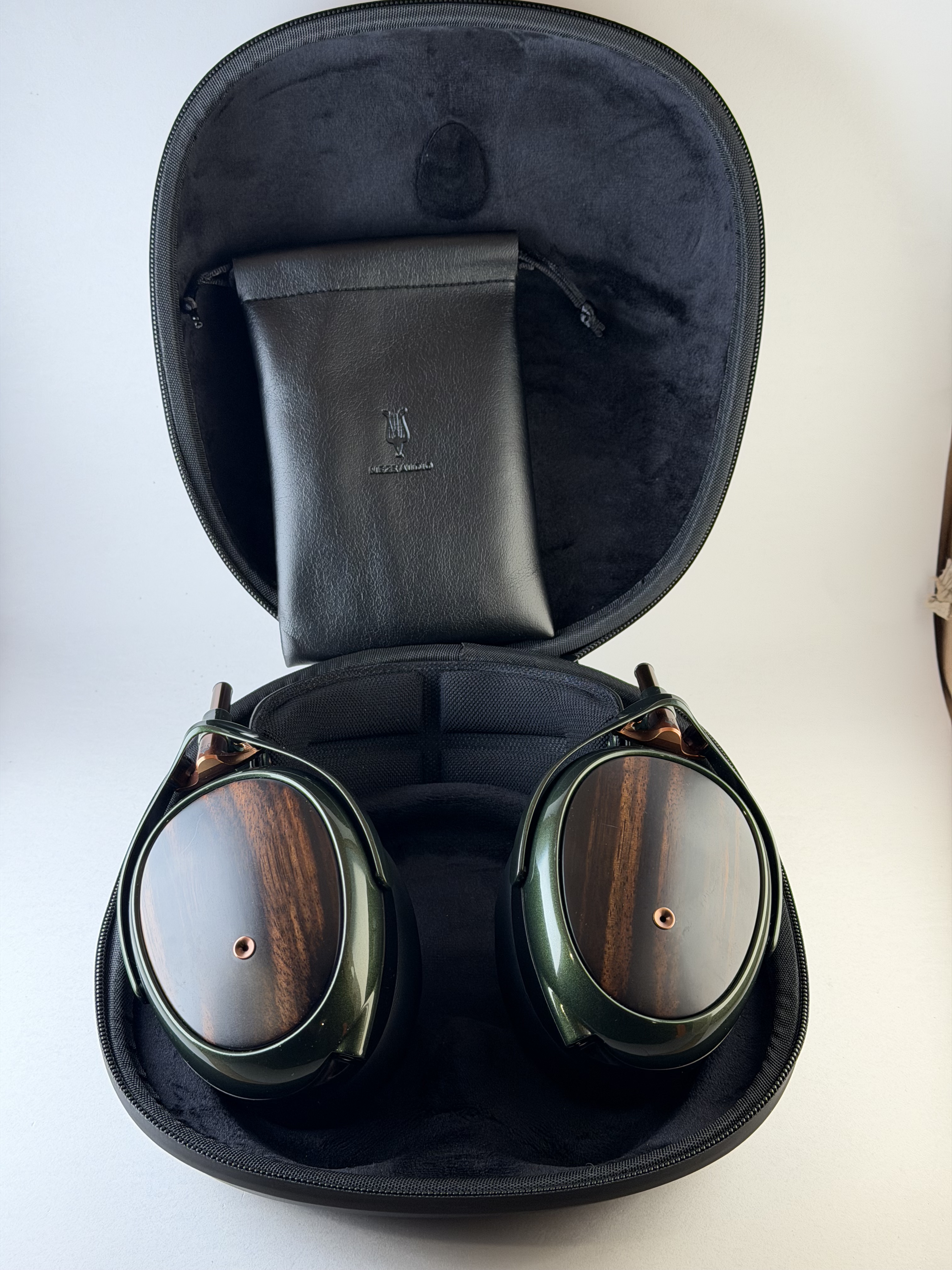
The Meze Strada is a closed-back, dynamic driver headphone from Romanian manufacturer Meze. Like Meze’s higher end products, the Strada is built by hand at their Baia Mare factory (unlike some of their lower end products, which are assembled in China). The Strada use the same drivers as the Meze 109 Pro, one of my very most favorite headphones. They are, for a Meze closed back, dangerously close to “reasonably” priced at an MSRP/MAP of $799. They’re also, clearly, designed to be a premium looking and feeling product, with a painted magnesium chassis and yoke, copper rods connecting the earcups to the band, macassar ebony cups, magnetic mixed PL leather and alcantara cups, and a really well-designed and comfortable padded headband. Strada ships with a really nice synthetic leather case and two premium dual-entry 3.5 mm, Kevlar-wrapped cables, one terminating in 3.5 mm (with a non-threaded 6.35 mm adapter) and the other in 4.4 mm.
The Strada are really quite easy to drive, with a nominal impedance of 40 Ohms and a sensitivity of 111 dB/mW, meaning they’ll run pretty well off of almost any device with a 3.5 mm audio jack. They’re also what I’d consider a moderately light headphone for one that feels so solid in the hand and on the head, weighing in at 330 grams without a cable.
The Strada have an … let’s call it unusual tune for an audiophile-focused headphone, with a pretty U-shaped sound signature. Here’s what it looks like on my rig:
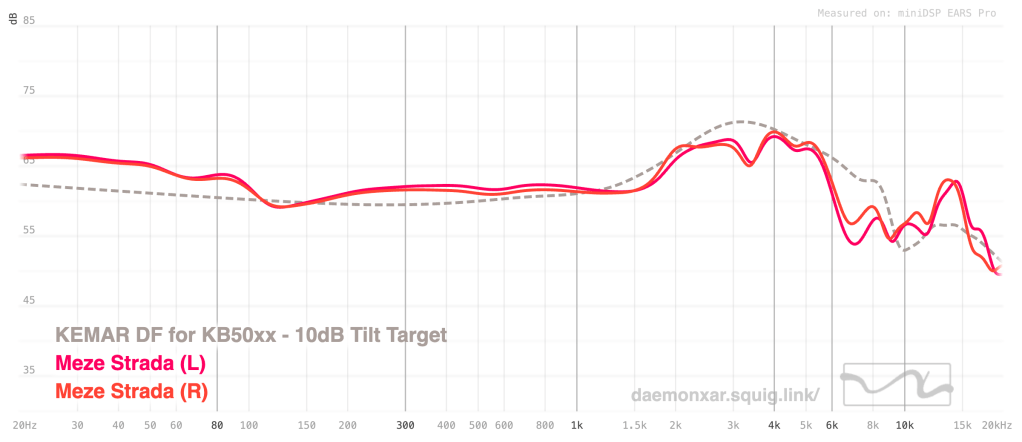
This is more or less what I hear. I’ll talk about this below, but there’s some weird timbral artifacts with the Strada that I attribute to a couple of FR artifacts, particularly the dip at 125 Hz and the oddities in the ear gain region (1.5-4 kHz). FWIW, I don’t hear that particular spike at around 14 kHz in a sweep, and nothing popped out in there during my listening sessions.
Sound
I’ll start by saying this: like the Elex and the 109 Pro, this is a headphone that I spent some time worrying about whether I actually liked, or just wanted to like. It’s a gorgeous pair, but a … unique tuning in my collection with some issues that can be off-putting on particular tracks.6 After a lot of listening over the last couple of weeks, I’m confident that I actually do like them as they sound out of the box, though I think they are MUCH better with some substantial EQ applied. Even with EQ, though, they’re not something I’d recommend for everyone.
Overall I would describe this as much more of a fun, casual headphone than a particularly resolving or technically focused one. It’s got a perfectly reasonable technical performance, but it’s also definitely tilted pretty far away from neutral even for a closed back.
Technicalities
The soundstage on the Strada isn’t particularly wide or deep (and a lot of it feels like it’s slightly behind your head) but has pretty decent layer separation/imaging within that stage. On a track like “Chan Chan” you get the guitar parts nicely out to the sides, the hand drums just slightly behind your head, and the vocalists just a hair left of center. While you can hear both vocalists, they feel like they’re occupying the same physical space. The guitars are generally well separated, though, not muddled the way that they can be on a lot of closed backs. There’s not a ton of front-to-back staging either, with the guitar riff on “Love Can Damage Your Health (Laid Mix)” mostly panning right to left without a lot of rotation.
The dynamics are pretty good, particularly for an easy to drive headphone. Setting the volume at the beginning of “It’s All So Incredibly Loud” had me reaching for the volume control around 2:20.7 The microdynamics are good but not great. One of the things that had me most excited about the Strada was the possibility of bringing the beautiful dynamism and impact from the Meze 109 Pro to a closed back, but it’s just not quite there. I want a little more impact from the bell tones on “Angel (Blur Remix)”, both the bass and the treble, though interestingly I do get a bit of the warble after the hit as the note settles into the correct pitch, which I don’t always get on headphones with better attack. Notes do fate crisply and appropriately, though, which is great.
Overall, the detail and resolution of the Strada is subjectively fine; I never particularly felt like I was missing any details from tracks I know well,8 but I also never heard anything new jump out at me either. Pretty good hiss and finger-sliding on the beginning of “What Did I Do?”, though some of the finger noises later on in the track feel a little indistinct compared to a more detail-oriented headphone like the 109 Pro or Audze LCD-2.
Timbre is … well, potentially one of the weakest parts of the Strada, at least in specific regions of the frequency response. Generally bass and treble are pretty great, sounding clean and natural. In the midrange, though, particularly the human vocal range … much less so. Which, unfortunately, is also the part of the frequency response we’re most likely to hear something that sounds wrong. Hope Sandoval is pretty flat and lifeless on “Paradise Circus,” Dave Bayley is quiet and just not quite right on “It’s All So Incredibly Loud,” etc. It’s not every voice, and EQ fixes a lot of it and makes it sound better. Even uncorrected it doesn’t bother me after the first fifteen or twenty minutes once my brain has had a chance to adjust, but these probably aren’t a pair of headphones I’m going to use to listen to vocally-focused music very often.

Bass
The bass response on the Strada is generally pretty good and goes all the way down to the audible basement. There aren’t a lot of headphones where I can really hear the 20 Hz range on AudioCheck.net’s Frequency Response test, but the Strada clearly reproduce those tones on my head. The one flaw of the bass response is that it dips a bit towards the upper end of the bass/the transition to the midrange in a way that can make some things feel a bit hollowed out. At the midpoint of “Paradise Circus” the bass line should be thrumming and driving the song forward, but as it goes up in pitch the volume drops a bit and I find myself wanting to turn the volume up to get a more satisfying resonance and vibration. That said, it’s a good, clean, and crisp bass; I just want more of it in that transition area. On “Out of My Hands” the bass slips in nicely around 2:48 and then builds beautifully over the next minute as the song climaxes and recedes. You do get all of the notes on “Got ‘Til It’s Gone,” something a lot of dynamic drivers struggle with at the very bottom. Tracks that don’t have a lot of information in that transition range generally sound really good in the bass; see, e.g., “Remain Nameless” where the kick drum and bass avoid the trouble areas pretty cleanly.
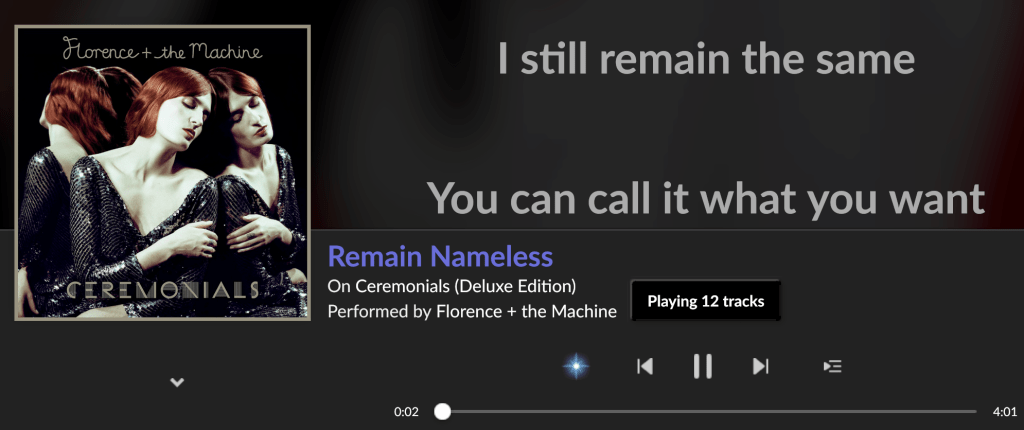
[Editor’s note: as an example of the dip in the upper bass, there’s a particular note or two at the upper end of the upright bass’s line on “Birds” that just disappears consistently in a pretty distracting way. As an example of the really excellent bass extension, I’ve listened to “Islands” by The xx probably two hundred times, and I’m not sure I’ve ever really heard that entire bass line on a pair of headphones. It’s pretty cool.]
Brain wobble on “Limit To Your Love” is really clean but not as emphasized as it is on some headphones, and as mentioned above the microdynamics/slam aren’t particularly strong. Same on “What Did I Do?”; it’s beautifully crisp but I might want a little more dynamism on some of the notes. The notes are there and well-reproduced, but they don’t impact quite as solidly as I want.
All that said, the bass is pretty easy to fix with EQ. I haven’t been able to get any more slam out of the bass without turning up the volume (I’m pretty sure that’s not a thing you can EQ for?) but adding the EQ profile discussed above fills in the dip and evens it out a lot.
Midrange
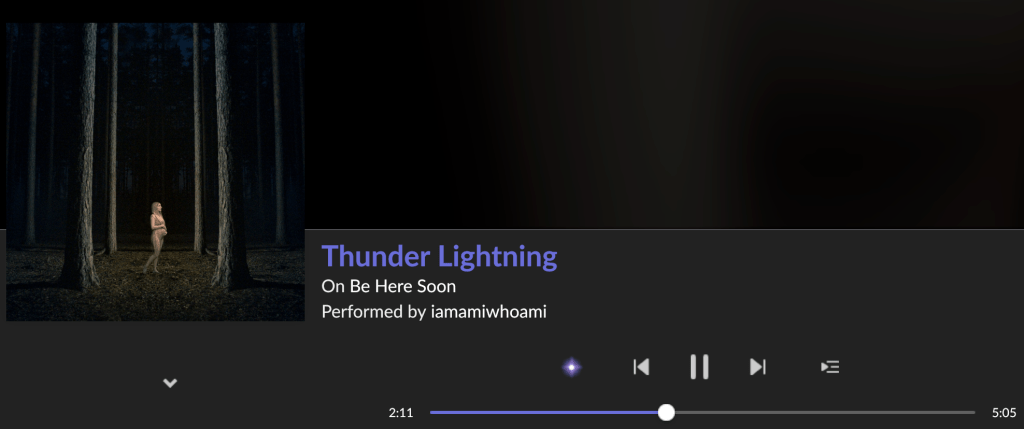
The midrange on the Strada is probably the biggest disappointment, especially compared to the same driver’s performance on the 109 Pro (one of my favorites on a non-Sennheiser headphone). It’s not bad, per se, mostly just inconsistent. There are tracks where parts are just a bit recessed (for example, just the rhythm guitar part on “Only Here and Nowhere Else”; the lead guitar is beautifully done), some where voices are quieter than I want them to be (Dave Matthews on “Out of my Hands”), and some where the timbre is just … off (vocals on “It’s All So Incredibly Loud” where Dave Bayley’s voice is flat and lifeless). It’s a little frustrating because in other places it’s great; Jonna Lee sounds incredible on “Thunder Lightning” in both the main and backup vocals, and the Strada is one of my favorite ways to listen to “Cold War”, with Cautious Clay seamlessly transitioning in and around the instruments. Ditto “What Did I Do?”; Justin Hicks is almost perfectly balanced throughout that track (even towards the end, where the timbre gets a bit funky on other headphones).
I’ve been trying to figure out if there’s a pattern in terms of where the vocals get funky, and I think it might be where male and female vocals start to bleed together on average? It’s most distinct with women singing in their lower ranges (Hope Sandoval on “Paradise Circus”) or men singing in their upper register or falsetto (Sampha on “Like the Piano” or Dave Bayley on “It’s All So Incredibly Loud”). But even that’s not particularly consistent; Dominique Fils-Aime sounds incredible on “Birds,” even when she dips down pretty low in her register.
Outside of vocals, though, I really enjoy the midrange on the Strada. It’s one of the cleanest midranges I’ve encountered on a closed back headphone for most instruments. “Garcia Counterpoint” is laid out, incredibly well, with all of the guitars and other stringed instruments layered beautifully and distinctly, and the warble on the violin around 2:45 is absolutely perfect.
It’s worth noting that EQ cleans up most of the issues I have with the midrange; it’s occasionally still just a very little bit distracting, but well within the range of enjoyable listening. It also mostly fades after fifteen or twenty minutes of music through the Strada as my brain recalibrates, though every once in a while something pops out as wrong-sounding.
Treble
The treble on the Strada is generally pretty enjoyable for me; I know people talk about it being a pretty hard U-shape, but for me it comes without a lot of sharpness in the treble. For the most part, it’s clear, and crisp, and timbrally correct. It’s certainly got some dips above 5-6 kHz but they’re not particularly distracting, and I don’t hear any particular peaks on my head.
The guitar and vocals on “2021” are nicely relaxed without being recessed on the Strada, though some of the muted trumpets on “Will O’ the Wisp” do feel like they’re a bit too muted at times. Timbre is overall pretty good, though there are a few little issues. The claps on “Remain Nameless” feel a bit artificial (though not claps on other tracks like “Birds” or “Paradise Circus”), and some synths on “Coffee” sound a little more synthetic than they usually do. Bells are nice, crisp and clean on that track though.

[Editor’s note: as I was editing this, I did run across a track where the treble is a bit excessive. On Bauhaus’ “Bela Lugosi’s Dead”, there are a couple of guitar feedback patterns that get brain bleedingly loud even at reasonable listening volumes (particularly around 2:00). I’m going to spend a little time hunting that down this week, but for now it’s a track I’ll skip on the Strada.]
Because the Strada’s treble sounds pretty good to me out of the box, I tried the EQ profile above with the three treble bands (5.9 kHz, 7.5 kHz, and 10 kHz) turned off and they did start to read as sharper; seems like they’re fine out of the box because of the relative balance across the midrange and bass, and cleaning those up a bit does require toning down the treble a bit too to maintain overall cohesion.
Amplifier Compatibility
I haven’t had any particular issues with the Meze Strada on any given amplifier, though despite being an amplifier skeptic I will say that anecdotally, I don’t think you get the best out of the Strada from the Chord Mojo 2 (my favorite amp) or the Holoaudio Bliss (KTE); in relatively brief testing, neither sounded quite right with them. When I get around to doing my next set of blind amp/DAC testing, I’m tempted to throw the Strada in the mix. They do generally sound pretty great even from dongles though; these are pretty efficient headphones and they aren’t particularly hungry for power. Definitely compatible with little devices like the Snowsky Echo Mini or the Fiio CP13 cassette player.
Beyond that, I do think that the Strada plays particularly well with a hybrid tube amp like the Apos Gremlin; I think the Strada benefits a bit from the warmth of tubes, and it might help fill in a bit of the hollowness I’m sometimes getting between the bass and the midrange.
Overall Impressions
The Strada aren’t a headphone that’s going to be for everybody. They’re an unusual tune, maybe even a marmite tune. I personally like them out of the box, but they really do shine with some EQ applied to balance some of the quirks without losing the things that make the Strada great.
I mentioned above that this is one of those headphones that I found myself wondering if I actually liked, or just wanted to like. After a couple weeks of regular listening and a lot of A/B’ing while preparing to write this, I’m satisfied that I actually like them. They’re weird. They’re not always what I’m going to want to listen to, and there are definitely some things I wouldn’t choose to listen to on them, but they’re a fun and interesting addition to my collection particularly as a change of pace listen.
Build Quality & Appearance
The Strada is a Meze-designed and -built product, so you can be pretty certain that the industrial design is well thought through and constructed.
A quick note on their noise isolation. These aren’t the most isolating closed back headphones in the world; while they’re worlds more isolating that something like the Audivina, I can still hear my fingers typing on a Microsoft split keyboard while I type this, if I don’t have music playing through it. I don’t hear the HVAC system in my office, the fan on my laptop spinning, or my dog in the hallway sighing loudly, but these aren’t the most sound-blocking closed backs I own. I’d put them about on par with something like the Fiio FT1, and behind something like the Focal Elegia/Celestee.
Connectivity
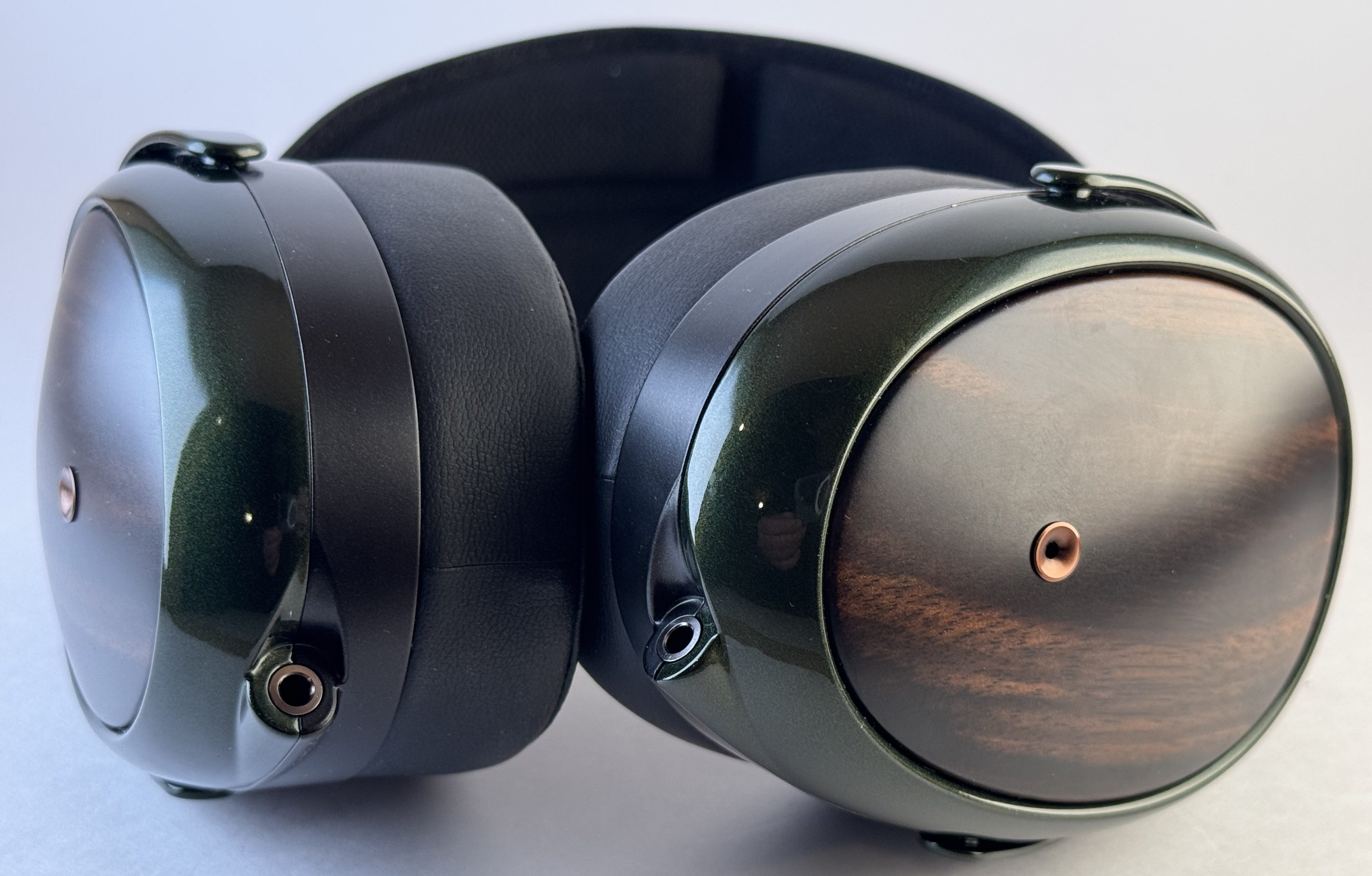
The Strada eschews the mini-XLR connectors Meze uses for their higher end stuff (Empyrean, II, Elite, etc.) and sticks with a standard dual-entry, balanced capable, 3.5 mm jack running into the cups. This means that there is a wide array of aftermarket cable options if you want to upgrade over the OEM cable, and unlike the 109 Pro the 3.5 mm jacks aren’t recessed into the chassis, meaning that they’re going to be compatible with the vast majority of options on the market, even the chonky Focal barrels.
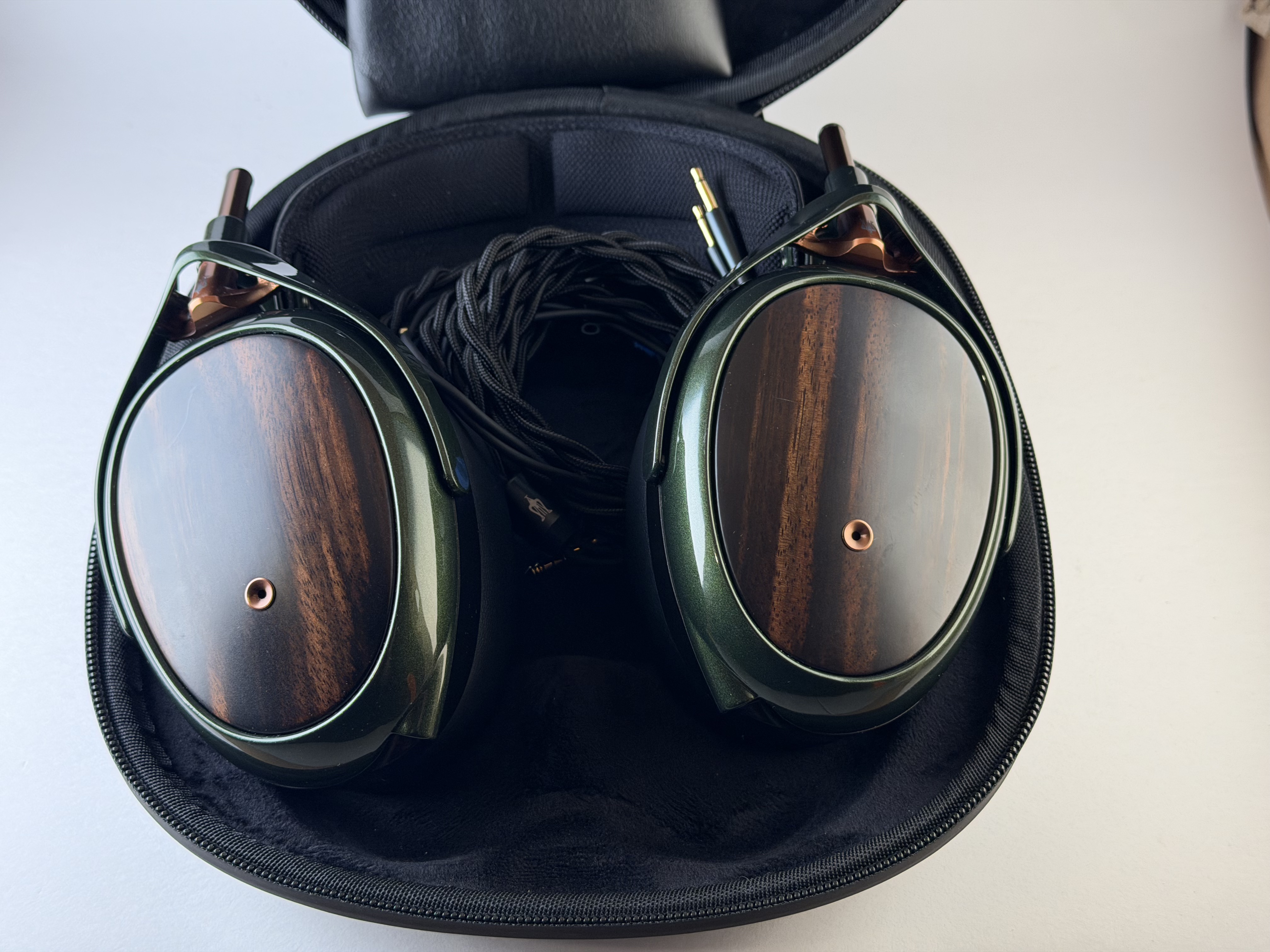
The Strada comes with two really excellent 1.8 m cables, one terminating in a 4.4 mm balanced connection and the other a 3.5 mm single-ended jack (and includes a non-threaded 6.35 mm adapter). The cables do really stand out compared to a lot of their competitors; while they’re rubberized above the split, the remainder of the cable is wrapped in Kevlar and is nicely braided. Zero microphonics, very little memory, easily coiled and draped. This is exactly what I want from an OEM cable. (I’m like 90% certain the single-ended cable is the same one that ships with the 99 Classics v2.)
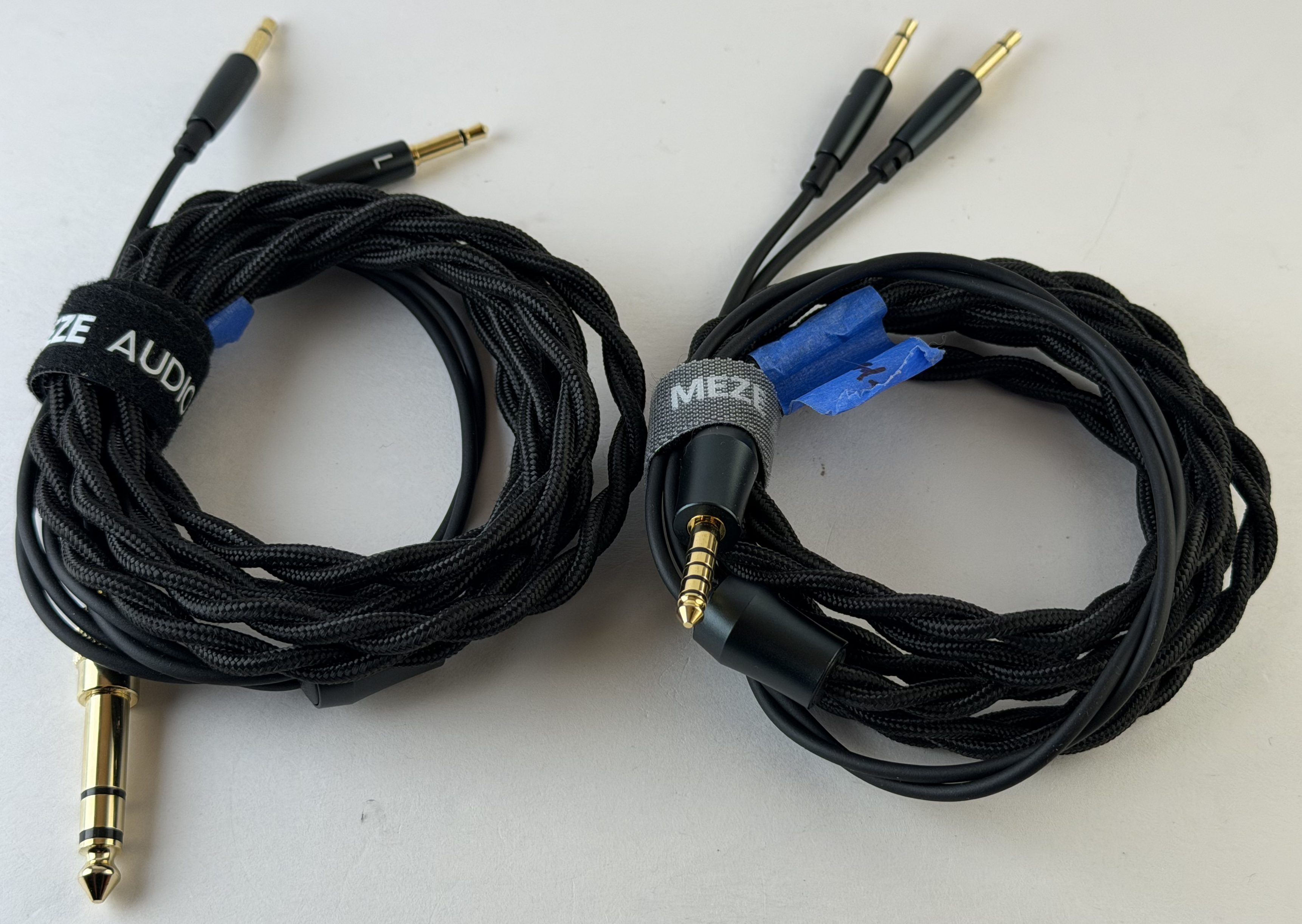
If I had to offer a suggestion for the Strada’s connectivity, it would be that I’d prefer XLR over 4.4 mm for the balanced cable (but adapters are cheap and easy to use), and a threaded 3.5 mm to 6.35 adapter over the included non-threaded one would be great.
Construction
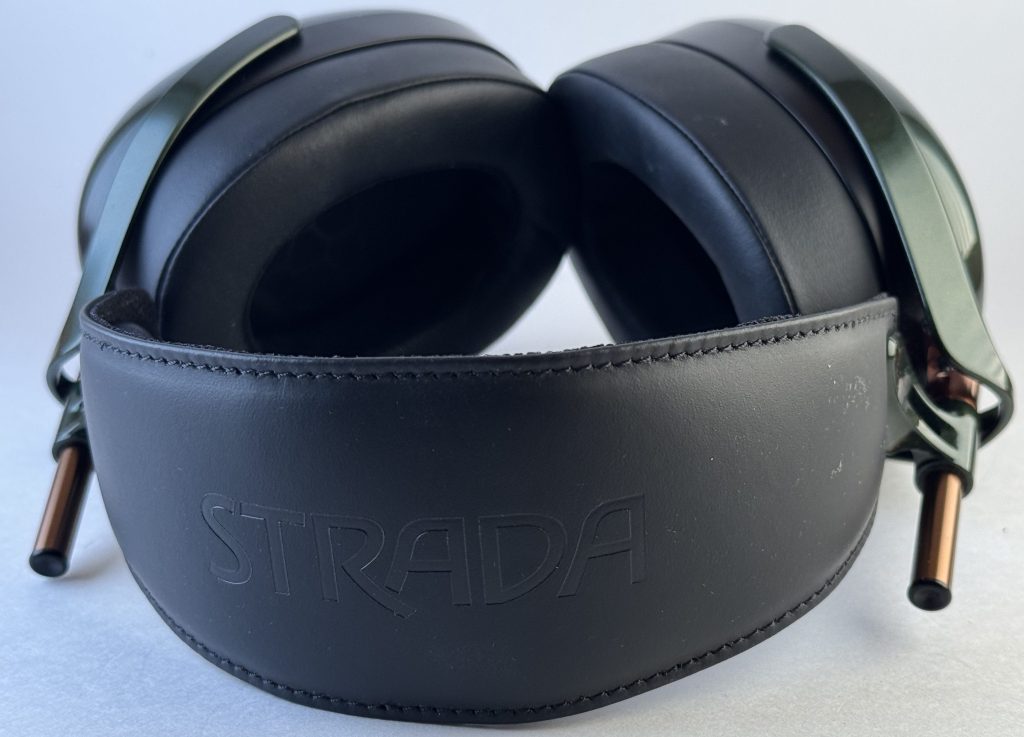
The Strada shares a the physical design of the Meze Liric, which is mostly a suspension strap-less version of the Elite/Empyrean design. It has a single padded pleather headband (rather than the more typical Meze spring bands with a suspension strap). The headband is a nicely appointed vegan leather with Strada engraved on the top, and a padded underside with both side-to-side and front-to-back splits that help prevent hotspots. It’s surprisingly flexible, and well-calibrated to be comfortable. It takes very little effort to bend it out to fit on my head, but a lot more effort to expand it much further. On truly prodigious noggins, it may end up being a bit clampy.
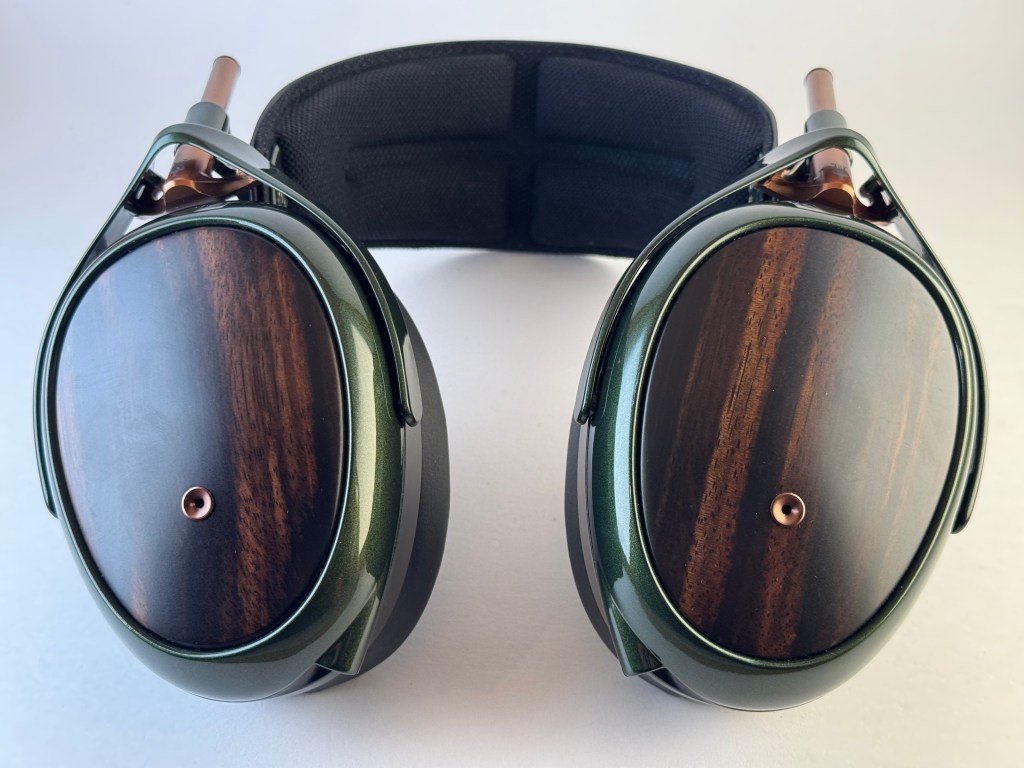
The headband is mounted via a painted magnesium fixture to lovely copper-colored rods that in turn attach to the painted magnesium yokes, which mount to the painted magnesium cups. The cups have beautifully designed Macassar ebony cup insert.
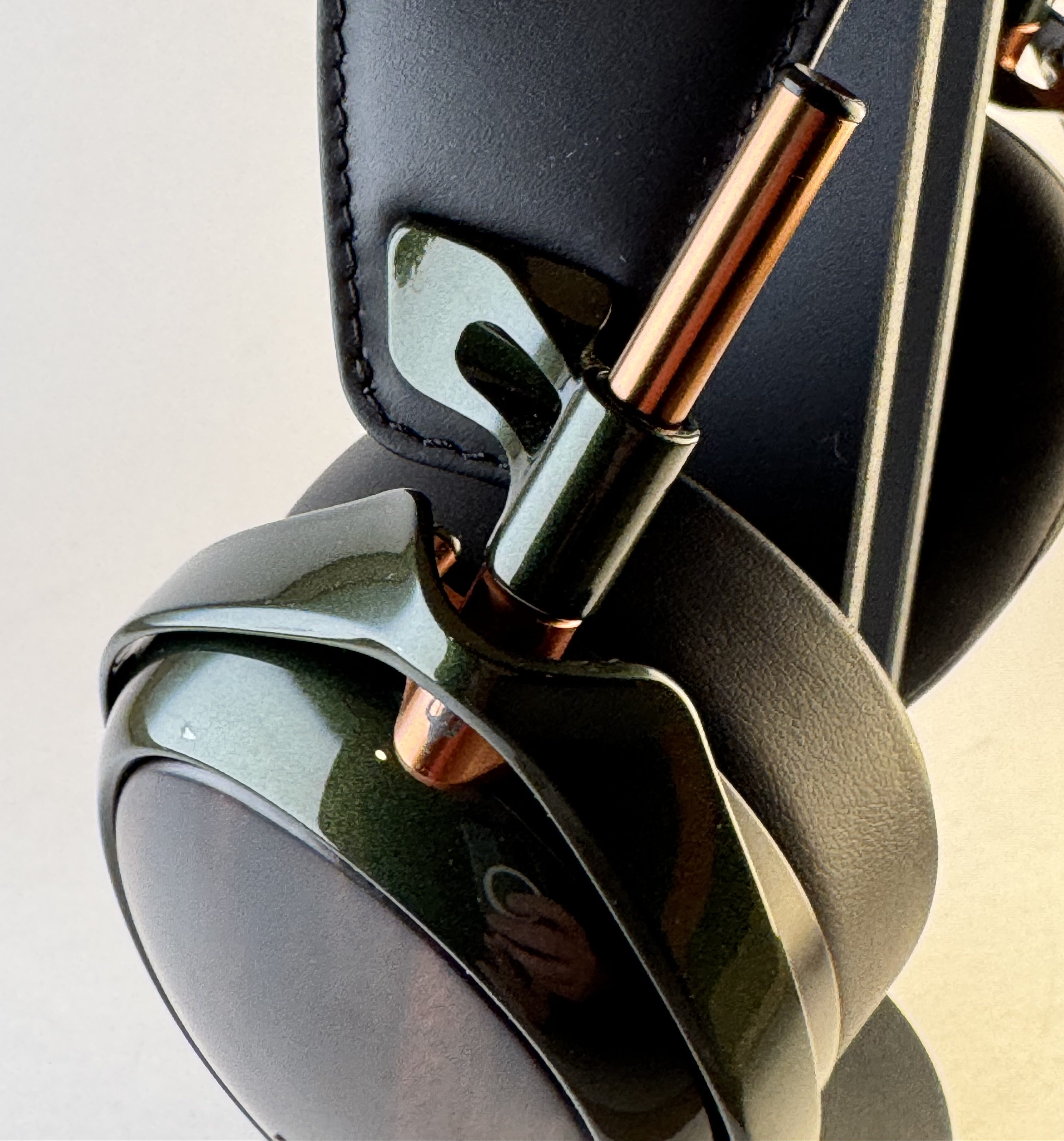
The cups rotate a full 360 degrees (honestly, I wish they rotated a little less easily), and tilt probably around 40 degrees. The earpads attach to the cups via magnets9 (dear god, why doesn’t everyone do this?!?!10), making them theoretically easy to pad roll (if likely more expensive to replace11). The pads are also really well-designed in their own right; compliant enough to be very comfortable, wide and deep enough to fit at least my ears perfectly, and did I mention that they attach magnetically?
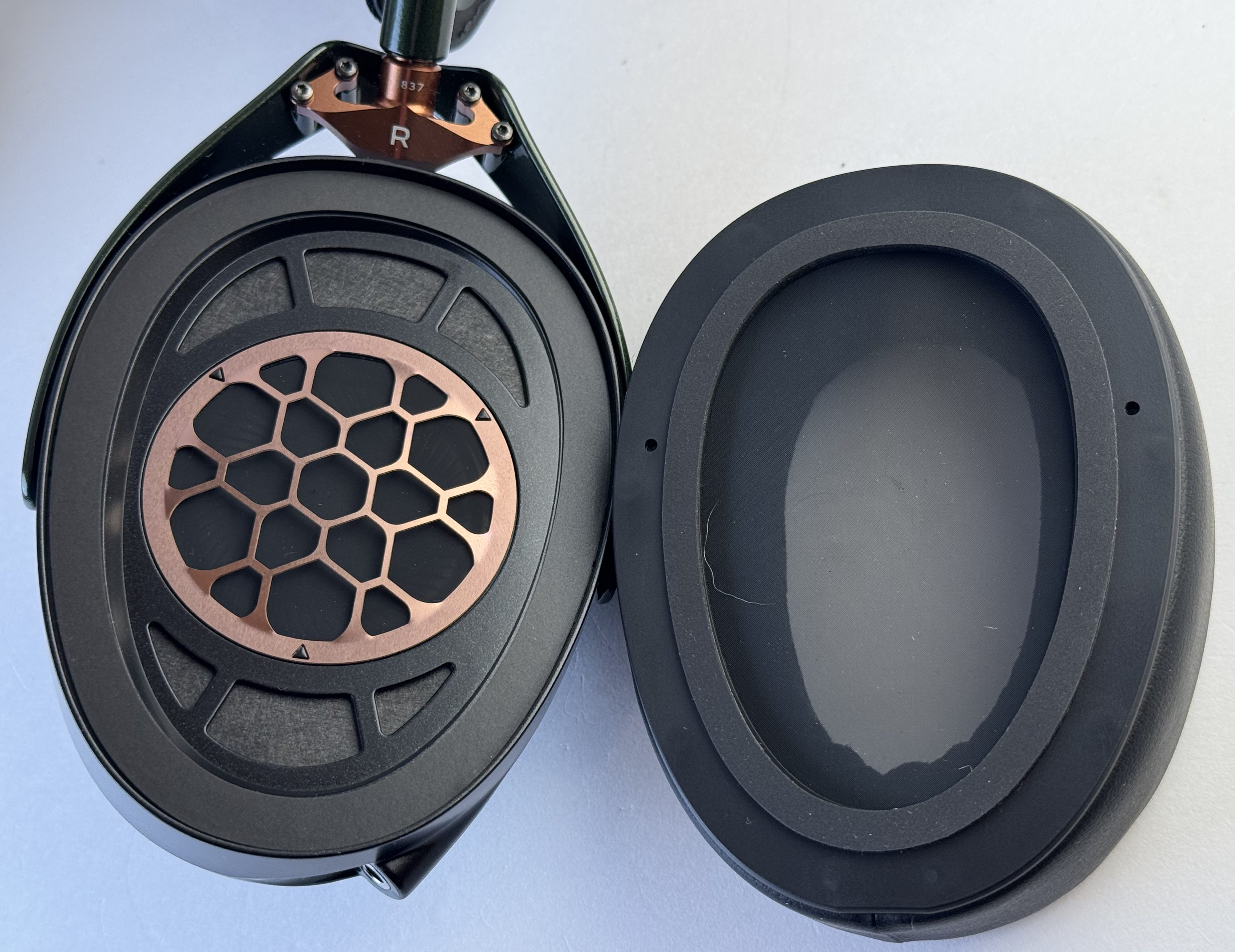
If I were going to change one thing about the Strada’s build, it would be the fully-rotating cups. They’re not quite as loose as the ones on the Empyrean II, but they do rotate freely enough that I have to use two hands to put them on or take them off: if you just grab one cup, they’ll flop around and you run the risk of damaging something OR not getting them properly settled on your head.
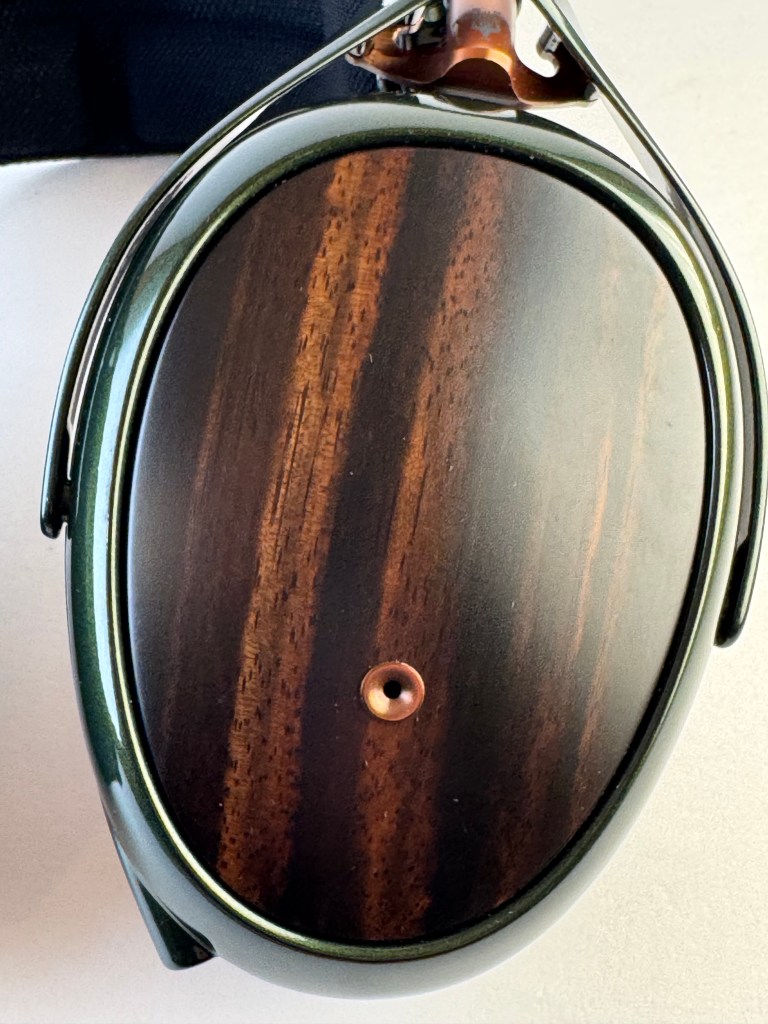
It’s worth noting that these bass ports are for realsies; if you block them, you can distinctly hear the bass fall off. Probably the clearest demonstration of bass porting that I’ve experienced with a headphone, but I definitely wouldn’t use these in an environment where the headphone is likely to be pressed up against something that might block it.
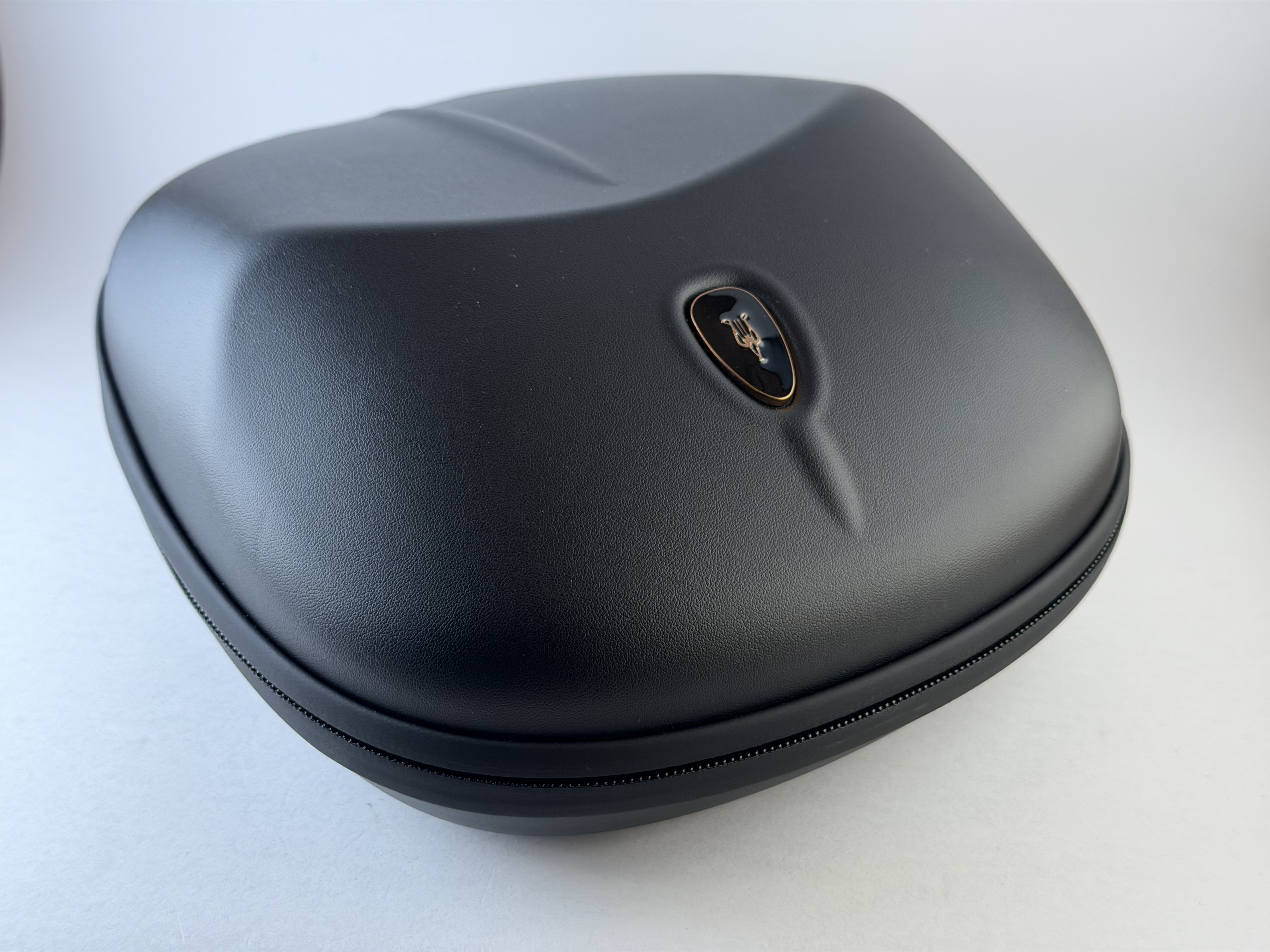
The Strada also ship as part of an excellent package. They come with a nice, semi-rigid case made out of a shock-absorbing polymer, a pouch for the accessories, and the two excellent cables I mentioned above. They don’t come with the Meze branded USB-C dongle that the 99 Classics v2 do, interestingly. As mentioned above I’d prefer an XLR cable for the balanced option and a threaded 6.35 mm adapter, but those are pretty minor issues. And as cool as a Meze dongle is, the odds that I’d ever use it are … very low indeed.
Comfort
These are among the most comfortable closed-back headphones I’ve ever worn, behind maybe the Sennheiser HD 480 Pro (need more time with them to be sure of that verdict). They’re relatively light, have just the right clamping force to distribute the weight nicely, and the design of the headband means that it does reasonably well even when it’s pretty hot in my office (though the cups are isolating enough that they do get a bit sweaty … probably unavoidable on a pair of closed back headphones).
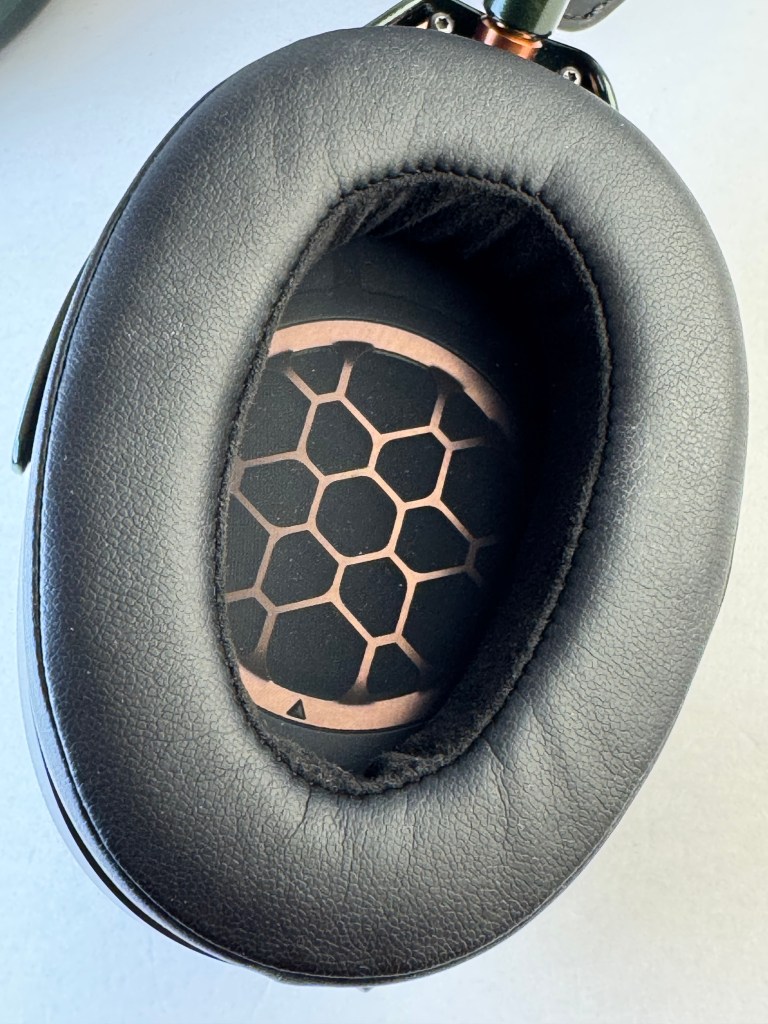
The only criticism I will offer is this; the tilt on the ear cups is limited enough that getting the pads sealed over my ears isn’t a sure thing every time I put them on. The tops of the cups have a tendency to pull off my head ever so slightly, breaking the seal, and I find myself pressing in on the top of cups every time I put them on. This is the opposite problem I have with the Empyrean II, which has a tendency to have the bottom of the cups creep out, but it’s a pretty minor either way. I mentioned in my 109 Pro review that I have to put them on and then adjust them each time, and that hasn’t prevented them from being my favorite headphone under $1k.
Appearance
Appearance is, as always, subjective. But DAMN, these are gorgeous headphones. The mix of the copper accents, the painted magnesium, and the beautiful Macassar ebony makes these arguably the prettiest headphones I’ve ever owned, behind only maybe the Bokeh Closed. There are people who won’t like the look, but they’re … wrong. Or have bad taste.
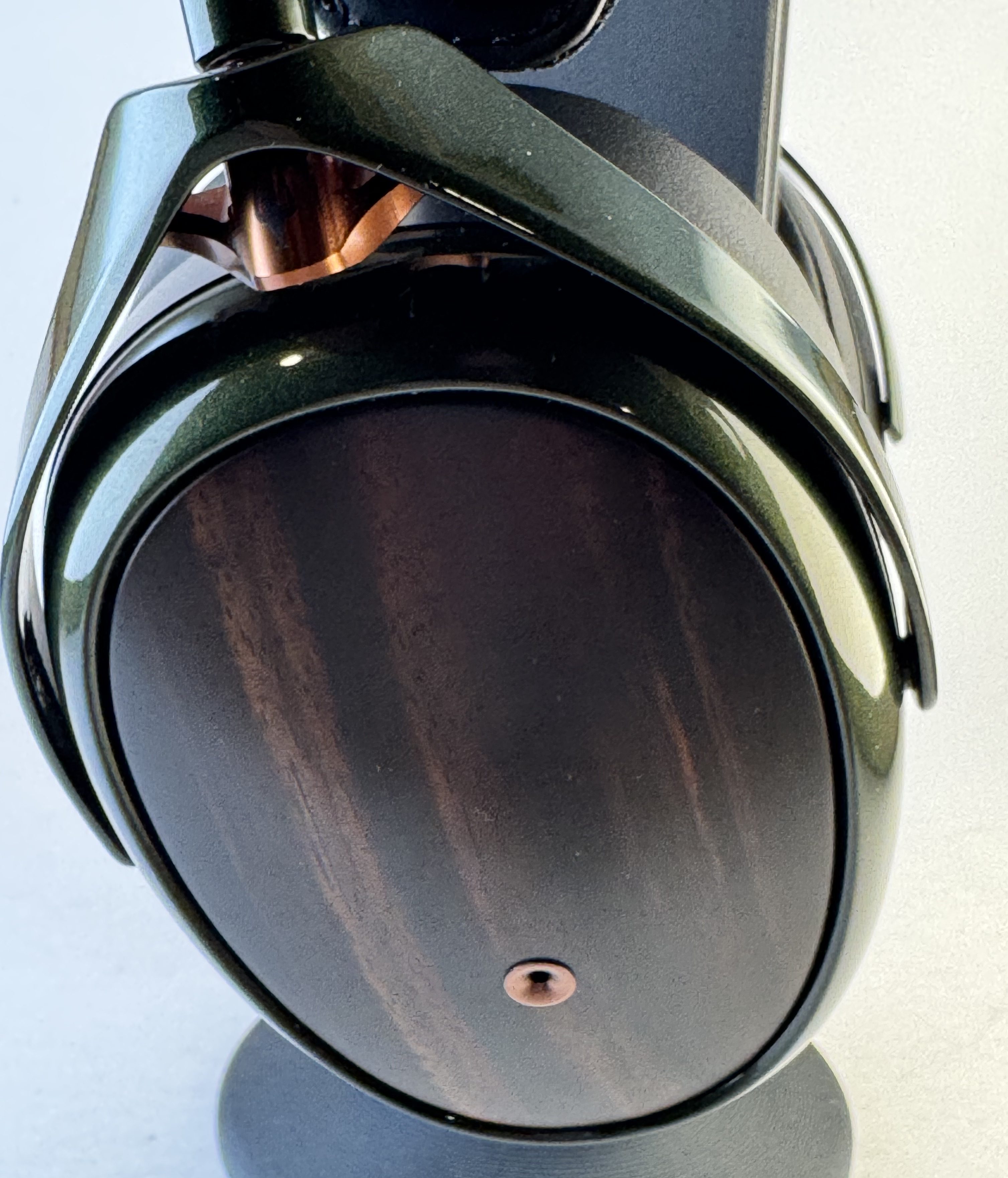
While I like the Meze aesthetic and the band + suspension strap look of both the Empyrean II and the Meze 109 Pro/105 AER/99 Classics/v2 styles, the single band of the Strada (and Liric before it) do help alleviate the Cyberman issue that those headphones present. I can wear these in public and any looks I get will be based on the colors and patterns rather than the cage around my head, and I do appreciate that.
Value & Comparisons
I mentioned in my 109 Pro review that I feel weird about calling a $799 headphone a good value … and fortunately in this case, I’m not sure I actually think it’s a good value so I don’t have to try to defend that proposition.
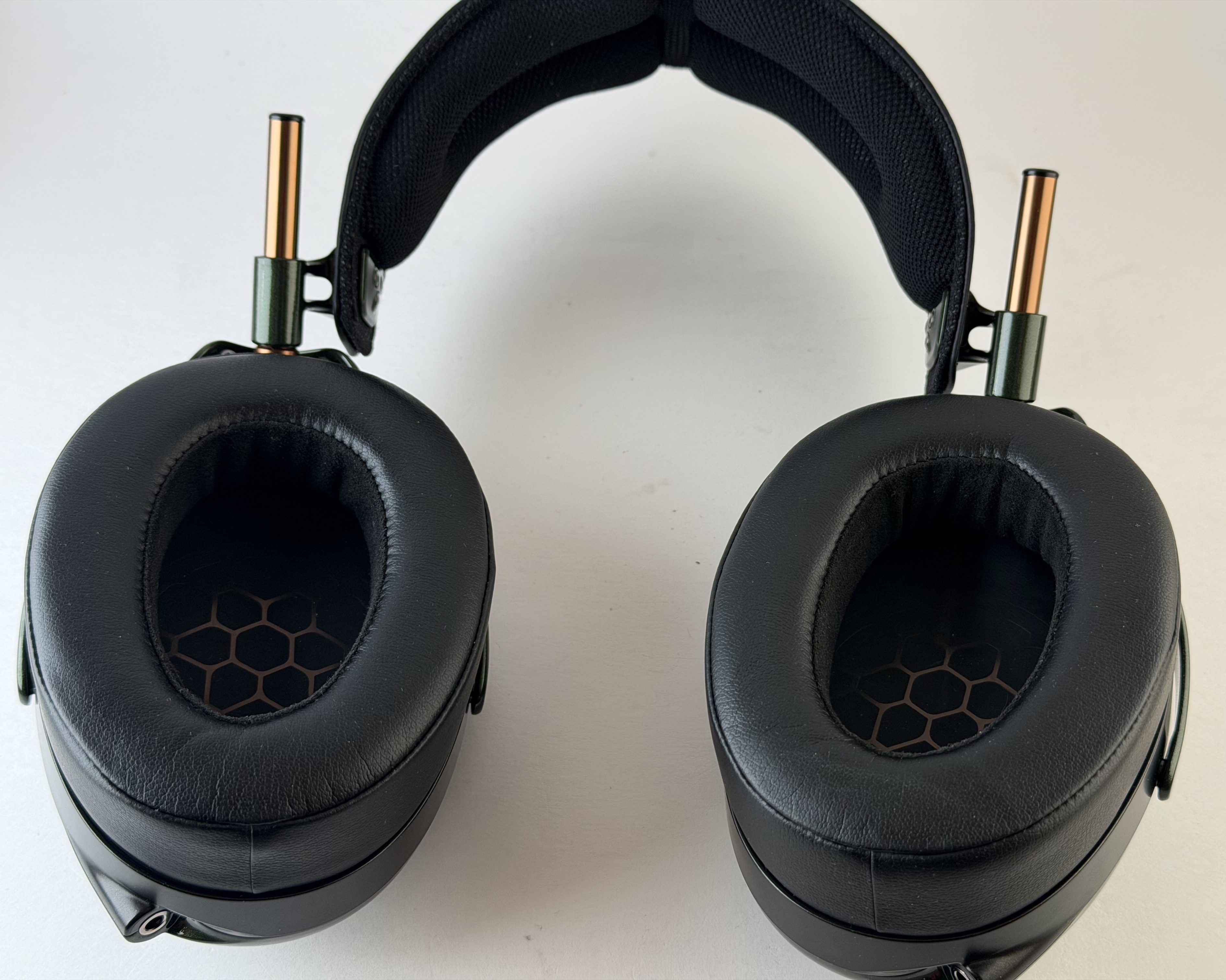
Is Strada a good headphone? Absolutely, with the caveat that it’s not going to be everyone’s cup of tea.
Is it a good design, well-built, and comfortable? Absolutely, with the caveat that it’s going to be warm in warmer weather because it’s a pretty isolating closed back.
Is it a good $800 headphone? Well … there aren’t a lot of headphones that I think are really worth $800 in a market where you can get things like the HD 6XX at $220, the Hifiman Edition XV at $400, or the Meze 109 Pro at $799. It’s a bit easier for me to sell on the closed back side, in a market that’s historically been pretty shallow and limited. But the last few years have had some pretty great releases, value-wise. If a person can get a Fiio FT1 or Beyerdynamic DT 270 Pro for $150, a Sennheiser HD 480 Pro for $400, the Focal Azurys for $650, or build an Ouroboros for like $100, is a funky $800 Meze closed back worth the price of admission?
It is for me. Your mileage may vary. I really do enjoy this headphone, both as a beautiful and interesting design AND as a way to hear albums that I love differently. As I’ve been working on this review, I’ve been listening to The xx’s “xx” via the Apos Gremlin/Druid R2R stack. It’s an album I’ve heard probably a few hundred times, and I’m genuinely hearing it differently via the Strada. I’m not sure I’d necessarily say it sounds better on the Strada than the Sennheiser HD 480 Pro, but it’s definitely different. There’s a whole sub bass line that I’m not sure I’ve fully heard on a headphone before. And I’m the kind of person who swaps headphones multiple times a day to avoid getting bored. I appreciate that Meze (like ZMF) is willing to zig when everyone else is zagging, even if not all of their offerings particularly land for me. This one just happens to work on my head pretty well, with or without EQ.
At the end of the day, I am putting this in the same category as the ZMF Bokeh Closed and Aeolus; they are beautiful, interesting objects that I’m glad to own and use, but that I’m am not going to use particularly frequently. I’m fortunate enough to be able to afford to keep pairs like this around for variety, a fact for which I’m eternally grateful.
If you need one pair of headphones for regular listening, or you need a neutrally-tuned headphone for your use case, the Strada are not for you. If you want something new and fun and interesting, and particularly if you’re willing to invest the time and effort it takes to get these tuned to your head, I commend them to your attention.
I’m definitely keeping these around. If they were stolen or broken, I wouldn’t pay MSRP for a new pair12 but I’d definitely be on the lookout for a lightly used pair for my collection. And they’re starting to pop up occasionally on markets, usually around $620 but as low as $450 (without the box).
Now, a couple of comparisons.
Meze 99 Classics v2
The most obvious point of comparison is to Meze’s own “entry-level” closed back, the Meze 99 Classics v2 that I reviewed a few weeks ago. It’s a recent enough review that I still stand by basically everything I said there. To paraphrase myself: if the choice is between these two headphones, the average listener should absolutely take the Classics v2 at $349 over the Strada at $799; it’s a much more conventional tune (though more consumer-oriented than most headphones I review, which tend to take a more audiophile bent). That said, if someone is looking for a more traditional closed back tune, they’re probably better off going with something like the Sennheiser HD 480 Pro instead of either; as much as the 99 Classics v2 is a more “normal” tune than the Strada, they still bring their own funkiness.
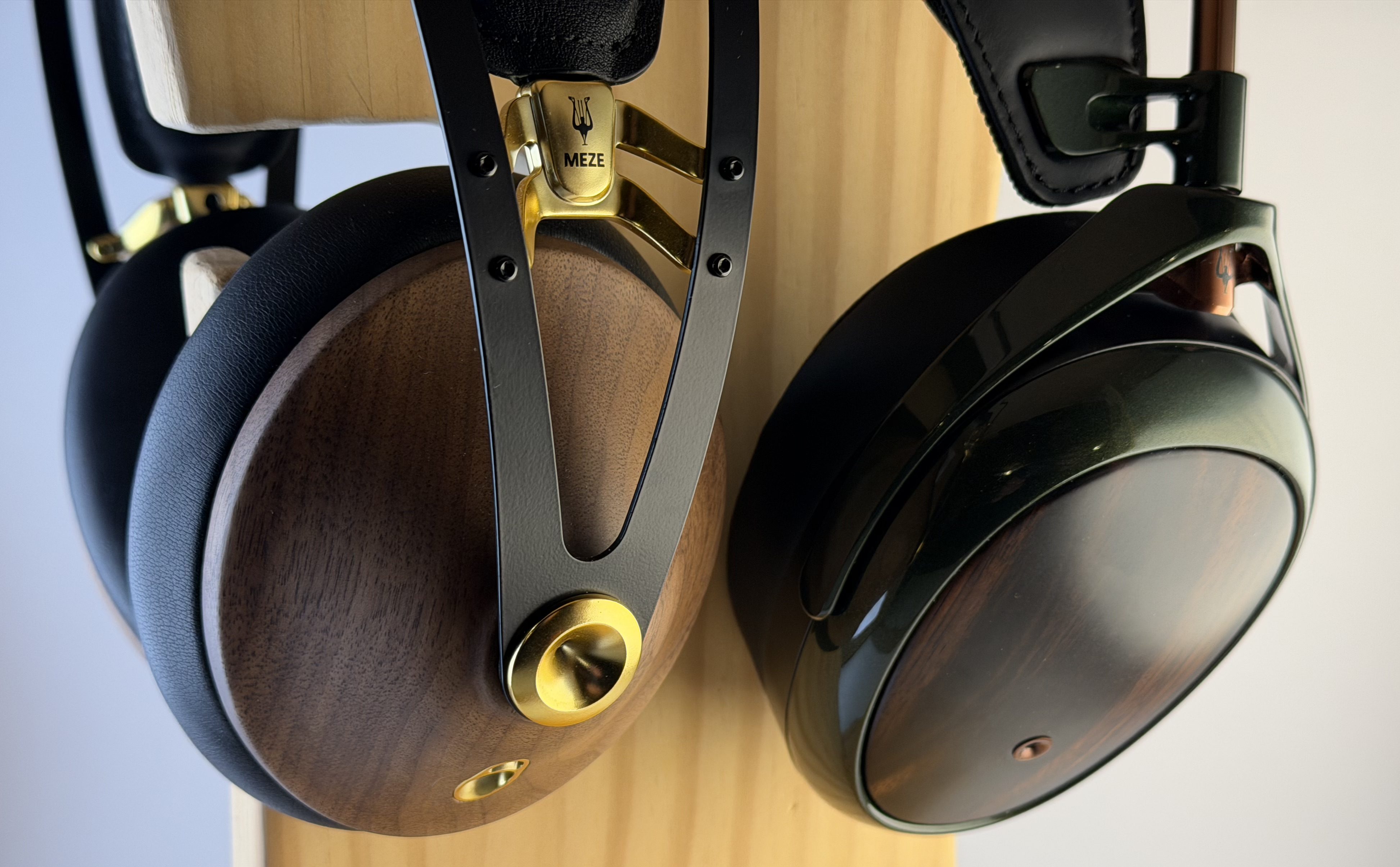
As far as a direct comparison, I think the bass is more or less a wash (the 99 Classics v2 has a REALLY great and cohesive bass tuning with pretty good slam, but lacks a bit on the sub bass that the Strada excel at, while the Strada particularly struggles in transitions), the mids on the 99 Classics v2 are considerably better (especially without EQ), but the treble on the Strada is better on my head. Strada is also substantially more comfortable and better built; I like the 99 Classics and they’re a good headphone but they look and feel (and frankly are!) much less premium than the Strada.
Here’s how my units measure:
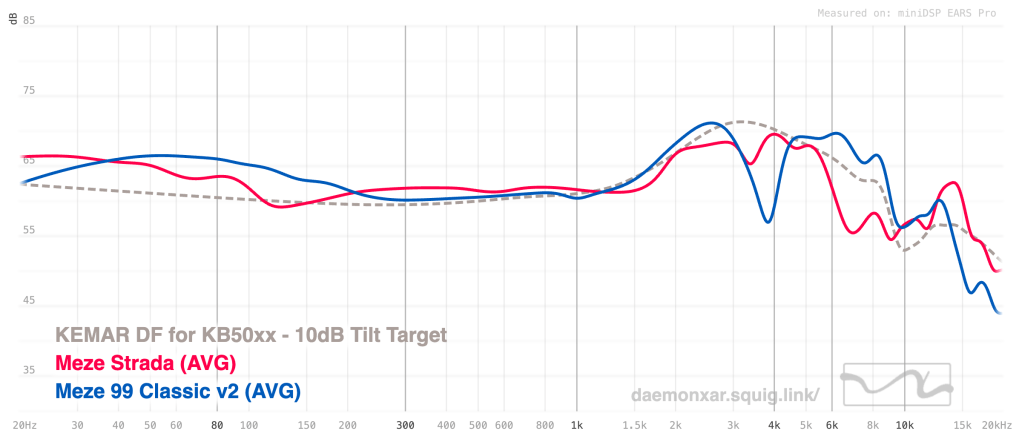
While I don’t hear the 99 Classics v2 as being as cohesive as some other options like the 109 Pro or HD 480 Pro, I also don’t hear them as quite as funky above 3.5 kHz as this suggests. The rest of it is about right, though I don’t think I’d have guessed how much more mid bass energy the 99 Classics v2 has between 40 – 200 Hz.
Verdict: As said over on the 99 Classics v2 review, for me personally the Strada is a much more interesting headphone and the one that I would take. Most folks should probably go 99 Classics v2 here. This is particularly true at MSRP; as much as I personally prefer them it’s hard to argue that the Strada is $450 better than the 99 Classics v2.
Sennheiser HD 480 Pro
To me, this is a harder (and more interesting!) call. These are two very different headphones to me; the Sennheiser HD 480 Pro is if not neutral, at least neutral-adjacent and certainly being hailed (and reviewed!) as a great new option for a studio closed back,13 while the Strada is … let’s call it funky.
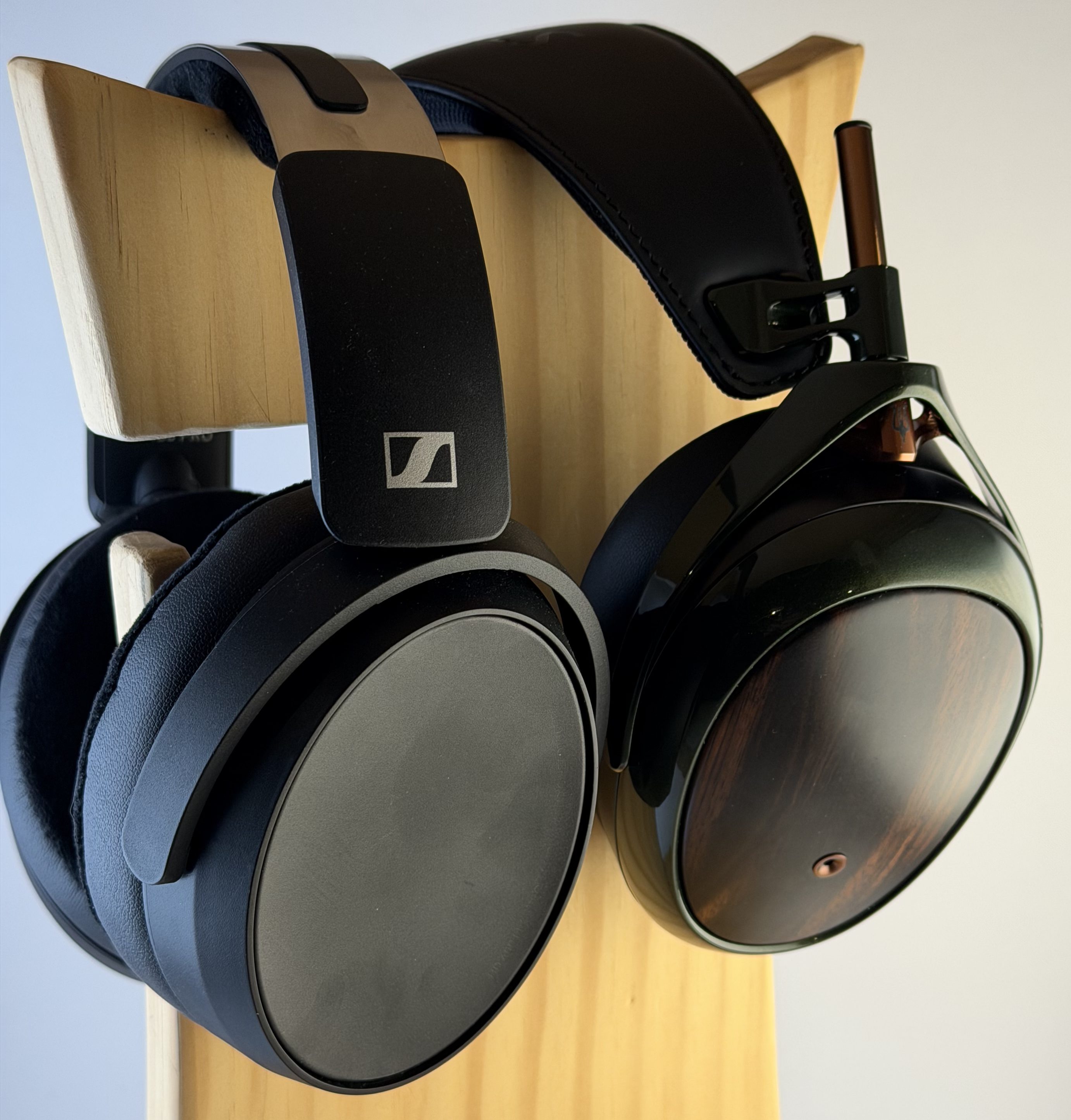
I think your better choice is going to depend on what you’re looking for in a closed back headphone. If you want a more traditionally tuning, the 480 Pro is your better choice. If you want something a little off the beaten path, the Strada might be for you. I think the bass is probably a wash (480 Pro hits harder, the Strada is maybe a bit cleaner), the midrange is better on the 480 Pro, and the treble is … surprisingly close. I think the 480 Pro has better detail and soundstage, but the layer separation so far seems pretty similar. Same with comfort; the 480 Pro is very similar to the 490 Pro in terms of physical and industrial design and that’s one of the most comfortable headphones I own, but the Strada is definitely made of nicer materials while the 480 Pro is slightly lighter. But the Strada is also twice as expensive; you could buy the 480 Pro and have $400 to buy another pair of headphones or source gear too.
Here’s what my units look like:
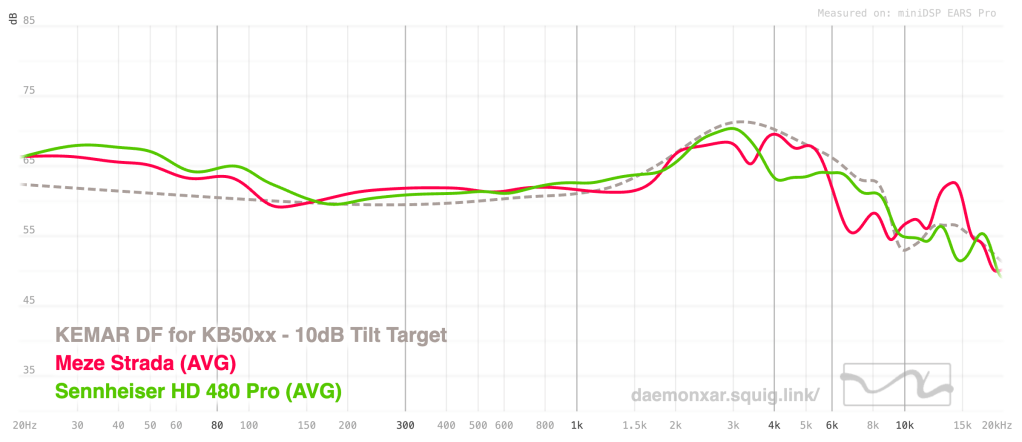
I noted this in my 99 Classics v2 review, but I was genuinely surprised by how closely these two headphones graph to each other, particularly given how cohesive and consistent the 480 sound, and how disjointed and hollow the Strada can sound on challenging tracks. I guess this is my reminder that it doesn’t take a huge change in FR to shift how a headphone sounds on my head; this is another matchup I’m curious to revisit when my rig comes back with my EQ profile applied.
Verdict: Honestly, this could go either way for me personally. I think both will be long-term staples in my collection. For the average person, I’d say 480 Pro is going to be the right play. If nothing else, they’re half the price. Genuinely curious to revisit in a few weeks when I do my review of the 480 Pro, and then to check back in in a year or two to see which I end up grabbing more often. I have a sneaking suspicion it’s going to be the Strada, unless the 480 Pro manages to displace the Elegia as the go to closed back in my rotation. The Strada just occupies a unique niche in my collection, whereas the 480 Pro is more an excellent example of a not-uncommon general profile.
Focal Elegia/Celestee
The Focal Elegia has been one of my favorite headphones for most of the last year, and is probably my favorite closed back from a sound perspective (the Bokeh Closed is my favorite from a “happy to own this” perspective). They’re also one of those “Phil likes a thing most people have mixed feelings about” headphone, with a slightly unusual tune for a closed back.
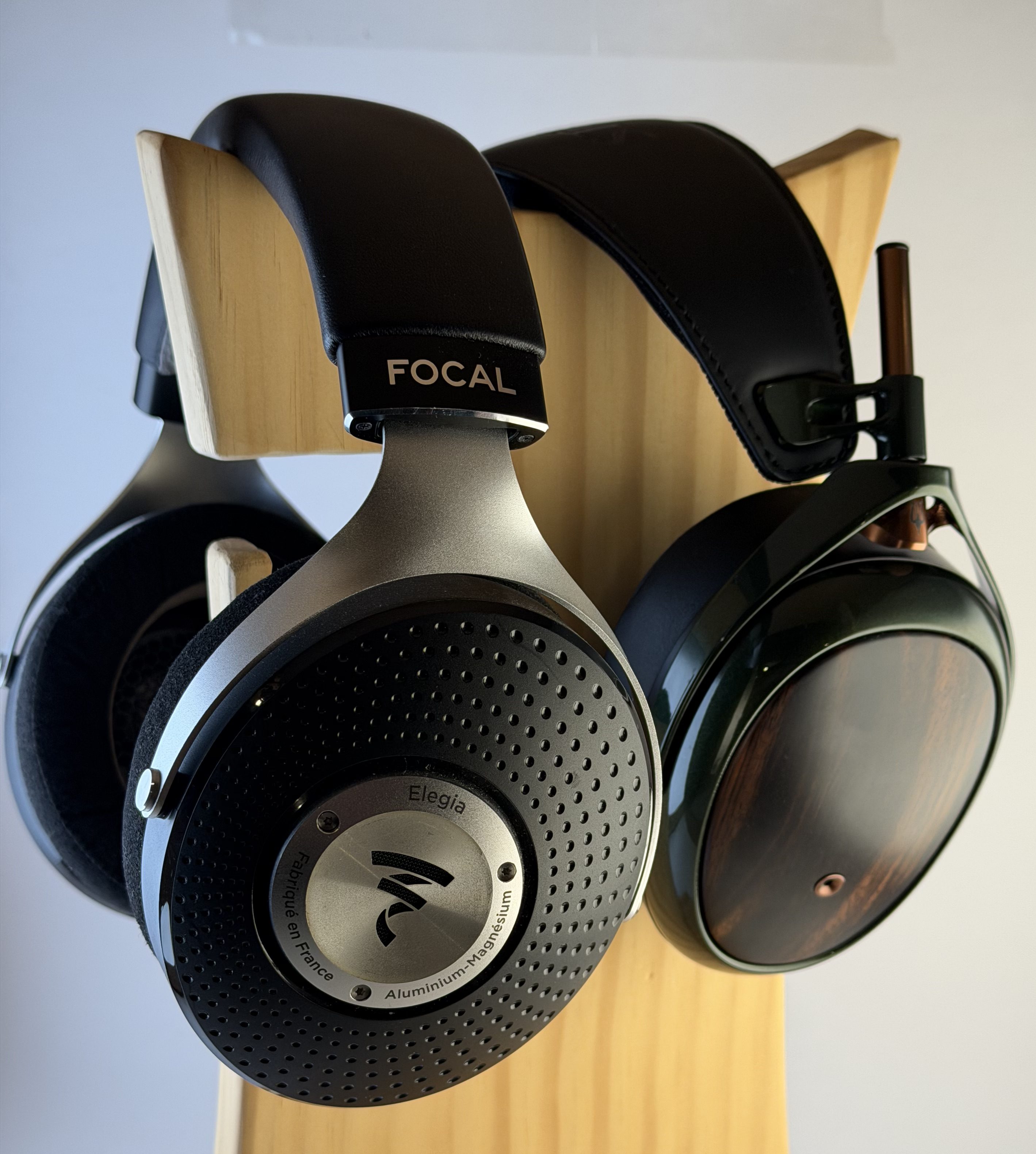
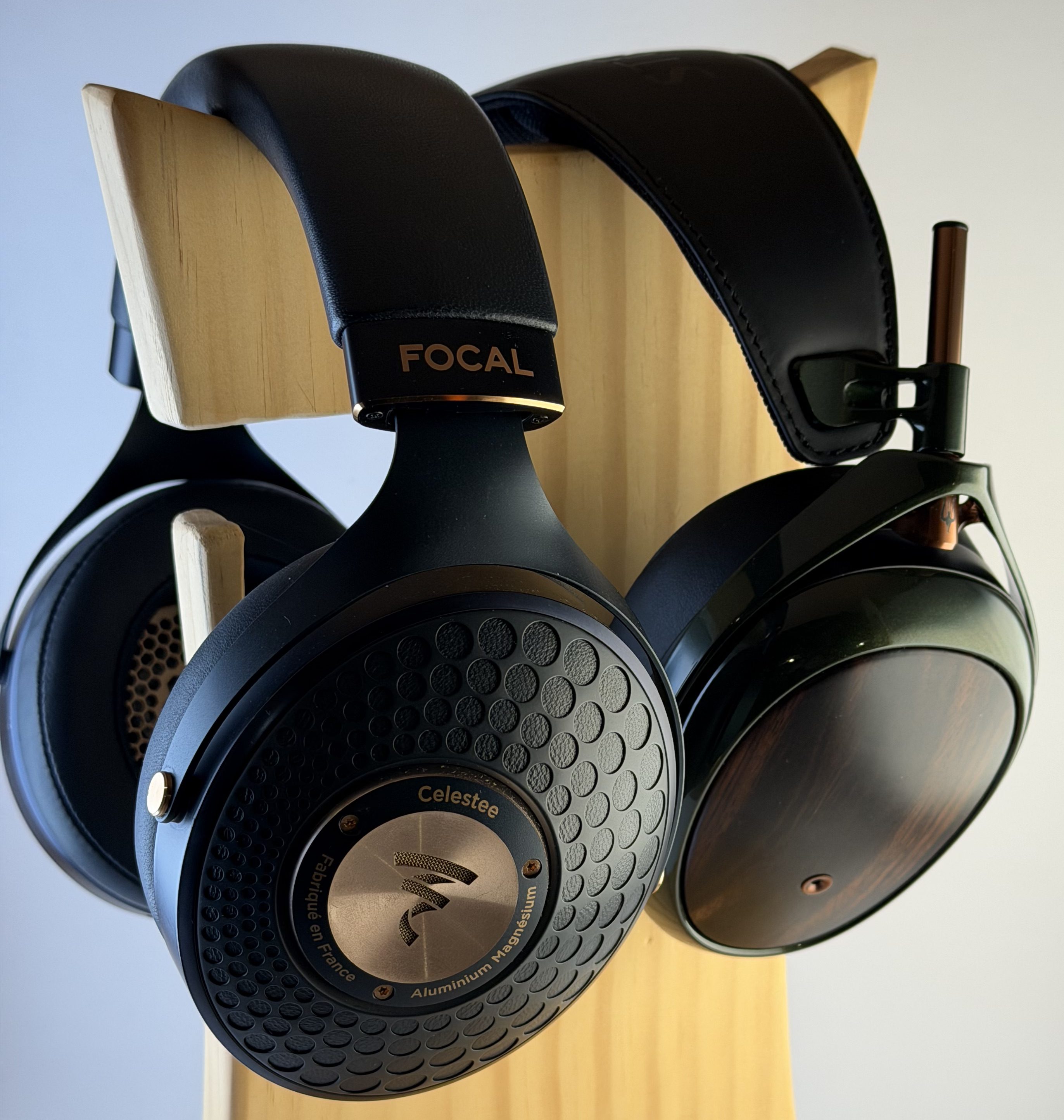
I know the biggest knock on the Elegia is that they’re too weak in the bass; I’ll still take their bass over the Strada. I have said a few times that I’ll basically always take quality over quantity for bass, because I can usually add more via EQ, and that’s 100% the case with the Elegia.14 There are definitely tracks where I might notice the sub bass roll off (particularly in the sub bass, and particularly on a track like The xx’s “Islands”), but the Focal magic is still there; no matter how the bass measures, the Elegia have a remarkably vibrant and dynamic low end, with lots of slam. Mids are better on the Elegia as well, though I’d say the treble is a toss up. Strada is marginally more comfortable (and marginally lighter) but neither bother me at all. Elegia are a more technical headphone, at least to my ear.
Celestee is pretty similar, except that (at least initially) I feel like Celestee might fill in the few weaknesses in the Elegia’s presentation; it has better bass (it has a particularly impressive extension down into the sub bass) and a more traditional midrange, though it comes with potentially a little bit of overemphasis in portions of the mid bass and a little treble wonkiness. So far it isn’t particularly bothering me.15 I definitely need more time with Celestee (particularly with dialing in a EQ profile), but I think out of the box I’m taking Celestee’s bass and mids over the Strada, though I think I marginally prefer Strada’s treble and comfort.
Here’s how my units measure:
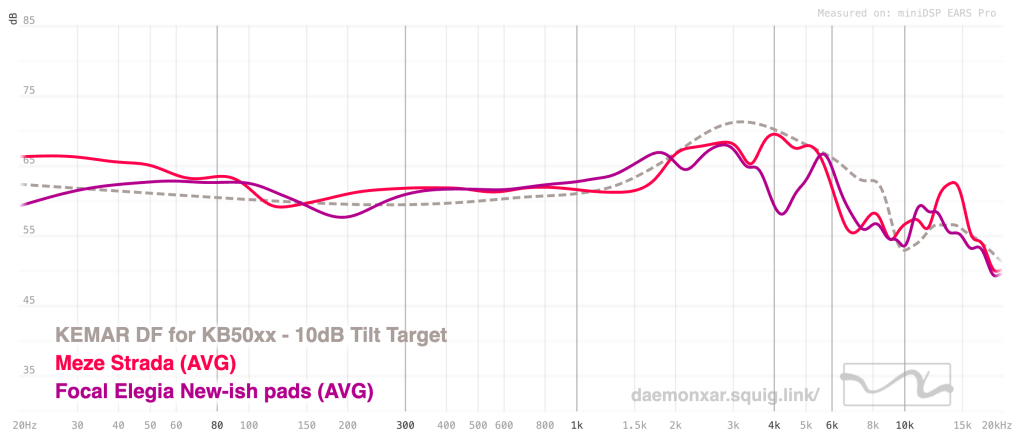
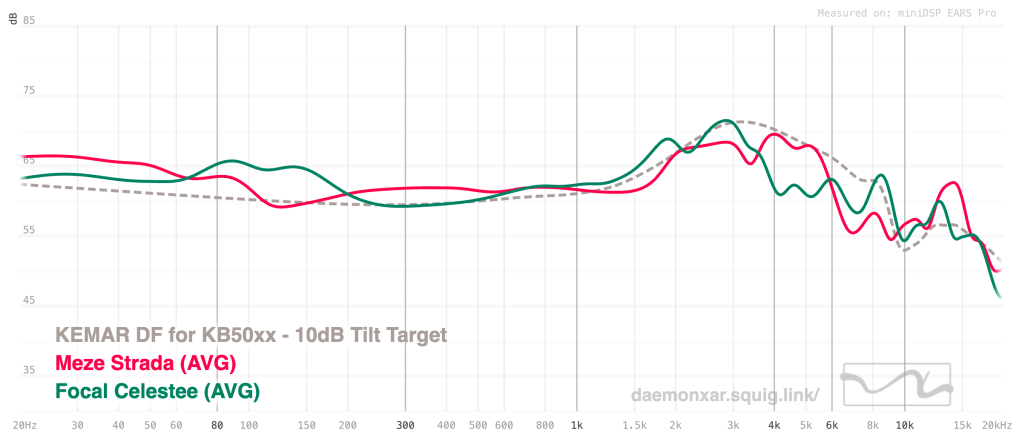
I’m a bit surprised by how much mid bass the Celestee measures with, and how anemic the Elegia’s bass measures comparatively; honestly even without EQ Elegia’s bass always feels incredibly well balanced and clean to me, and I’m looking forward to doing a deep dive on Celestee vs. Elegia in the near future.
Verdict: I’m taking either Focal over Strada for most of my listening, though both are arguably much “safer” tunings for a closed back and I’m not sure I have room in my long-term collection for both, whereas Strada stands out as something unique.
Hifiman Audivina
I talked about this a little in my Audivina mini review, but this is a much more interesting comparison to me than most of the reviews of the Audivina would suggest it should be. I’m on the record as not only not hating Audivina, but kind of liking it (especially with EQ!).
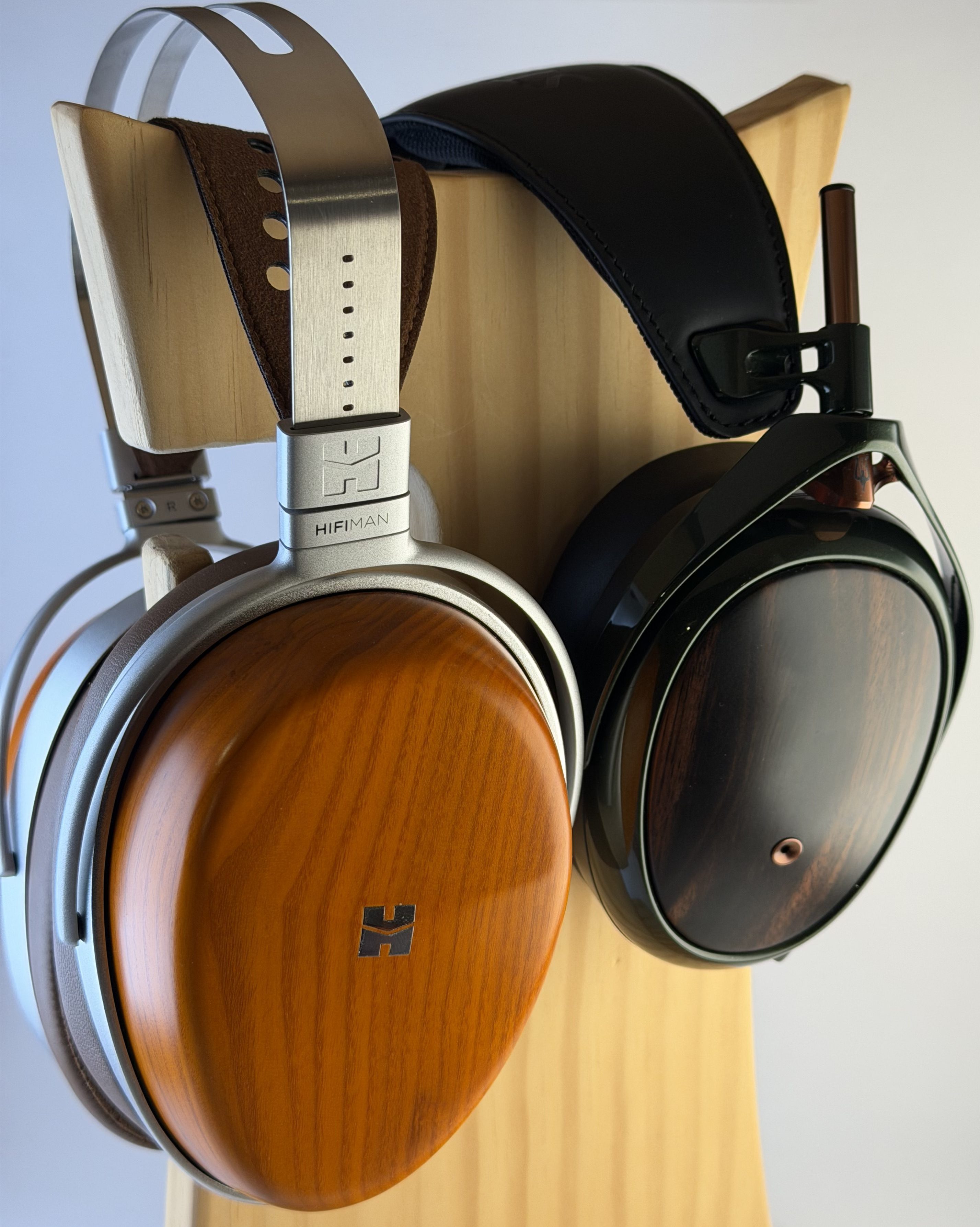
Out of the box, the answer is clearly the Strada. While it’s a strange tune, it doesn’t make grown men cry the way the Audivina can. If you’re not going to expend the time and effort to EQ your headphones, and you have to pick between two headphones, get the Strada.
If you’re willing to spend the time and energy tuning, I think it becomes a much more interesting question. If you need sound isolation, your answer is still Strada; the Audivina is charitably thought of as a semi-closed back headphone, with very little actual attenuation of outside sounds. Here’s what I said about the comparison in that mini review:
The Strada is more comfortable, and will better fit my use case for a closed back headphone as … you know, actually closed back. The Strada can be used out and about, whereas the Audivina is really a desk queen. I think for that reason, I would take the Strada over the Audivina but I wouldn’t probably recommend either to the average person.
As far as a direct comparison, as EQ’d, Strada has better bass (though Audivina has surprisingly nice, resonant bass given how light it is), Audivina better mids, and I prefer the treble on Strada (though Audivina is by no means particularly problematic on my head). Audivina is probably a slightly more technical headphone, if that’s what you really care about, but the Strada is much better built and much more comfortable on my head.
We’re not going to talk about Audivina’s wild pricing choices.
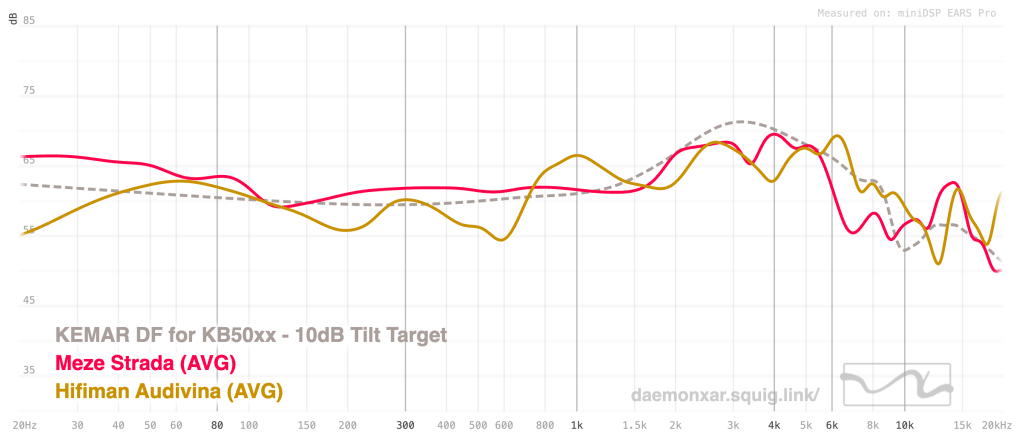
Man, Audivina is just weirdly tuned. I would love to know what Hifiman said internally about it before its release. I applaud bold tunes, but Hifiman closed backs … ooh boy.
Verdict: While neither are going to be a great option for a casual listener, I think the Strada is definitely the better headphone and better pick for pretty much everyone. I’m keeping the Audivina mostly because they’re a great demonstration of the occasional disconnect between price and quality in the headphone space, and because I genuinely enjoy them from time to time. Strada offers some of the same things, but in a VERY comfortable chassis and in a form that I can enjoy without EQ in a pinch.
ZMF Bokeh Closed
Though they’re very different companies, I find myself thinking about the Meze Strada as more in-line with ZMF’s headphones: beautiful pieces of art that make bold and innovative choices in terms of tuning, but that don’t always particularly land. For me, the Bokeh Closed absolutely landed. It was really the first closed back that I genuinely loved, and while they’re not my favorite closed back anymore, they’re always going to be pretty close to my heart just based on what they meant to me when I first bought them.
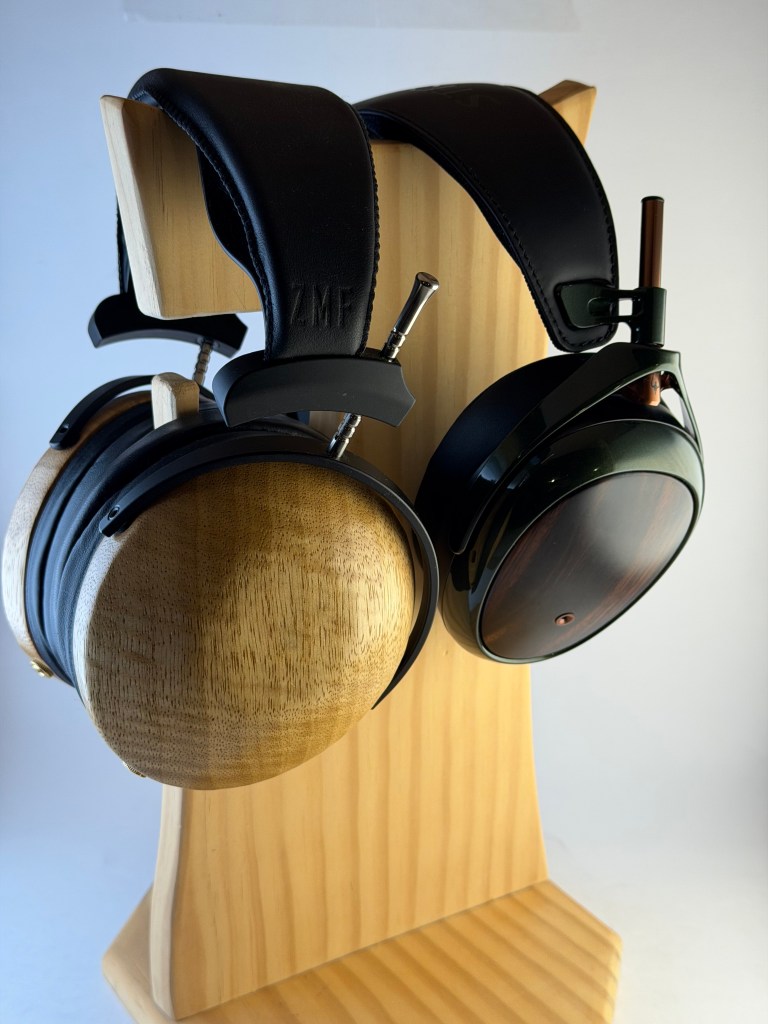
Between these two, I prefer the bass on the Bokeh Closed; it’s richer and more resonant, with a bit more slam, though the Strada is no slouch. The bass also feels just a little more cohesive on the Bokeh. The midrange is better on Bokeh too; I would like a little more vocals on the Bokeh pretty regularly, but they’re substantially better than the vocals on the Strada without EQ. Treble is a bit better on the Bokeh as well, though it’s reasonably close. Technicalities are pretty close too, though the Strada is feels much more intimate and immediate, while the Bokeh can at times feel a bit like you’re sitting back away from the musicians.
Comfort wise … well, I love the Bokeh, and they’re incredibly comfortable on my head. They’re also almost 500 grams, almost a full 60% heavier than the Strada. Both are comfortable, but I’m going to give the win to the Strada here by a small margin. As far as attractiveness … man, in direct light my Bokeh are almost hypnotic, but every pair is different. The Strada is consistently beautiful across all units. And, finally … well, the Bokeh is like 50% (or $400) more unless you find a used or b-stock unit.
Here’s how my units match up:
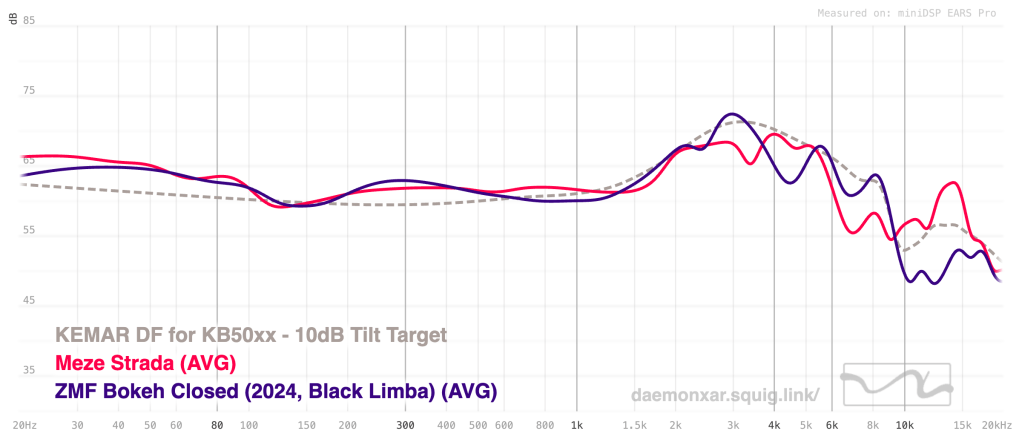
I’m genuinely surprised how well these track below around 2 kHz; the bass feels deeper and richer on the Bokeh, and I would really have expected the differences in the mids to be more substantial than they are. I’m so curious to spend some more time this summer trying to figure out what to look for in a graph to explain cohesion; to me the Strada really feels scooped in the middle, while the Bokeh feels consistent throughout, and I’m curious to try to explain that with measurements.
Verdict: If you can afford it, the Bokeh is both a more normally tuned headphone for the average person AND probably the better headphone from a technicalities perspective, though it’s definitely not a wild comparison. Particularly for people who won’t use EQ, the Bokeh will be more accessible.
For me, I think the extra $400 is worth it, though I’m really curious over the next year to see which I listen to more.
Meze 109 Pro
I mentioned in my Meze 109 Pro re-review the other day that while I understand why people are interested in a comparison between it and Strada (same driver, after all!) I’m not sure it’s a particularly useful comparison given their different styles and use cases, but I’ll go ahead and throw it in here too. Here’s what I said over there:
Strada is a closed, hard U-shaped headphone, while 109 Pro is an open, mild- to moderate-v-shaped headphone. Based on tuning alone, I’d be waaaay more likely to compare the 109 Pro to something like the Sennheiser HD 480 Pro (review forthcoming!) than Strada if you wanted a closed-back comparison. If you need noise isolation in your listening environment, the Strada is the better choice. If you don’t, the 109 Pro is, I think, a substantially better headphone overall; it’s definitely more consistent and cohesive, and way more fun to listen to out of the box.
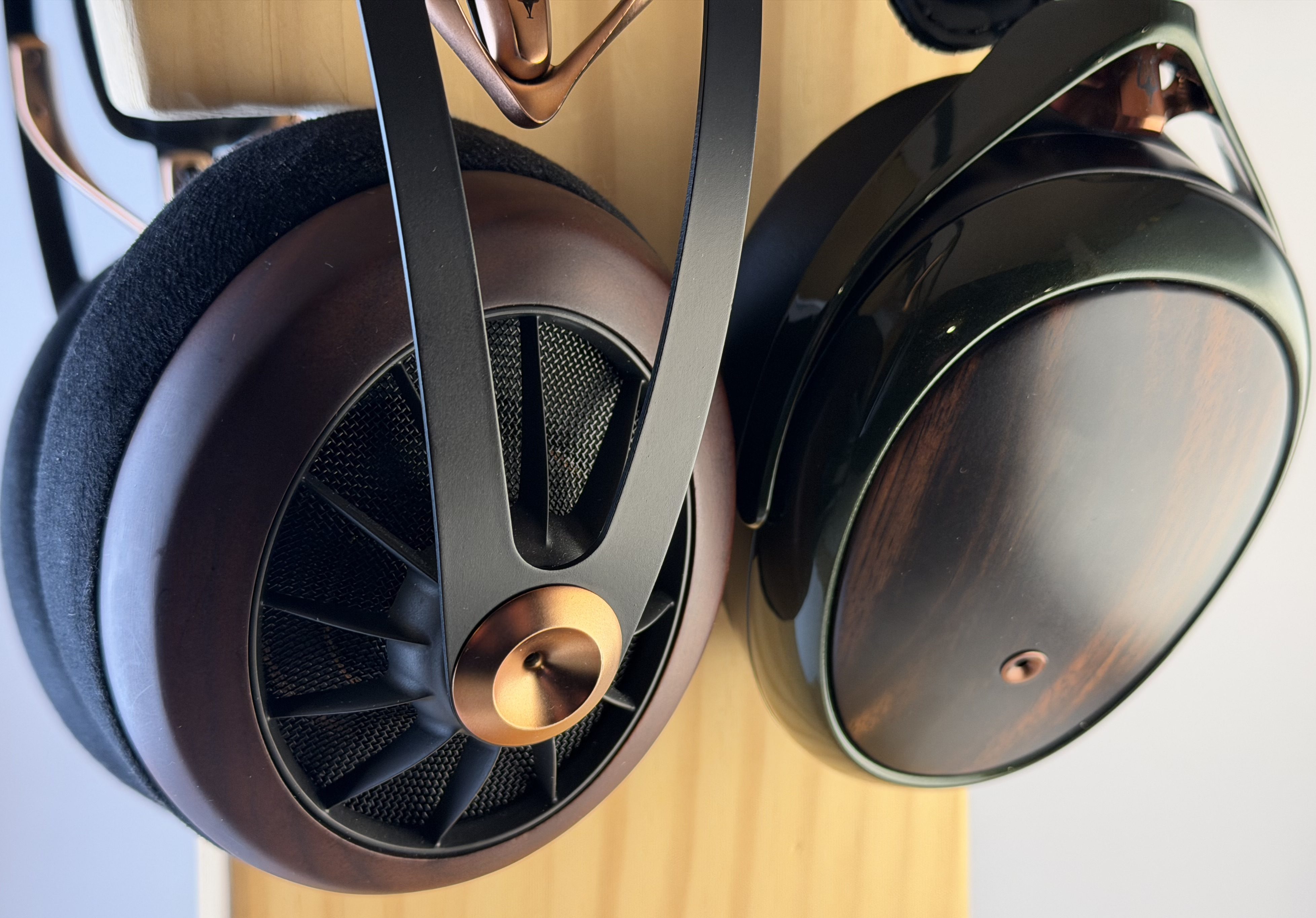
I think that’s largely still right. The bass is definitely stronger in terms of quantity on the Strada than the 109 Pro, but the quality skews pretty strongly towards the 109 Pro. I do add a tiny bit of bass to the 109 Pro via EQ but without it, the slam and dynamism is still just better, regardless of the absolute level. The mids are better on the 109 Pro, though I might very slightly prefer the treble on the Strada (it’s a little less peak-y and less prone to sharpness), though neither is particularly problematic on my head. 109 Pro is definitely more comfortable; it’s marginally heavier, but the pads are softer, the suspension system more forgiving, and it’s substantially more open for airflow purposes. I will take the Strada off the wall every once in a while when I’m bored with my regular rotation, but the 109 Pro is my regular rotation.
Here are how my units measure on my rig:
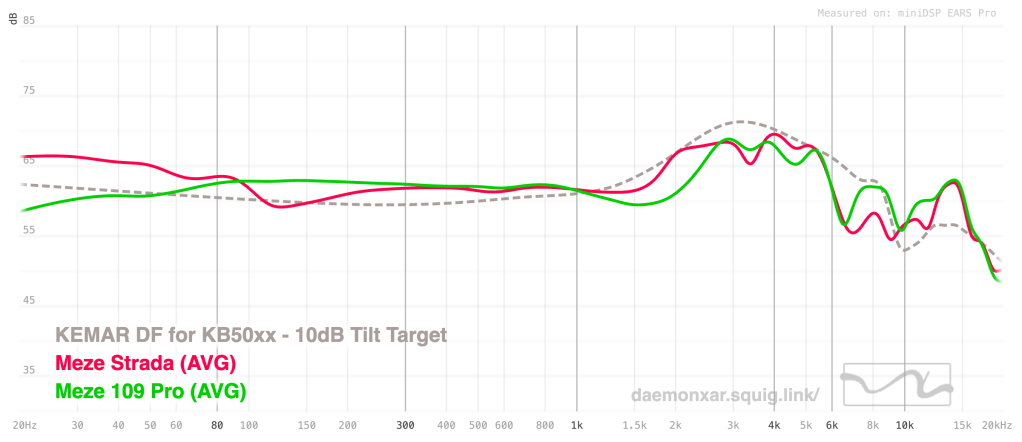
I get fewer of the dips and peaks in the treble on both units, but the rest of this looks roughly right. When my rig comes back I’m going to compare the FR of them both with EQ; I’m going to guess they look more similar but I’ll still be able to pretty easily tell which one is which.
Verdict: The 109 Pro is the clear winner here unless you NEED to have noise isolation. Here’s what I said in conclusion on my 109 Pro re-review comparison:
The 109 Pro is my favorite headphone under $1,000; as much as I enjoy it (and I do), the Strada is not. Strada is also likely to be a pretty polarizing headphone for a lot of listeners; folks will probably either really like it or really hate it and not a lot will fall in the middle.
After a lot more listening (and additional hours of fine-adjusting EQ), this is still true. I like the Strada; I love the 109 Pro, add in the fact that they’re at worst the same price (and often the 109 Pro is cheaper, either on sale or as a lightly-used unit) and the 109 Pro is the winner by a country mile.
Overall
The Meze Strada are an unusual closed back, and I think I both understand and appreciate what Meze was going for with them. They’re also an incredibly well done example of industrial and consumer product design; beautiful, functional, and incredibly comfortable.
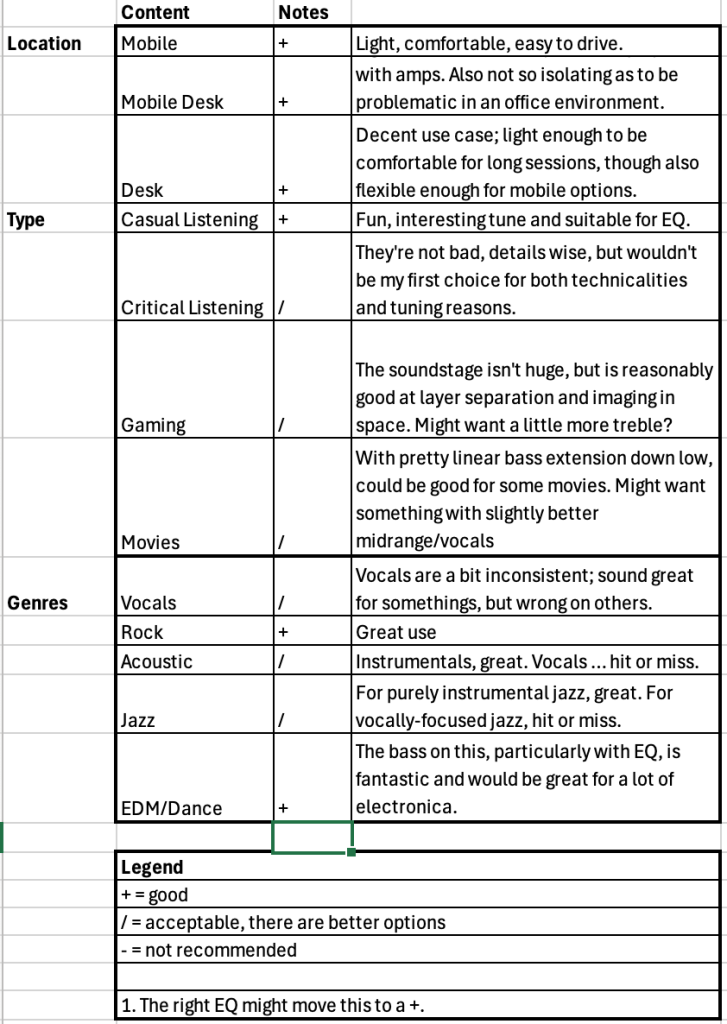
The Strada are still not a headphone for everyone. If you’re looking for a “normal” tune, this ain’t the headphone for you. If you’re not interested in spending some time on EQ, these probably aren’t the headphone for you either.
If you’re open to something different, and fun, and you’re willing to spend some time making it work for you, they’re a pretty remarkable pair of headphones and a good addition to most collections. And, like all higher end headphones, it’s worth doing some serious shopping around if you can’t find a lightly used pair.
- Anytime you’re buying an expensive pair of headphones, I recommend contacting one or more local retailers to see if anyone is willing to give you a discount. It won’t always work, but the markup on headphones is pretty substantial and some retailers may be willing to cut you a deal slightly below minimum advertised pricing if you are nice, up front about it, and a good customer. ↩︎
- With EQ, 7 out of 10 Denalis. ↩︎
- I score bass, mids, and treble on a two part scale: 1-5 for quantity (5 being the highest), and A-E for quality (A being best in class, E being laughably bad). For soundstage it’s also a two part scale, with the number representing the width and the letter the separation within it. ↩︎
- For comfort/fit, my scale is A-E with A being disappear entirely into the background and E being I want to tear my ears off to stop feeling these headphones on my head. I’ve had one E: the Koss PortaPro. ↩︎
- I’m super good at rationalization, right? ↩︎
- Definitely a marmite tune. ↩︎
- It’s worth nothing that some of the loudest sounds at the beginning of that track are in frequency ranges that are a bit scooped on the Strada, so it’s possible that I started with the volume higher than I would on a similar headphone without that scoop. ↩︎
- With the exception of some sub bass lines on some tracks by The xx, but I attribute that more to an unusually good deep sub bass response rather than exceptional resolution. ↩︎
- And with a better system than the Empyrean II, which never quite feels like it’s fully attached. ↩︎
- Because it’s expensive. I know. I just spent twenty minutes last week trying to get the ear pads back on my 109 Pro and it’s still too fresh. ↩︎
- Meze doesn’t currently have spare Strada pads available for sale, but most of their magnetic ear pads retail around $199. ↩︎
- To be fair, I didn’t pay MSRP for this pair either. ↩︎
- Really curious to do a lot more dedicated listening on them; I commented in my 99 Classics v2 review that the v2 sounded boring compared to the 480 Pro … and excitement is not something I particularly associate with studio-tuned headphones … ↩︎
- Elegia is apparently prone to the driver excursion problem that some of the older Focals suffer from, but I never add enough bass or listen loud enough to be personally concerned about that. ↩︎
- Really need to get to my Celestee review at some point soon. ↩︎
 Phil's Superpower of Enthusiasm
Leave a comment