
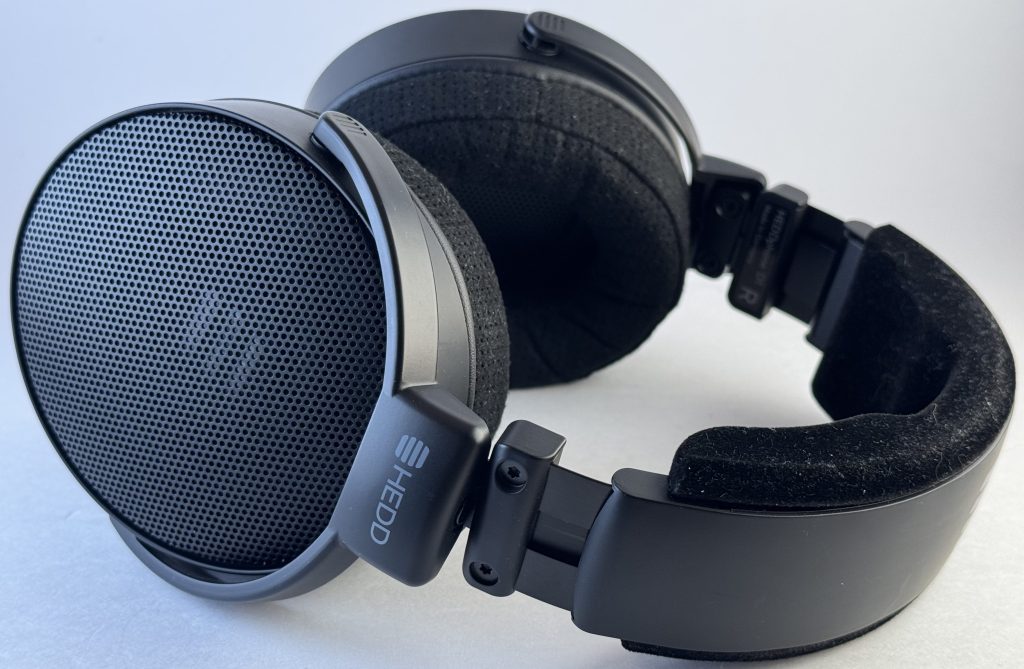
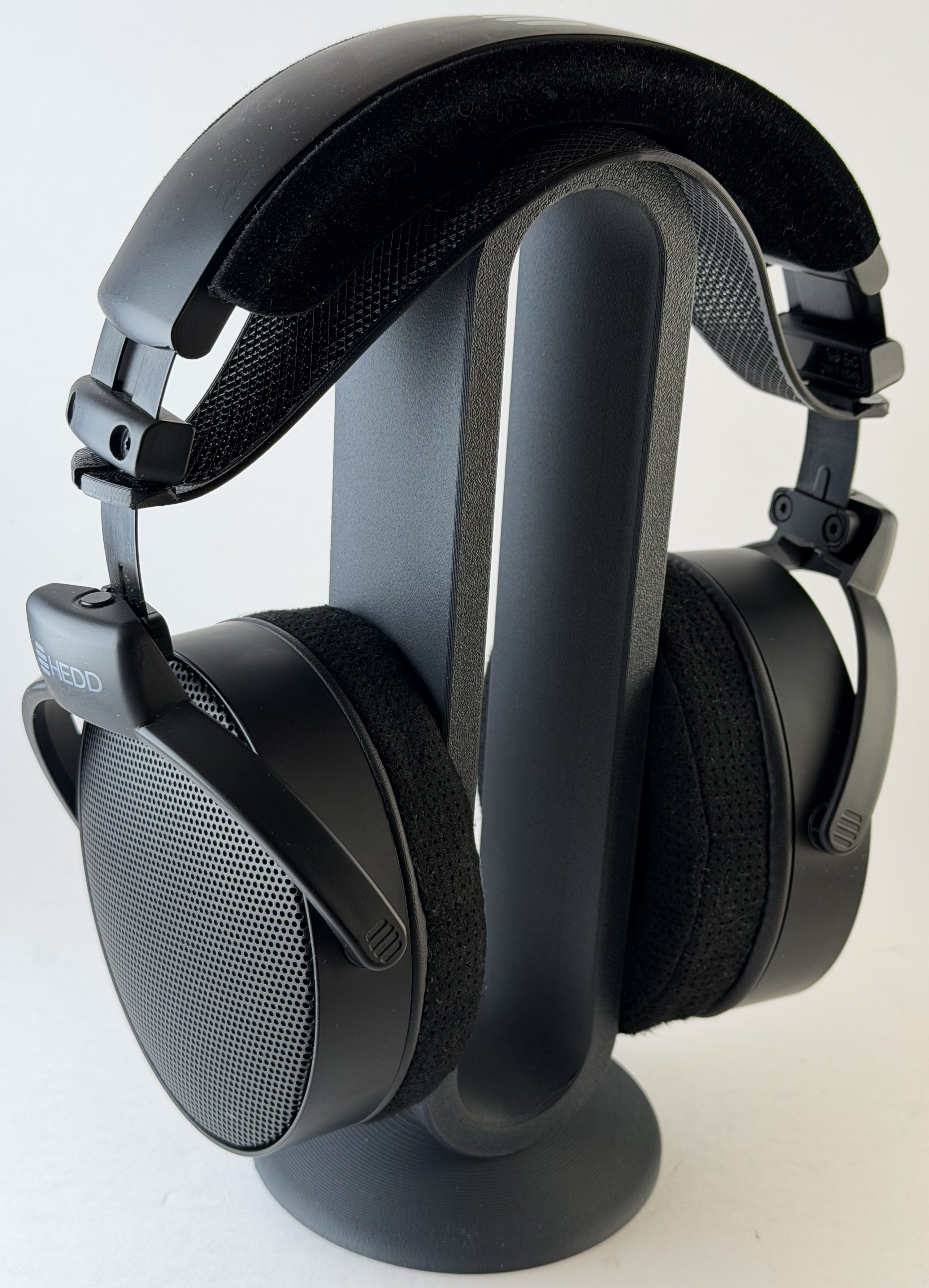
[ORIGINAL MSRP $799. Currently available intermittently from a number of online retailers for MSRP,1 or for $699 (open box) from Headphones.com. Purchased lightly used from r/AVExchange for $600 in April 2026.]
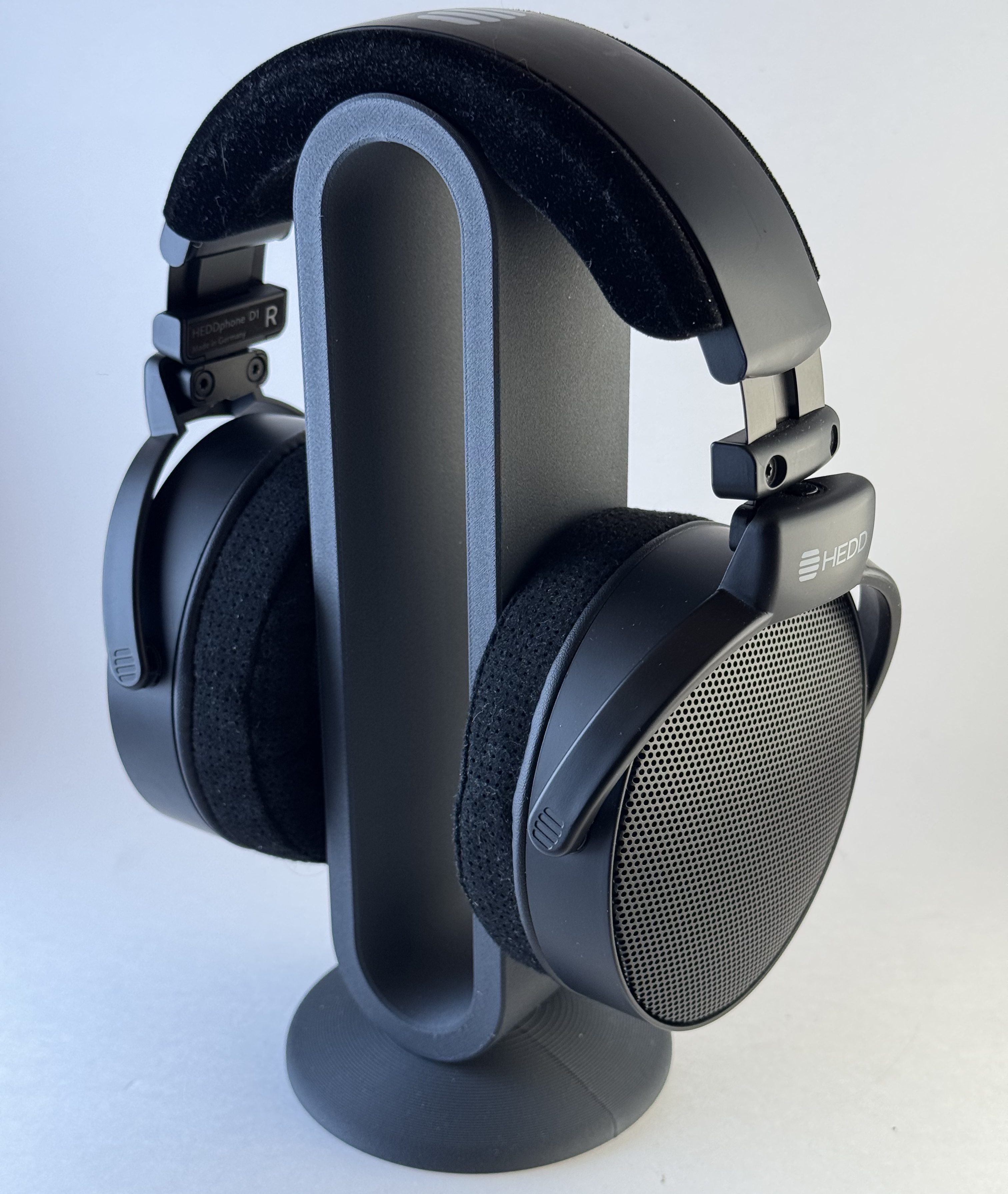
[Tl;dr: The HEDDphone D1 are a really excellent pair of headphones, both in terms of being fun to listen to and in terms of their technical performance. They made a whole lot of best of 2025 lists, and they’re definitely worthy of all of their accolades; they’re probably my new favorite midrange performance on a headphone, particularly for human vocals.
There are a couple of little quirks with them that may affect long-term use (in particular, the design of the cups means that on cold days my ears are occasionally brushing cold metal in a way that’s not particularly pleasant), but it’s not enough to dissaude me from wholeheartedly endorsing and recommending the D1 to people on the market for a great open-back headphone. They’re so good, in fact, that they’re going to displace a couple of my long-term mainstays for their primary use cases.
Most people probably shouldn’t spend this much on headphones, but if you’re a person for whom it’s a reasonable choice, I commend the D1 to your attention, particularly if the Meze aesthetic and design is not for you.]
Cost-agnostic: 9 out of 10 Denalis

Cost-sensitive: 7 out of 10 Denalis

TABLE OF CONTENTS:
Introduction
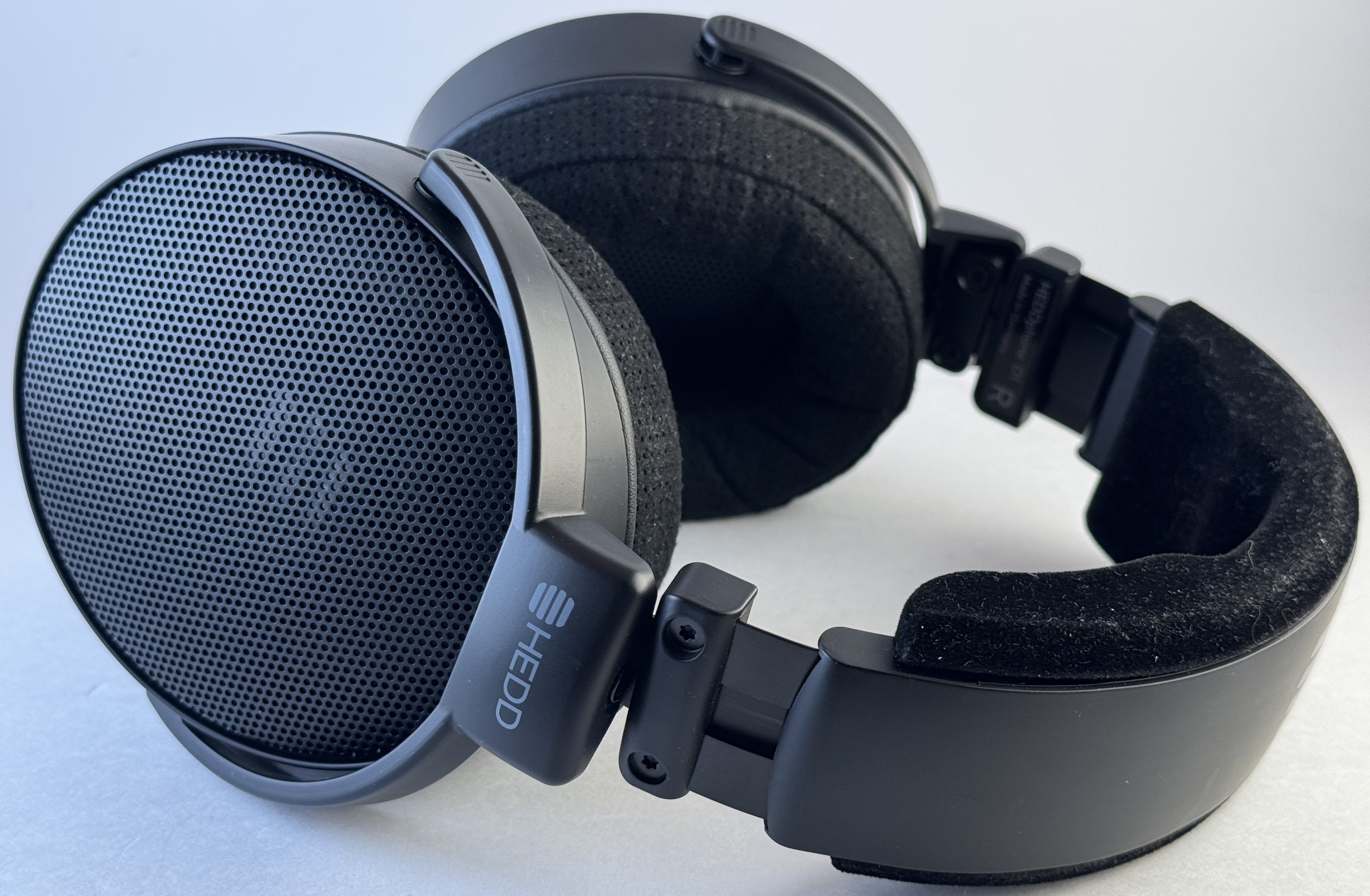
HEDDphone4 is a manufacturer that’s been on my radar for a number of years, but none of their products really spoke to me until I started seeing reviews of the D1 pop up (almost universally favorable ones, too).5 The D1 is also pretty expensive $799 and has been pretty consistently out of stock or backordered since its release in November 2025, so I figured it was the sort of thing that I might get to try in a few years after the hype died down. And then … it popped up on r/AVexchange for 25% off in April, shortly after I’d sold a number of pairs of headphones and had a little bit of a balance burning a hole in my Paypal pocket … so I decided to take a chance. They’re still a rarity on the used market (I actually got a couple of private messages after the seller marked them sold asking if I’d sell to them if I didn’t like the headphone), and I figured I’d be able to sell them pretty easily if I decided I didn’t like them.
Well … spoiler alert, because I’m about to devote a whole lot of words to telling you that I like them. A whole lot.
Review notes
Testing rig
Here’s my basic testing protocol.
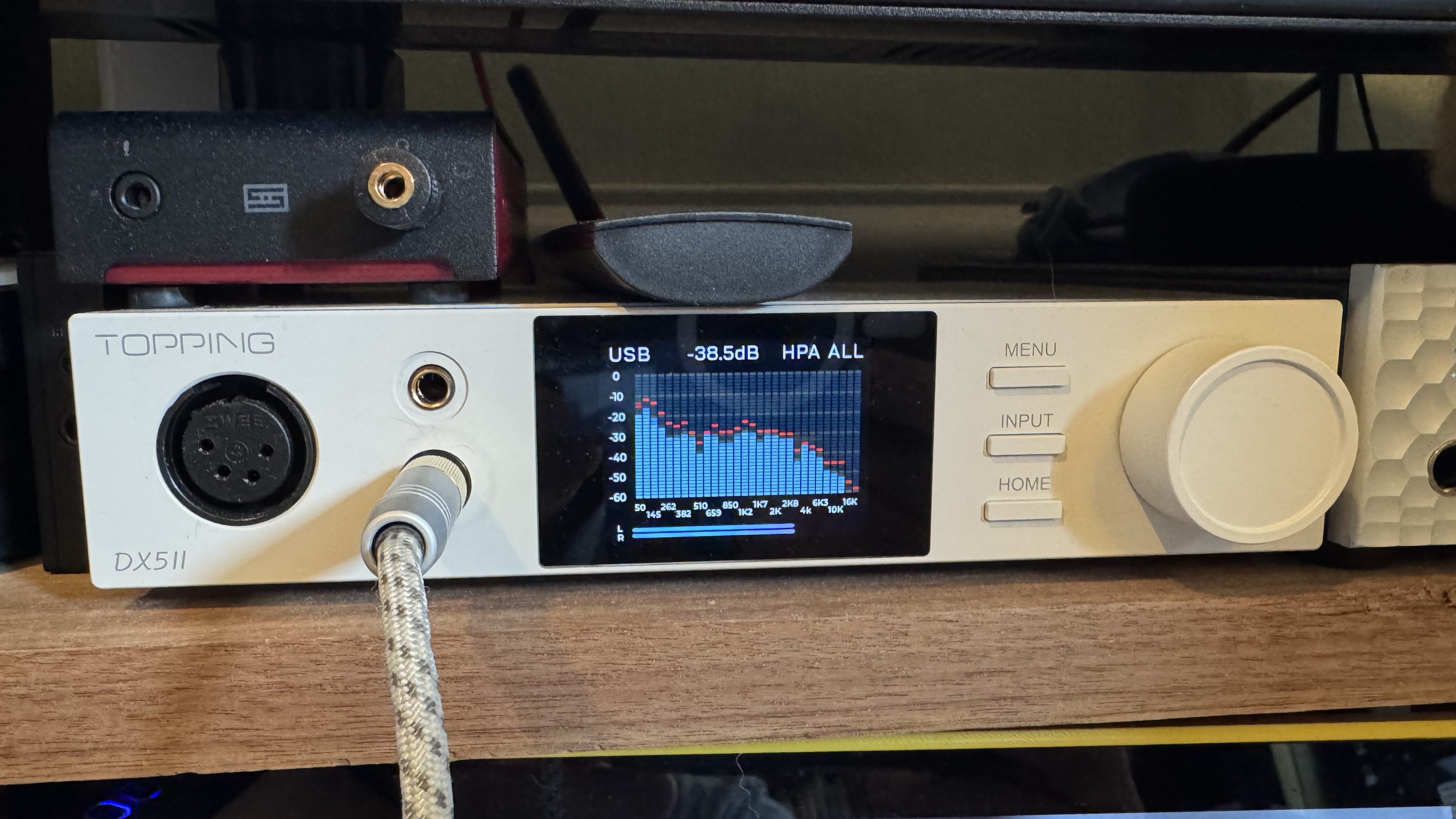
Based on my philosophy on the allocation of resources in headfi, except where otherwise noted I’m going to primarily be testing these with a Topping DX5 II, running balanced (4.4 mm) via a 2.5 mm Meze upgrade cable6 I got for $20 over the holidays and connected via USB-C to a Mac Studio running the Roon client.
EQ
As noted in the Bathys review, I mostly prefer to test headphones with their default tuning, assuming that most people won’t take the time or make the effort necessary to use a third-party EQ. The Heddphone D1 sound great to me out of the box; I haven’t felt any particular need to apply EQ for my listening with them so far. I’ll see what I think after some dedicated, focused listening.
EQ Update
[EQ Update: I’ve spent some time now with Oratory1990’s EQ preset available here, and I’ve only made two tweaks; I dropped both Band 1 (the low shelf) and Band 5 (the high shelf) by 1 dB and have been pretty pleased with the results.
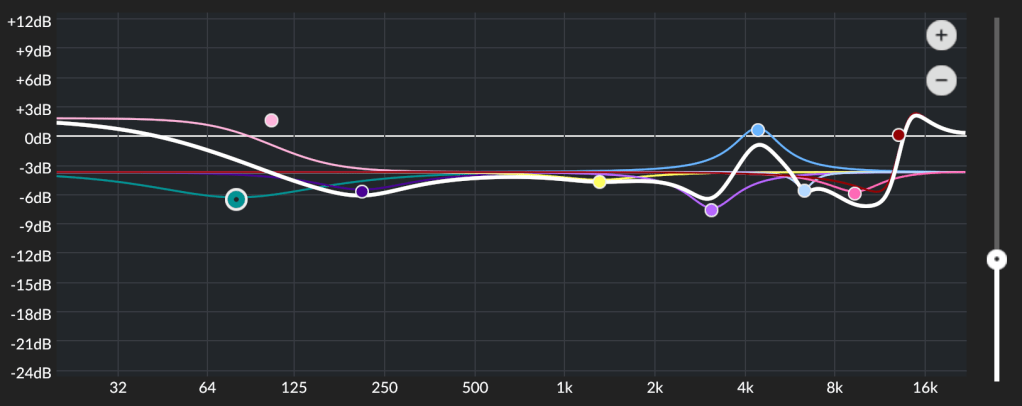
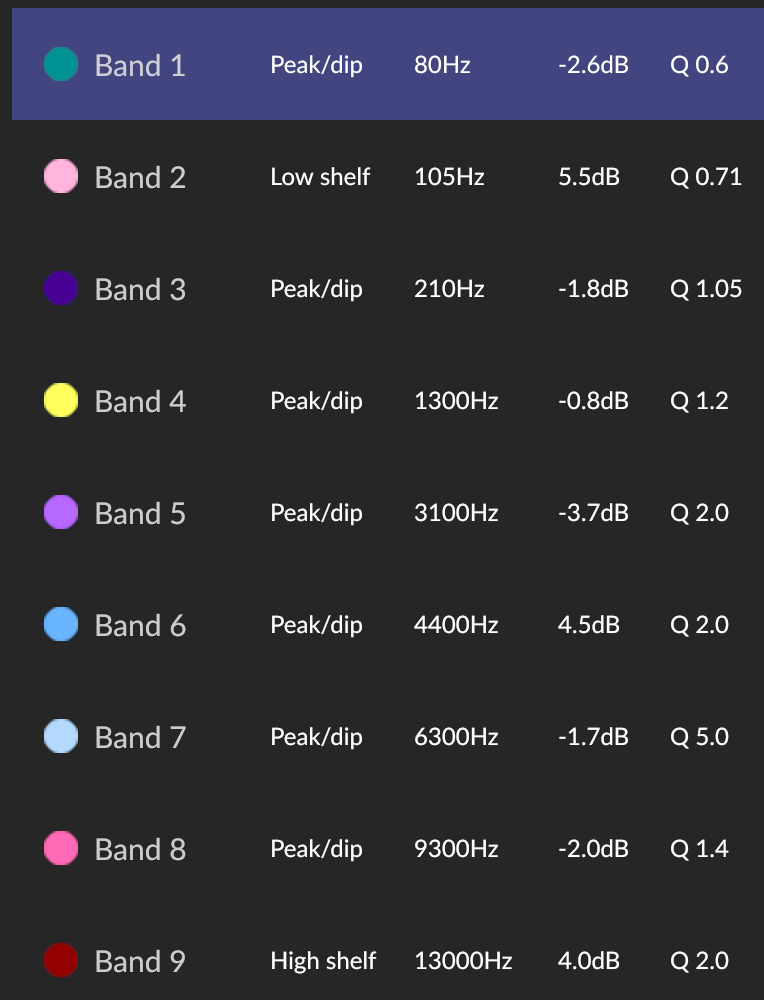
The HEDDphone D1 sound really good out of the box, and don’t need any EQ at all. I’m going to guess that I’m mostly not going to bother applying it for future listening, but if you want a place to start here it is.]
Volume
Here are the volume settings I use with the HEDDphone D1 (unless otherwise noted, running via Roon with no headroom management, playing Daft Punk’s “Face to Face” from Tidal):
- Apos Druid/Gremlin: 11:00 (4.4 mm)
- Dongles:
- Apple: 50%
- Crinear Protocol Max (max internal volume): (single-ended)
- Fiio KA11: 35%
- JCALLY JM12: 60%
- Fiio K11 R2R: 53
- Holoaudio Bliss (KTE): -38 dB (Low-Z, balanced 4.4 mm), -32 dB (Low-Z, single-ended 6.35 mm)
- Mytek Brooklyn Bridge: 55%
- Schiit:
- Mimir/Jotunheim 2 (Mimir has a -15 dB pregain applied via Forkbeard): low gain, 10:00 (balanced); low gain, 11:15 (single-ended)
- Modi/Magni: low gain, 12:00
- Modius/Magnius: low gain, 9:45 (balanced); low gain, 9:00 (single-ended)
- Topping DX5 II: -31 dB (single-ended), -35 dB (balanced, 4.4 mm)
My torture testing list
I am in the process of shifting to a new transducer torture testing list, and will update this block with the full set of links once I settle on a progression a little more. For now, here’s what I’m using in addition to the above links.
The Basics
Heinz Electrodynamic Design (HEDD) is a German high-end audio company known for producing high quality (but quirky!) headphones and speakers. Before the D1, announced in November 2025, their headphones were generally around $2,000 and had some … quirky tunings. The D1 appears to be their first foray into a slightly less rarified product tier, and features a more traditional audiophile tuning.
The D1 is an open-back, dynamic driver headphone. It’s a relatively easy headphone to drive, with a nominal impedance of 32 Ohms and a sensitivity of 100 dB/mW, making it a pretty good candidate for both low-powered dongle DACs and the few devices that still have a 3.5 mm audio jack. It’s a moderate weight headphone at around 350 grams without a cable. It also uses a standard dual-entry 3.5 mm cable system, and comes with a a perfectly adequate, cloth-wrapped single-ended 2 meter cable that terminates in a 3.5 mm jack with a threaded 6.35 mm adapter. HEDD will also happily sell you a 2 m balanced cable for the D1 for only $349, though the standard nature of the connectors make it easy to source a cheaper balanced cable if you so desire (though again it’s a pretty easy pair to drive, so balanced is optional as it almost always is).
Sound
I will admit to being pretty skeptical of the hype around the Heddphone D1; they were so universally loved right out of the gate that I had flashbacks to mid-2017 and the near-universal acclaim the internet had for the (frankly kind of awful, but I fell for it too) DT 990 Pro. I’m particularly prone to worrying about that with products that are hard to source, or where reviews are few, far between, or made from the same small number of potentially golden samples. See, e.g., the Hifiman Audivina, where a lot of the early reviews were the same couple of sample units Hifiman sent around to reviewers on forums and which ended up getting pretty similarly good reviews … until the product actually released. The D1 was more or less constantly out of availability for months, and is still mostly backordered online, so they’re not as accessible to the public as some of their peer products.
Consider me skeptical no longer.
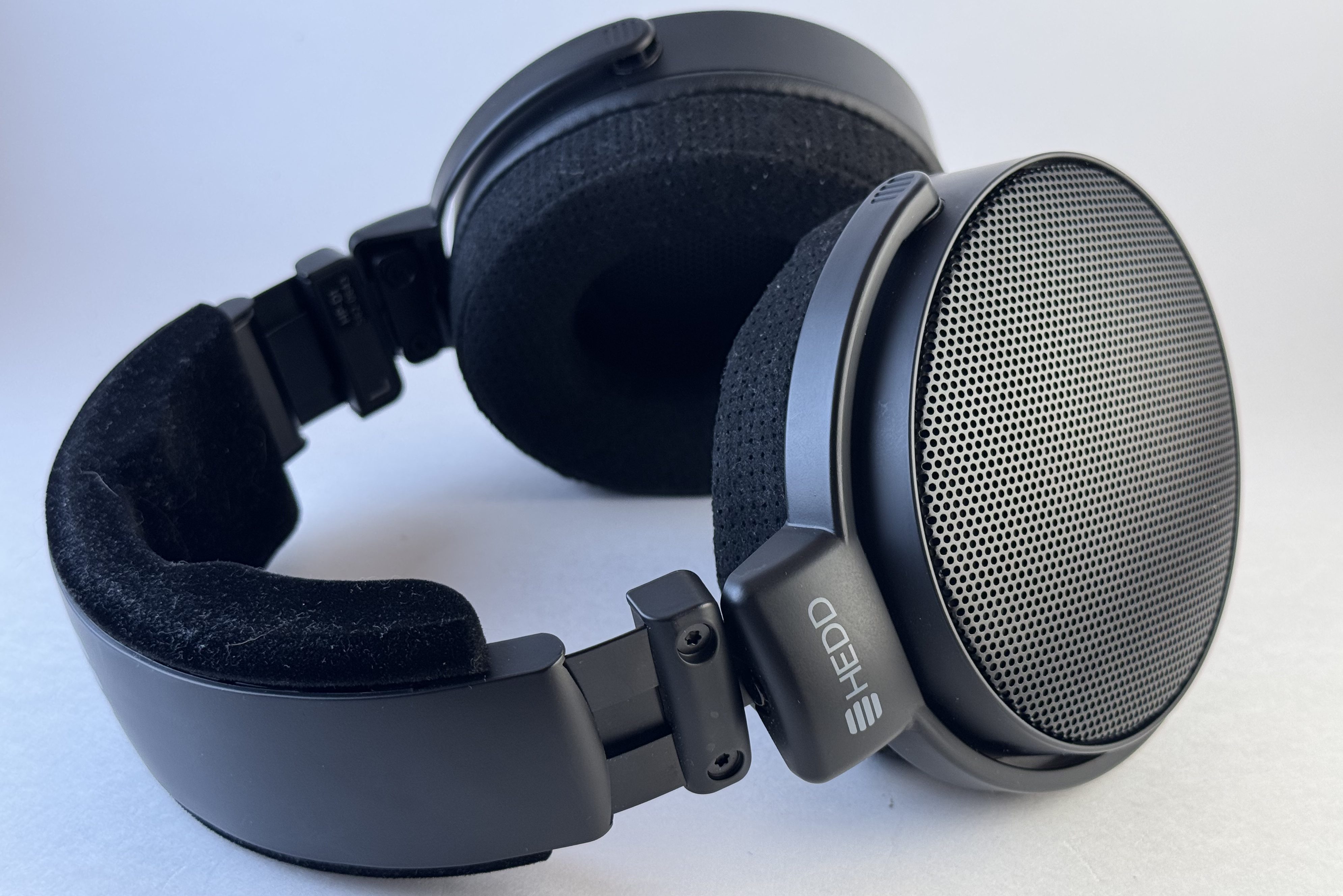
The D1 aren’t a perfect headphone; I get a little bit of excess treble on my head sometimes, and I would like a hair more bass on them for a lot of my listening, and they’ve got a comfort quirk for me (more on that later) but they’re … really damned good. And at least on my head, mostly really comfortable.
The $799 price point is a crowded one, with a lot of great options at or under the $800 mark, but I’d say the D1 hold up well to all of them. I don’t think they quite knock off the Meze 109 Pro as I worried a little in my recent review of them, but there’s a reasonable conversation to be had about it.
Here’s how my pair measure on my rig:
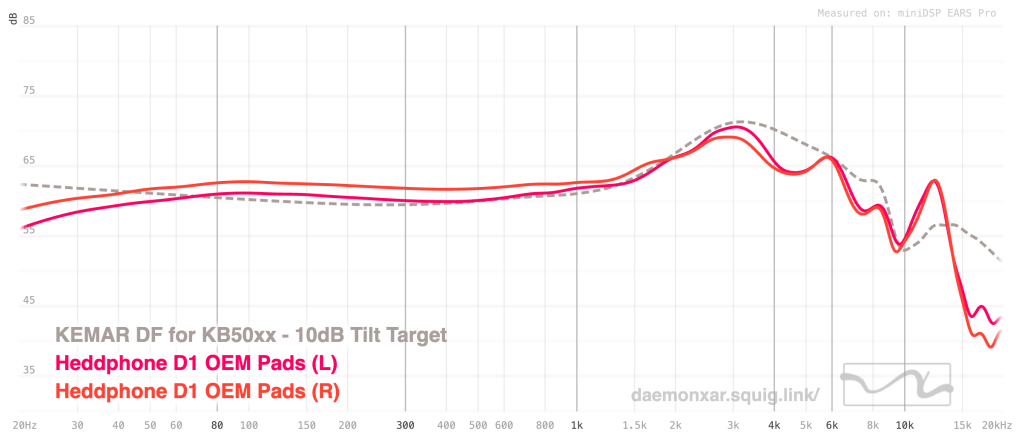
This is basically what I hear. The spike up there at around 12 kHz really only goes up to about the volume of the midrange, so while it stands out from the frequencies around it, it’s not particularly sharp in the context of most music.
As almost always, I’m reviewing these headphones with no EQ applied.
[Editor’s note: there’s a weird quirk with the D1 where adding a little pressure on the outside of the cups to increase the clamp force changes at least my perception of tuning in what seems to be a pretty pleasing way: vocals feel more intimate, bass just a little slammier, and treble maybe even a hair recessed. And that benefit appears to stick around for a minute or so after pressing in the cups as the earpads slowly reinflate.
It’s not a huge variation, but when I took some measurements with the D1 suspended by a Capra strap (and thus with a little more clamp pressure) I did get some consistent shifts in the frequency response vs. regular measurements. I want to spend some more time with this over the next few weeks, so for now I’ll say … just be aware. Graph (darker red & blue are no Capra strap, lighter are with the Capra strap):
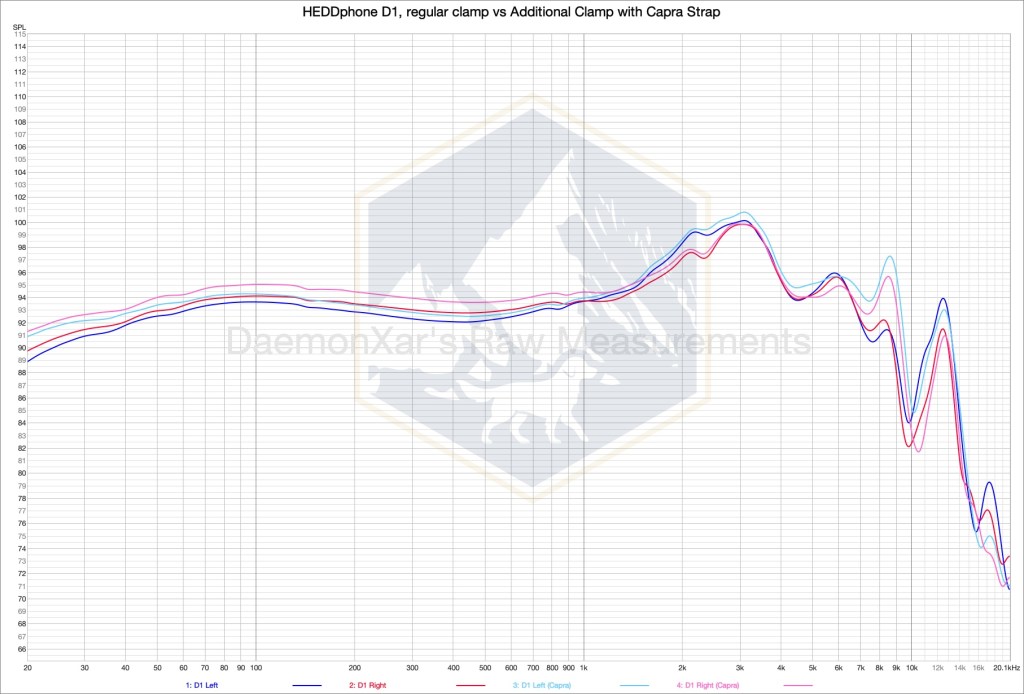
I can’t really figure out a way to measure this with any kind of accuracy or to create a more consistent, measurable and tighter seal yet. I haven’t been able to bend the spring steel in without taking the entire headphone apart, which I’m loathe to do while working on this review. As a result, I’ve done my listening and commentary based on the out-of-the-box clamp; just know that if you can get a little more clamp you might get an even better7 performance.]
Technicalities
The soundstage on the HEDDphone D1 is reasonably wide without being distractingly so. The guitars on “Chan Chan” are nicely placed in space out to either side, though the instrument and layer separation within that stage is good, not great. If I didn’t know where the hand percussion was, at times I might not be able to hear it through the rest of the busy mix, and some of the guitar accents are a little more buried in the mix than I would want in a perfect world. The front-to-back soundstage is similarly decent, with a bit of rotation in the opening guitar riff on “Love Can Damage Your Health (Laid Mix)” rather than just sounding like it’s panning right to left.
[Editor’s note: man, this instrument and layer separation is absolutely confounding me. There are tracks where the separation is really disappointing and some (instrumental) parts almost feel like they’re missing (“Chan Chan”) and others where I am hearing vocalists clearly for the first time ever (“Same Ole Mistakes” by Rihanna). Even on “Chan Chan” where some guitar and percussion parts basically disappear into the background, I’m hearing the two vocalists more distinctly than I have on almost anything I’ve ever listened to that track on. And on a track like “Garcia Counterpoint”, I’m hearing all three guitar parts clearly laid out in space.
It might be related to tone range? The good separation appears to be happening in the midrange and the lesser or missing parts more in the treble? I’m … confused.]
The dynamics are pretty good; setting the volume at the beginning of “It’s All So Incredibly Loud” had me reaching for the volume control around 3:10. The microdynamics are good, not great. I would like more impact on front and a bit more warble on the back end of the bass bell tones at the beginning of “Angel (Blur Remix)”, though the treble bell tones are well done and nicely impactful.
The detail and resolution on the D1 is really excellent; they’re the sort of headphone where even when listening to songs I know well, I hear little details here and there that I wasn’t aware of. I’ve listened to “The Hunter Gets Captured By the Game” by Massive Attack off the “Batman Forever” soundtrack hundreds of times, and I heard what I thought was a high hat pattern off to the right on the Hifiman Sundara, but I’m pretty sure it’s a regular cymbal after listening to it on the D1. There’s also a little quiet sound down in the bottom of the mix around 1:30 on Alt-J’s 3WW that I’ve definitely never heard before; almost like someone slowly pouring a soda into a glass.
That said, it’s also the kind of detail that can occasionally cross into graininess or sandiness, particularly on poorly mastered or mixed tracks. ANOHNI’s “4 Degrees” feels overly saturated and stark and gritty on the D1, to the point where it’s quite unpleasant to listen to.8 I think about it this way: it’s like applying a sharpening filter too many times to an image in a photoeditor; at some point it crosses from crisp and clean into faux detail and the D1 crosses that line on a few tracks here or there.
Timbre is mostly really good, though occasionally something has a little extra shimmer or warble on it in a way that I don’t love and I don’t think is present in the track. For example, occasionally Joe Newman’s falsetto goes a little shaky on “3WW” that I don’t think is really there in the mix; at the very least I don’t hear it on other headphones. And some of the guitar and piano tones on that track are just very slightly off. It’s definitely more the exception than the rule, here, and I have had very few moments like that with these headphones over the last few weeks. And in other places, the timbre is truly excellent; there are a few places in Alt-J’s really excellent “Dissolve Me” where it turns out that what I thought were synths were just Gus Unger-Hamilton singing, which is incredibly clear while listening to with the D1. On a similar and hilarious note, I sometimes have a hard time telling whether a particular line in “Same Ol’ Mistakes” is Rihanna or Kevin Parker (which should NOT be a challenge, but it is what it is). On the D1, it’s crystal clear to me which is which.9
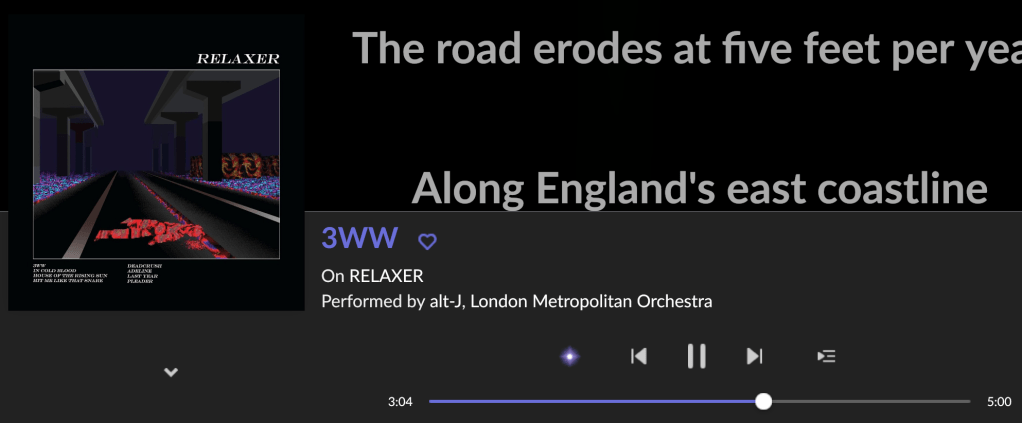
I think the biggest criticism I’d offer of the D1 is the inconsistent and occasionally disappointing layer and instrument separation. Particularly when tracks get busy and a number of instruments/vocalists are in a particular frequency range, it feels like some things get muddled or lost in the mix, most tellingly on “Chan Chan.” It’s particularly interesting on tracks that I know really well, as my brain seems to be trying to fill in the missing information and I have to really think about what I’m hearing vs. what I think I should be hearing on particular tracks.10 It’s a shame; the D1 can be an incredibly detailed headphone, and it’s a bummer that some of that gets lost in busyness. [Editor’s note: I want to revisit this in future listening with EQ.]
For better or worse, the D1 are particularly open, even for an open back headphone, to the point where some quieter tracks are hard to listen to when my heat pump is going in the back yard (outside my office, but only about ten feet away in a straight line), and I definitely hear a lot more of my keyboard when I’m using them than a lot of my other open back options.
Bass
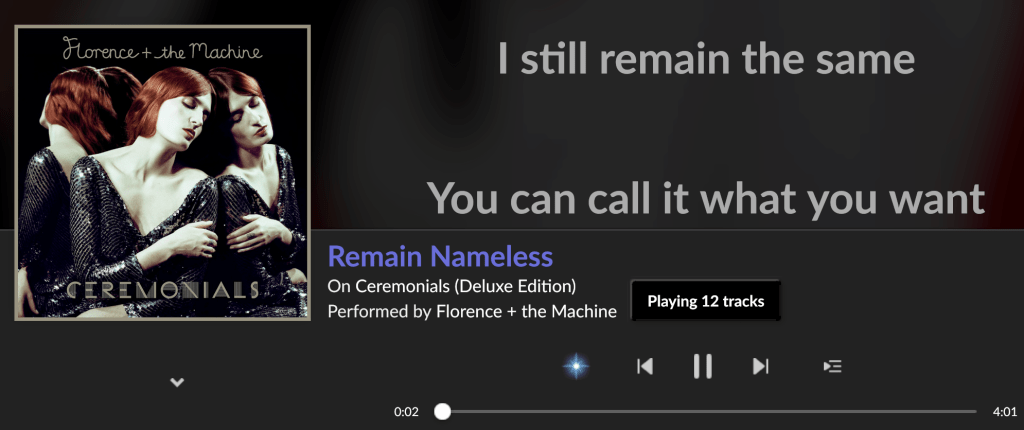
The bass response is generally quite strong, clear and crisp and textured. It doesn’t have quite the texture and resonance that you get from the Meze 109 Pro or the Strada, and it doesn’t have quite the same deep extension as the 99 Classics or the Edition XV, but it’s really good for a dynamic driver headphone. It also has a decent impact and slam; while I don’t get quite as much accenting on a track like “Angel (Blur Remix)” as I might want, the overall quality of the bass is excellent. Ditto on “Out of My Hands” around 2:48, where the string bass slips in smoothly and then gradually builds throughout the rest of that track. It’s particularly good in the sub bass to mid bass transition; the repetitive low A on the bass guitar in “Nobody Speak” just grooves throughout the track. The bassline on “Cold War” is tangible and physical in a way that I really appreciate, and it’s really beautifully split across the channels. Same with “Remain Nameless,” with a nicely textured timpani groove. The rumble on the low end on “Limit to Your Love” is deep and satisifying and clean, and only the very bottom most notes start to roll off. Similarly, on the Gorillaz’ “Welcome to the World of the Plastic Beach,” you can feel and almost hear the very lowest bass notes, which is … frankly impressive for headphones.
There are definitely a few places where the bass could use a little fiddling; there’s one particular (and oft-repeated) bass note in “What Did I Do?” that’s consistently just a little quieter than the notes around it, and I ran across a handful of other examples where a small range of the bass region was a little out of step with the rest. Overall though, really nice bass tuning out of the box.
Midrange
This is going to sound like I’ve hit my head recently, but … I … I think I might very slightly prefer the mids on the D1 to even the legendary HD 600. Mostly. For some things, at least.
The midrange on the D1 is generally really, really excellent, both in terms of balance and timbre. There’s a whole lot to like here; this is the first headphone I’ve ever used where I can really clearly tell Kevin Parker and Rihanna’s voices apart on “Same Ol’ Mistakes.”11 Jill Scott is perfect on “Calls”, even when the mix gets pretty busy in the middle (and you can hear the main and backup vocals distinctly and clearly placed in the mix). It mostly does a great job with instruments in the midrange too; the guitars on a track like “Fresh Tendrils” are rich and textured without being too in your face. Ditto the more delicate and detailed overlapping guitar parts on “Garcia Counterpoint”; while I might want just a bit more separation in their tone (see the note above about layer separation) they’re clean and crisp and their interplay is really lovely.
This remarkable tonality and clarity does not come without a cost, though, in that the vocals can be SO forward at times that they slightly bury other things in the mix, particularly things like guitars in the bass to midrange transition zone that some other headphones have struggled with (*cough* Strada *cough*). As an example, the rhythm guitar part in “Only Here and Nowhere Else” that starts at the beginning and drives through most of the piece is just slightly too far back in the mix, though the lead guitar line is damned near perfect. The slightly distorted vocals in the Chorus on “The Night Does Not Belong to God” come across as a little harsh and punchy, and Johnny Cash is maybe a little bit too forward for a lot of “Hurt” (and not just where the recording gets a little hot). Conversely, I’d like a little more of Florence on “Remain Nameless,” particularly the background vocals but also the lead line in places.
I’m genuinely fascinated by the D1’s midrange. I don’t know that it will be what I want to listen to for everything, but I think they genuinely might displace the HD 600 in my rotation for vocal-heavy music. I think the HD 600 is probably slightly better balanced throughout the midrange, but man … I’m genuinely stunned by how clearly and distinctly you can hear individual voices even in a track like “BLACKBIIRD” with really intense overlap. I’ve listened to Dave Matthews Band’s “Busted Stuff” a lot over the last couple of decades, and I don’t think I’d ever realized how much the organ out in the left channel sounds like it’s underwater … but I definitely hear it on other headphones too now that I’m listening for it.
Treble
The treble on the D1 is probably the weakest part of its tuning. It’s not bad, particularly compared to a treble heavy headphone like the Edition XS, but it definitely edges into harshness and sharpness on tracks like “2021” and “Will O’ the Wisp,” my usual suspects for treble issues.12 The snaps on “Birds” are on the sharp side, though turning down the volume a little bit definitely helps, and the click throughout “Magic” by Coldplay is downright unpleasant at anything other than a pretty low volume. Same with some of the squeaks and distortions on Soul Coughing’s “True Dreams of Wichita”; really love the overall tone and timbre on that track with these headphones but the C section is just not a lot of fun with the default treble.
Interestingly, the bells on “Coffee” which can be sharp on a lot of headphones are really sanded off and mellow at times, in a way that’s not unpleasant per se but is a little disappointing; it’s a kind of spicy that can work well with the rest of that almost dreamy, floaty track.
I think the story of the D1’s treble is a tale of inconsistency. Mostly, I find the treble pleasant: crisp and clean without being harsh, but with a couple little oddities here and there. I would REALLY like to know how these measure on my head; maybe someday I’ll get my HRTF measured!
Amplifier Compatibility
The HEDDphone D1 doesn’t seem to be particularly amplifier-sensitive. I’ve listened to it on a broad range of devices from cheap Apple/JCALLY dongles, to the midrange Topping DX5 II all the way through the Holoaudio Cyan 2/Bliss (KTE) stack and a lot of the things in between, and it’s done well with really all of them.
I’ll throw out my frequent note that these excel with the Chord Mojo II; I wondered if the additional perception of detail that I get with the Mojo 2 would negatively combine with the occasional grittiness of the D1 but for the most part they seem to play together really well. Interestingly, for whatever reason the few treble issues I noted for the D1 are reduced on the Mojo 2 … no explanation for that.
In limited listening, I wasn’t overly impressed by the D1 run through the Druid/Gremlin stack or the Nitsch x Schiit Piety; I’m not sure that the tuning choices or low impedance nature of the D1 particularly benefits from adding tube warmth, though I’ll do a little more listening over the next couple of weeks and see if I need to reevaluate.
Just for fun, I did a fair amount of listening to the D1 via the iBasso DX170 DAP I picked up on clearance from Heapdhones.com in the fall, and I’ve been really pleased with both that device (a few control/interface quibbles aside) and the way the D1 sound from them.
Gaming
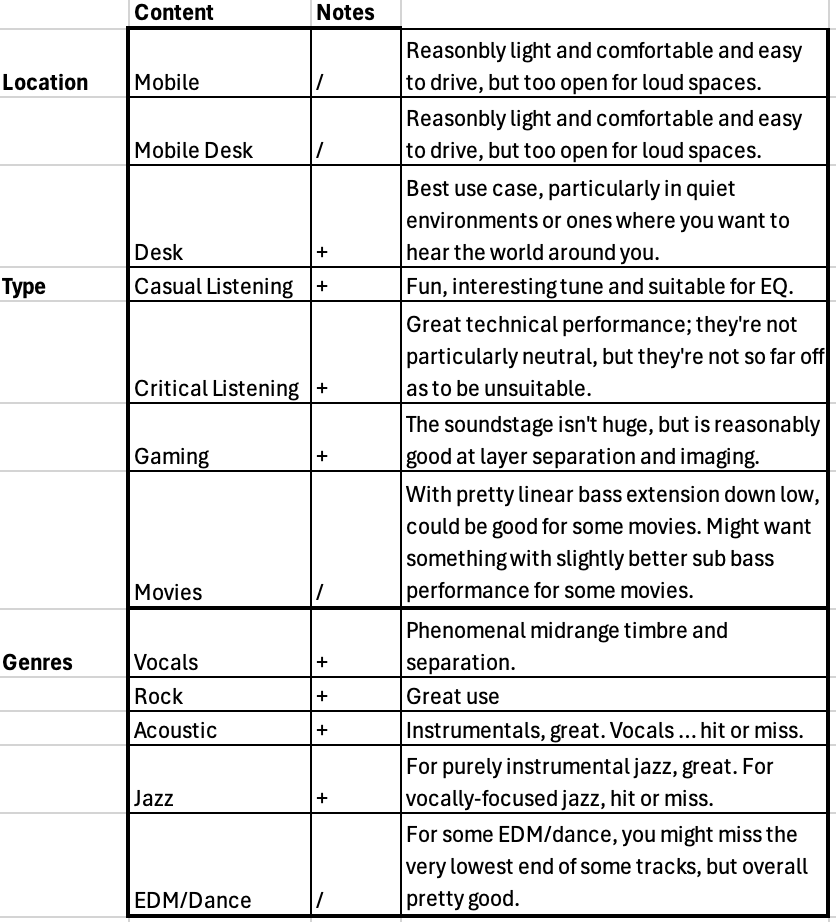
The D1 is a perfectly adequate headphone for gaming. The soundstage is decent and consistent, and the tuning is overall pretty well done. It has enough bass to be satisfying, really excellent mids for human vocals and midrange cues, and the treble is well-managed enough to work pretty well for most things. Plus, they’re comfortable and easy to drive. I probably won’t use them for a lot of gaming, especially in winter, but it won’t be because they’re bad at it.

Overall Impressions
Overall, I’m pretty happy with the sound quality and performance of the D1. The tuning is pretty close to perfect; I might want a bit more bass (not uncommon for an open-back dynamic driver) and a little less treble (also not uncommon for an open-back dynamic driver), but the overall approach is a really pleasant one that doesn’t leave me wanting very much. They’re also a nicely technical headphone, though again sometimes they’re a bit too fine-grained in the detail for specific tracks, and the soundstage/layer separation is … confusing and inconsistent, but overall pretty good.
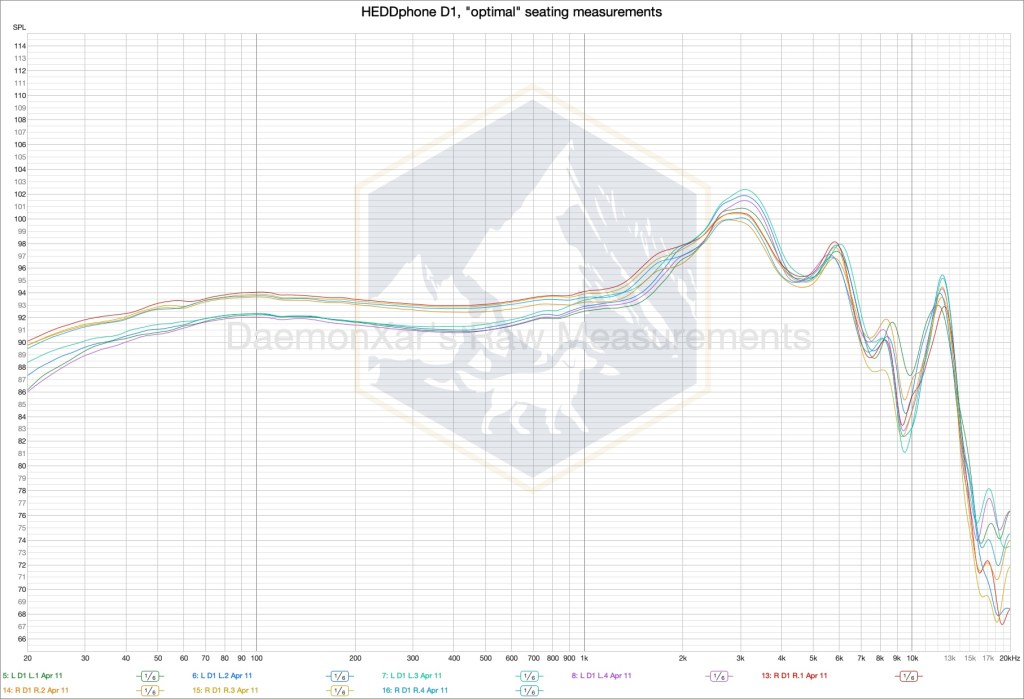
It’s worth noting that this is a headphone with a fair amount of positional variation. When I measure it as far forward, back, up, and down as I can on my measurement rig, I generated 6-7 dB of variation in some frequencies, though I’m open to the possibility that the left forward measurement reflects a break in the seal rather than a true variation.
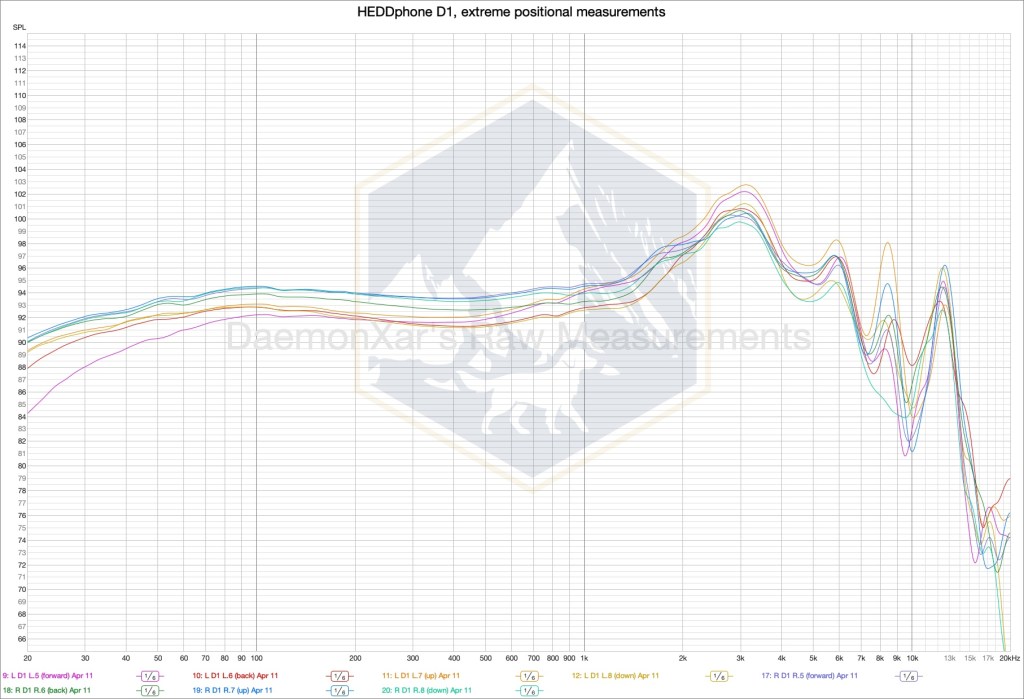
Variation in “optimal” seatings was substantially lesser, though; as long as they’re close to centered on your ear you should get pretty consistent frequency response.
Build Quality & Appearance
These don’t particularly look or feel like almost $800 headphones. In this price range I tend to expect more premium materials: woods, nice metals, higher quality plastics, and these look and feel much more akin to something like the $200 HD 6XX; perfectly nice ABS plastic cups and yokes, painted metal grill, and a padded plastic headband with a spring steel core. It’s definitely not the end of the world, and on some level I do appreciate that HEDD focused mostly on the sound, but … we do listen with our eyes sometimes, particularly for a product in this price range.
Connectivity
To my great appreciation, HEDD has gone with a pretty standard dual-entry, 3.5 mm cable system. This means that they’re compatible with cables from a bunch of other manufacturers (most Focals, Hifimans, Fiios, and lower-tier Mezes) as well as a bunch of cheap, decent aftermarket options. It ships with a 2 m, single-ended, cloth-covered cable that terminates in a 3.5 mm jack with threaded 6.35 mm adapter. It’s a perfectly competent cable, with nice drape and not a whole lot of shape memory. I would like for a headphone in this general price point to come with a balanced cable option, but at the end of the day I have a bunch of good dual-3.5 mm options laying around my house anyway. If you don’t, I wouldn’t worry about it; the D1 is so easy to drive you won’t have any particular need for a balanced cable.
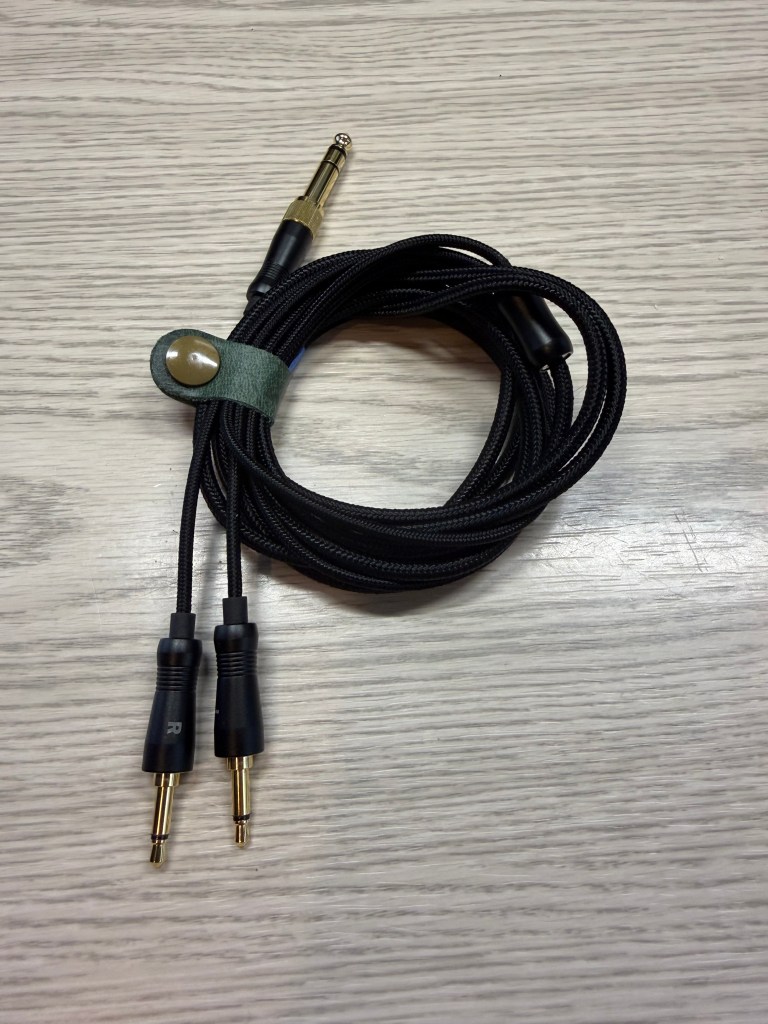
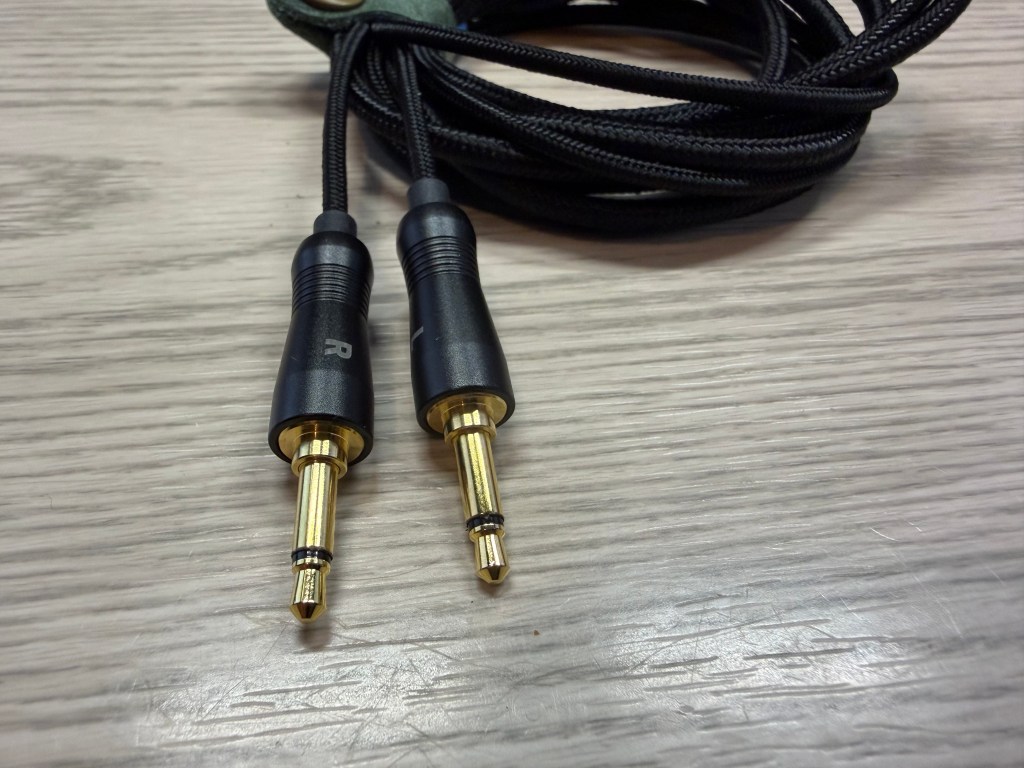
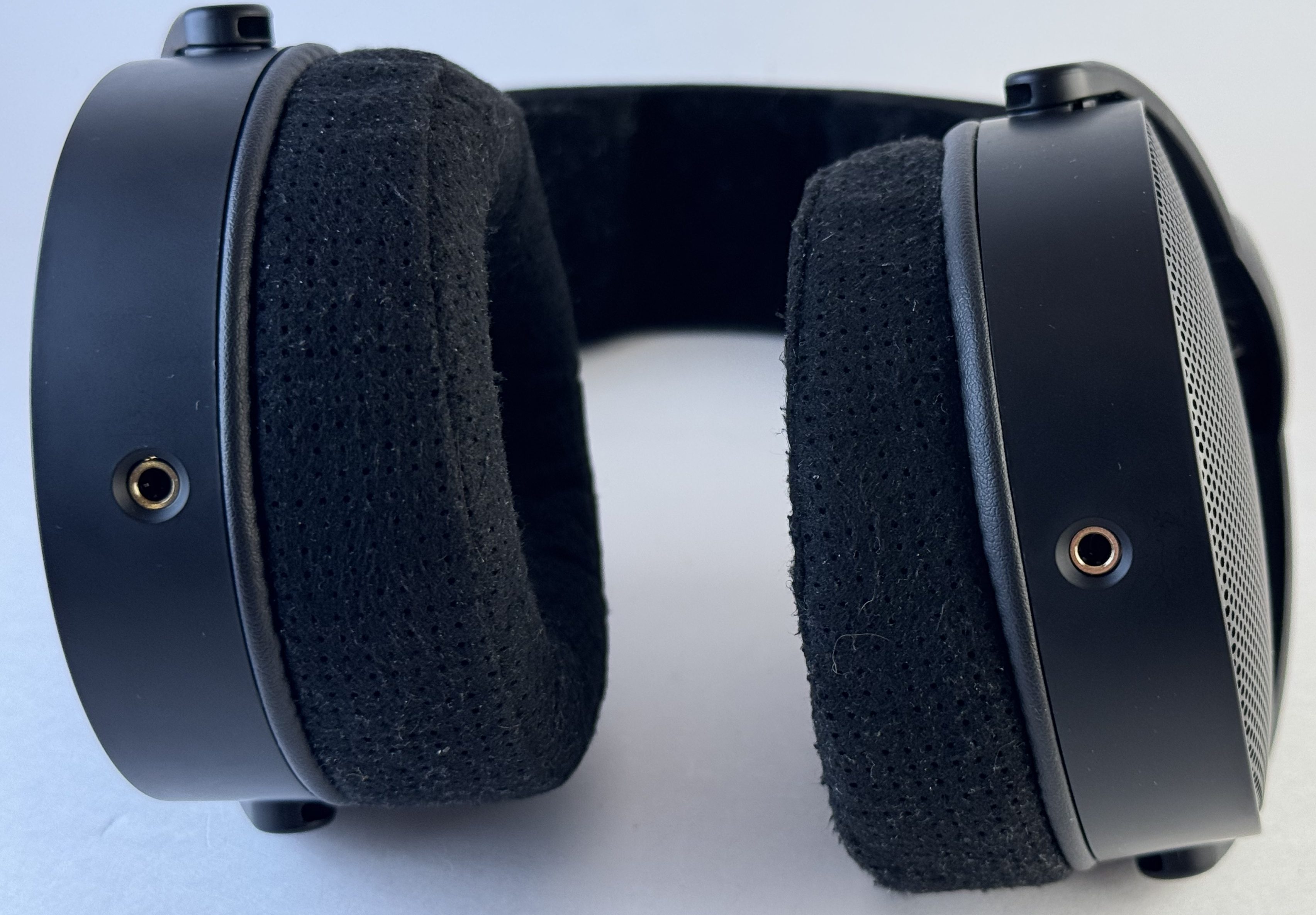
The D1 largely forgoes the recessed ports that you find on older-style Focals and some Meze products, though there is a VERY slight recession around the ports. At least on my unit, even the chunky (9.5 mm diameter) barrel-shaped Focal connectors appear to get a good, complete connection, though you might struggle if you found a cable with even thicker barrels.
Construction
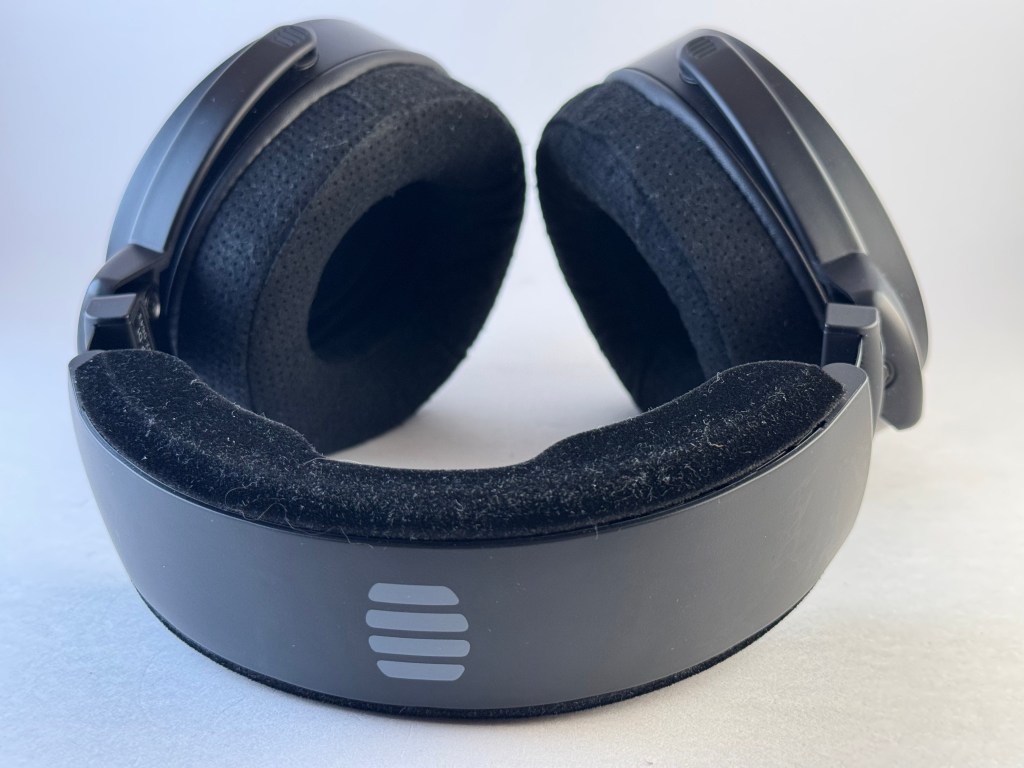
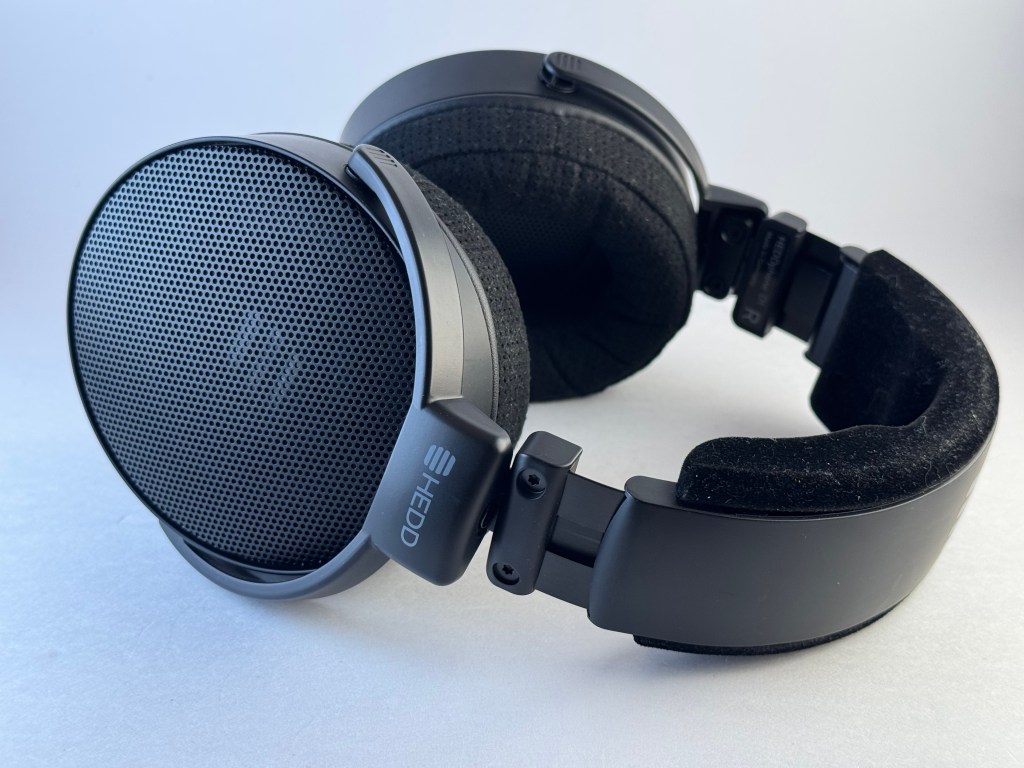
The D1 is primarily constructed of plastic, with a thin metal grill on the outside of each cup and a metal spring steel band. The bottom of the headband is a pretty stiff foam covered in what feels like velvet, with a cutout in the middle to reduce hotspots.
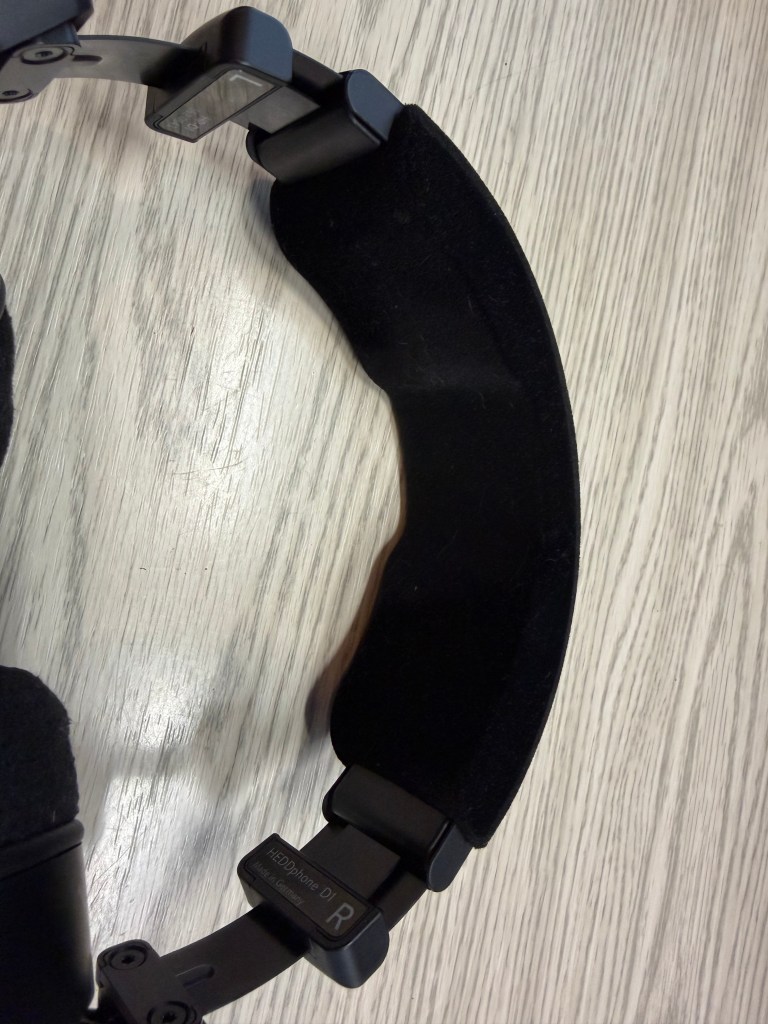
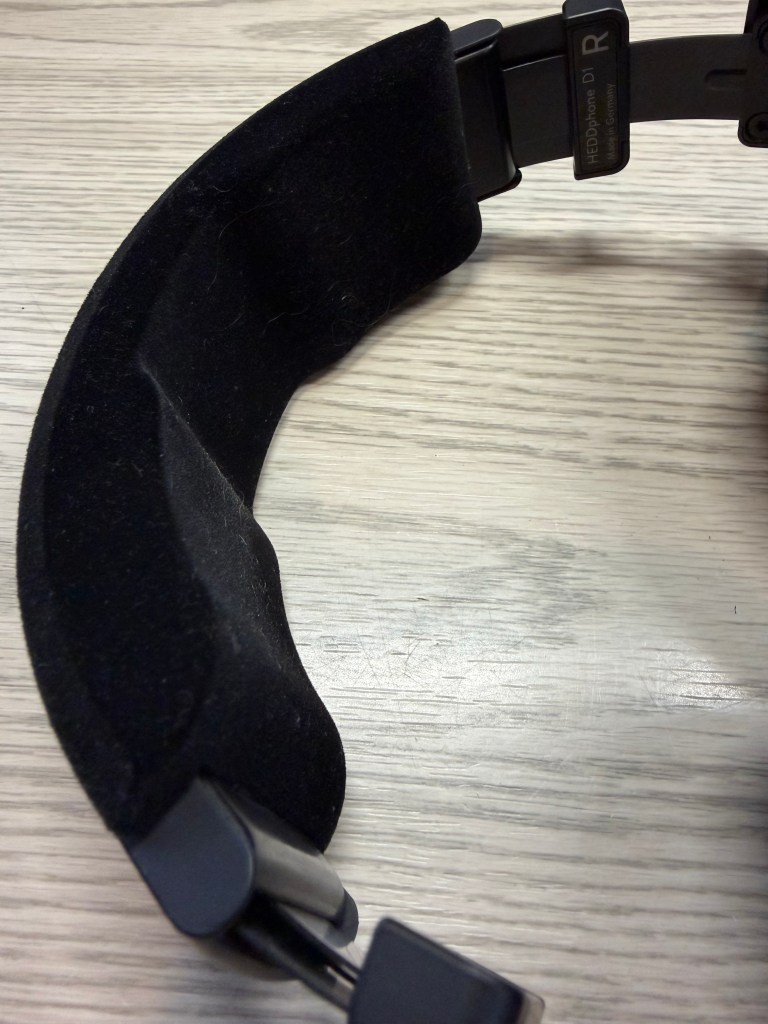
The yokes are plastic, and let the cups both swivel and tilt approximately 45 degrees.
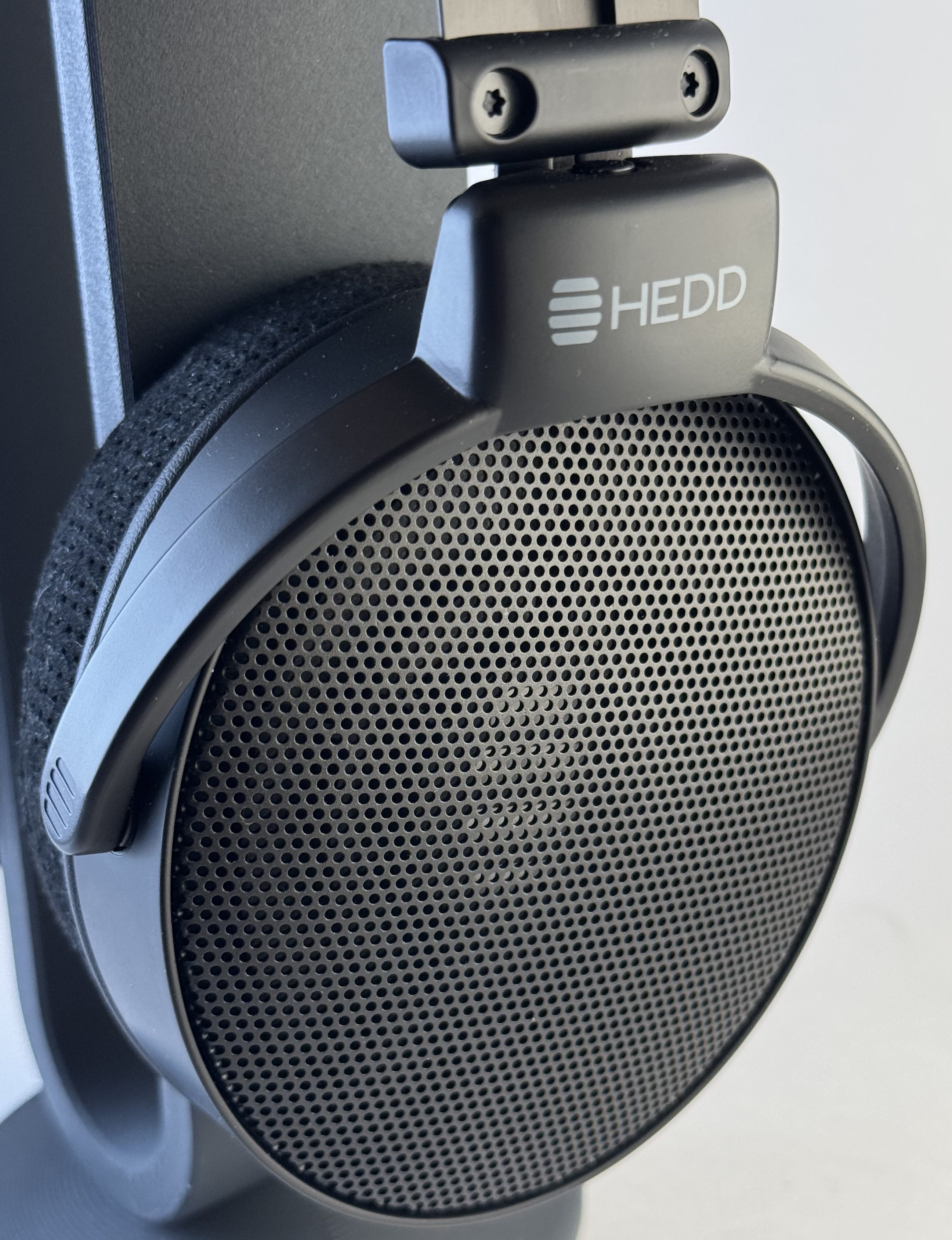
One of the selling points of HEDD’s products is repairability, in that it’s pretty easy to take their products apart to do servicing yourself. If you have the right Torx screwdriver, you can break the headphone down quickly via easily-accessed screws.
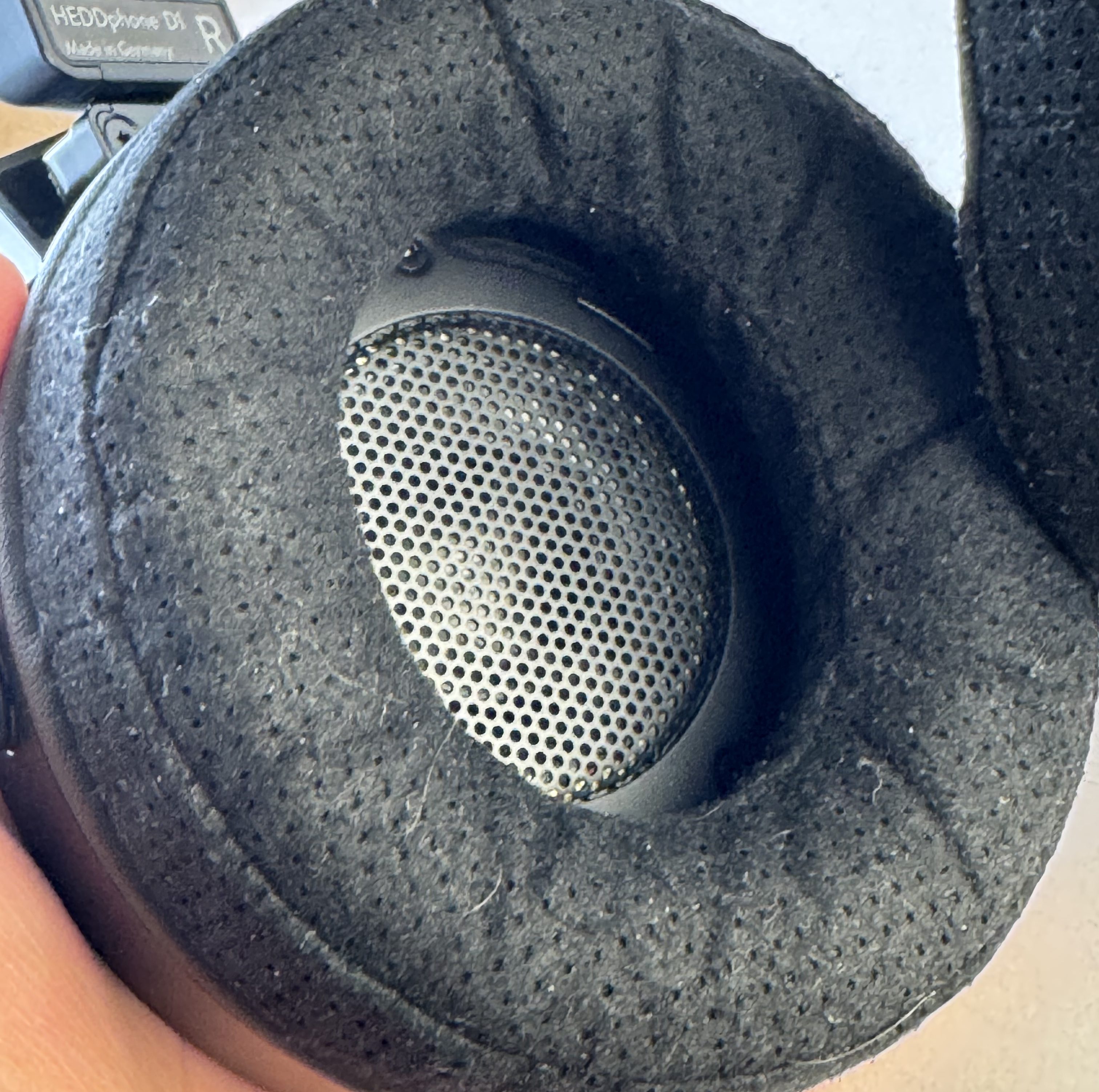
The earpads are a nice, compliant foam wrapped in perforated velour. They’re about 25 mm deep, giving me just enough clearance for my ears. On a cold day, the (metal) ring around the grill on the inside gets cold and can be surprising if you press in on the outside of the cups.
The combination of the headband adjustability, the yoke design, moderate clamp force, and the ear pads combine to make it pretty easy to get a good, consistent seal without a lot of fussing; unlike the Meze 109 Pro, I don’t have to adjust them once they’re on my head to make everything connect right.
Overall, it’s a good, clean industrial design, one that feels pretty solid in the hands and on the head, but one that doesn’t wow me in any way for a $799 product. They really do remind me of the 6X0s in this respect; there’s no question that they’re well built and thoughtfully designed, but they are just a bit underwhelming build-wise.
[That said, velvet and velour are hard materials to live with in a house full of golden glitter. This is not a problem unique to the D1.]
Comfort
Overall, the HEDDphone D1 are a pretty comfortable headphone. The foam on the top is VERY firm (though I’d be curious to see if it loosens up over a few months of regular wear). While I didn’t personally have any problems with it during my testing, I can see why the prior owner printed or bought a Capra strap for it.13 I appreciate how compliant the ear cups are, though they compress enough that my ears definitely occasionally brush the grills on the inside of the cups. As noted above, those grills are metal and can be surprisingly cold to the touch if you’re not expecting it.
Overall, the D1 don’t disappear on my head the way something like the 109 Pro do, but I haven’t had any real comfort issues during testing, even for long sessions.
Appearance
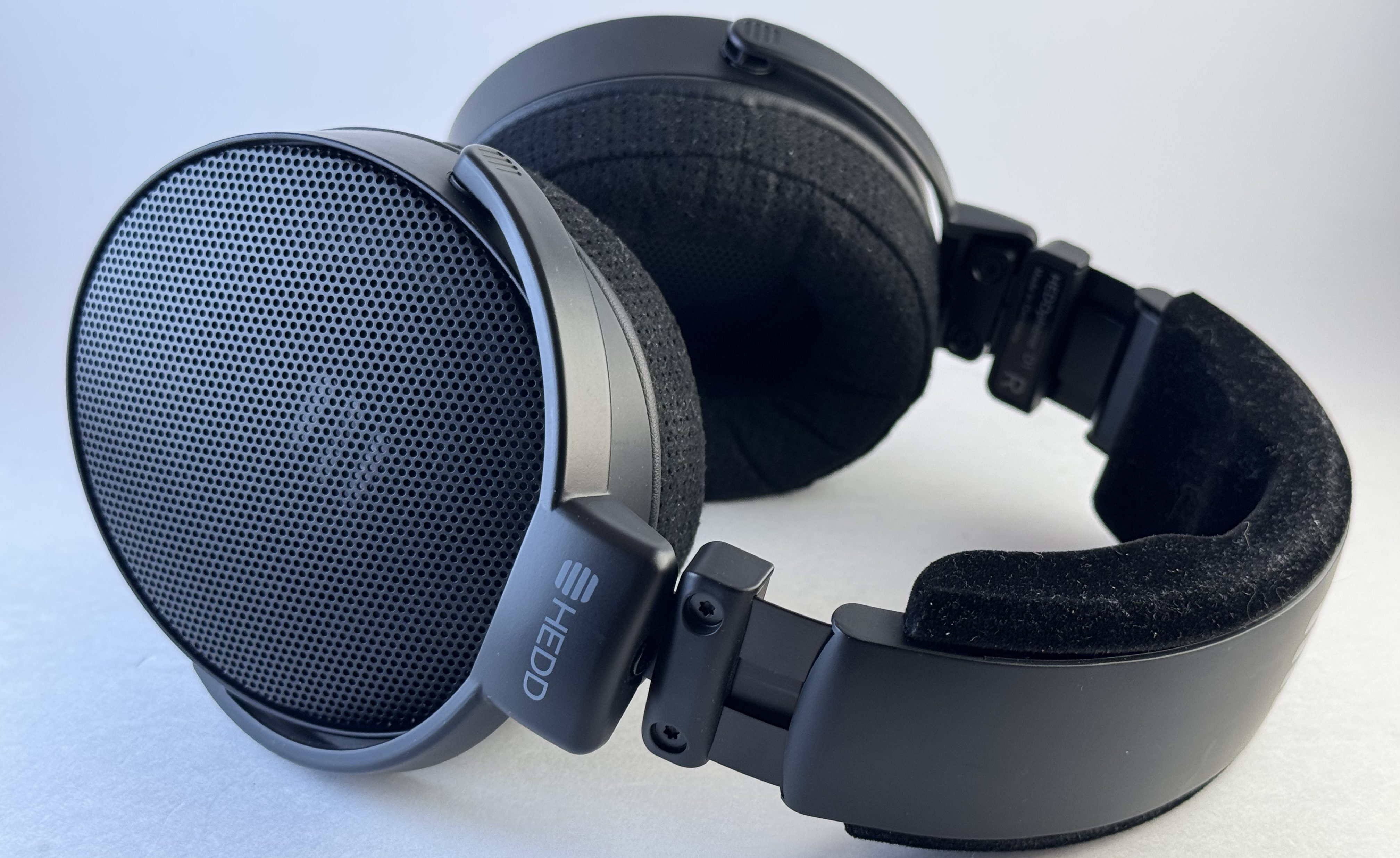
Appearance is, as always, a personal preference, but I think the D1 is … perfectly adequate. They’re a very headphone-y looking headphone, not that far off of the platonic ideal for a headphone. Not fancy, or anything you’d show off, but perfectly fine to get the job done. Less Cyberman-y than some, as well, if that’s one of your concerns.
Value & Comparisons
I went into this review with some real questions about the D1, and it’s been a bit of a journey. I keep going back and forth on what I think about its detail resolution, the soundstage and layer separation, tuning … it’s more perplexing a headphone than any I’ve reviewed in a while. I definitely like them. I have no reservations about calling them a good headphone. But are they a great headphone?
I commented in my Meze 109 Pro review that I have a hard time calling a nearly $800 headphone a value, and I’m still working my way through that. I’ll reiterate here what I said over there: most people shouldn’t spend $800 on a pair of headphones. BUT, if you’re going to spend $800 on a headphone, this isn’t a bad option; they’re really well built and designed, and the technical performance is really quite something. If I didn’t have the Meze 109 Pro around (spoiler alert!) I think I’d probably get a lot of use out of them. As it is …
Your mileage, as always, may vary. If you want something with the technical chops of the Focal Clear but either can’t find one or can’t wear one comfortably, this would be one of my top recommendations. It’s got some … oddities, but overall it’s a great pair of headphones.
[Editor’s note: the caveat I’ll throw out here is that while the D1 are mostly pretty comfortable, wearing these on a cold day I REALLY noticed my ears brushing the internal metal grill anytime I adjust the headphone (particularly with the Capra strap on it). It’s not a deal breaker, but does color my impression of them and was a bit annoying for the last few days, when the temperature here dropped into the mid-60s.]
Sennheiser x Drop HD 6XX
The Sennheiser x Drop HD 6XX is a great headphone, and one near and dear to my heart. It’s also the bar by which I measure all other open-back headphones, even the much more expensive ones. Fortunately, given the 4000% price markup, the D1 clears that bar handily.
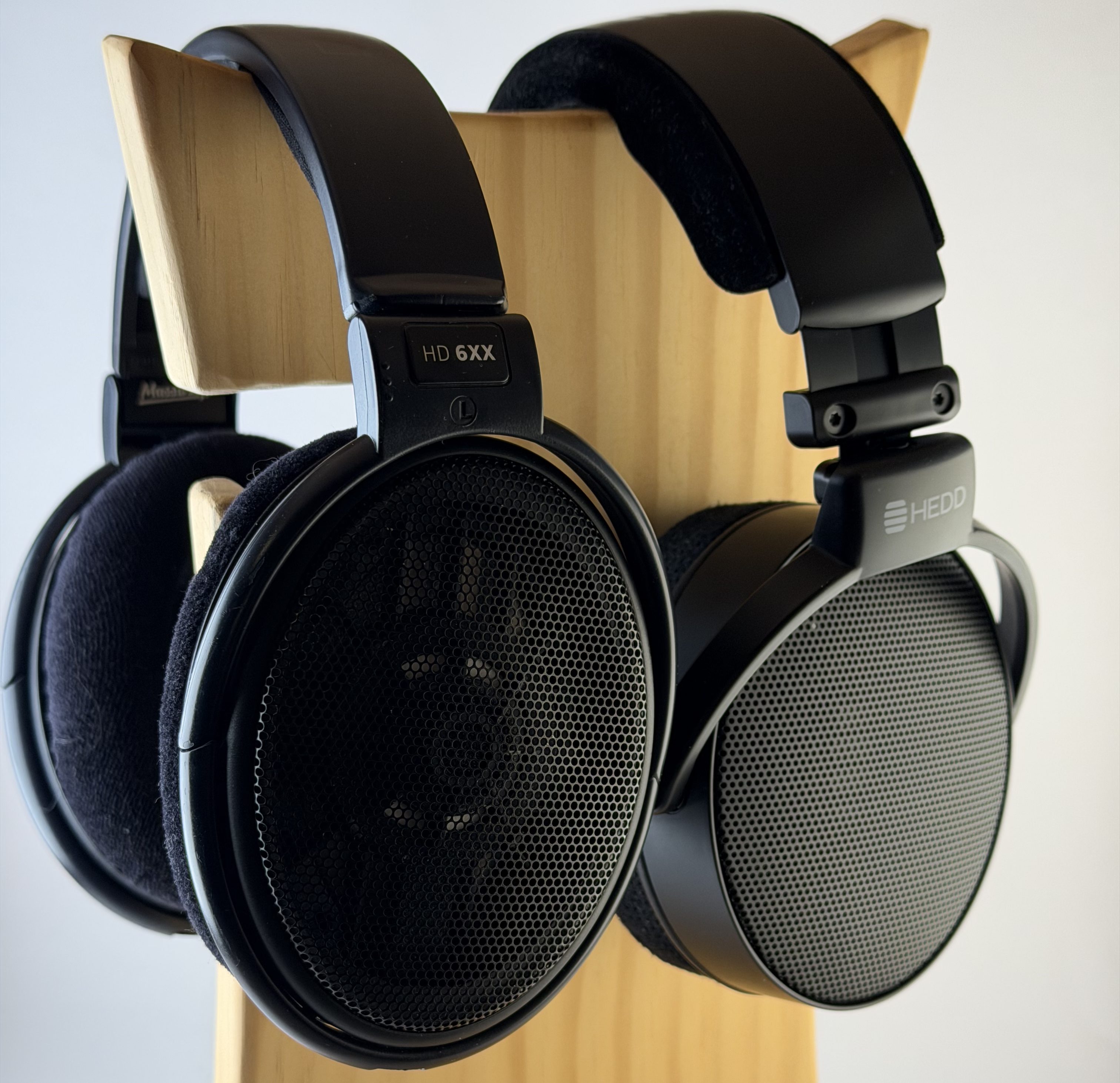
This isn’t a particularly fair comparison, so I’ll run through it pretty quickly. The bass, mids, and technicalities are all substantially better on the D1. Treble is pretty even, and I’d say the comfort is also pretty equivalent, with the 6XX being much clampier but the D1 having the shallow pads/metal grill issue. The D1 feel like a pretty straightforward upgrade from the HD 6XX, at least to my ears.
Also worth noting that I think the D1 puts the final nail in the coffin of my love for the HD 600; I’ve been keeping them around for very vocal-forward music, but I think the D1 are just plain better for everything, including the midrange/vocals.
A quick glance at the graphs:
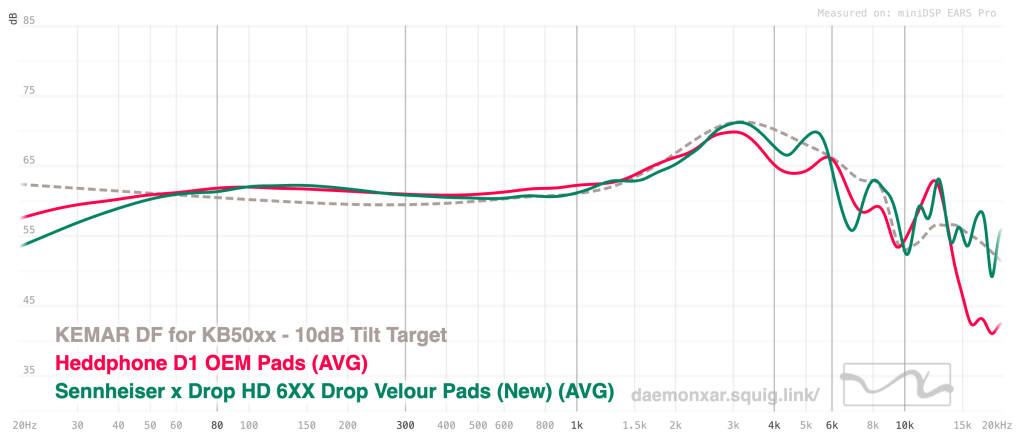
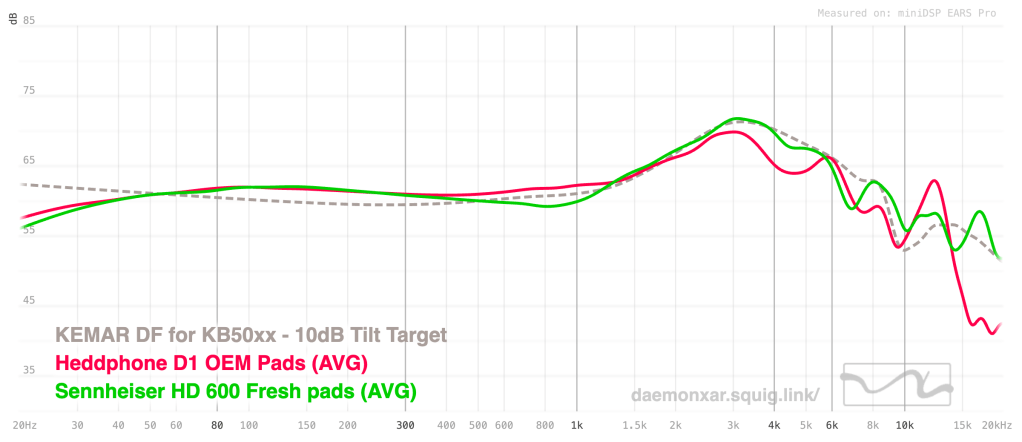
That’s actually even closer than I would have expected; the D1 definitely sound bassier to me, but I’m a bit surprised that above 60 Hz or so they’re pretty even. The rest of that generally makes sense to me; I don’t particularly hear peaks that stand out on either.
Verdict: D1. If you can afford the extra $600 or so, they’re a substantial improvement in basically every way except treble and comfort, and the technical improvements are substantial outside of maybe non-midrange layer separation.
Meze 109 Pro
The most interesting comparison to me is the Meze 109 Pro, my favorite headphone under $1,000 and a pair that will always be near and dear to my heart.
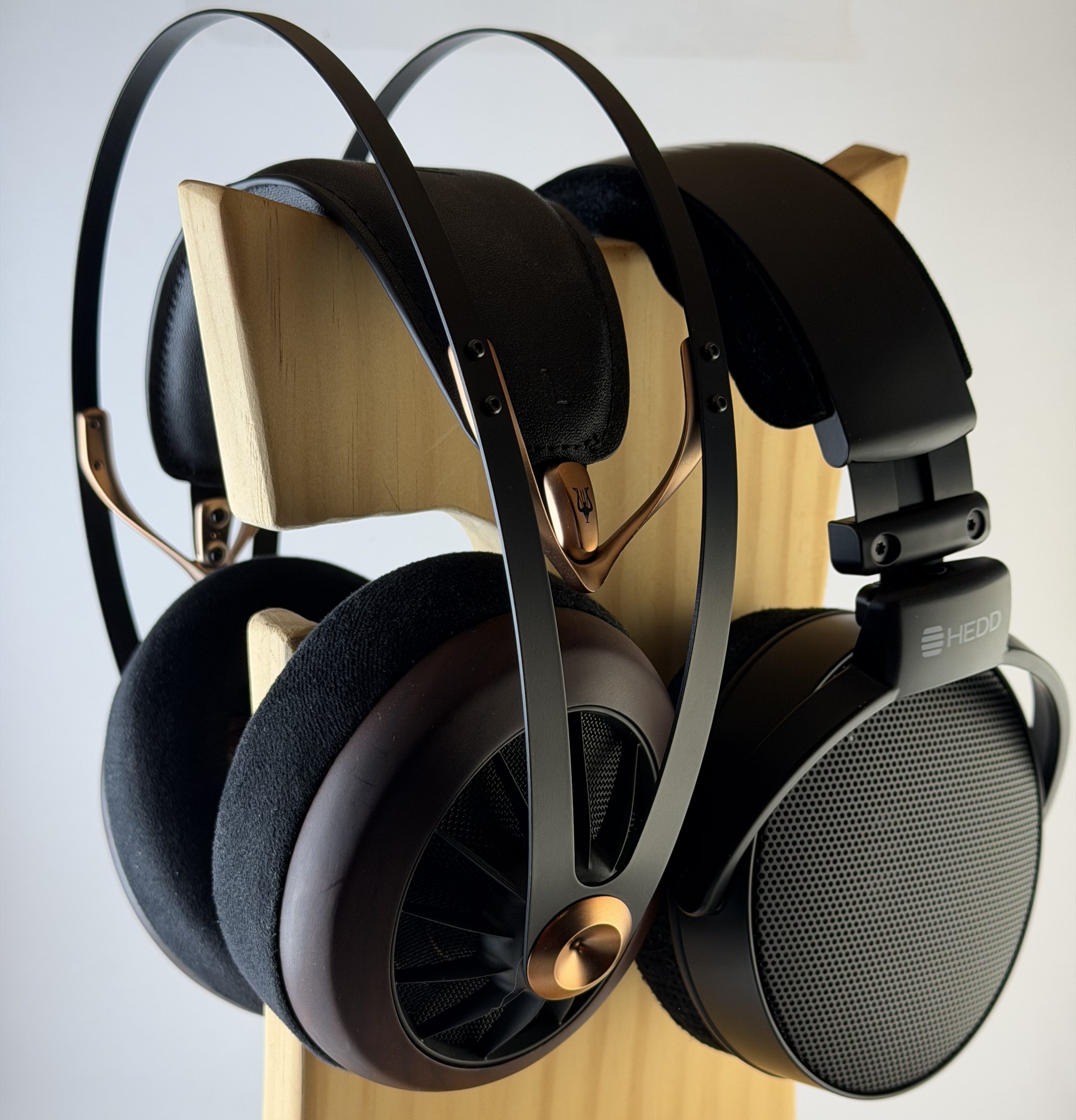
They’re a pretty close matchup, to me. I will (personally!) take the Meze’s bass and treble over the D1, but it’s not a huge difference. The midrange on the D1 is mostly better than even the 109 Pro’s excellent midrange, though it has its own quirks too. The comfort and aesthetics on the 109 Pro win pretty solidly in my book (even discounting the inner driver on a cold day issue); the 109 Pro is one of, if not the most, comfortable headphones I’ve ever owned and while the D1 is pretty comfortable, it’s just not quite there. And I’m a sucker for the Meze aesthetic. The D1 does have arguably better technical performance in a lot of ways, but … sometimes to it’s own detriment. The soundstage is awfully close, and the 109 Pro has better (best in class?) layer and instrument separation … except for the midrange, where on some tracks the D1 adds an entire layer of detail and timbre that I’ve never heard on anything else.
Is the midrange improvement and technicalities enough to let the D1 take pole position in my under $1,000 category? I don’t think so, at least not for me. The D1 are a great headphone, but the 109 Pro feel like coming home. To a warm, buttery, magic home. I’ve been toying in my mind with equating the differences between them to the HD 6XX/600 comparison; on the surface it seems reasonable; the D1 is a more mids-focused and more “neutral” tuned headphone compared to the 109 Pro, but I think that such a comparison might sell both pairs short. The D1 is a bit more neutral, but is still a really fun, lively tune for most of my music whereas at least my HD 600 unit can be boring at times. And while the 109 Pro tilts towards the warmer side, it’s also a really good, objective performer for critical listening, while the 6XX is … less so.
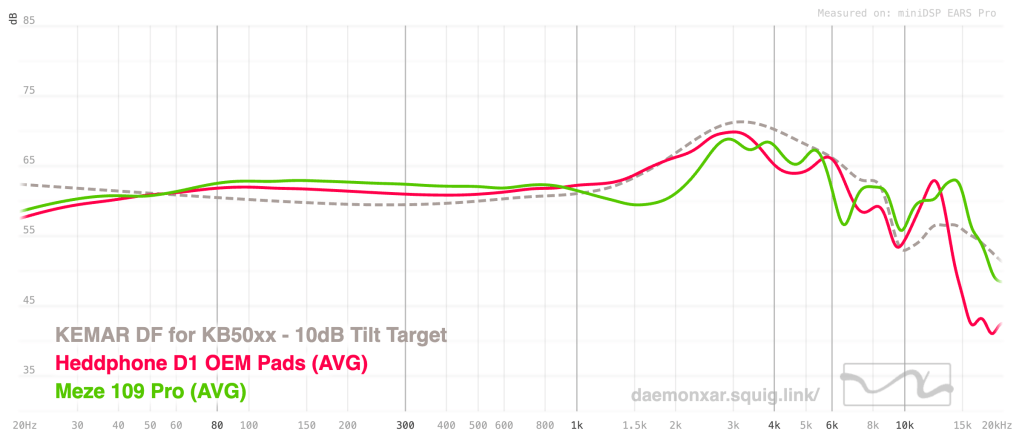
That looks about right; definitely better low end energy from the 109 Pro (though it’s not a huge difference), and while I don’t think I hear the mids scoop on the 109 Pro quite that much, there’s definitely a lot more in the upper midrange/into the presence region on the D1, comparatively.
Verdict: I’m choosing the 109 Pro, though this isn’t as crazy a comparison as I thought it might be when I first got the D1. My initial impressions of the D1’s layer separation was that they were … lacking, and after a lot more listening I’ve come around to appreciating the D1 more. That said, they’re still not going to quite matchup to the 109 Pro on my head. You’re not going to go wrong either way, but particularly with the 109 Pro often on sale and HEDD still trying to catch up with demand for the D1 (and therefore a dearth of used units, or new units on sale), I think the 109 Pro is both the better headphone and (at least for now) the better value choice unless you’re really focused on vocals.
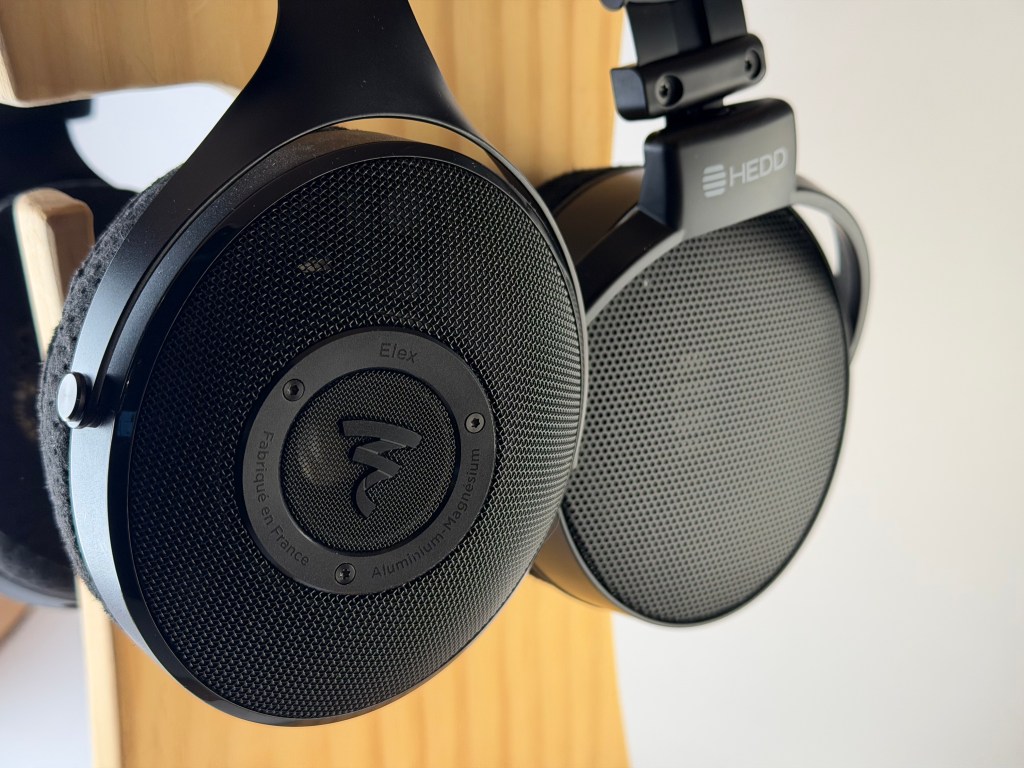
Focal Elex
The Focal Elex is another of my very most favorite headphones, both for what they represent AND for the way they sound on my head.
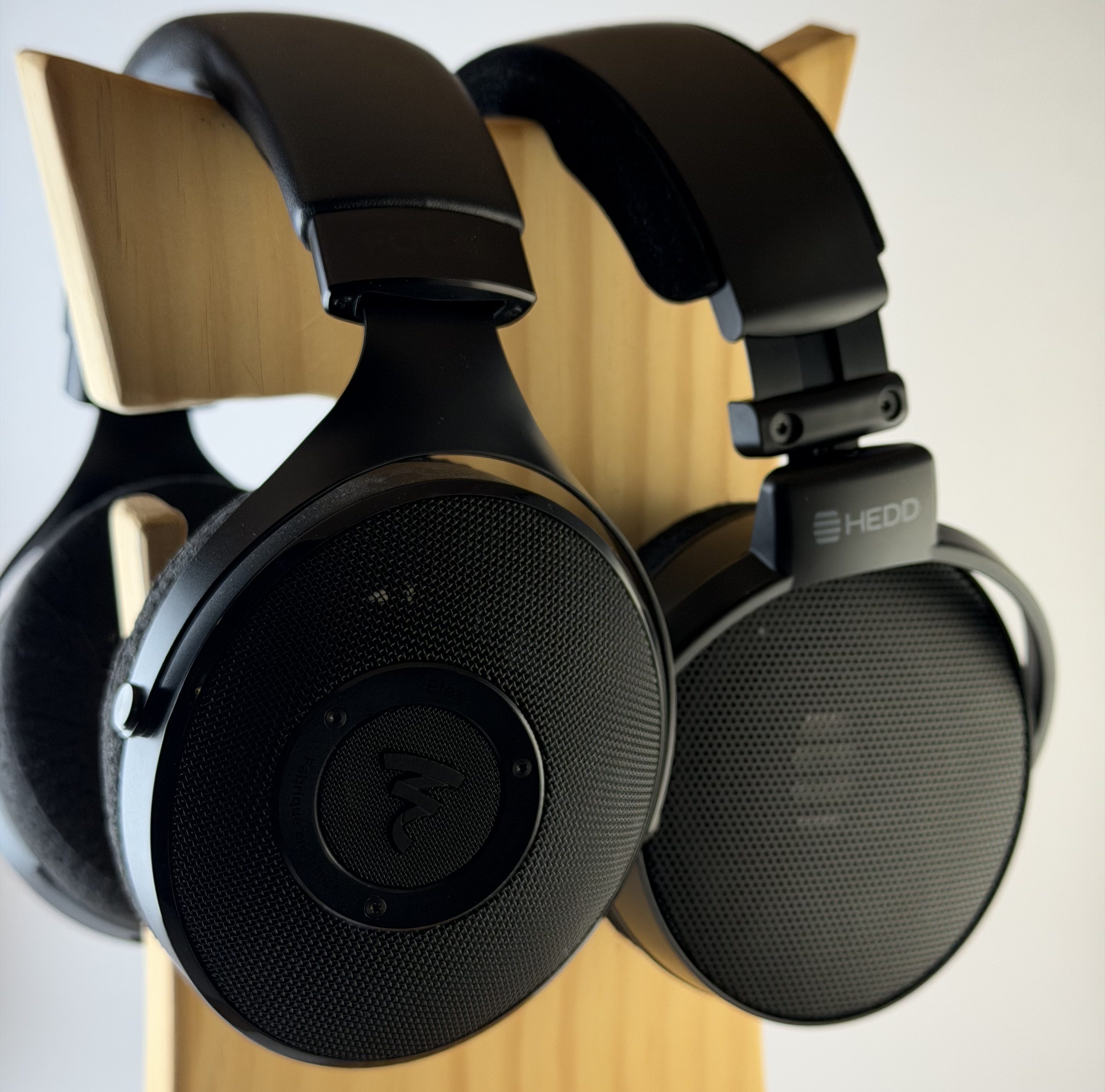
The Focal Elex are an interesting beast, in that like a lot of older-style Focals, independent of their frequency response they just have a particularly satisfying slam in the bass; a real sense of weight and impact behind their notes. I noted in my Meze 109 Pro review that I thought the 109 Pro brought a little more richness and depth to the bass than the Elex did. (I probably ought to go back to Elex and spend some time with EQ to see if I can bring that texture out on the Elex.)
I think this is probably the most interesting and most even comparison I’m going to do in this review; these are VERY close headphones to the point where I’ve written most of this without coming down clearly on one side or another.
I’m taking the bass on the Elex, and it’s not particularly close. They measure pretty similarly, particularly down low, but Focal slam is a thing on my head, and it’s so damned good to listen to, plus as it turns out I like the additional warmth in the mid bass through the transition into the mids. I’m definitely taking the midrange on the D1; it’s just a really extraordinary thing. I keep going back to “Same Ol’ Mistake” and realizing how much clearer the voices are on the D1 vs. the (really quite good!) midrange on the Elex; now that I know what is Rihanna and what is Kevin Parker I can sort of hear it on the Elex, but when I go back to the D1 it’s like being hit over the head with it. Anecdotally, the Elex is probably a less technically-oriented headphone, though I’ll take its soundstage and layer separation (outside of the midrange) over the D1 any day. For an example, the hand percussion on “Chan Chan” disappears a bit into the mix on the D1, but is pretty clear and located nicely in space on the Elex. For me, the treble is a toss up; the treble on both is probably the weakest part of their performance, but by no means problematic on my head. Things might stand out just a little bit less on the Elex, but it’s so close as to not particularly factor into my decision. On my head, the Elex is both a little more comfortable and a little more consistent in sound
Here’s the graphs of my units:
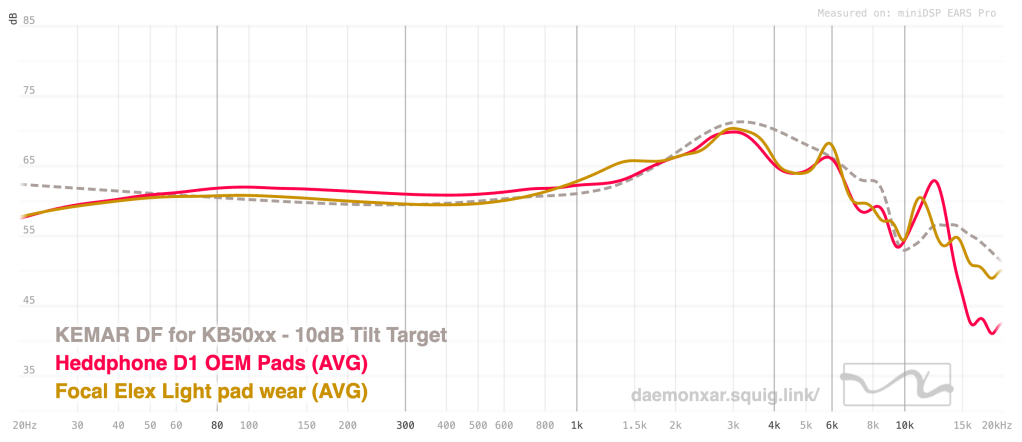
This is more or less what I hear on my units, though I’m fascinated by the 600 Hz to 4 kHz; I definitely have no idea what gives the D1 it’s remarkable clarity and timbre in the midrange. The rest of it makes sense.
Verdict: it’s close, but all things considered I’m taking the Elex by a hair. The bass on it is just so good, and while I listen to a lot of music where vocals matter, the vocals and midrange on the Elex are really good; good enough that I’m willing to take the trade for comfort, soundstage, and bass slam. Because of how close the Elex and Clear are, I think I’m probably taking the Clear over the D1 too; in fact, if I were trying to get the technical performance and detail of the D1 I’d be inclined to go with the Focal Clear over the D1 to add a bit of that Focal magic, particularly at current prices (used or new from headphones.com).
Audeze LCD-2pf
I am a big fan of the 2012 Audeze LCD-2 pre-Fazor aka LCD-2.2 pf (as well as the 2016 revision with Fazors, which I really ought to review one of these days); they’re probably my favorite planar magnetic headphone, particularly once I apply EQ.
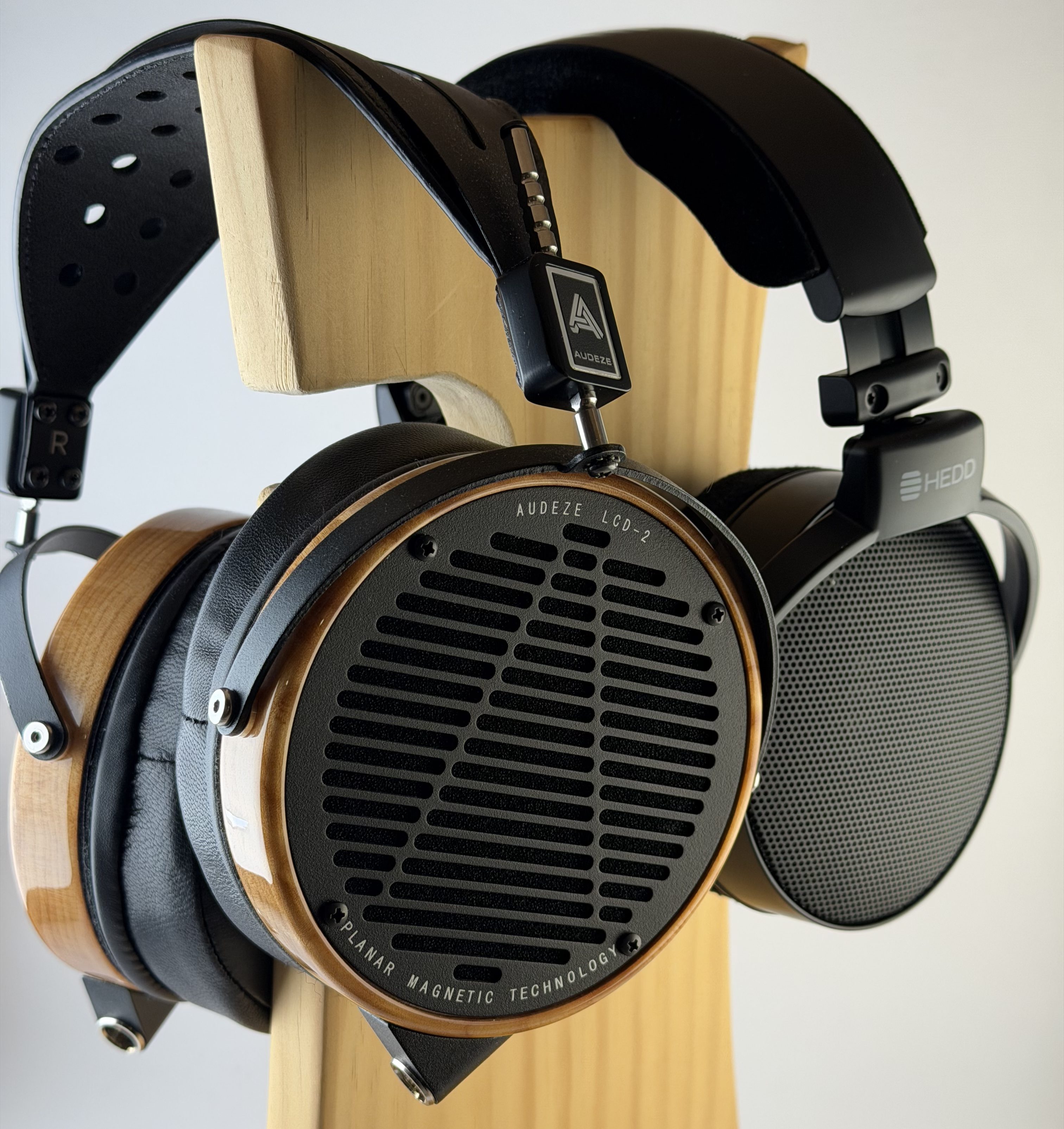
Out of the box, I’ll take the bass of the LCD-2.2 (quantity, quality, and the ever-intangible slam), the mids of the D1, and consider the treble a toss-up, but the timbre on the on the LCD-2 can be funky, particularly in the midrange. Comfort-wise, the LCD-2 are among the heaviest headphones I own, but that doesn’t particularly bother me, and I appreciate just how cavernous and soft the ear pads are. The LCD-2 are also, at least to me, a bit better built and much nicer in terms of aesthetics. The LCD-2 are a surprisingly detailed and technical headphone, with one of the best soundstages and among the best layer and instrument separation I’ve heard on a headphone.
If you are willing to take the time and have the patience to tweak the LCD-2 to your own head and preferences, I think that they are the better headphone by a substantial margin. They’re pretty much a blank slate for EQ. It’s possible that I could get the D1 to a similar place if I invested the time and energy tweaking their tuning, but they’re good enough out of the box that I haven’t bothered to take the time yet.
Here’s how they measure:
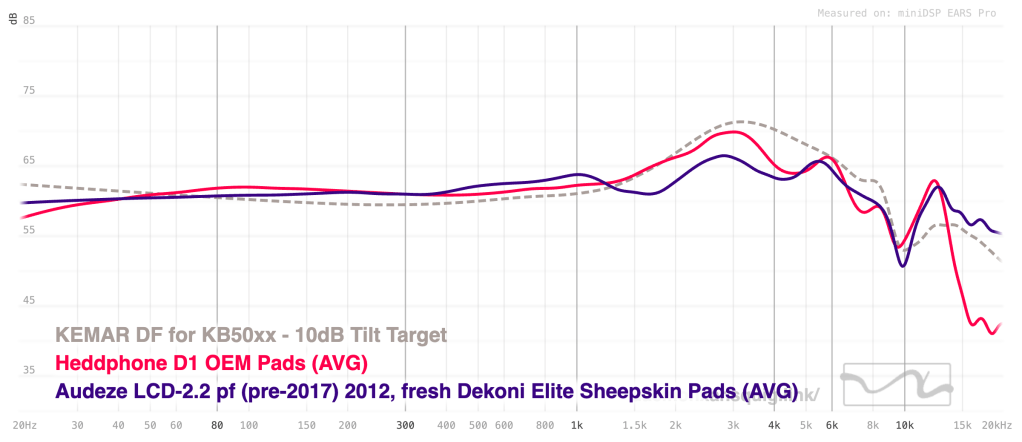
That’s about what I hear. When I EQ the LCD-2 I fill in a lot of that midrange “dip”14, but I don’t think I hear it quite that flat between 1-6 kHz on my head anyway.
Verdict: If you’re not going to EQ, the D1 is pretty clearly the better choice for. If you’re interested in EQ, I personally think I’m going to spend a lot more time listening to the LCD-2 than the D1, outside of very vocal forward music. If I were mastering, I’d go with the D1 though; it’s definitely a much more neutral sounding headphone.
Sennheiser HD 490 Pro
I am an unabashed fanboi of the Sennheiser HD 490 Pro; in my review of them I discovered that they’re my favorite 6X0 (sure, they’re not technically a 600-series headphone15, but spiritually and sonically … yeah, they are). They’re my default recommendation for anyone looking for a comfortable headphone for long listening sessions, or who care a lot about soundstage/layer separation (which they excel at). They’re also substantially cheaper than the D1, retailing at around half as much (and often on sale for around $350).
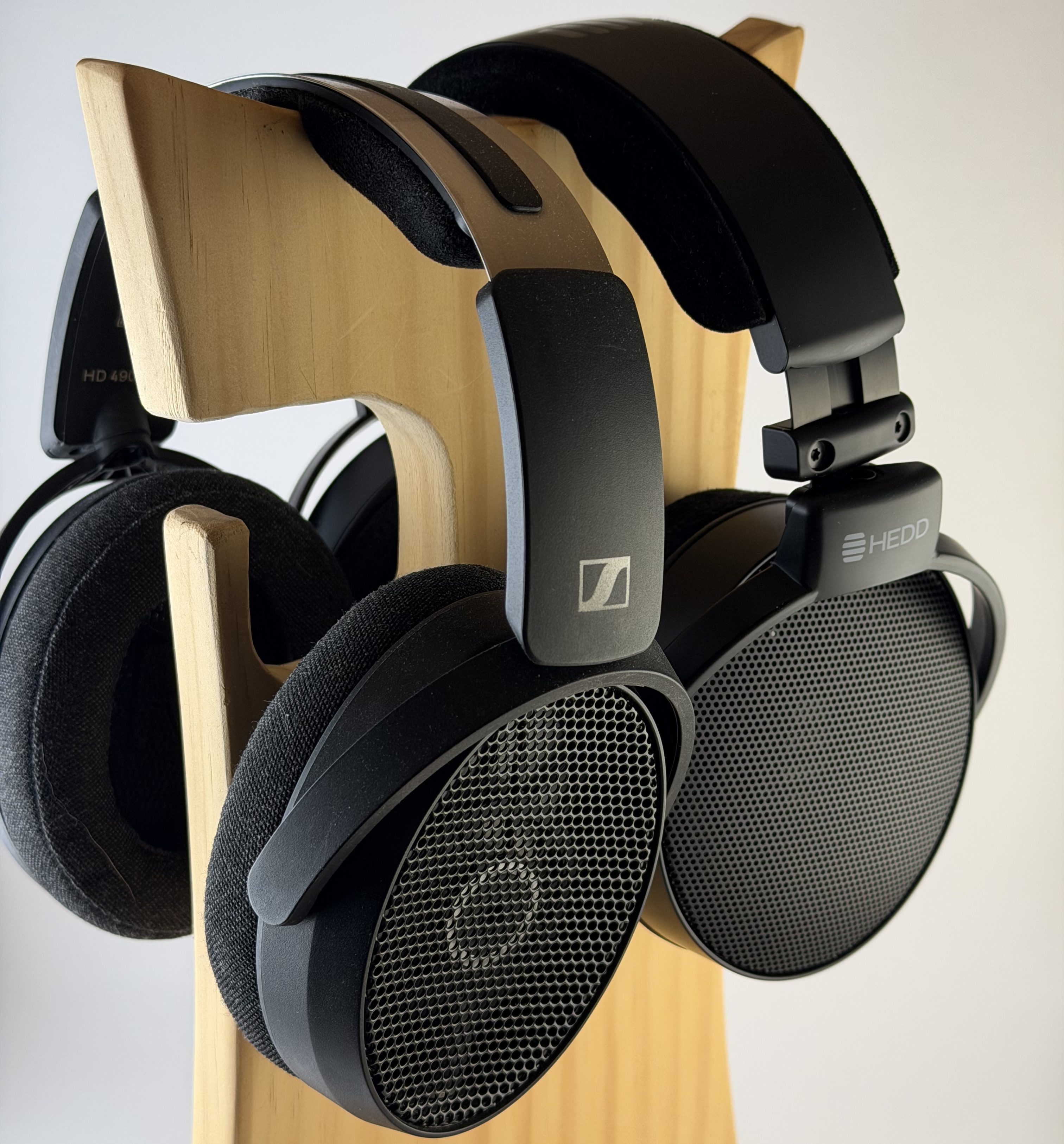
I think the D1 is pretty clearly the more technical headphone. Though it perhaps trades a little bit of bass quantity for quality, it’s got a better midrange and a marginally smoother treble on my head. It’s also less comfortable; the 490 Pro is one of a very small number of headphones whose comfort I’ve rated as an “A.” The 490 also comes to the table with two sets of pads (with noticeably different tunings), and the versatility of being able to pick an ear cup to plug in to.
So is the the D1 worth double the price of the 490 Pro?
This is a hard sell for me. The D1 is better, but it’s definitely not twice as good. That said, even the 490 Pro is well into diminishing returns territory. If you’re only going to have one pair of headphones, I could make a pretty good argument for the D1 being the better play, as long as you can comfortably wear them and aren’t bothered by the shallower cups.
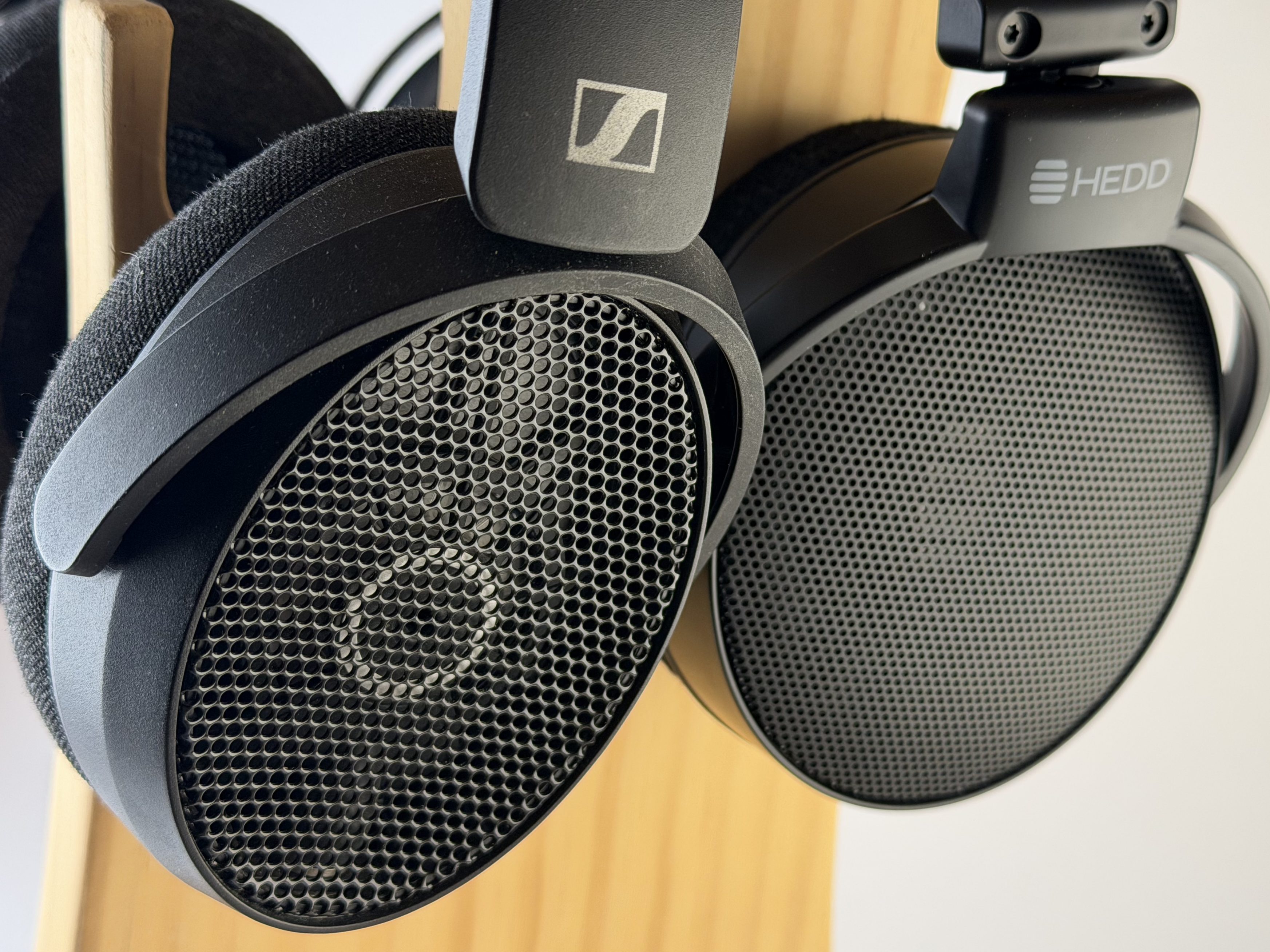
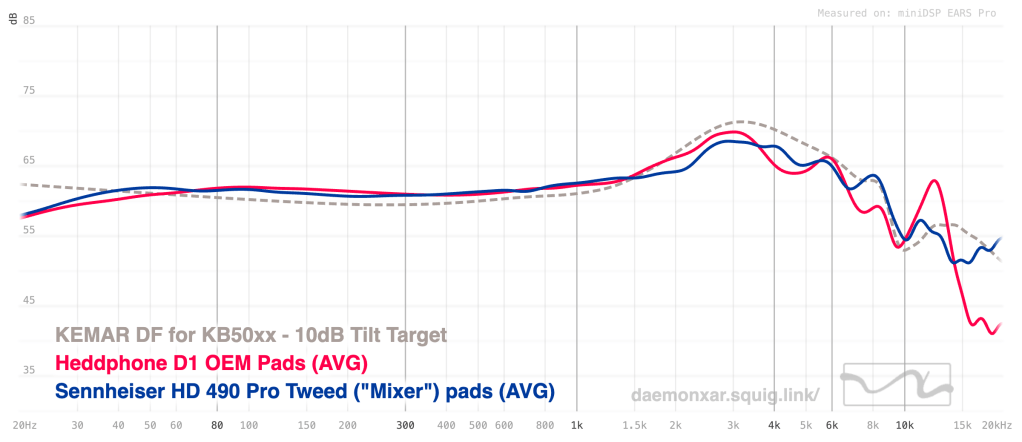
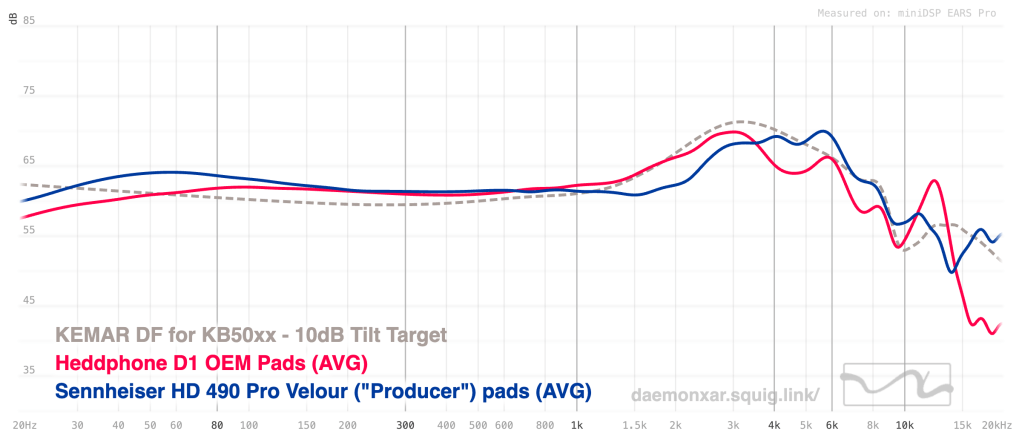
I’m a little surprised by how closely the tweed (“mixer”) pads measure to the D1; the D1 is definitely a more exciting listen to me but I guess it’s just that little bit extra in the mid bass and midrange to treble transition. The velour (“producer”) pads is a bit closer to what I expected; I find myself mostly just using the velour pads on the 490 Pro and they definitely trade a strong bass performance for a weaker midrange, comparatively.
Verdict: The D1 is the better headphone, though it’s not by a huge margin and they are much more expensive. This is another one of those ones where I’m going to give you a good, lawyerly answer as to which you should choose: it depends. Personally, I’m more likely to grab the HD 490 Pro for listening just based on the comfort and versatility, but if I’m doing more focused, critical listening (and not listening to the kinds of poorly mastered tracks the D1 will punish) I might gravitate towards the D1.
Hifiman Arya Stealth
When I reviewed them back in February of 2025 (feels like ages ago!), I declared the Arya Stealth to be my favorite objective open-back headphone. Since then, I’ve had a chance to try some other pretty resolving headphones and have liked some of them more than the Arya, but they’re still a pretty good yardstick to compare critical listening headphones against. After all, most folks in the space have heard them or at least have some impressions of them.
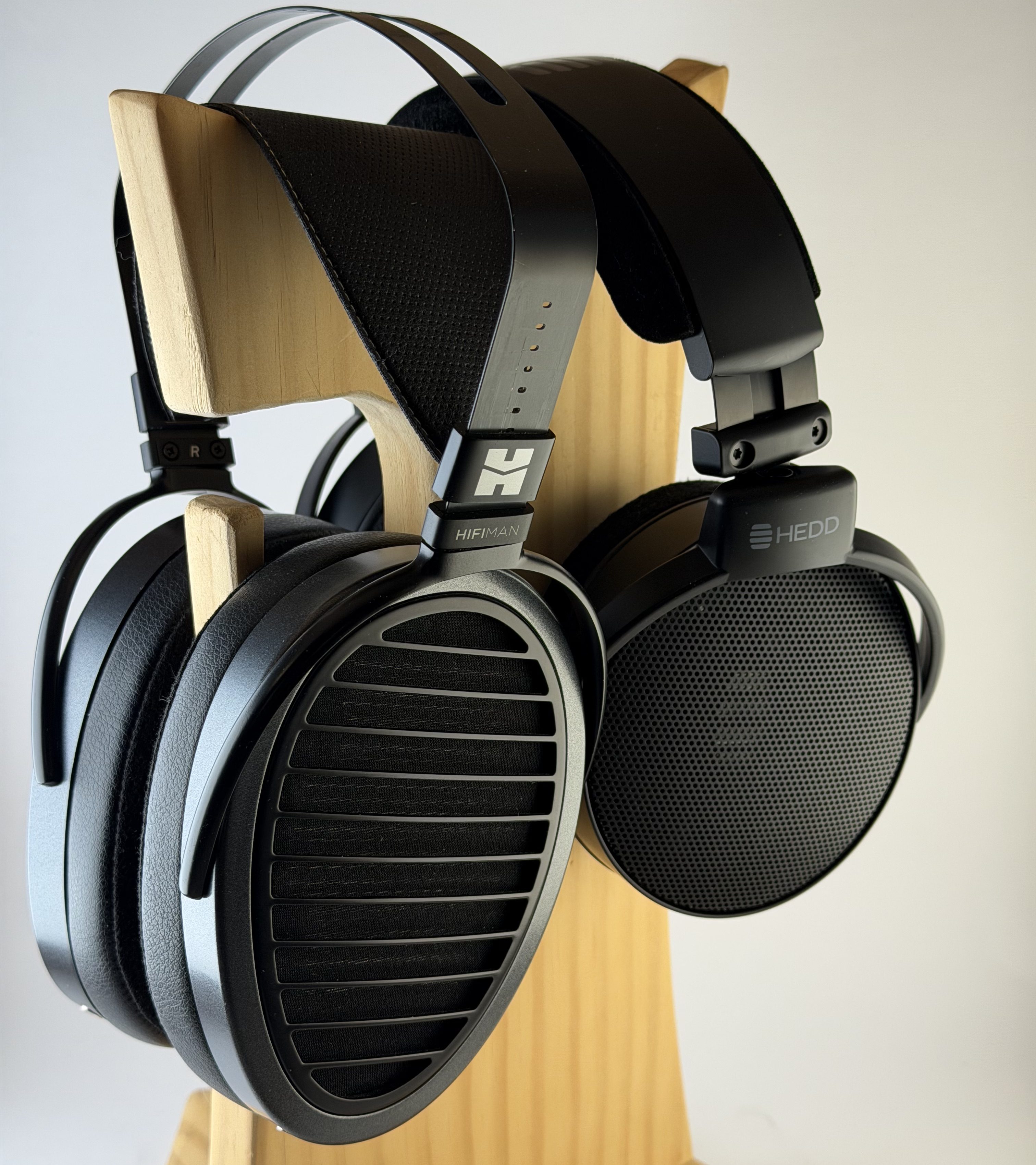
This is another headphone that I think the D1 may have basically pushed out of my listening rotation. I’ve kept the Arya Stealth around through a couple of rounds of selling off headphones because they are such a good reference headphone, and because they really excel at critical listening. They’re also a couple hundred dollars cheaper than the D1 at the moment, though it’s my hope that the D1 will come down a bit in price over the next few years as HEDD catches up with demand and the newness wears off. But for now, is the D1 worth $200-300 more than the Arya Stealth?
For me, I think it probably is. The bass is pretty similar between the two, but feels richer and a bit more textured on the D1 than the Arya Stealth. Mids are clearly better on the D1, and I prefer the treble on it as well (the Arya Stealth gets a bit spicy for me on at least some tracks). I’m also not a fan of the headband on the Arya Stealth; it’s not particularly comfortable on my head and tends to slide around during normal use a bit too much for my taste, and honestly … I don’t think the Arya Stealth is any more resolving or better staging than the D1. Plus, it’s just a bit boring to me, clinical and dry.
If you want a more clinical, objective sound you might prefer the Arya Stealth, but I’m likely never going to pick it over the D1 for either causal or critical listening.
A glance at the graph:
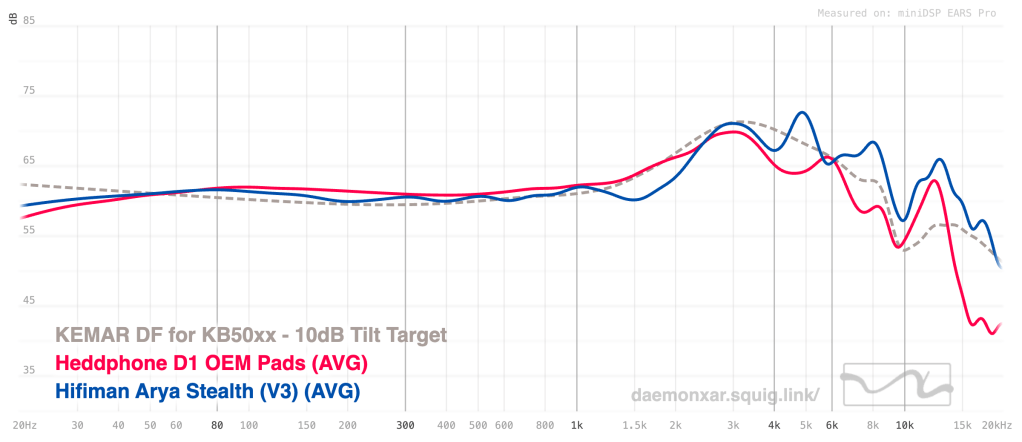
This all looks about right. I don’t actually hear the Arya as having better extension down deep, but even on the graphs that’s only a couple of dB. The mids and treble are absolutely spot on for my head.
Verdict: The D1 wins here on my head. The Arya Stealth are a perfectly competent headphone, but they’re very much not to my taste at this point in my audio journey. If you can afford the extra couple hundred bucks, the D1 is a worthy upgrade in my book.
Hifiman HE600 (coming soon!)
The last headphone I want to compare the HEDDphone D1 tp is the relatively new Hifiman HE600, another of Hifiman’s 2026 releases along with the excellent Edition XV and (supposedly not great) Audivina LE.
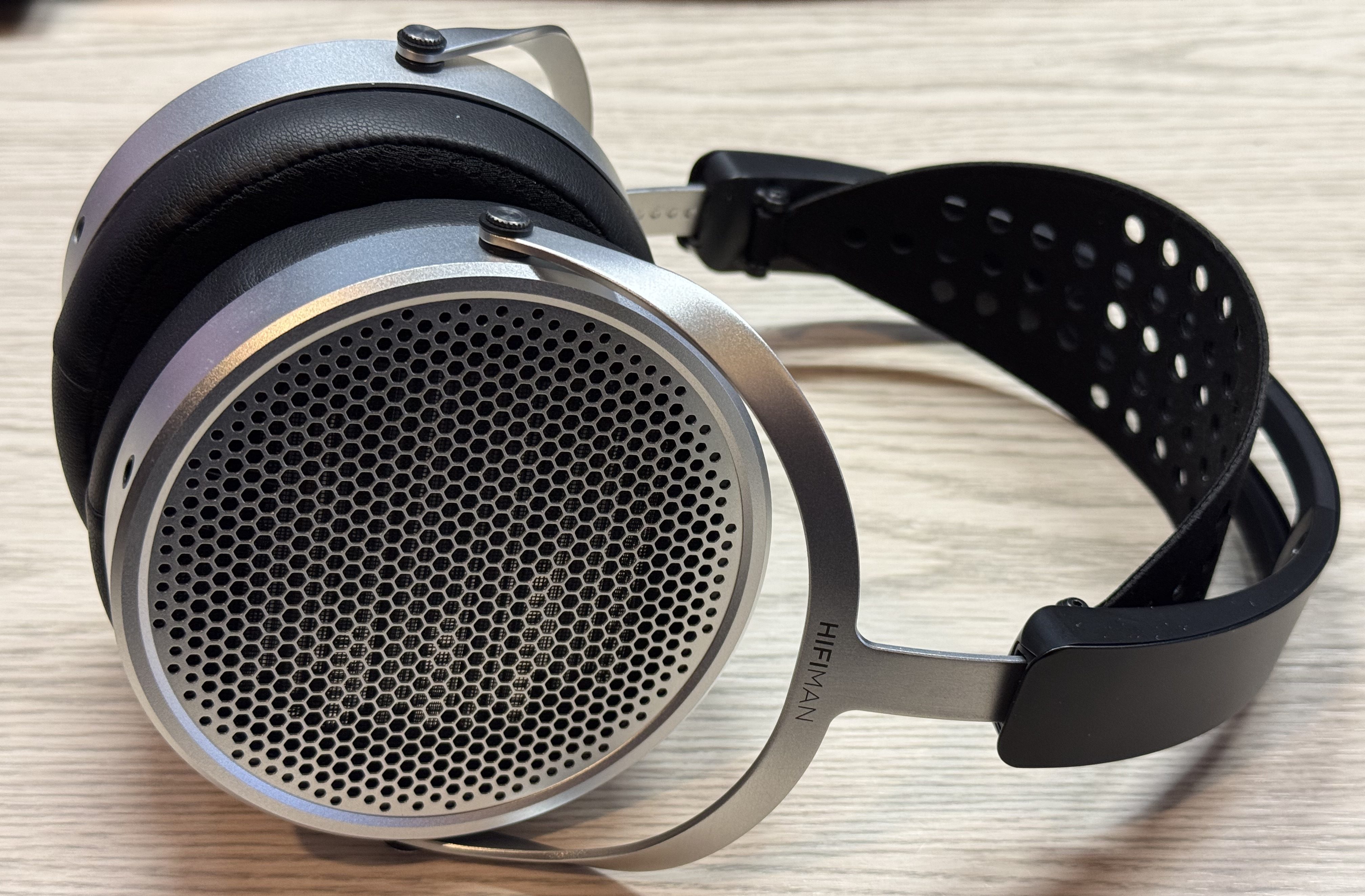
I haven’t had the HE600 long enough yet to be confident in my comparisons and thoughts and have really only started my review listening, so I’ll come back and update this when I finish up that review.
[I might also come back and update with the Fiio FT7 at some point.]
Overall
I’m a pretty big fan of the HEDDphone D1, as it turns out. It checks a couple of boxes for me, and appears to have edged out the Sennheiser HD 600 for vocals and the Arya Stealth for me for critical listening, and those are headphones I’ve been hanging on to for those use cases for quite a bit.16 We’ll see if this is what gets me to actually list the Arya Stealth for sale, or if I keep holding on to them “for comparison purposes.”
The D1 are a genuinely pretty excellent pair of headphones, with a good, fun out of the box tuning, and a surprisingly good technical performance at a dangerously close to reasonable price. I’ve got a couple of long-term comfort questions with the D1, and I’m curious if we’re going to get a market for non-OEM parts at some point. I’d love slightly thicker ear cups that didn’t impact the tuning too much, and I’d appreciate the ability to replace the inner driver grill with something a little less susceptible to cold.17 I’m also looking forward to seeing what HEDD does next; as far as I’m concerned, these headphones are well-worthy of all of the praise that they’ve gotten over the last year, and I’m hoping they’ll bring a more moderately priced product to market in the near future.
I recommend these without reservation; they’re a great headphone.
- Heddphone appears to still be unable to meet demand for this headphone, which is pretty remarkable in the modern era. Headphones.com will let you pre-order as of June 2026. ↩︎
- I score bass, mids, and treble on a two part scale: 1-5 for quantity (5 being the highest), and A-E for quality (A being best in class, E being laughably bad). For soundstage it’s also a two part scale, with the number representing the width and the letter the separation within it. ↩︎
- For comfort/fit, my scale is A-E with A being disappear entirely into the background and E being I want to tear my ears off to stop feeling these headphones on my head. I’ve had one E: the Koss PortaPro. ↩︎
- They spell it this way. I’m not going to work very hard to follow suit, and will likely call them Heddphones a lot. ↩︎
- HEDDphone and HEDDphone TWO are both VERY expensive and … inconsistently rated. ↩︎
- Just for fun. Cables are cables are cables. This is just a high quality of life cable. ↩︎
- Better in my estimation, but your mileage may always vary. ↩︎
- Some of it’s definitely in the mix; I do hear some of that grit on a headphone like the Elex or 109 Pro but to a much lesser extent. It’s possible this isn’t a detail issue, but I lack the vocabulary to describe it another way. ↩︎
- Also it’s clear to me now that it’s both of them singing most of the time, which makes me feel a bit better. But it’s so much clearer on the D1 than something like the Elex. ↩︎
- When people ask me what they should listen to while testing a new pair of headphones or speakers, my default answer is always what they know best, but there is a downside to things you listen to a LOT. ↩︎
- I know how that sounds, but … seriously, listen to that song closely. It’s almost always both of them singing, and it’s so eerily similar that the first time I heard this song I was confused as to why Roon had spun up a Tame Impala record in the middle of Rihanna’s “ANTI (Deluxe Edition).” ↩︎
- After a few headphones with treble issues in other areas, it’s actually a tiny bit reassuring to get back to one where the treble problems are the normal ones. ↩︎
- And see the note above about the ways in which it appears to affect the frequency response. ↩︎
- Not really a dip as much as a lack of the ear gain bump that most headphones have (and should have based on our anatomy!). ↩︎
- Or even made by the same company as them, anymore. ↩︎
- I even missed the HD 600 enough for some vocal music that I traded back for my original pair, after I’d traded them away as part of a deal to get my pair of Focal Clears. ↩︎
- Maybe I’ll try printing one! ↩︎


Leave a Reply